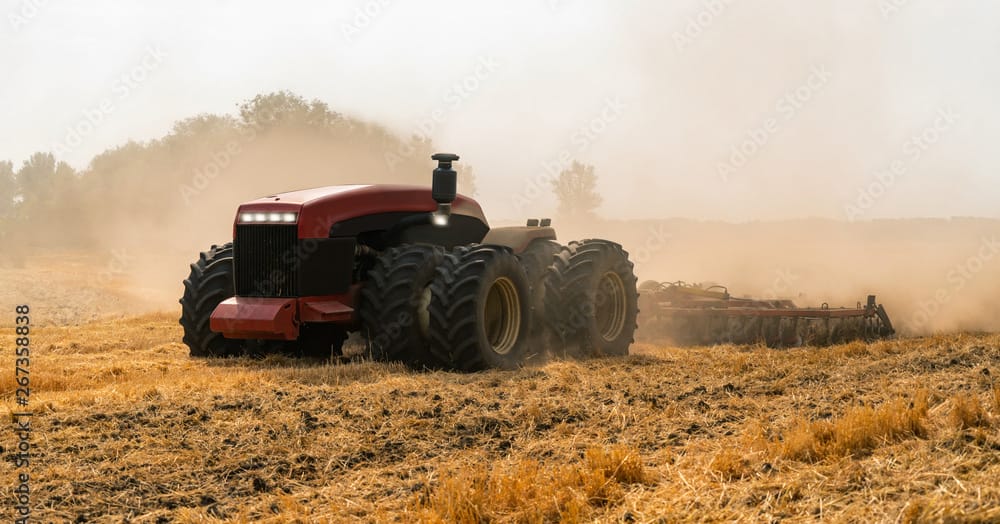
The landscape of agricultural technology is quickly evolving, and autonomous tractors stand out as a beacon of innovation.
These cutting-edge machines have undergone remarkable transformations, now capable of operating entirely autonomously using advanced camera systems, obstacle detection sensors, and Global Navigation Satellite System compatibility. Currently, autonomous tractors offer a range of applications in an agricultural context, including mowing, discing, aerating or seeding fields.
At Tall Timbers, we are eager to explore the potential of this cutting-edge technology to optimize quail habitat management.
The vast majority of habitat management activities are conducted with tractors in some capacity, making them an indispensable tool for land managers. Already, we’ve taken our first steps towards incorporating autonomous tractors into our practices by testing their use for mowing pastures at a site in central Florida.
While the current state of autonomous tractor technology does not fully align with our specific applications in quail management, we remain committed to exploring its potential.
As new methods and technologies become available, we plan to test and adapt them to suit the needs of our targeted conservation efforts. We anticipate future practices that include cutting perimeter fire lines, mowing roads, and running feedlines, with the innovation of “teach-and-repeat” functionality.
Our journey with autonomous tractors is guided by several key questions:
- What are the realistic applications of autonomous tractors in a quail management context?
- How can reduced labor requirements improve overall productivity and efficiency?
- How can this technology promote the long-term sustainability of quail management practices?
Through research and collaboration, we aim to address these uncertainties while uncovering the broader implications for quail management. What do we all stand to gain? Autonomous tractors may afford the following benefits:
- Plantation productivity increases because of 24/7 driver-free operation hours.
- Operators spend less time in the seat, so they have more flexibility to complete other essential tasks.
- Capital expenses decrease because less expensive machines can be utilized to house the autonomous system.
- Environmental impacts are reduced through more precise and targeted operations.
- Long-term sustainability is possible with technology-driven solutions for traditional conservation practices.
We are committed to navigating the challenges associated with integrating autonomous tractors with transparency and diligence. This includes ensuring the reliability of this unique technology across diverse field conditions and addressing potential workforce implications. We recognize the need for collaboration and feedback from landowners, managers, and stakeholders during this endeavor and we aim to ensure that our outreach efforts are informed and inclusive.
As stewards of quail habitat, we recognize the importance of embracing innovation while staying true to our conservation mission. Autonomous tractors have emerged as potentially powerful allies in the quest for efficiency and sustainability, heralding a promising era of technology-driven conservation practices.