In recent years, Tall Timbers has expanded the Game Bird Program by establishing regional quail programs throughout the Southeast to work with private landowners to improve bobwhite habitat and thusly populations across their historic distribution.
As a part of our new 10-year strategic plan, Tall Timbers is committing to engage as a full organization in expansion bringing with it the scientific expertise that has driven species research and conservation in North Florida and South Georgia for decades.
Meeting this goal will mean growing our conservation impact not only for Northern Bobwhite but also the other species that benefit from the fire regime prescribed for the upland habitat used by quail.
It is also important to note that our quail managed lands have more than just upland habitat to offer─ they often include wetlands, hardwood stringers, fields, prairies and even agricultural fields. Collectively, these habitats host a wonderfully diverse ecological community.
Thanks to this heterogeneity, there’s many opportunities for research and monitoring to improve our understanding and ability to manage for biodiversity on our quail-managed lands outside of our core region of the Red Hills and Albany.
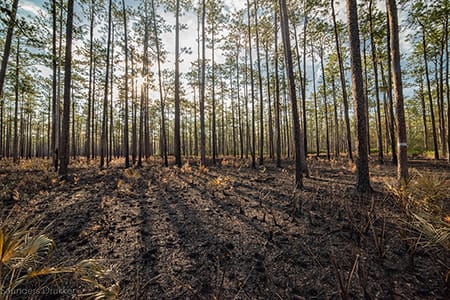
These opportunities extend to Species of Greatest Conservation Need (SGCN) that stand to benefit the most due to their declining numbers. With this in mind, we aim to inform management practices and grow recognition for biodiversity benefits from a quail management framework that promotes patchwork, mosaic burning on a two-year rotation.

A Berry’s Skipper. Photo by by M.J. Krotzer.
While it will take some time to inventory biodiversity across expansion sites, we do know that the opportunities for biodiversity benefit will vary across the Southeast.
For example, Ames Plantation, the hub of our Mid-South Regional Program in Grand Junction, Tennessee has an abundance of Prairie Warblers, a SGCN that we do not encounter breeding as often at properties with the Red Hills region.
In contrast, you can find SGCN like gopher tortoises, wintering Henslow’s Sparrows, and striped newts at Livingston Place, Tall Timbers’ 7,400-acre research site outside Monticello.
Escape Ranch in Kenansville, Florida is yet another example─ not only does the site host skipper butterfly SGCN, but the populations are thriving. In fact, to our knowledge, the Berry’s Skipper population located there is the largest in Florida.
This is not because Escape Ranch is going above and beyond other quail lands for the sake of their butterflies.
It is because of its location in the Southeast and its application of a quail-management oriented approach to fire.
Specifically, the burn units are interspersed and burned on a 2-year rotation, which creates a mosaic of 1-year and 2-year roughs that are ideal for butterfly populations in Central Florida prairies.
Ultimately, by monitoring the biodiversity of quail-managed lands and growing our understanding of how to support SGCN within a quail management framework through research, we will inspire new partnerships and maximize our impact throughout the Southeast.