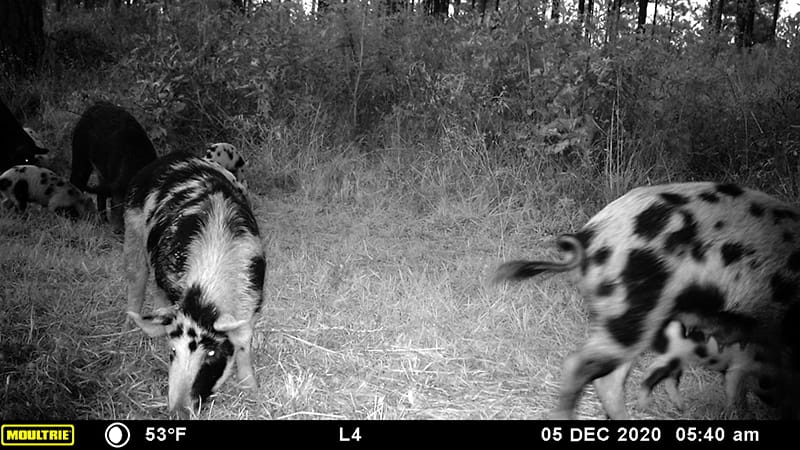
By University of Georgia Master’s student, Kelsey Hoskins
If you happen to have noticed orange flagging tape on the trees around North Florida and South Georgia last year, then I hope you were smiling.
Because below that flagging was one of the 151 trail cameras that were deployed across nine properties in the Red Hills as part of a region-wide effort to measure the impact of feral hogs, possibly the worst nuisance landowners have ever had to deal with.
To combat the growing impact of feral hogs, Tall Timbers partnered with The United States Department of Agriculture’s Wildlife Services to implement large-scale wild pig removal efforts.
The Feral Swine Eradication and Control Pilot Program was funded through the 2018 Farm Bill but funding for the pilot program is slated to wrap up in September 2023. Continuing to build on the momentum of hog removal over the last three years by securing more funding is a priority Tall Timbers advocates for in the 2023 Farm Bill. It paid for trappers and equipment to aid in removing feral hogs across the region.
The objectives throughout the pilot were to assess the efficacy of removal efforts and to measure reduction in pig numbers, their sign and damage and determine if pigs displaced native game species.
Surveying wrapped up in July of 2022.
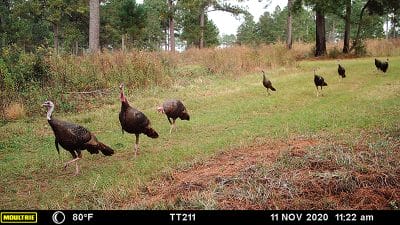
With over 150 wildlife cameras across the landscape, Kelsey’s data show a displacement of native wildlife such as turkey and deer on the landscape while feral hogs are present, and the return of native wildlife, once feral hogs are removed.
Wild pigs are an invasive mammal capable of swift adaptation, allowing them to flourish in various environments and survive on multiple food types. Pigs are heavily destructive to native plant life, water quality and, research conducted since 2020 has shown, impact native game species like turkey and deer.
Recently, this problem has developed through the Red Hills.
We found that overall, there was no complete displacement but rather strong shifts in deer and turkey activity patterns before and after pig removal occurred.
An activity pattern analysis was used to monitor potential displacement connected to feral pigs. Deer shifted their active period more nocturnal and reduced their daytime activity when pigs were present. Similarly, turkeys recued their midday activity when pigs were present on a surveyed property.
The program was wildly successful in capturing invaluable data about hogs and in the removal of more than 4,000 destructive hogs from the landscape.
In total, 47,000 images of our target species were collected, which included wild pigs, white-tailed deer, and eastern wild turkey. Over 3,700 images were of pigs and within those we counted over 7,000 pigs, some of which appeared in multiple photos. Additionally, we collected 38,938 images of deer and 4,981 images of turkeys.
The pig monitoring crew would like to thank all participating landowners and managers for allowing us to visit your property and collect all this data.
Tall Timbers hopes that the Farm Bill will renew this successful project and we will be able to expand to areas outside of the Red Hills in order to assist more private landowners. Tall Timbers will continue efforts to include feral hog control in future Farm Bills, and encourages landowners to talk to their elected officials for continued support of this project.