This article was written by Tall Timbers Research Director Morgan Varner and Smoke Science Program Director Holly Nowell
The last week of March Tall Timbers hosted the 4th International Smoke Symposium (ISS4). Held every few years by the International Association of Wildland Fire, this symposium is more than just a conference, it is a vital opportunity for multiple agencies and individuals concerned about wildland fire smoke to come together to exchange knowledge and create new ideas surrounding smoke and smoke management.
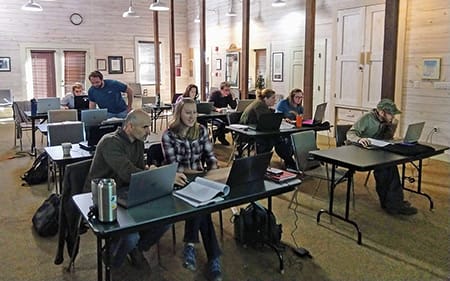
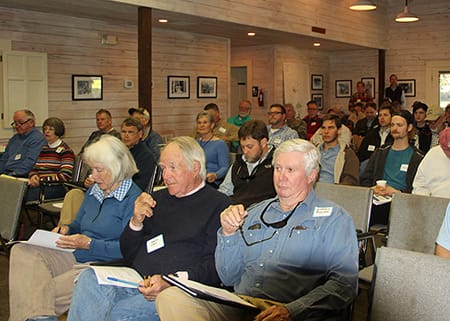
ISS4 drew over 200 participants from 13 different countries, split between those joining us in person at the Leigh Perkins Education Center and an audience attending virtually. The diversity of attendees was wide, ranging from federal agencies and NGOs to wildland fire practitioners and academic researchers. The exchange of knowledge included sessions spanning from smoke modeling, public health impacts, and integration of remote sensing and tools, to workshops exploring the Environmental Protection Agency Exceptional Events process, and using products such as FireSat, and BlueSky smoke modeling.
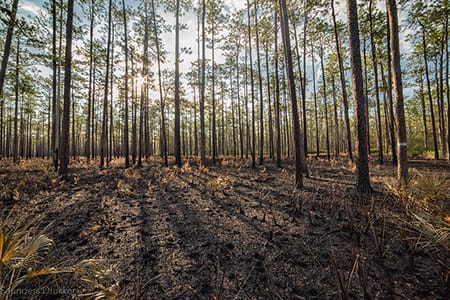
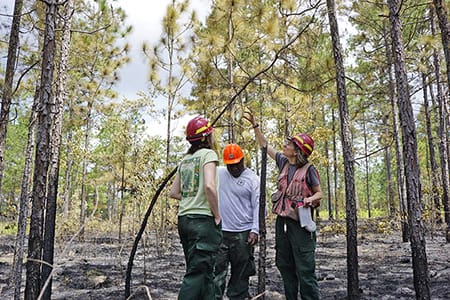
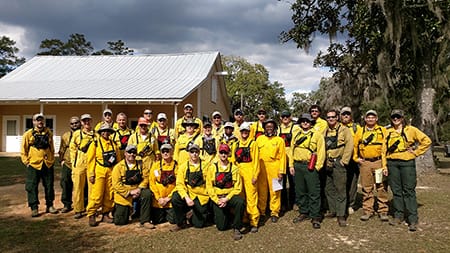
What truly set ISS4 apart from previous conferences was the frequent fire environment at Tall Timbers. Instead of being held at a university or in a city, the symposium was held on-site at the height of the spring burn season when land management activities are at their peak. We conducted a live prescribed fire demonstration and, for many researchers who spend their days studying smoke in front of computer screens or in labs, this was their first time witnessing a prescribed fire in person.
The importance of this event was further underscored by our distinguished keynote speakers. We were honored to host U.S. Department of Agriculture Undersecretary Michael Boren, who not only gave a speech, but answered questions and toured our facilities. NASA Physical Research Scientist Aaron Naeger provided an engaging technical talk doing a deep-dive into current fire and smoke research, while Heather Brassel provided the often-overlooked perspective of a private landowner from the Red Hills. Her story of managing the land with prescribed fire on private property deeply resonated with attendees.
The feedback has been overwhelming: our guests didn’t just value the symposium, they valued Tall Timbers. Between sessions, attendees could be found networking on the back porch or hiking the trails to Lake Iamonia and the Bird Observatory on Gannett Pond. Seeing a landscape properly managed for years by prescribed fire provided a powerful, living testament to Tall Timbers’ mission.
We were also honored to concurrently host the Southeast Prescribed Fire and Air Quality Smoke Summit VIII. This unique meeting between state forestry and air quality agencies with leaders from EPA Region 4, Tall Timbers, other NGOs and organizations such as the Southeast Regional Partnership for Planning and Sustainability and Southern Fire Exchange allowed for the sharing of lessons learned across state lines. These types of meetings ensure that the Southeast remains united in its response to smoke challenges.
As the symposium closed, a common sentiment echoed through Perkins’ halls: the desire to return. ISS4 proved that Tall Timbers is just not a location, but a leader in the effort to innovate and protect the use of prescribed fire. New bonds were formed that will yield valuable research and partnerships for years to come.