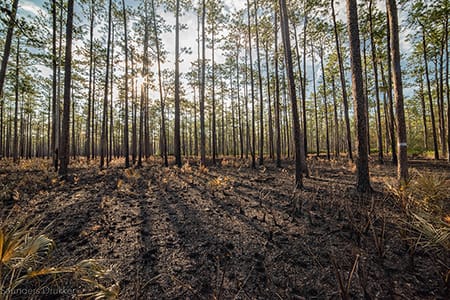
Most savannas and grasslands worldwide are sustained by frequent fires that kills the above-ground portion of long-lived plants that then resprout from belowground parts, including roots, rhizomes and other nutrient storage structures. However, very few studies have taken a look at how much biomass is beneath the soil surface or how it might be influenced by fire regimes, especially in the Southeastern U.S.
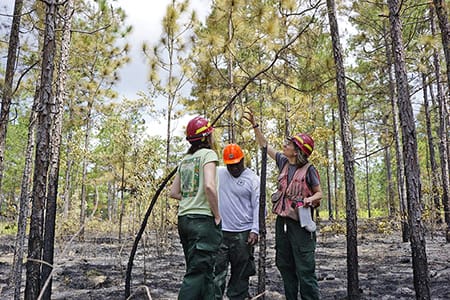
An independent study led by undergraduate student Nithya Guthikonda from Yale University used the Pebble Hill Fire Plots long-term fire experiment to study belowground biomass in a native upland longleaf pine-wiregrass savanna. She and Tall Timbers Fire Ecologist Brandi Griffin measured plant aboveground biomass and belowground biomass down to 20 cm (8 inches) soil depth in plots that had been treated with fire at 1 to 4-year intervals for two decades. They also compared subplots with and without wiregrass.
The results of the study were published in the journal Plant Ecology, (2026) 227:21.

Excavated dwarf dangleberry (Gaylussacia nana) showing woody rhizomes.
The frequency of fire had little effect, suggesting that the belowground part of the plant community responds slowly to changes in fire frequency. However, the belowground biomass of woody species was lower where grass biomass was higher, suggesting competitive interactions between bunchgrasses and woody species at small spatial scales.
Aboveground and belowground biomass in the pine savanna from the study were within the range of measurements in humid savanna systems worldwide, with four to five times more biomass belowground than aboveground. That was only including belowground biomass in the top 20 cm of the soil!
Growth of such large amounts of biomass underground, where it is safe from fire, is key to the long-term stability of these “old-growth” grassy ecosystems. It also makes them highly susceptible to intensive soil disturbance that destroys their otherwise long-lived root systems.
This study allowed us to learn a great deal about the belowground structures of particular species. We were surprised at how many legumes (bean family) that are herbaceous aboveground have large woody roots and rhizomes beneath the soil. Also, many asters (sunflower family) have “xylopodia”, or swollen belowground structures, from which roots grow and from which they can resprout repeatedly.