This story was written by Stoddard Bird Lab Director and Avian Research Technician Jeff Gardner
The Stoddard Bird Lab recently kicked off a new research project involving the study of Bachman’s and Henslow’s sparrows, two species of greatest conservation need that require fire-maintained habitat to survive.
Funded by the Sam Shine Foundation, the project aims to determine both species’ response to the typical current timing of prescribed fire on many Southeast properties peaking in March and April.
Bachman’s sparrows are year-round residents of the Red Hills region and are most commonly found in slightly drier portions of fire-maintained pine savannah, where open groundcover and scattered shrubs provide suitable structure. Henslow’s sparrows, in contrast, overwinter in the Red Hills after migrating from northern breeding grounds. They are typically found in the wetter portion of fire-maintained savannah that consists mostly of a dense, grassy understory. These species are especially elusive in the winter months when they spend much of their time on the ground beneath the herbaceous cover and are often seen only when flushed.
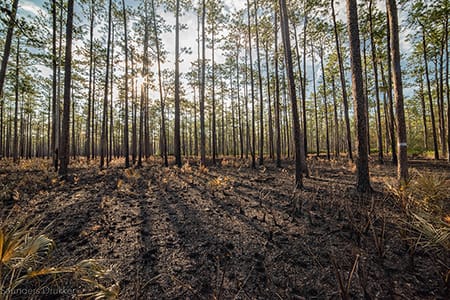
Historically, fire was a regular occurrence across the southeastern landscape, often caused by lightning storms and human-set fires. As a result, woody shrubs were kept to a minimum while herbaceous plants and grasses flourished, providing the open understory that both species prefer. Today, prescribed fire is used to maintain the open understory condition.
In the Red Hills region, prescribed fire use peaks in March and April, which is earlier than the lightning strike fire season which historically was important prior to changes in fine fuels (wiregrass dominated to old-field vegetation dominated) and changes in land use objectives (bobwhite being the dominant current land use objective). The pre-lightning season happens to coincide with the transition between the nonbreeding and breeding seasons for these sparrow species.
For the Henslow’s sparrow, the seasonal transition marks the time of year for northward migration back to their breeding grounds, but for the nonmigratory Bachman’s sparrow, it is a time for territory establishment and defense in preparation for mating and nesting.
The implications of pre-lightning season fire are understudied.
For example, it is unknown whether a pre-lightning season fire could stimulate an earlier departure and shorten the time the Henslow’s sparrow has to fatten up for its flight northward. It is also unknown whether a pre-lightning season burn can lead to temporary or permanent territory abandonment by a Bachman’s sparrow.
To better understand how these species respond to prescribed fire in the pre-lightning season, the Stoddard Bird Lab is using the latest tracking technology to document a sparrow’s location repeatedly over the course of several weeks.
Specifically, sparrows of each species are captured, banded, and harnessed with VHF coded NanoTags. Every individual receives a metal USGS band with a unique number and combination of color bands that allow for resighting even after the NanoTag battery life ends.
Once a sparrow is tagged, its position can be located using handheld telemetry equipment or even a local Motus Station if in close enough proximity. Vegetation measurements are also collected if sparrows are flushed to better understand microhabitat preferences of these species. Together, these data will provide deeper insights into the implications of pre-lightning season burns on space use and site fidelity, which in turn can inform management recommendations for these species.
While our study takes a nuanced look at the timing of fire, it is well known that prescribed fire is necessary for maintaining the habitat structure for which these birds depend. In the Southeastern pine forest, prescribed fire remains one of the most important conservation tools available, and when guided by field-based research, is integral to sustaining species of greatest conservation need.
Without fire, trees would gradually outcompete the grasses, forbs, and low growing shrubs, and as the understory became too dense, these sparrows would begin to look for habitat elsewhere; their subtle calls disappearing from the soundscape that characterizes the Red Hills region.