An application period is open for landowners in 11 North Florida counties to tap into $25 million in federal financial assistance for land management and conservation practices thanks to a new partnership between Tall Timbers and the Natural Resources Conservation Service (NRCS).
Tall Timbers is accepting applications for the Regional Conservation Partnership Program (RCPP) land management cost-share funding through October 3.
The funding award to Tall Timbers builds upon the success of a similar partnership it has implemented since 2021 in a portion of the Red Hills region.
The new five-year, “Florida’s Big Bend” Regional Conservation Partnership Program,” administered by Tall Timbers, will support NRCS’ Longleaf Pine Critical Conservation Area by implementing agricultural, forestry and wildlife habitat practices.
Available to landowners in Calhoun, Franklin, Gadsden, Gulf, Jackson, Jefferson, Leon, Liberty, Madison, Taylor and Wakulla counties, the partnership provides funding to implement conservation practices such as prescribed fire, forest stand improvement and tree planting to restore the health of fire-dependent forests and protect wetlands, critical open space, sensitive wildlife habitat, and water resources.
These practices will improve wildlife habitat, including habitat for at-risk species, such as Bachman’s sparrow, gopher tortoise, and northern bobwhite quail.
“The Regional Conservation Partnership Program is an example of public-private partnership at its best,” said Juan Hernandez, state conservationist for USDA’s NRCS in Florida.
Since 2021, Tall Timbers has worked with landowners in South Georgia and North Florida in the “Red Hills to the Coast,” RCPP, implementing conservation practices in the St. Marks and Aucilla River watersheds.
In that time, the partnership has helped more than 100 private landowners treat more than 13,000 acres with prescribed fire, plant more than 500,000 pine trees on 820 acres, of which nearly 463,000 were longleaf pine, implement more than 2,000 acres of forest stand improvement practices and treat roughly 900 acres of invasive non-native plants.
In addition to upland forestry and wildlife habitat improvement, the RCPP partnership has water quality benefits downstream.
The new partnership builds on the “Red Hills to the Coast” project and expands funding opportunities to landowners in six additional counties in Florida’s Big Bend.
“We are excited to continue partnering with NRCS for the next five years,” said Tall Timbers Conservation Coordinator Leslie Elmore. “The work we have been able to accomplish in partnership with NRCS through our previous RCPP award has been a tremendous boon to North Florida’s landowners, producers, local economies, and natural resources.”
The number of partners involved in the NRCS-RCPP project provides an indication of the level of support for implementing practices that improve and conserve Florida’s fire dependent ecosystems.
In all, 23 state and federal agencies, non-governmental organizations, institutes of higher education and private landowners have pledged more than $31.4 million in matching contributions and will implement more than 100,000 acres of prescribed fire, forest stand improvement, tree planting, and conserved land in the Big Bend region.
Landowners like Larry Perrin have tapped into the financial assistance as a way to manage their land for wildlife and timber.
Perrin, who is working to establish a conservation easement with Tall Timbers on his 420-acre property in Madison County, uses frequent prescribed fire, manages oak hammocks and pine uplands and incorporates wildlife management throughout.
Working with a small, nimble nonprofit like Tall Timbers that has experience with private landowners has helped people like Perrin accomplish their goals and strengthened partnerships.
“Tall Timbers has been a blessing in disguise,” said Perrin, who does most of his land management on his own and using his own equipment. “The cost-share programs are bringing in some money and that is beneficial.”

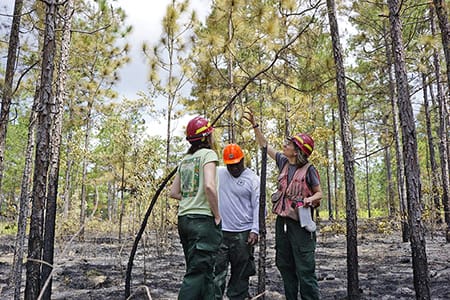
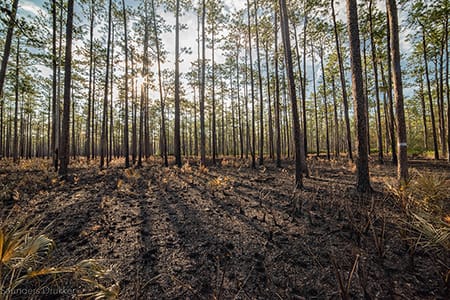
A stand of recently-burned longleaf pine. This stand, and many others like it, will benefit from additional prescribed burns funded through this
partnership.
The RCPP cost-share funding not only helps landowners pursue their management objectives but flows into the local economy when they choose to tap into the vast network of forestry consultants and contractors in the Big Bend region.
Harper Hanway, owner of Apex Forestry in Jefferson County, works closely with Tall Timbers and landowners to help implement forestry practices and achieve their goals.
“Landowners want to be good stewards, and the NRCS-RCPP partnership with Tall Timbers brings money and technical support to the Big Bend region to help people with the cost of conservation practices like prescribed fire and tree planting,” he said. “As a private forestry business, I’m happy to help clients implement these conservation practices and create some job opportunities along the way.”
Approximately half of the Florida Big Bend funding will be used to purchase conservation easements on forest lands, providing permanent protection for pine and hardwood forests and the wildlife dependent upon them.
An application period for conservation easement projects will be announced in the future.
Tall Timbers anticipates strengthening its partnership with the Florida Department of Agriculture and Consumer Services. FDACS’s Rural and Family Lands Protection Program and Tall Timbers’ RCPP program can work together to permanently conserve rural working lands in the coming years.
By combining funding with FDACS, Tall Timbers can assist forest, crop, and livestock producers who want to keep their working lands intact to provide food and forest products that benefit all Floridians.
Private landowners interested in applying for RCPP land management funding can contact Tyler Macmillan at 850-556-5799 or tmacmillan@talltimbers.org or Nelson Ball at nball@talltimbers.org.
Producers interested in working with Tall Timbers and FDACS to pursue a conservation easement can learn more at www.fdacs.gov.