Prescribed fire critical to habitat for migrating Henslow’s sparrows
In the low-lying areas among the longleaf pines, a small group of biologists search for one of America’s most secretive birds. As footfalls disturb damp grasses, a small sparrow emerges and flies a few yards away before dropping suddenly back into the grass to run. The biologists set up their nets to catch the small migrant from the north, the Henslow’s Sparrow.
The Stoddard Lab is no stranger to these grass-walking sparrows. For many years, the lab has studied Bachman’s Sparrows and Grasshopper Sparrows from Tallahassee, Florida to Bainbridge, Georgia. The common theme among all these sparrows is their connection to the vegetation structure — the Henslow’s Sparrow is no different.
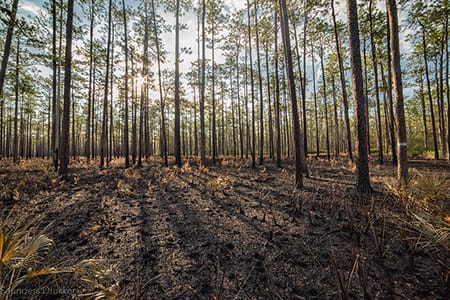
The Red Hills region of Georgia and Florida harbors many Henslow’s in the winter months due to the vast amounts of fire-maintained pinelands reminiscent of their summer breeding grounds. Similar to our year-round residents, such as Northern Bobwhites and Bachman’s Sparrows, there’s a particular association with fire and the habitat that they prefer.
Visiting scientist, Erik Johnson, joined with the Stoddard Bird Lab to assist in the annual Henslow’s Sparrow captures. Back in 2004, he worked on Henslow’s Sparrows in Louisiana as part of his master’s work at Louisiana State University and he now serves as Director of Conservation Science at Audubon Delta.
“I found that after a growing season burn, the wintering Henslow’s density was highest. Then each year after that burn, the Henslow’s density decreased by about half, until it essentially reached zero after about three years,” Johnson said.

Visiting researcher Erik Johnson holds a Henslow’s Sparrow after banding it, measuring it, and collecting a small blood sample. Volunteer Jeff Shenot excitedly photographed the colorful little bird.
In our region, one of the highest capture rates occurred in winter following a mid-April burn. Fortunately, due to regular use of prescribed fire, we don’t have many properties that allow a 3-year rough to develop.
The reason for this trend is simple. Next time you’re in the pine savannah, try shuffling your feet to move around. One year after a burn, this is very easy to do. So called ‘bunch grasses’ like wiregrass leave spaces of bare soil between clumps of grass making a small scale “canopy road” to walk through. Conversely, the three-year post-burn environment is like a jungle of matted vegetation. You might be only able to make it a foot or so before tripping over a briar or having to resort to excessive force to plow through the vegetation.
So far, the Stoddard Bird Lab has captured almost 30 of these elusive sparrows this year. Finding these birds requires multiple individuals to flush birds up and into our nets, a technique the bird lab has used many times on other grass-walking sparrows.
This year, the Stoddard Bird Lab is collaborating with master’s student Emily Nastase of North Carolina State University to collect blood samples from the Henslow’s we catch. The samples will help us understand where our winter sparrows come from and how they are related to Henslow’s found in other parts of the country.
The range of the Henslow’s Sparrow spans from New York to Nebraska, and it is yet unknown where the Red Hills migrants spend their summers.
The software developed by the federal government to report records of bird banding flashes a warning each time we enter the bird’s name: “Not common in your area.” We’ve captured over 160 individuals over the years, including nearly 50 birds in a small, 10-acre parcel we sample repeatedly.
Our ties to the north could weave a complex conservation story that is yet unknown. But thanks to our collaborations with bright minds such as Johnson and Nastase, we can hope to understand more about the birds that call our pinelands home.