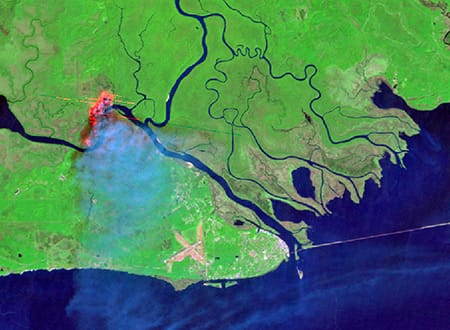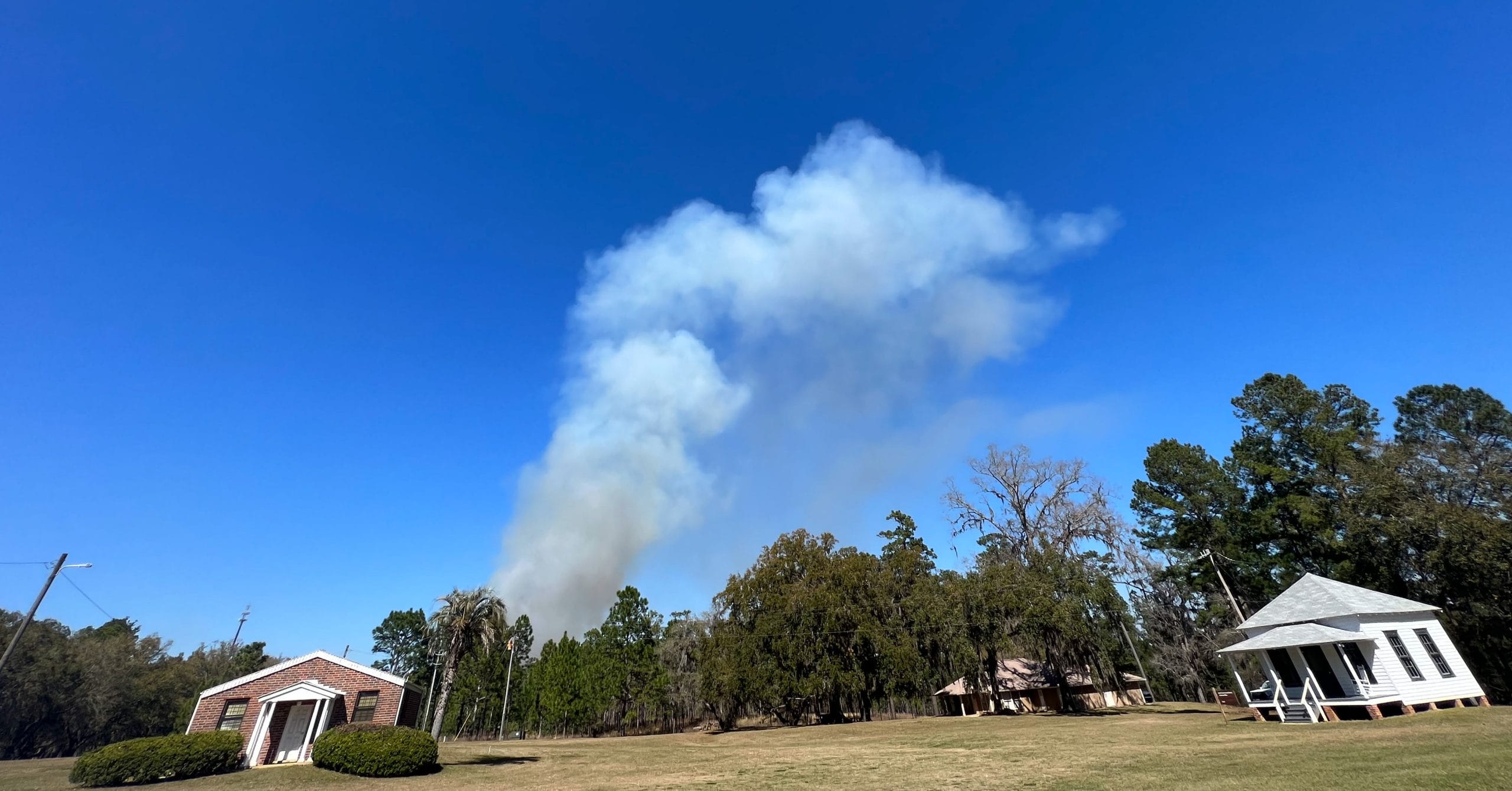
As prescribed fire practitioners, smoke is our most visible connection to the public.
While we consistently work to manage smoke emissions and avoid directly impacting roadways and population centers, the U.S. Environmental Protection Agency has passed new annual air quality standards that could restrict the valuable tool that is prescribed fire.
Tall Timbers is heavily engaged in the new air quality standards and continues work to ensure that prescribed fire implementation – a key to mitigating the negative air quality, health and safety impacts of wildfire – remains strong across the Southeast and the rest of the country.
Part of that continued focus includes hiring Holly Nowell, PhD, as Tall Timbers Smoke Science Program director, with generous support from the Williams Family Foundation of Georgia.
Nowell’s approach is to better understand, map, and help fire practitioners manage smoke in the Red Hills, Albany and eventually at a national level using the well-established Tall Timbers model of bringing science to the problem-solving process, with advocacy and training based on that science.
Tall Timbers Research Director Morgan Varner said hiring a smoke scientist is a bold investment for the organization that will have a lasting impact on the coexistence of prescribed fire use and the people who live nearby.
“It’s the biggest change for our science staff in 20 years. Smoke has always been something we worried about but never invested in formally,” Varner said. “We try to confront ideas, policies and opinions with data, so we see the Smoke Science program addressing that.”
Varner said Nowell comes into the job with a huge user network of fire practitioners on the ground who are eager for information. At the same time, high-level policies and regulations are being developed in Washington.
“It’s a local and national issue,” Varner said. “It addresses how fire prone landscapes interact with humanity.”
A methodical approach to an acute issue
Managing smoke and emissions, whether from restoring and maintaining bobwhite quail habitat, promoting rare plants or recovering endangered animals, has become a major hurdle in regional and global fire and conservation management.
Although there is an acute issue with emissions readings in the Albany area, where an EPA sensor has previously reached the annual emissions level, work there will help inform other areas on managing their use of prescribed fire to support air quality in nearby communities.
The annual PM 2.5 standard was tightened in February from 12 micrograms per cubic meter to 9. These very fine particles are released by various sources, including power plants, diesel trucks, farming, and fires—both wild and prescribed. PM 2.5 is so tiny it can enter the lungs and bloodstream, contributing to asthma, heart attacks, and strokes.

Holly Nowell, PhD, will lead Tall Timbers’ efforts in smoke science.
To be clear, Tall Timbers supports air quality standards for human health. We disagree with the approval of the rule before doing the work to establish a clear path for prescribed fire implementation.
“We need to take a methodological approach, not just a short-term reactionary approach,” Nowell said. “I’ll start by looking at what is causing Albany to go out of attainment and analyze historic burn permit years. Albany is a case study that can be applied to other areas.”
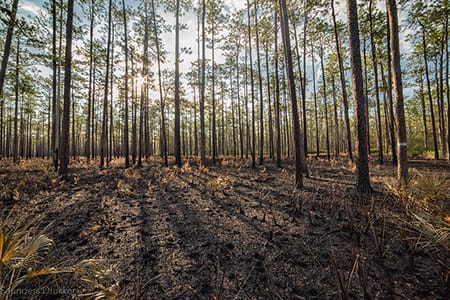
The reality is that a large percentage of the burning in the Red Hills and Albany is centered around the needs of the bobwhite quail and its pine upland habitat. Most fires land within the first five months of the year as does the smoke that accompanies them.
Nowell’s work will help inform managers where they may be able to make tweaks in their prescribed fire implementation.
“I am here to work with land managers using science to find practical solutions,” she said. “We need to work together to develop solutions that work for everyone.”
Nowell, who started at Tall Timbers in 2022 and led the Geospatial Lab since January, has a PhD in meteorology from Florida State University, two MS degrees from FSU in Meteorology and GIS, and her BA from Washington University in St. Louis. Before Tall Timbers, she served as a Post-Doctoral student at FSU and held positions with NASA, the National Weather Service and the University of Southern Mississippi.
On the recent advocacy front, Tall Timbers also endorsed the National Prescribed Fire Act of 2024 which includes continued investments in prescribed fire training and important policy direction to help protect existing burning while also expanding the use of beneficial fire. That includes work to ensure prescribed fire’s continued use under the new EPA rules.
Watch Tall Timbers’ Research Director Morgan Varner talk about the need to invest in the science of smoke below.