Winter disking is a land management tool used to disturb the soil, set back plant succession, and maintain a mix of annual and perennial plants, mainly forbs (weedy plants).
Research on the Whitcomb plots at Tall Timbers has shown that disking between October and January produced higher percent cover of important bobwhite foods such as ragweed (Ambrosia artemisiifolia) and partridge pea (Cassia fasciculata), as well as a higher percent and higher diversity of phytophagus insects (the insects that quail eat such as ants, spiders, and other predaceous arthropods).
Disked fields can be good brood habitat for foraging bird species; they are rich with insects; the bare ground allows for easy movement by the young birds; and the plant structure allows for protection from avian predators. These forb dominated fields provide diversity to a forested landscape and can be essential habitat for cottontail rabbits, deer, bobwhite, turkey and other songbirds.
Depending on the management objectives, soil type, and vegetation type, fields can be entirely disked or partially disked (strip disking). By disking the entire field annually, the manager is maximizing brood habitat. By disking 1/3 – 1/2 of each field every year, a manager can increase brood habitat, while maintaining year around cover and food resources.
Winter disking also has many positive attributes compared to planting food plots.
First of all there is the economic aspect; winter disking, where the seed bank is intact, has minimal cost (fuel and tractor maintenance). In areas without an adequate seed bank, (such as abandoned agricultural fields, also referred to as old fields), a winter disked field typically can be perpetuated from one year of planting the desired old field plant species versus planting annual food plots such as sorghum, millets, or sunflower, which require an additional annual cost of seed and fertilizer.
Secondly, the old field vegetation has evolved with drought conditions, so in those years that the food plots don’t produce due to lack of rainfall, old field vegetation will still grow and provide wildlife benefits.
Past land use and soil type considerations determine the benefits of winter disked fields.
When reclaiming a fallow pasture field, exotic grass control is a necessary first step; fescue, Bermuda, and Bahia grasses are often present and are an impediment to wildlife and old field vegetation.
Learn more about controlling exotic grasses in uplands
They must be controlled for successful field management to occur. Soil type will determine the amount of brood use. In loamy or clay soils, such as much of the Red Hills region of north Florida and south Georgia, frequently burned upland pine forests with adequate sunlight for groundcover will actually be the preferred quail brood habitat, and winter disked fields will be used the least. In these areas, strip disking may be more beneficial for meeting other habitat needs such as year-round cover and nesting habitat.
Conversely, on sandy, dry soils, such as in the greater Albany area of Georgia, and portions of the Red Hills area where groundcover in the uplands can be sparse, winter disked fields will be the preferred brood habitat and will be highly used.
In these areas, disking the entire field annually will improve brood habitat while the native or old field groundcover will provide the nesting and year around cover. Similarly, native wiregrass and longleaf sites, (typically sandy soil and low fertility) the native ground cover will provide excellent nesting and year around high quality habitat, while existing winter disked fields can provide high quality brood habitat.
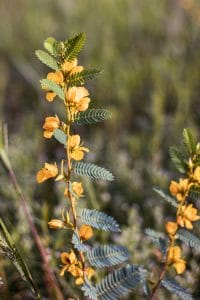
Partridge pea responds well to a winter disking
Disking of intact native groundcover is not recommended; these areas have not been disked before, and do not have the appropriate seed bank to respond positively to winter disking. In this situation, brood use in newly disturbed native groundcover will be much less than in recently burned intact native groundcover.
Forbs such as partridge pea, ragweed, mint blue curl, and blackberry (to name a few) can be an important food resource for many birds and mammals.
Timing of winter disking will determine what plants will be prevalent. In a study conducted on the Whitcomb plots at Tall Timbers, annual percent plant coverage of ragweed in the Oct/Nov plot was 52%, but was 86% in the Dec/Jan disked plot. Partridge pea had 32% cover in the Oct/Nov disked plot and 12% in the Dec/Jan disked plot. Blackberry was 11% cover in the Oct/Nov disked plot and 43% in the Dec/Jan disked plot.
The key to determine when to disk is to watch for when the desired plant species’ seeds mature. However, timing and the amount of rainfall in a given year will also have an effect on the plant community response as seen through sampling of the Whitcomb plots during various years.
Research has shown that size of fields is also an important consideration. While smaller fields will be used by broods, it is hard to get the property’s field percentage very high unless you have the recommended 2-4 acre size. On high quality soils (loamy or clay), one field per 20 acres (10-20%) is a good rule of thumb. On low quality, sandy soils, up to 30% of the landscape kept in fields is beneficial.
Field management is just one component of wildlife management. Managing the forest with frequent fire, and thinning to get adequate sunlight to the ground are the most important factors in creating and maintaining high quality, early succession habitat.