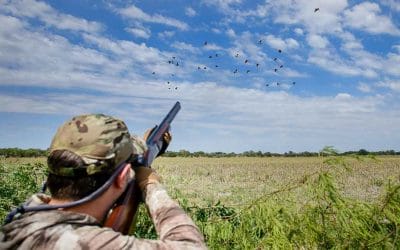
Tall Timbers has long prioritized stakeholder driven research. About five years ago, managers in the Red Hills and Albany region began asking questions about the local mourning dove population and an apparent decline in hunt success. Tall Timbers responded by working with 13 different managers (including Tall Timbers and Livingston Place) to develop a protocol to trap and band dove.
Specific questions to address included: What percent of the local dove population is harvested annually? Are locally produced doves staying local or moving south? Are migrant doves from the north contributing to harvest? As dove are a migratory bird, trapping required coordination with the Florida Fish and Wildlife Conservation Commission, Georgia Department of Natural Resources, and the Bird Banding Laboratory with the U.S. Geological Survey.
For the next four years, Tall Timbers staff and local managers trapped and banded more than 1,800 doves. Fewer than 150 of these doves were harvested and most of those were harvested within a few miles of where they had been banded. We found little evidence that locally produced dove moved far based on band returns. Accounting for nonreporting bias (banded dove harvested but not reported) and for dove shot but not found, we estimate that between 10-20% of the banded dove were shot each year. This is similar to or slightly higher than national averages and is not a concerning harvest level.
We also analyzed harvested dove feathers to examine stable isotopes to approximate the latitude of origin for migratory birds. The results suggest that a portion of dove harvested (especially during the December season) did originate from areas north of our region and are contributing to hunt success.
So, what do these findings mean for the reported decline in hunting success?
There are several possible explanations, including:
- An increase in managed fields and feeding for bobwhite may be spreading dove across the landscape,
- An increase in urban bird feeding may be spreading dove across the landscape, and
- A general decrease in the national population of dove.