Despite timber damage from several years of hurricanes and an extreme drought that lingered over the North Florida and South Georgia for eight months, state forestry officials in both states are predicting low probability of a Southern Pine Beetle infestation.
The destructive forest pest which is about the size of a grain of rice can overtake and kill large areas of pine forest during an outbreak by overwhelming the trees’ natural defenses. If trees are already stressed – due to storm damage or drought conditions – they become even more susceptible.
Through annual monitoring programs in Florida and Georgia, state officials are predicting a minimal likelihood that the beetles will become a problem in 2026.
However, there is an elevated risk in the Tallahassee-region centralized in Gadsden, Wakulla, Leon, Liberty Alachua and Okaloosa counties in Florida based on trapping counts in those regions.
Gadsden County is at the most risk, with a 74% chance of an outbreak, followed by Wakulla (31%), Leon (23%), Liberty (22%), Alachua (17%) and Okaloosa (11%) counties.
Several active SPB infestations were collected in Gadsden County traps and this year’s prediction is likely a carry over from several infestations found in the county in 2025.
Florida Forestry officials noted that the prolonged drought lasting through late April caused water stress to a number of trees in North Florida, leading to higher tree mortality. Although drought does not lead to SBP outbreaks, already stressed trees are targets for other bark beetles like Ips and black turpentine beetles, which can then become host trees for an existing SPB infestation to spread from.
But drought conditions can also be detrimental to SPB colonies. Water-stressed trees provide low-quality habitat for the beetles and extreme summer heat tends to suppress colony development.

An aerial view of a Southern Pine Beetle infestation. Photo from the Mississippi Forestry Commission.
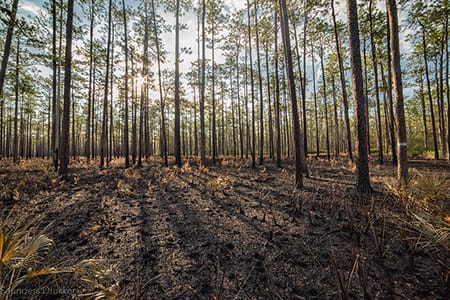
As it relates to the Red Hills, management of overall forest health is a major contributor to the spread of SPB. Widely spaced trees seeing frequent, low-intensity fire, is great mitigation to prevent the spread of SPB whereas high density stands can accelerate their spread.
In Georgia, the three counties with the highest probability of an SBPB outbreak, Carroll, Coweta and Paulding counties, just west of Atlanta. Overall, the west-central part of the state is at the highest risk for an infestation.
Identifying a Southern Pine Beetle infestation and what to do
The beetles attack stressed trees by boring through the bark and into the inner layers. Once one or more beetles has invaded a tree, they send out pheromones that alert other beetles that a stressed tree has been located.
A tell-tale sign of a SPB infestation is sap on the exterior of the bark that resembles popcorn as the trees attempt to repel the beetles with their natural defenses. From the air, the infestations appear as patches of trees with reddened needles.
As beetles begin to infest a stand of pines, needles begin to turn red as they devour the trees. Consulting with a forester can help determine the best way to address a growing infestation, but often, it involves cutting down trees within a radius of roughly two tree heights.
Read more about the Florida Southern Pine Beetle 2026 prediction
Read more about the Georgia Southern Pine Beetle 2026 prediction