The Red-cockaded Woodpecker was one of the first species originally listed under the Endangered Species Act but was recently downlisted from endangered to threatened by the U.S. Fish and Wildlife Service after decades of conservation efforts.
So, what does this new status mean for the future conservation of the species?
Where are the woodpeckers at today?
The reason for the downlisting is the continued success of land managers to maintain and grow their populations.
Artificial cavities, translocations, and the continued use of prescribed fire have all been major tools to bring the woodpecker back to the landscape much more quickly than otherwise would have been possible.
Today there are over 120 populations of the Red-cockaded Woodpecker throughout the southeast.
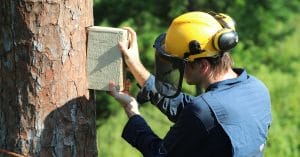
Rob Meyer, Tall Timbers’ Woodpecker Conservation Specialist installs a red-cockaded woodpecker nest cavity
The latest regional survey conducted by Tall Timbers and Georgia Department of Natural Resources found the red-cockaded woodpecker population in the Red Hills region between Thomasville, and Tallahassee has increased to approximately 240 family groups.
This is a significant milestone, as the population was around 180 groups when Safe Harbor was implemented in 2000. The Red Hills population remains the largest red-cockaded woodpecker population found on private lands.
Much of their historic range remains uninhabitable and after seeing the effect of the latest Hurricane Helene (and previously Hurricane Michael in 2018) it is clear to see that populations will remain threatened by increasing severity of storms.
Of the remaining populations, 108 of them are considered to have a ‘low’ or ‘very low’ populations status and are the most susceptible to future declines. Only 6 populations are of a ‘high’ or ‘very high’ population status as of the most recent assessment.
Thus, the work isn’t over yet.
What does this mean for Safe Harbor?
One key development in the success of bringing back the Red-cockaded Woodpeckers has been Safe Harbor program. This agreement between landowners, the state, and the federal government has excelled at lowering the burden of working around a protected species on private lands.
The status change of the woodpecker will not change existing Safe Harbor agreements.
Federally threatened species share much of the same protections as endangered species including avoiding direct harm and preventing habitat loss. Thus, the Safe Harbor program remains relevant to the new threatened status of the woodpecker.
If you have any questions about the Safe Harbor Agreement, in Florida please contact Rebecca Pfaller at rebecca.pfaller@myfwc.com, in Georgia please contact Joe Burnam at jonathan.burnam@dnr.ga.gov.
For further information on the reclassification, contact Nicole Rankin, Manager Division of Conservation and Classification of the U.S. Fish and Wildlife Service at (404) 679-7089.
What does this mean for the future?
It is clear that the management of the woodpecker has come a long way since its initial listing and it is also clear we are not out of the woods yet.
As long as populations remain small, isolated, and dependent on artificial cavities to sustain themselves, conservation efforts will be required to keep them on the landscape.
The downlisting may also open up new research opportunities and conservation strategies.
For example, if populations remain small and isolated, perhaps new research into chick-swapping may help reduce inbreeding potential.
Read more about chick-swapping efforts at Tall Timbers.
Another example would be testing new ways of releasing translocated woodpeckers that could result in better establishment rates. With fewer concerns as a threatened species, researchers may be granted more leniency to explore new management tools and refine existing ones.
With cooperation from private landowners, Safe Harbor, and the decades of work from conservationists have made this downlisting possible.
While Red-cockaded Woodpeckers remain a threatened species for now, we must continue these efforts to prevent it from being endangered again.