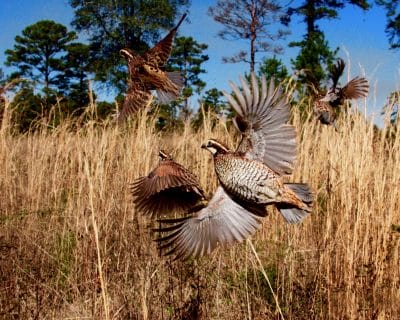
The third year of a study by Tall Timbers and other partners hopes to capture data about movement patterns of mourning doves in the Red Hills and Albany regions of Georgia and Florida.
During the 2022-23 hunting season, the initial year of the study done in collaboration with several private properties in the region and the University of Georgia, 24 bands were reported back to Tall Timbers out of 497 put onto birds, a 5% return.
Out of the 24 harvested banded birds, 17 were harvested on the same site in which they were banded and six were harvested on different sites, two of which were sites not involved in the banding last summer.
The furthest bird movement documented was a bird banded in the Red Hills which was harvested in Palm Beach County in early January.
We are again asking everyone to keep a close eye out for leg bands on any of your harvested birds during dove season.
Reporting your harvested banded birds directly to the USGS Bird Banding Lab (BBL) and Tall Timbers will allow us to better understand the ecology and demographics of doves in this region.
After reporting bands to the the BBL, please send an email to Dwayne Elmore (delmore@talltimbers.org) at Tall Timbers including the band number, the date you harvested the bird, and the location where you harvested the birds (preferably a set of GPS coordinates, if possible). Harvest location coordinates will allow us to better understand the distance the dove traveled from the location it was banded to the location it was harvested.
Have no fear, we will not release this more detailed location information and will only pass on the harvest state for the official Bird Banding Laboratory data.
For more information about the scope of the project, please see the following article originally published in our 2022 edition of Quail Call. Thank you in advance for the submission of any banded birds and good luck this year!
The 2024-25 mourning dove seasons for both Georgia and Florida are listed below. Check your state’s laws for all hunting season dates.
Georgia: September 6th – October 12th, November 22nd – 30th, and December 19th – January 31st
Florida: September 27th – October 19th, November 8th – 30th, and December 19th – January 31st
Mourning Doves: The Other Highly Prized Bird
By Nicolas Lusson, Lead Game Bird Technician, originally published in the Summer 2022 edition of Quail Call.
Dove hunting is an important cultural and economic activity in the Red Hills, with some fields in existence for over a hundred years. However, over the past decade dove use of properties has varied dramatically. Some properties now have so few doves at their managed fields that hunting no longer occurs, whereas other properties harvest several hundred to thousands of doves in a single season.
Most hunting and harvest in the Red Hills and Albany regions occur during the early phase of the dove season, which raises concern about the effect of harvest on local populations.
In addition to high variability of field use, there has been an overall observed decline in dove harvest across many properties in the region. Most hunting and harvest in the Red Hills and Albany regions occur during the early phase of the dove season, which raises concern about the effect of harvest on local populations.
There is also concern that the amount of dove fields in the area is causing the local population to disperse more widely across the landscape, reducing the apparent dove population. Several property managers and our research group have instigated a study, along with Florida Fish and Wildlife Conservation Commission and Georgia Department of Natural Resources, to begin to explore these potential issues. We are interested in examining the movement patterns of mourning doves within and among the properties of the Red Hills and Albany regions of Georgia and Florida.
Also, we aim to calculate the harvest rates to compare with statewide rates in Georgia and Florida. Our primary approach for measuring these processes is banding a lot of doves relying on you dead-eye shooters to “capture” some of them! All we ask is that you report the band numbers to us!
Banding provides data on the geographical and temporal distribution of the dove harvest, origins of birds harvested, mortality, survival, longevity, differential vulnerability of age and sex classes to shooting, and other information useful to managing the species.
To monitor harvest rates, many states, such as Georgia and Florida, collaborate with the United States Fish and Wildlife Service (USFWS) to band doves every year. Breeding Bird Survey (BBS) data reflects that dove populations have been growing in the region. However, recent anecdotal evidence based on banding data suggests a decline in dove populations or an increase in recovery rates. Finer scale information about the relationship between hunter harvest rates and dove populations would inform larger scale population processes and management.
In addition to information about the harvest rates, banding can be used to study movements. Finally, we can explore landscape features and management actions that lead to greater success in dove hunting.
Wild bobwhite quail translocation to four states could help to rebound populations that have shrunk over the last century because of habitat loss.
This spring, Tall Timbers’ Game Bird Program moved 320 birds from the Red Hills and Albany regions to properties in Alabama, Georgia, Texas and Virginia where researchers have been working closely with landowners to reestablish nearly 15,000 acres of quality quail habitat and rebuild populations across the birds’ historic range.
The project in Virginia was the first time Tall Timbers translocated birds there, and the move of 120 birds to East Texas is part of the Western Pineywoods Quail Program launched just two years ago.
“Here in the Red Hills and Albany, wild quail are thriving due to the dedicated land owners and managers who work to ensure that quality habitat exists year after year. However, across the rest of their historic range, wild quail haven’t been as fortunate,” said Tall Timbers Red Hills Game Bird Research and Extension Biologist Alex Jackson.
There are a number of reasons quail numbers have dwindled: habitat loss, focus on agriculture and silviculture, increase in predators and the abandonment of prescribed fire as a management tool.
Researchers work with landowners interested in seeing more quail to improve their habitat. Only those that are conducive to supporting a long-term, healthy population are considered for translocation.
Participating landowners agree to follow a Tall Timbers management plan and researchers work closely with state game agencies over the course of the translocation project.
The hope is that in five years, areas where quail once lived will again have a thriving, huntable population, roughly one bird per acre.
Quail were relocated from the Red Hills and Albany to properties in Alabama, Georgia, Texas and Virginia.
“Translocation is not a panacea,” Jackson said. “The only time we’ll consider a translocation is if landowners have done the work and the habitat is right. Wild quail are a delicate resource, so we want to make sure when we move them they’re going to be taken care of.”
Jackson said building a healthy quail population where they’ve all but vanished can build buzz around translocation and spark the use of beneficial land management practices in surrounding areas.
Tall Timbers is developing a full-time quail expansion biologist position with a focus on working with landowners outside the Red Hills and Albany with tools like translocation to jumpstart quail population restoration efforts. The Game Bird Program has regional quail programs in the Carolinas, Central Florida, Alabama and now the Pineywoods of East Texas, southern Arkansas and western Louisiana.
In East Texas, the ecosystem is similar to the Red Hills and Albany with clay soils and open pine savannahs, but the region has pretty much lost all of its wild quail population, said Brad Kubecka, Tall Timbers’ Western Game Bird Program Director.
The East Texas property where quail were translocated this year had previously lost all of its birds, but in 2020 Tall Timbers started working with the landowner on improving habitat.
The landowner reintroduced fire, began mulching and creating brood fields, all practices that are effective in the Southeast, and researchers began monitoring it as a possible site to move birds.
“Simply restoring habitat does not mean a population will respond if there is no population there to begin with. This is why translocation is important after habitat restoration in these regions that have lost their birds,” Kubecka said. “We’re using the data from these translocated birds to tell us whether our blueprint from the Red Hills and Albany can work here.”
The Texas translocation included 60 birds in January and another 60 in March. Kubecka said there is research to determine if moving birds a few months before the spring breeding season gives them a leg up when it’s time to start nesting.
The question is if slightly longer acclimation to the release site could in turn improve reproduction with earlier nesting and higher nesting rates. If comparable to March releases, this gives researchers more flexibility in translocating logistics. Researchers have already found quail nest bowls and are monitoring nine pairs that appear to be preparing to breed.
“The first three months after release are the hardest on quail,” Kubecka said. “In the first three months this year, we’ve had exceptional survival; 90% of our birds were alive. They were doing as well or better than our resident populations. That’s very encouraging.”
On a brisk April morning, biologists from four separate agencies gathered south of Tallahassee to initiate the first attempt to restore the frosted elfin butterfly to a place where it had disappeared many years earlier.
The frosted elfin is a small, cryptic animal that emerges once each year to fly, mate, and lay eggs in early spring.
Figure 1. A frosted elfin butterfly. Photo credit: Dave McElveen
The range extends from Canada to Florida to Texas, but range-wide declines imperil nearly every population, and populations in Georgia disappeared over a decade ago. Hardwood encroachment and lack of fire pose two of the primary threats — hardwood shrubs grow tall in the absence of fire and shade out the elfin and its only host plant in our region, the sundial lupine.
The Munson Hills area of the Apalachicola National Forest has the best-studied population of frosted elfin anywhere on Earth. Since 2010, efforts to monitor and study the population have been conducted by volunteers and researchers to obtain critical fire management information. This information then goes to the Forest Service staff that work hard to sustain this rare butterfly, and other fire-dependent species like bobwhite quail and red-cockaded woodpeckers. But increasing wildfire risk associated with extreme weather events makes it imperative to expand the range of elfin to avoid having all our eggs sitting in one burned up basket. Afterall, the Munson Hills area is the location of only one of two populations of frosted elfins left in Florida.
Prospects for a return to Georgia took a turn for the better recently thanks to on-going research conducted by Tall Timbers and the fine management practiced by our colleagues at the Jones Center at Ichauway. Located in Newton, Georgia, Ichauway has thousands of acres of fire-maintained habitat and a population of lupine the elfins need. With years of hard work, we can finally put our knowledge into practice and return the species to Georgia.
The elfin has a 1-inch wingspan and typically flies for a couple weeks before laying eggs and dying. Chances of a return to Ichauway seem pretty bleak if left up to Mother Nature, but perhaps some help could tilt the balance. The Munson Hills location is the closest known population, but it is still over 60 miles away. To put that in perspective, that would be like you traveling over 4,000 miles in less than 2 weeks (you would need to average 11 mph to make it in time). It is clear they will need some assistance. Unfortunately, this isolation is not uncommon, and is why translocation of animals has become such a familiar tool for biologists today.
Luckily, Tall Timbers has a history of successful translocations, including red-cockaded woodpeckers, bobwhite quail, brown-headed nuthatches, and grasshopper sparrows, to name a few. But unlike these animals, butterflies have several different life stages that could be moved: eggs, caterpillars, pupae, or adults. Those that have wielded a bug net know that butterflies can be hard to catch, but caterpillars on the other hand rarely put up such a fight, and make good translocation candidates.
Figure 2. David Cook (FWC) finds a frosted elfin caterpillar for translocation. Photo credit: Tim Donovan FWC
The plan was simple: collect caterpillars from the Munson Hills in the Apalachicola National Forest and move them to Ichauway. Biologists and researchers from the Florida Fish and Wildlife Conservation Commission, U.S. Forest Service, the Jones Center, and Tall Timbers met at the Munson Hills to do just that. In just a few hours we collected 60 frosted elfin caterpillars. Half of these caterpillars were to be immediately moved to Ichauway for release onto host plants, while the other half were kept to be released as adults next spring. This allows us to test which life stage of the butterfly is best for future translocations of the species elsewhere. When a caterpillar was found, we placed it in a Petri dish and placed it inside a Styrofoam box to regulate its body temperature.
Once we gathered the caterpillars, a convoy of vehicles left the forest to usher the species across the Florida-Georgia border. With state and federal entities in tow, and permission slips in hand from multiple state and federal agencies, you would have thought we were transporting the President. Politicians aside, once we crossed the state line we would be in the possession of the rarest native animal in the entire state. The whole population of frosted elfins in Georgia, contained in a single Styrofoam box.
Once at Ichauway, we moved into the forest to deliver the caterpillars to individual lupine plants. The caterpillars would forage for another week before pupating at or below the soil surface. After that, they would remain as a chrysalis for nine months, waiting out the hot temperatures of the summer and the cold of the winter to emerge next spring. Because of this long dormancy, we put protective cages over the plants where we placed caterpillars to ensure no hungry spiders or wasps take our new Georgia residents. The other 30 caterpillars that were not placed in the forest were kept in the Petri dishes and fed lupine leaves until they too pupated. They will wait in a climate-controlled incubator until next spring when we will reunite them with their cohort at the lupine patch.
Come February 2023, frosted elfins will once again fly over Georgia soil performing their spiraling courtship displays and laying their eggs among the lupine flowers. While the premise of the reintroduction was simple (caterpillar carpooling), there were years of work devoted to learning more about these butterflies—from their biology, to their interactions with fire, and from many people and entities devoted to saving a small endemic species. As conservationists, it is a cathartic moment to have made progress in an age of mass extinction.
Figure 4. The caterpillar caravan entering the Jones Center with caterpillars carpooling in the rightmost vehicle. The delivery sign shows us the way. Photo credit: Tim Donovan
The number of great photos taken during the event was simply too much to put in one article, so our photographer for the event, Tim Donovan, has made it available here instead. Feel free to check out all the moments of this first ever translocation and reintroduction of the frosted elfin.
Thank you to all who helped in this effort, including Jessica Valdez and Matt Trager with the U. S. Forest Service, David Cook with the Florida Fish and Wildlife Conservation Commission, and Anna Yellin with the Georgia Department of Natural Resources. I would also like to recognize an almost decade’s long effort from volunteers Dean and Sally Jue, Virginia Craig, Dave and Jean McElveen, and David Harder for providing vital information on the Munson Hills population. Thank you to Kier Klepzig, Lisa Giencke, and Tom Sheehan at the Jones Center for assisting with the project and committing to frosted elfin conservation in Georgia. Funding for this project was made in part by Gulf Power Company, Fish and Wildlife Foundation of Florida’s Conserve Wildlife License Plate grant, as well as the U.S. Fish and Wildlife Service, the At-risk Species Program.
Figure 3. Frosted Elfin caterpillar hunters. From left to right, back row: Lisa Giencke (JC), Crystal Bishop (JC), Tom Sheehan (JC), Victoria Cassidy (JC), Allie Snyder (JC), Gabe Tigreros (JC), Mady Dunlap (JC), David Cook (FWC), Jessica Valdez (USFS), and Rox Oxford (USFS). front row: Nelson Ball (TTRS), Emma Jonas (TTRS), Rob Meyer (TTRS), and Dave McElveen (TTRS). Photo credit: Tim Donovan
The Florida Department of Transportation announced big news on August 5, saying it completed a study of the Northern Turnpike Extension without recommending a specific corridor to connect to U.S. 19, and that it would not move forward until options could be reassessed to address significant community concerns; this isbig news. Some context on this complicated issue might be helpful.
For more than two years, Tall Timbers, conservation organizations around Florida, and residents statewide raised concerns and objections over Senate bill 7068 from 2019 (known as M-CORES), which called for the construction of three toll roads spanning over 330 miles throughout the state. From 2019 to 2020, steering committees evaluated each of these three proposed toll roads, ultimately producing final reports containing numerous recommendations and concluding that they could not agree that there was “a specific need for a completely new greenfield corridor or modifications of existing facilities through the study area to achieve the stated purpose.”
Subsequently, in 2021, the Florida Legislature passed SB 100, which repealed M-CORES and removed the requirement for a toll road through Jefferson County and the Red Hills. SB 100 instead called for DOT to include in their work program, “the construction of controlled access facilities as necessary to achieve the free flow of traffic on U.S. 19, beginning at the terminus of Suncoast Parkway 2 Phase 3 [Citrus County], north predominantly along U.S. 19 to a logical terminus on Interstate 10 in Madison County.”
Proposed Northern Turnpike Extension corridors
SB 100 also called for DOT to begin working on a study to extend the Florida Turnpike from its current terminus in Wildwood (Sumter County), to a new terminus determined by DOT (somewhere on U.S. 19 in the Florida Big Bend). This is the Northern Turnpike Extension that DOT just shelved in the face of widespread citizen opposition and “No build” resolutions from Citrus and Levy Counties and the towns of Dunnellon, Inglis, and Yankeetown.
Questions we’re asking:
Does this mean the Northern Turnpike Extension to U.S. 19 in Citrus or Levy County will not be built? That’s hard to say. DOT’s statement notes that while the controversial project is sidelined, the door is still open to evaluating corridor concepts that respect environmental and community concerns. In the near-term, DOT will focus on improvements in the I-75 corridor, as suggested by many conservation groups, residents, and toll road steering committee members.
How does this decision affect the Florida Big Bend and the Red Hills? At this point, DOT will continue following the legislative directive in SB 100 to study improvements to achieve the “free flow of traffic” on U.S. 19 from Red Level in Citrus County to Madison County. Critics have noted that the perceived need for improvements to the underutilized U.S. 19 was based in part on connecting U.S. 19 with the Florida Turnpike, resulting in increased traffic from Central Florida through the Big Bend. Absent that interconnection, it appears to raise the bar for justifying significant enhancements to U.S. 19, which Florida TaxWatch noted in 2020 was a project with “little demonstrated transportation need.”
Before the end of 2022, DOT is scheduled to hold additional public outreach opportunities to receive input on potential improvement to U.S. 19. Communities throughout the Florida Big Bend—which includes one of the longest stretches of undeveloped coastline in the continental United States—will need to fully participate to ensure DOT hears concerns about impacts to natural resources, working rural lands, and rural community character in a state that has already lost many of those amenities.
Applications for financial and technical assistance for interested St. Marks and Aucilla Basin property owners are now open. In 2021, Tall Timbers was awarded funding by the U.S. Department of Agriculture to help provide both financial and technical assistance to St. Marks and Aucilla basin property owners in north Florida and south Georgia. This funding was awarded through the Natural Resources Conservation Service (NRCS) Regional Conservation Partnership Program (RCPP), and after a successful year, has opened again for interested landowners.
This partner-driven effort leverages public and private funds to benefit natural resources on private lands and lasts for five years. The assistance will help landowners of non-industrial forestland in the St. Marks and Aucilla River Basins within Leon, Jefferson, Wakulla, Madison and Taylor Counties in Florida, and Brooks, Thomas and Grady Counties in Georgia. This includes efforts aimed at prescribed fire implementation, longleaf pine establishment, timber stand improvements, invasive plant treatment, and wildlife habitat improvement.
The assistance will help landowners of non-industrial forestland in Leon, Jefferson, Wakulla, Madison and Taylor Counties.
As part of a larger initiative project to protect these basins, Tall Timbers also partners with the Suwannee River Water Management District, Aucilla Research Institute, Apalachee Audubon Society, Wakulla Environmental Institute, St. Marks National Wildlife Refuge, and a number of individual private landowners in the Red Hills area to meet these goals.
Rebecca Armstrong, the RCPP Biologist with Tall Timbers, says this funding helps to preserve these areas’ beauty and importance, “The Aucilla and St. Marks watersheds contain some of the most unique and beautiful natural areas in Florida. So many landowners in the area are committed to managing and conserving their properties for future generations. We look forward to assisting even more landowners in achieving their stewardship goals through the RCPP program.”
Interested parties in Florida can submit their application by September 30, 2022 to obtain this funding. Georgia landowners in the watershed areas must submit their applications by November 4, 2022. Tall Timbers staff members are eager to meet with interested landowners to discuss their specific needs, determine property conditions, offer guidance on completing the RCPP application process and provide advice as needed.
Gopher tortoises are just one of the many imperiled species that will benefit from the land management and conservation components of this RCPP project. Photo by Preston Ballard.
Applications will be evaluated for funding based on local, state, and nationally developed criteria for optimizing environmental benefits. Landowners ranking highest in a funding category will receive funding according to priority and are subject to the availability of program funds. While funding decisions come directly from NRCS, Tall Timbers staff plan to work with landowners closely from the application period through project implementation to earn any needed funding.
Peter Kleinhenz, the Partnerships Program Coordinator for Tall Timbers, says, “It has been remarkable to see the interest in land management activities like prescribed burning and longleaf pine planting among landowners in our project area. The Tall Timbers RCPP team looks forward to working with even more landowners this cycle to get land management implemented that will improve our landscapes for people and wildlife.”
Private landowners or agricultural producers interested in receiving RCPP funding and getting involved with this project can contact Tyler Macmillan at tmacmillan@talltimbers.org or Peter Kleinhenz at pkleinhenz@talltimbers.org.
Landowners hoping to maintain their pine uplands with prescribed fire can receive 75% cost-share for this land management practice. Photo by Preston Ballard.
Land conservation and exemplary land management supported by the RCPP program will benefit waterways like the spring-fed Wacissa River. Photo by Preston Ballard.
Thank you for submitting a job post request
Say NO to a New Toll Road in Jefferson County
The M-CORES program, which includes the proposed Suncoast Connector Toll Road in Jefferson County, passed through the Florida Legislature at breakneck speed with little review or analysis. Tall Timbers has a number of concerns given the potential for significant and wide spread impacts. These include fragmenting public and private conservation lands, robbing business from Main Street Monticello, impacting our rivers and other water resources, and making prescribed fire more difficult and costly.
Join us in asking the Jefferson County Board of County Commissioners to OPPOSE the Suncoast Connector toll road and its path through Jefferson County.
Take action now with our easy email form.
Send an email to all five Jefferson County Board of County Commissioners with one click!
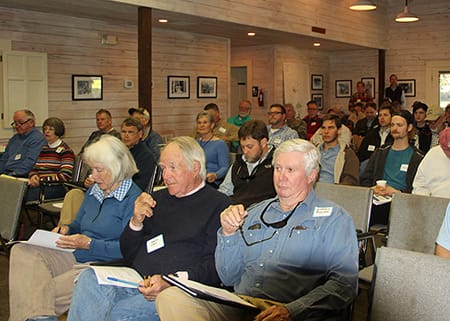
Burn prioritization modeling seminars and fire modeling tools are supported by Wildland Fire Science to train managers in the important planning stages of prescribed fires.
Educating and guiding the next generation of fire researchers and managers is a key goal of Wildland Fire Science and a resource for testing new ideas in fire research.
Tall Timbers hosts the premier fire technology transfer organization—the Southern Fire Exchange. This JFSP funded effort helps connect research to management through webinars, workshops, and support of the Prescribed Fire Science Consortium.
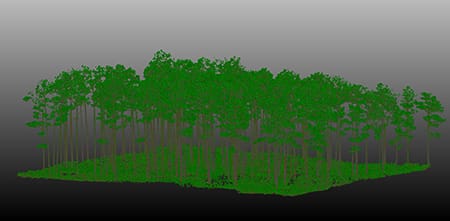
Working with partners in the Prescribed Fire Science Consortium, the program is building nexgen 3-D fuel beds using terrestrial LiDAR and novel sampling techniques to power new fire behavior models for prescribed fire managers. This work links to Tall Timbers work in wildlife habitat usage and ecological forestry.
The Longleaf Legacy landscape prescribed fire burn team arm of Wildland Fire Science works directly with landowners and partners to effectively put fire on the ground and promote prescribed fire throughout the region.
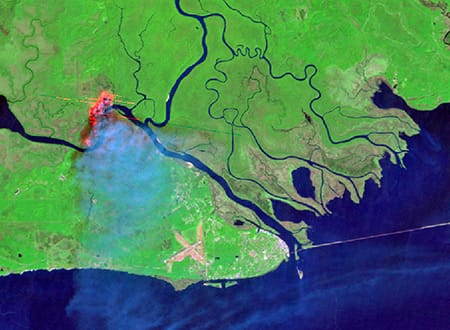
Tall Timbers is leading an effort to map fire regimes at the landscape scale. Staff work with numerous agencies to evaluate fire records and satellite imagery to build this critical conservation database. https://skfb.ly/6DqOY
Tall Timbers hosts the Prescribed Fire Science Consortium, a national network of researchers and managers who promote integrated research and management to advance next generation tools for fire practitioners. https://arcg.is/1DSjDT
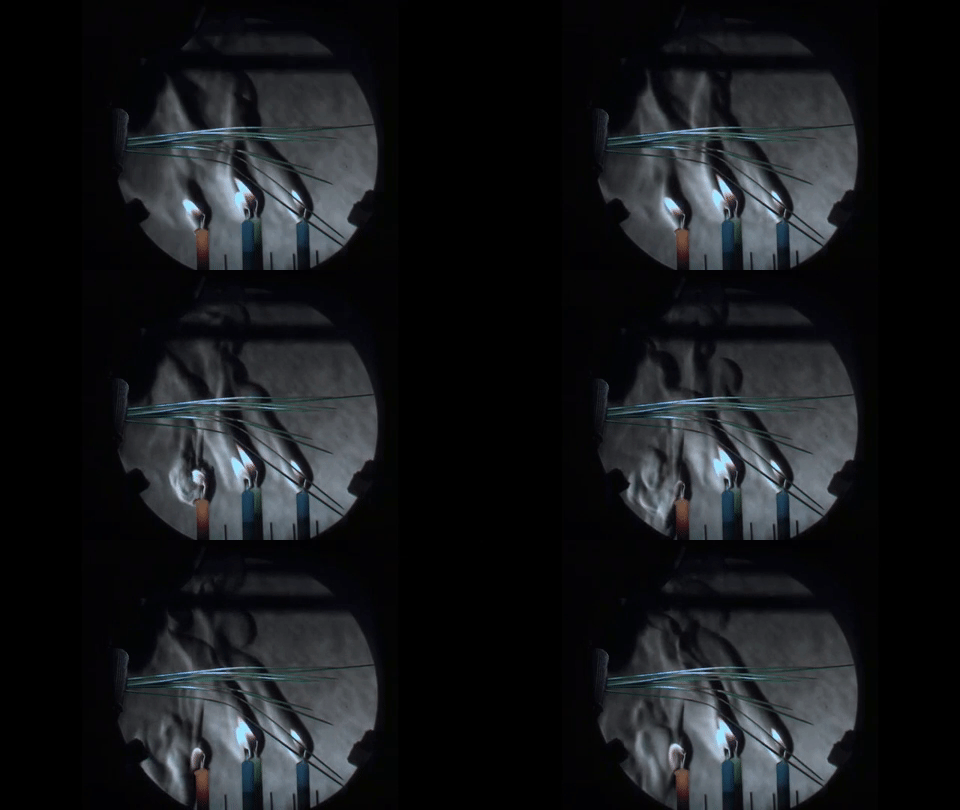
We are linking physics and field observations to understand the fluid dynamics of fire behavior surface fire regimes. Our work combines field observations using advanced thermal imaging techniques, laboratory studies, and coupled fire-atmospheric modeling to help managers improve outcomes of managed fire regimes.
Selected Publications authored by Wildland Fire Science staff.
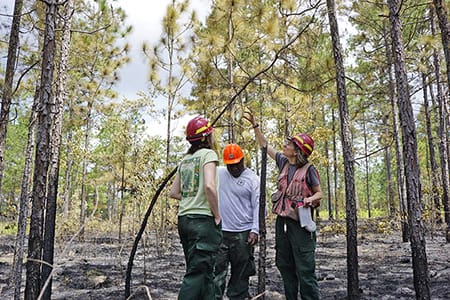
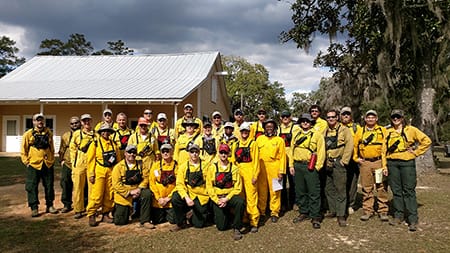
Staff and researchers support Federal fire training by serving as a cadre for NWCG training courses, ranging from basic wildland fire to advanced fire effects.
(PFTC) specializes in training fire fighters the principles and techniques of prescribed fire through practical hands-on experience. https://www.fws.gov/fire/pftc/
Private land owners are the largest source of prescribed fire in the country. These land owners and the culture of fire that was maintained by them during decades of suppression are a part of why Tall Timbers is a world-wide center for prescribed fire science. Workshops and fire training are a critical focus of the Longleaf Legacy Landscape Burn Team and our support of the Georgia Forestry Commission Prescribed Fire Center in Marion County.
The conserved lands of the Greater Red Hills region are found on working, income-producing properties that support agriculture, forestry, and recreational hunting. These properties contribute $272 million annually to local economies and support 2,300 jobs. [link to Planning & Advocacy section] The landowners’ strong stewardship ethic preserves their working lands while replenishing drinking water supplies, protecting water quality, and providing wildlife habitat for dozens of rare and endangered species. Tall Timbers’ conservation easements on these working properties encourage landowners to retain their traditional livelihood by keeping farms in family ownership.
Home to world-class wild quail populations, the Greater Red Hills region contains the largest concentration of gamebird preserves in the United States. These preserves also support the largest community of Red-cockaded woodpeckers on private lands. Indicators of high quality habitat found here include the gopher tortoise, Bachman’s sparrow, fox squirrel, and many amphibians. Tall Timbers’ conservation easements identify and protect the critical habitats of these species.
The region also boasts outstanding aquatic resources. Large river systems, like the Flint/Apalachicola, Ochlockonee, and Aucilla, flow from Georgia and feed into the Gulf of Mexico to support some of the world’s most productive estuaries. Large disappearing sinkhole lakes, like Iamonia, Miccosukee, and Jackson, provide habitat for an array of aquatic species and migratory birds. Tall Timbers’ conservation easements protect these vital watersheds and wetlands that are the lifeblood for the ecological health of the region.
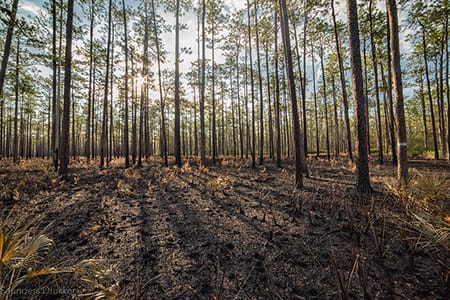
Once dominated by longleaf pine, our pine woodlands support abundant wildlife and local economies. These forests need prescribed fire to stay healthy. Herbert L. Stoddard and his associates Ed and Roy Komarek were pioneers in this emerging scientific field during the mid-20th century. Tall Timbers continues that legacy with applied research on prescribed fire and land management. Today, there is a tremendous need to expand prescribed fire use beyond the Red Hills to ensure ecosystem health and reduce wildfire risk. Additionally, Tall Timbers uses conservation easements to permanently protect private woodlands while balancing the need for economic return from selective timbering.