Looking for a gift for the hard-to-shop for person in your life or the herpetologist interested in one of the Southeast’s most iconic reptiles?
Then Diamonds in the Rough should be on your holiday shopping list.
Written by President Emeritus of Coastal Plains Institute and former Tall Timbers research director Bruce Means, Diamonds is the quintessential work detailing the life history of the Eastern Diamondback Rattlesnake.
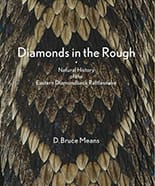 At 418 pages, Means coalesces 40 years of research into the largest cold-blooded terrestrial vertebrate and provides an in-depth look at the snakes’ habitat, seasonal activity, history and management recommendations accompanied by vivid photos of them in the wild.
Over 38 years, Means studied diamondbacks at Tall Timbers, Alligator Point in Franklin County, Florida, and Little Saint Simons Island in Georgia and added to what was a limited understanding of how these venomous reptiles live.
Means’ own run-in with a rattlesnake bite in 1993 led to the first chapters of this book being published and in 2017 it was published by Tall Timbers Press.
Diamonds however is more than an ecological look at the rattlesnake. It instead, is an ode to an epochal part of the southern pine forests, wrote author Joe Hutto in the book’s forward.
“If there is some living thing in the longleaf wiregrass ecosystem that would serve as an icon –some phenomenal animal certain to take your breath away again and again and again – that creature is surely the adult Eastern Diamondback Rattlesnake,” Hutto wrote. “Those of us who have lived closely and intimately with other animals realize just how complicated and even sophisticated is their behavior, life history and ecology. Deep immersion in another species’ natural history instills a much greater appreciation of its kind. A rattlesnake becomes much more than a dangerous threat to be loathed or killed. It is revealed as a complex work of living art well-adjusted to survive over eons in its particular environment.”
Bruce Means is the President Emeritus of Coastal Plains Institute and Land Conservancy. He is a courtesy professor of biological science at Florida State University, where he has taught courses on the ecology of upland, wetland, and coastal environments of the southeastern U. S.
He was research director at Tall Timbers from 1978-1984. Read more about Bruce
Diamonds in the Rough can be ordered online HERE