By Justin Rectenwald | Project Collaborators: Albany Quail Project, Livingston Place, Central Florida Rangeland Quail Program, Tall Timbers, Ichauway, Rolling Plains Quail Research Ranch, University of Georgia–GAME Lab, originally published in the Summer 2022 edition of Quail Call.
Over the last several years, there have been many discussions between quail managers, property owners, and biologists about how harvest rates may affect wild quail populations. As wise stewards of the resource, our goal should be to maximize hunting opportunity, while minimizing any potential negative impacts on the population. Historically, the idea of over-hunting or pressuring bobwhites has not been an issue, because they have relatively high densities and low harvest pressure.
While populations on large private properties remain high and stable, ownership demographics and the economics of quail hunting have changed slightly in recent years. It has become more common for quail properties to have multiple owners that all want their fair share of hunting days, or they are looking for ways to offset the operating costs by leasing days to other hunters. Both of these situations can lead to an increase in the number of days hunting, which could equate to higher harvest pressure. Tall Timbers and others in the past have developed the industry standard for harvest rates, which sits at 15% of the fall population.
However, the kicker is that the recommendation of 15% is supposed to include birds that are crippled and not recovered as well. While it is easy to figure out how many birds you bring back to the wagon, we do not have a firm grasp on how many birds are actually crippled, and end up dying days or weeks later. Many believe, based on observations, that the current ratio of harvested to crippled birds could be anywhere from 3:1 to 1:1 depending on hunter experience and or a variety of other factors. While a higher than perceived harvest rate may not be a cause of concern on most properties, it may be a limiting factor on properties that are already pushing the 15% recommendation.

Many believe, based on observations, that the current ratio of harvested to crippled birds could be anywhere from 3:1 to 1:1 depending on hunter experience and or a variety of other factors. While a higher than perceived harvest rate may not be a cause of concern on most properties, it may be a limiting factor on properties that are already pushing the 15% recommendation.
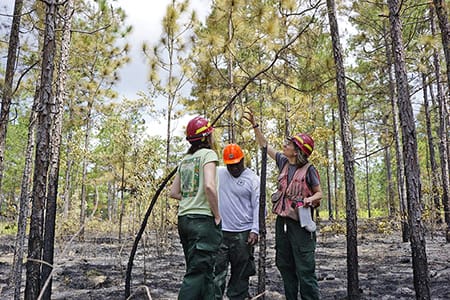
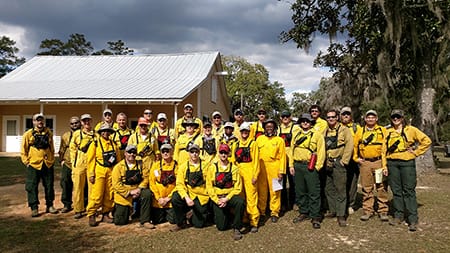
To determine the true crippling loss rate, Tall Timbers and the GAME Lab at the University of Georgia began a collaborative study that takes place on our primary study site in Albany, the Jones Center at Ichauway, Livingston Place, Tall Timbers, Escape Ranch in Central Florida, and the Rolling Plains Quail Research Ranch in Texas. Our staff of biologists and technicians tracked radio-tagged coveys during the hunts throughout this past season and recorded data on which coveys were shot into, the number of shots fired at each covey rise, the number of birds that were shot down and recovered, the number wounded that kept flying, and the number shot down and not recovered.
On the day after the hunt and 3–5 days later, we rechecked those same coveys in hopes of recovering whole, un-scavenged birds that were initially wounded during the hunt and later died as a result of their injuries. Our staff recovered whole birds on multiple occasions following hunts, and these birds were x-rayed and sent to have official necropsies performed to determine their actual cause of death. Figure 1 depicts several of these birds that were confirmed to have had lead shot in them by x-ray.
We will continue this study for the next few hunting seasons in hopes of providing a true estimate of crippling loss. We expect to see variations in the crippling loss rate, but we should eventually be able to determine how many birds are recovered, wounded, and lost for every 10 shots fired at the end of this study. While it will take multiple years of data collection to complete the study, our preliminary results indicate that for about every 2 or 3 birds picked up, there is another 1 that is crippled and not recovered. We will continue this study for the next several hunting seasons and will expand on the results and conclusions once we have a full understanding of the true crippling loss rate.