By Dr. Kevin Robertson, Fire Ecology Program Director
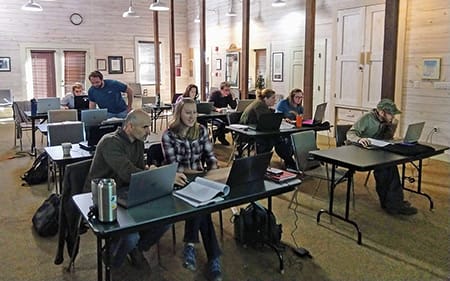
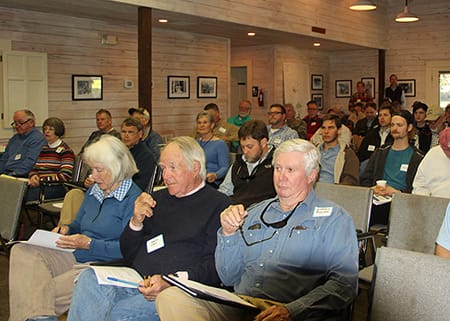
On February 7, the Fire Ecology Program, along with Florida A&M University, hosted a workshop called the "Wildland Fire Particulate Matter Emission Factor Workshop" in Atlanta to bring together many of the best and brightest air quality experts from around the country to discuss how well we measure our emissions from prescribed burns and wildfires. There were 34 participants at the workshop and another 30 participated by webinar.
The focus of the workshop was on "emission factors", which are little known but very important numbers that tell us how much pollution (such as particulate matter in smoke) is created per fuel consumed during fires. They are used by air quality agencies to develop emissions inventories, which have a big influence on air quality policy as it relates to prescribed burning. Also presented and discussed were a wide range of related topics, including estimating area burned, fuel loads, and fuel consumption at state and national levels, which are also important to developing emissions inventories.
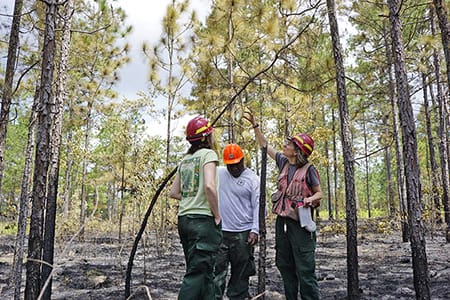
Glynnis Bugna (Florida A & M University) at left and Kevin Robertson (Tall Timbers), at right, measuring fire emissions on Tall Timbers Research Station. Photo by Timothy Molo.
One of the salient themes arising from the presentations and discussion was our relative lack of knowledge about how much organic soil (peat, muck) is consumed during fires, and how much particulate matter it produces. Fuel load maps have so far focused on surface fuels, such as vegetation and litter, and have largely neglected organic soil, which has to be monitored or modeled for water table fluctuation to know how much of it is available for consumption. Methods of estimating emission factors to date have also focused on surface fuel flaming combustion, while possibly missing the emissions that result from smoldering of organic soil and duff long after the flames have passed. Residual particulate matter from smoldering may also cause emission factors to be over-estimated using surface measurements because of accumulation of particulates close to the ground following fire.
It seems we have a lot to figure out, but the meeting and its upcoming summary document will steer us in the right direction for getting the right numbers on smoke produced from our fires.
The well managed pinewoods of our region serve as the winter homes of nearly 14 different species of sparrows. Much like many landowners of the region, these sparrows conduct their breeding season activities all across North America but then head our way starting in late October. The winter of 2011-12 will have to go down as one of the most unusual on several fronts.
Last winter was absolutely phenomenal for one of the rarest wintering sparrows we have. Henslow’s Sparrows have undergone tremendous declines in recent decades and are estimated to number as few as 100,000 total individuals. Using mark-recapture survey procedures on Arcadia, Elsoma, and Beechwood plantations, we typically find a density of 0.4 Henslow’s Sparrow per acre. This past year, we document a density of 8.5 individuals per acre on two of the study areas. We banded over 50 new individuals and recaptured 5 individuals banded in previous years on this sites. Late April burns coupled with drought conditions last year appeared to create very good conditions – tall flowering stalks with lots of seeds but with very little vegetation at ground level. One sparrow caught us by surprise when we realized it had lost the use of one of its eyes (photo below). Life can be rough, but animals also have methods for dealing with adversity.
Henslow's Sparrow pictures by Tara Tanaka
We also had some special sparrow stars make an appearance on Tall Timbers. Elliot Schunke and Matt Klostermann spotted a Green-tailed Towhee and Lark Bunting on the property one morning when they were out doing some nuthatch work. Both species occur out west and rarely show up this far east. A number of Green-tailed Towhees have been seen outside their normal wintering range this year, but the bunting drew crowds of birders to the property on a couple of special field trips that were organized (some driving over 300 miles in hopes of seeing the bird).
Lark Bunting photo by Elliot Schunke; Green-tailed Towhee photo by Matt Klostermann
At Tall Timbers, Louise Ireland Humphrey left behind a legacy of bricks and mortar and a beech-magnolia forest
By Rose Rodriguez, Information Services Manager
Louise Ireland Humphrey passed away March 18 at Woodfield Springs, her plantation home in Miccosukee, Florida. She was a longtime supporter of Tall Timbers, and although she had not been to the research station for many years, she left behind a legacy that remains in bricks and mortar and a beech-magnolia forest.
Louise Humphrey had many philanthropical interests that benefited from her time and talents – Tall Timbers is fortunate that its organization was one of them. From 1982 to 1998, Louise was an active member of the Tall Timbers Board of Trustees. In 1990, she became chairman of the Development Committee. As chairman, she was responsible for raising funds to sustain the organization through annual membership giving and to help it grow, which she did very successfully, raising more than $3.5 million during her tenure for capital improvements. Through her energetic efforts and strong character, funds were raised to renovate the Tall Timbers barn into the E.V. Komarek Science Education Center, and through a capital campaign to expand the Stoddard Research Laboratory into the Wade Research Center. By action of the Board of Trustees in 1998, the main lobby and exhibit hall are named in her honor. Under her leadership, the restoration of the Beadel House was completed, and, $1 million was raised from her Hanna family members to purchase the Anders property, an adjacent 679-acre parcel of beech-magnolia forest now known as Hanna Hammock. The purchase protected Tall Timbers at its western boundary from subdivision development. And finally, the Birdwatch Education Center on Gannet Pond was renovated in 1993-1994 with funds from Louise and her sister Kate Ireland, in memory of their Aunt Pansy, Elizabeth Ireland Poe. The original Birdwatch Center was designed by Betty Komarek and was a gift from Pansy Poe to Tall Timbers.
Until her retirement from the Board, Louise was the chairman of the Naturalists’ Ball, the annual “tails and tweeds” event that she hosted at Pebble Hill Plantation – the proceeds benefiting the Tall Timbers Foundation. The event has changed since then, but the tribute to her involvement remains as she has been named the honorary chairman of the Ball, even as she was no longer able to attend.
For her three terms as a commissioner with the Florida Game and Fresh Water Fish Commission and years of service to Tall Timbers, Louise was inducted into the Florida Wildlife Federation Hall of Fame in 2001. She was honored in 2006, at the Naturalists’ Ball, by her friends, family and the staff of Tall Timbers for her many years of support and service to the organization.
Louise was an avid sportswoman who loved wing shooting, dogs and horses. She bred Labrador retrievers and racing thoroughbreds; was an avid fox hunter; hunted rabbits with her beagle pack; and competed in hunt horse shows. And she loved witches; she had a witch’s broom at her entrance that stated whether, ‘The Witch is in’ or ‘The Witch is out’.
The “Witch” is out.
Cheryl Richardson, Henrietta Walter, Ebe Walter and Louise Humphrey at the 2002 Naturalists’ Ball.
Short course for prescribed burn certification in Florida offered
A prescribed burn certification course is being offered, August 27-29, as a 3-day classroom version of the correspondence course. The course is limited to experienced burners and students must have at least three broadcast (acreage) burns in their name to qualify for the class.
North Florida Community College in Monticello is hosting the August course. Registration information (which will be available in May) can be found on the calendar of events at www.FloridaForestService.com. For questions about the course, please contact John Saddler 850-488-9360 or John.Saddler@FreshFromFlorida.com.
For those of you who take notice of your monthly investment statements, 401K balances and retirement accounts, the past several years have been an up and down roller coaster full of anxiety and unknowns. Not-for-profit organizations all over the country have suffered greatly through the “great recession” that began in 2008, and the subsequent slow recovery. The few that have emerged unscathed have been the ones who have tightened their belts, trimmed expenses and planned accordingly for the future. In February 2008, Tall Timbers celebrated its 50th Anniversary just as the financial markets were beginning the downward spiral to depths that hadn’t been seen in over 10 years. It was at that time that Tall Timbers, with its Board of Trustees leading the way, embarked on a major fundraising effort – an Endowment Campaign – the likes of which we had never attempted before. We followed all of the best practices of Campaign Management 101. We hired outside counsel to help craft a plan; performed a comprehensive feasibility study to test our case statement; conducted face-to-face interviews with some of our most ardent supporters and kicked off the silent phase of the largest campaign in our history – right as the Dow Jones Industrial Average slipped below 8,000. What timing!
I’m not sure what’s harder – trying to raise money for an intangible concept like sustainable endowment funds or having to do it in the toughest financial times since the stock market crashed in 1987. Needless to say, we had a game plan and moved forward with our first solicitation in January 2008. Under the leadership and guidance of the Campaign’s Co-Chairs Daphne Wood and Tom Rankin, and our Development Director Vann Middleton, we hit the ground running in the silent phase of the campaign. In a few short months, we had received 100% Board participation in the campaign, and in the process we had suddenly raised several million dollars.
The goal of the campaign was to raise significant, long-term sustainable resources for the research, conservation and education programs at Tall Timbers. In Research, we needed help in the Fire Ecology Program to shore up significant resources to replace “soft dollar” funding from grant and project dollars. In Vertebrate Ecology, we needed core operating dollars to fully fund Jim Cox’s position and to add a core funded Research Technician to his program. The Game Bird Endowment Fund, by far the most fully endowed program, needed additional resources to reach a milestone number that could adequately fund the annual needs of long-term quail research on Tall Timbers’ Kate Ireland Model Quail & Conservation Area.
The Land Conservancy had 3.5 positions COMPLETELY funded by soft dollar grants and project funds. As the largest regional land trust in both Georgia and Florida, with over 115,000 acres of land in Conservation Easement at that time, we only had two staff members out of six that were funded through our operating budget. With 80+ easements to monitor every year, and with new prospects interested in putting conservation easements on their land, we desperately needed to secure permanent funding to get the work done.
Our 10-year strategic plan identified the need to create an Education & Outreach Coordinator position, whose primary role would be to help work with landowners and managers to implement the best practices identified by our long-term research. This would be a new program and the ONLY new position identified in our Campaign plan.
Surprisingly, as the financial markets continued to tumble throughout 2008 and into the early months of 2009, where they hit rock bottom, a funny thing happened. At face to face visits, the prospects we identified from our earlier study started to open up about their love of Tall Timbers and how important the organization was in their annual charitable giving plans. People were willing to tell us that even in the darkest of times, they were prepared to help seed our future with a lasting gift to our Endowment Campaign. Just as our current Endowment Funds were losing over 30% of their value in the choppy investment markets of 2008-09, our closest friends were making pledges and promises to right the ship for the long run.
At this past month’s Naturalists’ Ball, we publicly recognized for the first time, those 74 donors who stepped up to the plate and accepted our challenge. With their generous contributions, over $9 million was raised for Tall Timbers Endowments. This is a tremendous accomplishment and one of which we are very proud. As a result, Tall Timbers has remained fiscally responsible in tough times. These new endowment dollars have allowed us to accomplish the following:
Fund the Red Hills Land Use Planner position, and 50% of the Land Conservation Biologist
Fully funded a Fire Ecology Biologist position for the Fire Ecology Program
Created the Education and Outreach Program ahead of schedule, by hiring a PhD level wildlife biologist
Fully funded the Game Bird Scientist and Biologist
Provide much needed program capacity to all programs at Tall Timbers
Above all else, the results of the Campaign allowed us to operate efficiently and effectively. Additionally, we were able to accomplish all of this while dropping our annual operating distribution “draw” from our Endowment Funds from a high of 7% in 2003, to a much more sustainable 4.28% in 2012.
Who knows where we’d be right now, had our Board decided not to move forward with the campaign in 2008. In my mind, there is no doubt that Tall Timbers would be a skeleton of its current self. As luck would have it, the seeds are growing and our productivity is as high as it’s ever been. The future looks bright for Tall Timbers. While we are thrilled with the $9 million result of our efforts thus far, the distribution from these funds will not completely cover our goal of 30-40% of annual operating needs. Be on the lookout for future correspondence on how you can participate and join the select group of donors who have stepped up for the future of Tall Timbers.
Thanks to all who helped plan, implement and gave to the Endowment Campaign. You have planted a foundation from which Tall Timbers can continue to grow and prosper in the years to come.
The M-CORES program, which includes the proposed Suncoast Connector Toll Road in Jefferson County, passed through the Florida Legislature at breakneck speed with little review or analysis. Tall Timbers has a number of concerns given the potential for significant and wide spread impacts. These include fragmenting public and private conservation lands, robbing business from Main Street Monticello, impacting our rivers and other water resources, and making prescribed fire more difficult and costly.
Join us in asking the Jefferson County Board of County Commissioners to OPPOSE the Suncoast Connector toll road and its path through Jefferson County.
Take action now with our easy email form.
Send an email to all five Jefferson County Board of County Commissioners with one click!
Burn prioritization modeling seminars and fire modeling tools are supported by Wildland Fire Science to train managers in the important planning stages of prescribed fires.
Educating and guiding the next generation of fire researchers and managers is a key goal of Wildland Fire Science and a resource for testing new ideas in fire research.
Tall Timbers hosts the premier fire technology transfer organization—the Southern Fire Exchange. This JFSP funded effort helps connect research to management through webinars, workshops, and support of the Prescribed Fire Science Consortium.
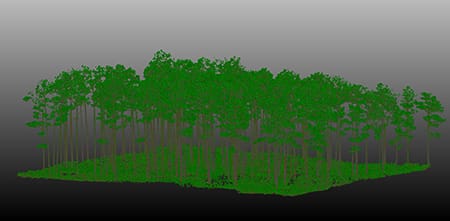
Working with partners in the Prescribed Fire Science Consortium, the program is building nexgen 3-D fuel beds using terrestrial LiDAR and novel sampling techniques to power new fire behavior models for prescribed fire managers. This work links to Tall Timbers work in wildlife habitat usage and ecological forestry.
The Longleaf Legacy landscape prescribed fire burn team arm of Wildland Fire Science works directly with landowners and partners to effectively put fire on the ground and promote prescribed fire throughout the region.
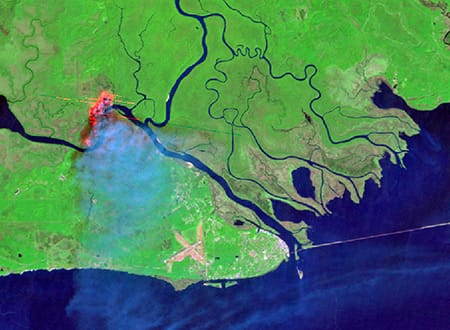
Tall Timbers is leading an effort to map fire regimes at the landscape scale. Staff work with numerous agencies to evaluate fire records and satellite imagery to build this critical conservation database. https://skfb.ly/6DqOY
Tall Timbers hosts the Prescribed Fire Science Consortium, a national network of researchers and managers who promote integrated research and management to advance next generation tools for fire practitioners. https://arcg.is/1DSjDT
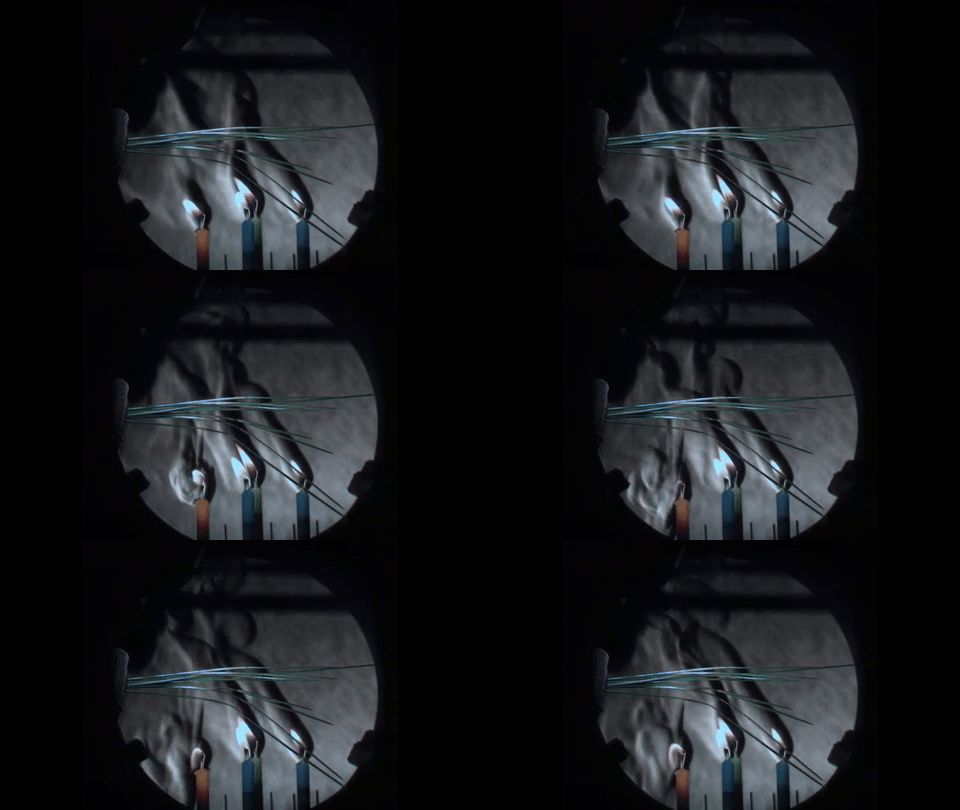
We are linking physics and field observations to understand the fluid dynamics of fire behavior surface fire regimes. Our work combines field observations using advanced thermal imaging techniques, laboratory studies, and coupled fire-atmospheric modeling to help managers improve outcomes of managed fire regimes.
Selected Publications authored by Wildland Fire Science staff.
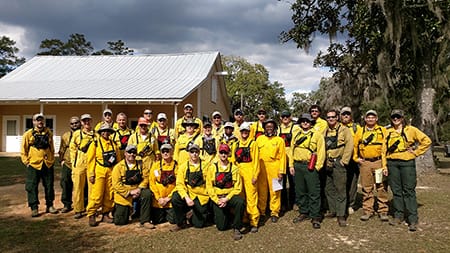
Staff and researchers support Federal fire training by serving as a cadre for NWCG training courses, ranging from basic wildland fire to advanced fire effects.
(PFTC) specializes in training fire fighters the principles and techniques of prescribed fire through practical hands-on experience. https://www.fws.gov/fire/pftc/
Private land owners are the largest source of prescribed fire in the country. These land owners and the culture of fire that was maintained by them during decades of suppression are a part of why Tall Timbers is a world-wide center for prescribed fire science. Workshops and fire training are a critical focus of the Longleaf Legacy Landscape Burn Team and our support of the Georgia Forestry Commission Prescribed Fire Center in Marion County.
The conserved lands of the Greater Red Hills region are found on working, income-producing properties that support agriculture, forestry, and recreational hunting. These properties contribute $272 million annually to local economies and support 2,300 jobs. [link to Planning & Advocacy section] The landowners’ strong stewardship ethic preserves their working lands while replenishing drinking water supplies, protecting water quality, and providing wildlife habitat for dozens of rare and endangered species. Tall Timbers’ conservation easements on these working properties encourage landowners to retain their traditional livelihood by keeping farms in family ownership.
Home to world-class wild quail populations, the Greater Red Hills region contains the largest concentration of gamebird preserves in the United States. These preserves also support the largest community of Red-cockaded woodpeckers on private lands. Indicators of high quality habitat found here include the gopher tortoise, Bachman’s sparrow, fox squirrel, and many amphibians. Tall Timbers’ conservation easements identify and protect the critical habitats of these species.
The region also boasts outstanding aquatic resources. Large river systems, like the Flint/Apalachicola, Ochlockonee, and Aucilla, flow from Georgia and feed into the Gulf of Mexico to support some of the world’s most productive estuaries. Large disappearing sinkhole lakes, like Iamonia, Miccosukee, and Jackson, provide habitat for an array of aquatic species and migratory birds. Tall Timbers’ conservation easements protect these vital watersheds and wetlands that are the lifeblood for the ecological health of the region.
Once dominated by longleaf pine, our pine woodlands support abundant wildlife and local economies. These forests need prescribed fire to stay healthy. Herbert L. Stoddard and his associates Ed and Roy Komarek were pioneers in this emerging scientific field during the mid-20th century. Tall Timbers continues that legacy with applied research on prescribed fire and land management. Today, there is a tremendous need to expand prescribed fire use beyond the Red Hills to ensure ecosystem health and reduce wildfire risk. Additionally, Tall Timbers uses conservation easements to permanently protect private woodlands while balancing the need for economic return from selective timbering.


 Louise Ireland Humphrey passed away March 18 at Woodfield Springs, her plantation home in Miccosukee, Florida. She was a longtime supporter of Tall Timbers, and although she had not been to the research station for many years, she left behind a legacy that remains in bricks and mortar and a beech-magnolia forest.
 Until her retirement from the Board, Louise was the chairman of the Naturalists’ Ball, the annual “tails and tweeds” event that she hosted at Pebble Hill Plantation – the proceeds benefiting the Tall Timbers Foundation. The event has changed since then, but the tribute to her involvement remains as she has been named the honorary chairman of the Ball, even as she was no longer able to attend.
 A prescribed burn certification course is being offered, August 27-29, as a 3-day classroom version of the correspondence course. The course is limited to experienced burners and students must have at least three broadcast (acreage) burns in their name to qualify for the class.