by Tall Timbers | Oct 25, 2018 | September 2014 | Vol 7 | No 3
4th Annual Places You’ve Never Herped Event at Dixie Plantation
By Kim Sash, Conservation Biologist
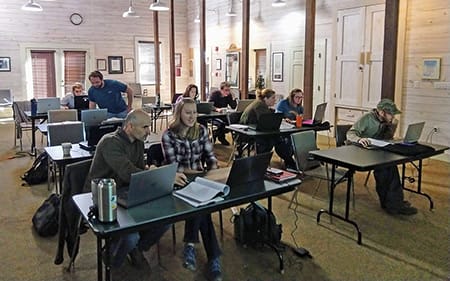
On April 26 and 27, the Orianne Society held their fourth annual Places You’ve Never Herped Event. Tall Timbers Research Station & Land Conservancy hosted the event at Dixie Plantation in Jefferson County, Florida. For the event, Tall Timbers partnered with the Orianne Society to start documenting the herp-to-faunal (reptiles and amphibians) species on Dixie Plantation. The Orianne Society is a non-profit organization focusing on conservation of imperiled snakes around the world. Each year the Orianne Society puts on the Places You’ve Never Herped event and advertises for a limited number of slots on their website (www.oriannesociety.org). After the event was posted this year, the 35 slots available filled up in less than three hours. Due to demand, we added an additional seven spots that were also filled that day.
A diverse group of people attended the event from all over the southeast; the oldest person was in their 60s and the youngest was a 9-year old aspiring herpetologist. The Orianne Society took care of the logistics for the event with help from Florida Fish and Wildlife Conservation Commission employees who provided team leaders for both days of “herping” (looking for reptiles and amphibians). We divided into four teams and over the course of two days checked traps and did a lot of hiking through the various habitats on Dixie Plantation. On Saturday night the group was enlightened by two presentations, one by herpetologist, Pierson Hill on rare amphibians of the Florida Panhandle; I gave the other presentation on Tall Timbers Land Conservancy’s conservation efforts in the Red Hills.
At the end of day two, there were a bunch of muddy, wet and blistered folks on Dixie Plantation. We counted all the species we caught and produced a species list. A total of 55 species were found over the two days of searching, the most ever found for a Places You’ve Never Herped Event! A few of the standouts included the dwarf and lesser sirens (similar to a salamander, but without legs), a gopher tortoise hatchling, pine woods tree frogs and mud snakes. We also found a few pinewoods snakes, which had not been documented in Jefferson County since the 1980s. The group also got a county record finding the first black swamp snake ever recorded in Jefferson County. After the list was compiled, the Orianne Society gave out several prizes to individuals for the most amphibian/reptile species found, the largest snake found, the prettiest turtle, and the smallest salamander found.
Overall, it was a very fun weekend and several people saw species they had never seen before. The event could not have gone as smoothly as it did without the collaborative effort of the Orianne Society, Tall Timbers, and the Florida Fish and Wildlife Conservation Commission; the fine crew at Dixie Plantation contributed to the success. If you would like to join the Fifth Annual Places You’ve Never Herped Event, go to the Orianne Society webpage (www.oriannesociety.org) and become a member.
by Tall Timbers | Oct 25, 2018 | September 2014 | Vol 7 | No 3
Thomasville Regional Airport expansion and the Aucilla River
By Neil Fleckenstein, Land Conservancy Planning Coordinator
Tall Timbers’ conservation easements protect many treasured resources in the Red Hills. The Aucilla River, a winding, spring-fed blackwater river is one of the most important. In addition to protecting miles of river frontage, Tall Timbers’ easements conserve over 44,500 acres of habitat in the Aucilla River basin. The river’s humble beginning near the Thomasville Airport belies the ecological, recreational, and historical importance of this regional resource. Its wildlife diversity, scenery, freshwater springs, and brief stretches of whitewater make it extremely popular with paddlers. Some of the most significant archaeological discoveries in the southeastern Unites States have occurred along the river. For these reasons, the Aucilla is designated as an Outstanding Florida Waterbody by the state of Florida.
The Aucilla River and the Thomasville Regional Airport—two seemingly unrelated proper nouns—share something in common: real estate. The Aucilla River begins approximately six miles northeast of Thomasville, near the airport’s main runway. The City of Thomasville is proposing to extend the length of that runway by 1,000 feet to better accommodate the class of business jets that currently use the airport. Due to the short length of the existing runway, departing aircraft currently are weight restricted on takeoff and often must make an added refueling stop to reach their destination. City officials note that providing adequate runway length is an integral component in meeting the present and future needs for business and recreational travel for the community and the Red Hills Region.
Tall Timbers is well aware and supportive of the vital role the airport plays in the local and regional economy, our transportation infrastructure, and way of life for the seasonal and year round residents of the Red Hills Region. Tall Timbers planning staff have met with City officials, airport consultants, and other interested parties and provided recommendations for moving forward with this project, while also protecting the headwaters of the Aucilla River.
In comments provided for the official permit record, Tall Timbers recommended that during the construction period, the City strictly adhere to all National Pollution Discharge Elimination System (NPDES) construction permit requirements related to erosion, sedimentation, and stormwater management. We asked that the City place particular emphasis and added protection during the height of summer storm season when heavy rain events could wash enormous amounts of sediment into Lost Creek, an important tributary of the Aucilla River. We also requested, in the likely event the City applies for and receives a variance to Georgia’s 25 foot minimum vegetative buffer zone for state waters, that the City use extreme care and all appropriate structural and non-structural management techniques to ensure the Aucilla River and its tributaries are protected from harm.
Tall Timbers also noted that the City’s preferred option for expanding the runway will result in the loss of 5.75 acres of wetlands and more than 26 acres of forestlands that buffer, filter, treat, and cool stormwater that leaves the airport, enters Lost Creek, and eventually discharges into the Aucilla River. We urged the City to go beyond traditional best management practices for treating stormwater from the airport. We recommended evaluating a range of structural and nonstructural practices to most effectively manage stormwater rate and volume and improve stormwater quality before it enters Lost Creek.
Finally, we noted that the airport runway extension will affect Lost Creek Forest, a publically accessible forest conserved through a collaborative effort involving Thomasville, Thomas County and many Red Hills residents. Tall Timbers recommended that the City develop an “interested parties” list to regularly communicate project progress and other relevant information to the public. This would be a prudent step given the potential for this project to impact Lost Creek/Lost Creek Forest and the Aucilla River, two publicly accessible recreational sites. Providing regular updates on the status of the airport construction project on the City’s website and other social media platforms will also improve communication with the public about an important project that should receive more public attention and scrutiny.
Tall Timbers believes this project can be completed in a manner that achieves the goal of enhancing the performance of the airport for its many customers while simultaneously protecting the regionally important Aucilla River and its tributaries. To do so will require that the City exceed minimum standards of protection and opt to aggressively protect vital Red Hills’ natural, scenic, and recreational public resources. We look forward to working with the City as this project moves forward.
Should you have any questions about this issue, please contact Neil Fleckenstein at 850-893-4153, ext. 335.
Protection of the Aucilla River and its watershed is a high priority for the TTLC. Photo by Richard Lenz
by Tall Timbers | Oct 25, 2018 | September 2014 | Vol 7 | No 3
Tall Timbers Endorses Florida’s Amendment 1
Tall Timbers joins other leading conservation organizations in endorsing the Florida Water and Land Conservation Initiative, Amendment 1 on the November 4, 2014 ballot. The purpose of the Amendment is to provide a stable, dedicated funding source for the acquisition of land or purchase conservation easements. The measure, if approved by voters would dedicate 33 percent of net revenues from the existing excise tax on documents to the Land Acquisition Trust Fund for 20 years. The Fund would be able to acquire, restore, improve, and manage conservation lands including lands protecting water resources and drinking water sources, forests, fish and wildlife habitats, recreational trails and parks, rural landscapes including working farms and ranches. The Tall Timbers Board recommends that where appropriate, these conservation and recreational lands should include opportunities for hunting on public lands.
Allison DeFoor, former advisor to Gov. Jeb Bush, remarked “Without pristine waters and unspoiled landscapes, Florida will lose the special appeal that has fueled our growth and prosperity…Amendment 1 ensures that our state dedicates adequate dollars into the most essential of public goods- protecting our waters and conserving our lands; it “lives within our means” by ensuring that taxes aren’t raised to do so; and it provides an earnest return on investment for generations to come…”. Tall Timbers urges its supporters to VOTE YES on AMENDMENT 1.
For more information on Amendment 1 go to: http://www.voteyeson1fl.org/
by Tall Timbers | Oct 25, 2018 | September 2014 | Vol 7 | No 3
Another Option for Feral Hog Control – Aerial Gunning
By Eric Staller, Natural Resources Manager
We had a great turnout at the last Land Managers Lunch, which was sponsored by Jager Pro. Jager Pro discussed their system of trapping for feral hog management. I would also like to make sure that you know about USDA/APHIS Wildlife Services, and their option to help manage your hog problems.
USDA/APHIS Wildlife Services acknowledges that it will take a combined, coordinated effort from us all to get a handle on the feral swine situation and reduce damage. Wildlife Services can now provide aerial gunning service to help remove feral hogs and aid in reducing feral hog damage. Like any method, aerial gunning has its limitations. However, it can be a valuable tool to accompany trapping and selective shooting. If you have any questions or would like to hear more about the aerial gunning program, please contact:
Luke Harvard
USDA Wildlife Specialist
(229) 403-2263
luke.b.harvard@aphis.usda.gov
I am soliciting ideas/topics you would like to have discussed at future lunch programs. Please email eric@ttrs.org with any ideas, or call 850-893-4153 x240.Thank you.
by Tall Timbers | Oct 25, 2018 | September 2014 | Vol 7 | No 3
Invasive Grass Control in Upland Pine Forests
By Eric Staller, Natural Resources Coordinator
Bahia and Bermuda grass are invasive, exotic, sod forming grasses which develop into low-quality habitat for bobwhite and other wildlife. Due to past land management practices, predominantly disking, mowing, chopping and thinning, sod forming grasses planted to hold roads have been able to invade the uplands jeopardizing the quality of ground cover. On many landscapes native grasses are preferred since they are the primary fuels carrying the frequent fires necessary to provide quality wildlife habitat. Therefore, the goal of recent research at Tall Timbers was to find the best methods to eliminate sod forming grasses from upland habitats.
The main focus of the research was to determine the best selective herbicide or combination of herbicides that specifically controls the problem sod-forming grasses and still allows the preferred native grasses and beneficial weeds to reestablish in the treated areas. In a perfect world we would like to mow or burn the area in the spring and then apply herbicide about a month later when the grass has re-sprouted and prior to seed head maturation to minimize the future seed source. However, in most established areas the seed source already exists so the application of herbicide can take place under the right conditions when time allows. The appropriate conditions for herbicide applications should occur when plants are actively growing and drought conditions should be avoided. Most importantly for applications to be fully effective apply a minimum of 30 minutes before a rain, this allows time for the herbicide to dry on the plant.
A total of 26 different treatments utilizing 8 different herbicides with multiple combinations, and concentrations were tested. Treatments were applied during June – August 2013, on three sites in Leon and Jefferson Counties in Florida. All treatment areas were surveyed using GPS, and photo points were taken prior to spraying, at 2-months post spraying, and at 1-year post application to determine efficacy of Bahia/Bermuda control and negative impacts on native grasses and forbs. All treatments were sprayed via a tractor and boom-less sprayer with 28-36 gal H2O and 21-32 oz non-ionic surfactant/acre. The common label for Sethoxydim is Poast®, and can be used; however Poast® has a higher percent active ingredient then the Sethoxydim SPC® we used, so the rates will be lower.
The following herbicide treatments showed the best one year control (>80% of target grass was killed):
Bahia – The best herbicide/combinations included:
- Metsulfuron (Escort® @1.5-2oz/acre), or
- Sethoxydim (Sethoxydim SPC® @24-34 oz/acre), or
- Metsulfuron + Aminopyralid (Opensight® @1.6 – 3.5 oz/acre), or
- Imazaquin (Septor 70 DG® @ 5oz/acre)
Adding Imazapic (3.2-13oz Plateau®) to any of these options increased Bahia control by inhibiting seed germination.
Bermuda – The best herbicide/combination included:
- Sethoxydim (Sethoxydim SPC® @ 34 oz acre), or
- Clethodim (Intensity 1® @ 44oz/acre), or
- Adding Imazapic (3.2-13oz Plateau®) to any of these optionswill increase Bermuda control by inhibiting seed germination.
Bahia & Bermuda – The best herbicide/combinations included:
- Sethoxydim SPC® @ 34oz/acre, or
- Escort® @1.5-2oz/acre + Sethoxydim SPC® @24-34 oz/acre, or
- 13oz Plateau®+2oz Escort®+44 oz Intensity 1®
The three herbicides that were NOT EFFECTIVE in controlling sod-forming grasses include:
- Clethodim (Intensity 1® @ 15-36 oz/acre)
- Imazaquin (Septer 70 DG® @ <3 oz/acre)
- Metsulfuron (Escort® treatment containing < 1.3oz acre)
Bahia grass has a few more control options than Bermuda, and they all can be purchased without a pesticide applicators license. The selectivity was very similar between the successful Bahia treatments; virtually all the native grasses were retained while different treatments controlled a slightly different suite of forbs.
Septor 70 DG® @ 5oz/acre, and Opensight® @1.6-3 oz/acre worked well on Bahia, but also negatively affected many natives such as Goat’s rue (Tephrosia spicata), Sensitive briar (Mimosa quadrivalvis), and quality quail plants such as Lespedeza, Partridge pea (Cassia fasculata), Beggars lice (Desmodium sps), and Ragweed (Ambrosia artemisiifolia).
Sethoxydim SPC® @34 oz/acre had >90% control, and also controls nut grass, while not controlling the beggars lice, lespedeza, rag weed, partridge pea, Goat’s rue and sensitive briar.
An important lesson learned from this experiment is thorough inspection of a site is needed before herbicide application takes place; you need to identify your target species. Our experience at Tall Timbers suggests that Bermuda is often mixed in with the Bahia, and goes unnoticed until it is released. The recognition of both species of sod forming grass will be treated differently than if just one species existed.
Further testing will be conducted using different concentrations of Sethoxydim SPC®, and Sethoxydim SPC® + Plateau®, as that mixture suggests high control of both Bahia and Bermuda while minimizing impacts to important forbs. Imazapyr (Arsenal®) is a viable alternative to control Bahia and Bermuda, however, it is extremely hard on most grasses, and due to its soil activity cannot be sprayed under desirable hardwood species. Bermuda controllers include Sethoxydim SPC® @ 34oz/acre, and Clethodim @ 44oz/acre, which we tested, and Imazapyr and Fuazifop which we did not. Both Clethodim and Fuazifop do require an applicator license. While the 13oz Plateau®+2oz Escort®+44 oz Intensity 1® treatment did control >90% of Bahia and >80% Bermuda, it controlled too much of the beneficial vegetation leaving the ground barren and therefore is not a suggested control based on our goals.
Based on our current research and objectives at this time we recommend:
Bahia grass control – Sethoxydim SPC® @ 24-30 oz/acre or Metsulfuron @ 2-3.5oz/acre
Bermuda grass control – Sethoxydim SPC® @ 30-34 oz/acre
To minimize germination – Plateau® @ 4-6oz/acre can be added to either chemical