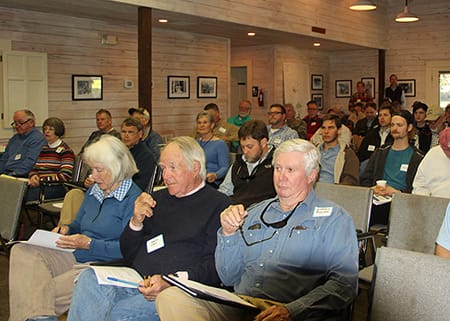
It’s time to give credit where credit is due. If it were not for conservation-minded private landowners throughout the country, we would have far less wildlife. And that wildlife includes birds.
In Florida and Georgia, private lands make up the majority of both states (79% and 90.3%, respectively). Many of these lands, such as shopping malls and golf courses, are unsuitable for many declining bird species. However, millions of acres of private lands in both states are conducive to these species and, in many cases, are the deciding factor in whether or not populations can persist in an area over the long term.
With this in mind, the Tall Timbers Land Conservancy is working to empower conservation easement landowners to document the birds that occur on their properties. Tall Timbers applied for a Cornell Lab of Ornithology grant to help them achieve this goal. They have partnered with the Alachua Conservation Trust and Conservation Florida, as well as with four Audubon chapters, to link Audubon volunteers with private landowners. The idea is to have solid birders from Audubon chapters teach landowners how to identify birds and use eBird to record what they see throughout the year. Land trusts like Tall Timbers often visit properties only once per year to conduct easement monitoring visits and, even then, often are not recording every bird species that they see. Helping landowners fill in the who, when, and where for different bird species in places where surveys rarely, if ever, occur could help to augment the efforts of ornithologists.
You may be wondering what this project looks like in practice. Well, the bottom line is that it’s been a lot of fun for all involved. Tall Timbers staff have conducted four landowner visits so far in partnership with Apalachee Audubon. At Hays Cummins’ and Donna McCollum’s property, participants got to watch hundreds of wading birds fly over their heads to a wetland roost at sunset. Helen and Tom Roth’s property offered the chance to see habitat restoration in action on a beautiful landscape, with a flock of gorgeous (and uncommon) purple finches providing icing on the cake. Serenading grasshopper sparrows at sunset rounded out a visit to Annie Schmidt’s property, that had already included steephead ravines, a waterfall, and salamanders. Guy Anglin and Jan Blue’s property visit resulted in great looks at a vesper sparrow, a northern harrier, bald eagles, and nesting red-headed woodpeckers.
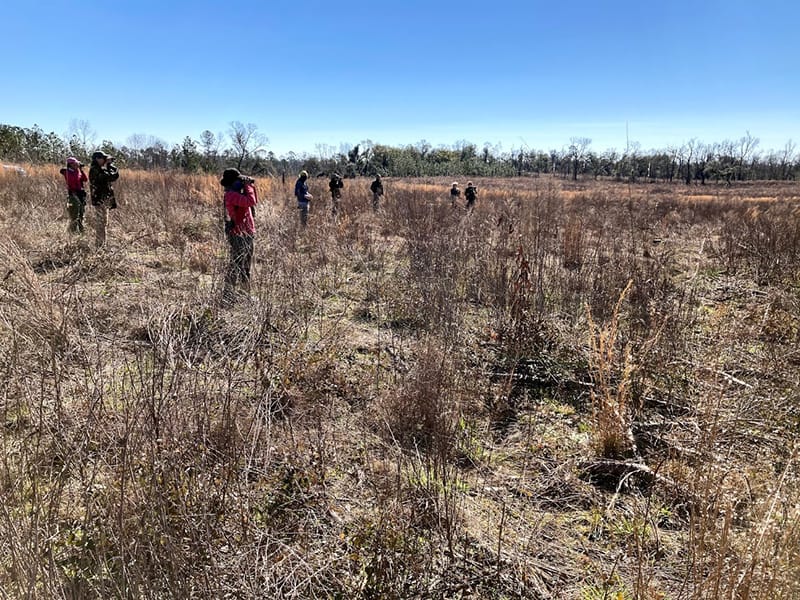
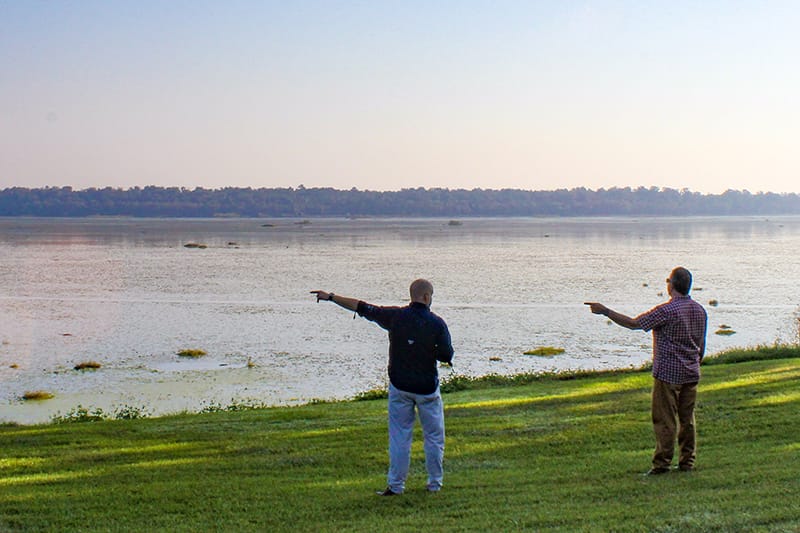
AAS volunteers and Tall Timbers staff scanning the ephemeral wetland owned by Hays Cummins and Donna McCollum.
Hays Cummins, who with his wife, Donna, owns the wading bird rookery mentioned above said, “It was a great day of fellowship and experiencing the many natural wonders of this region of Florida. It was so invigorating to be with people whose passions for the environment matched ours. Strong partnerships like this give us hope for the future of the region.”
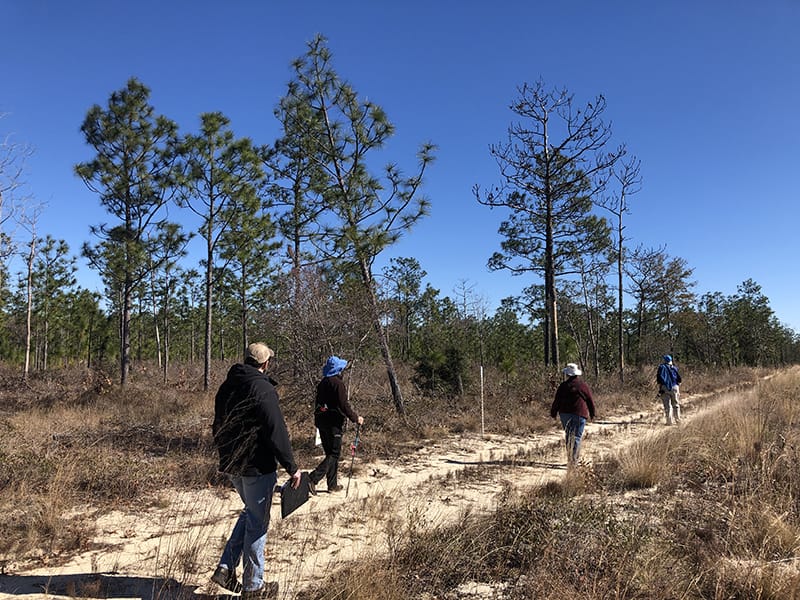
Birding in the restored longleaf pine savanna on Helen and Tom Roth’s property.
Apalachee Audubon volunteers posing by a waterfall on Annie Schmidt’s property.
Staring at a vesper sparrow found in a field on Guy Anglin and Jan Blue’s property.
The visits offer opportunities for Audubon members to learn more about habitat management, see the benefits of conservation easements firsthand, and experience spectacular natural habitats that they would probably never experience otherwise. They offer landowners the chance to deepen knowledge of their property and the species that occur within it, and maybe even introduce them to a new hobby.
With new birds arriving soon from places further south and more landowners showing interest in getting involved, the prospects of this project look promising. If you are interested in getting involved with the project, please contact Peter Kleinhenz.
Burn Team provides novel approach to expanding private lands prescribed fire use
The Tall Timbers Burn Team fills a valuable niche that directly aids in the use of fire on private lands. This is a small, well-trained unit that engages, educates and assists landowners to apply more fire on their land. In its first two years, the Team has already worked with hundreds of landowners across thousands of acres in Florida, Georgia, and Alabama.
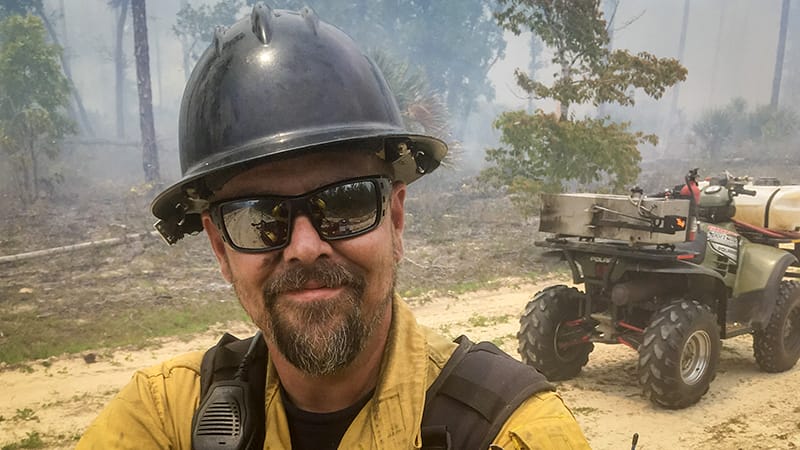
Jeremiah Cates, Private Lands Prescribed Fire Coordinator, conducts a prescribed fire on private lands.
The Burn Team was established within the Tall Timbers Private Lands Prescribed Fire Project as part of a focused effort to deliver science-based technical guidance to private landowners in the areas of risk management, prescribed fire planning and implementation, smoke management, and burn prioritization. The Burn Team approach is different from most technical assistance programs because they are ready to actually burn on your property.
There is no one recipe for all landowners. Assistance may mean helping the landowner find a qualified burn vendor. Or assistance may mean helping the landowner through the process of burning their land themselves. In cases where a burn vendor cannot be found, or the landowner is not able to burn themselves, the Team may conduct the burn for the landowner to help return fire to the landscape. Reducing fuels by returning fire to unburned areas can also help position the property for less complex prescribed fire use in the future.
Landowners have been impressed. A Pike County, Alabama owner wrote, “I have been around a few burns in my lifetime; however, I must stop and tell you the job the Tall Timbers bunch did for me was just short of remarkable. They were so far ahead on production, knowledge, equipment, and any other aspect of a burn that it’s hard for me to even describe.” Another couple from Calhoun County, Florida who suffered significant losses to Hurricane Michael in 2018 shared their gratitude and indicated that “Not only did they assist with the site preparation (burring for replanting), they also expanded our education in fire behavior.”
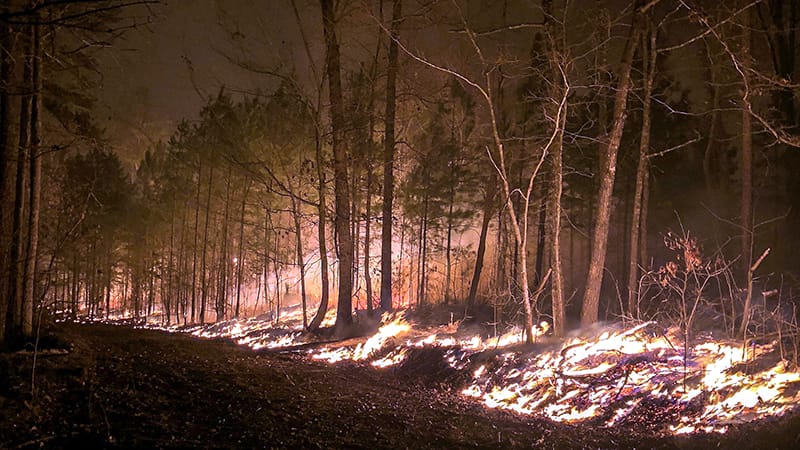
Private landowner Katherine Eddins of Cherokee County, Alabama shared an image of a prescribed burn on her property as it moved into the evening. Burn support was provided by Tall Timbers.
Annual membership gifts to Tall Timbers help support the Burn Team, along with grants and contracts. Private donations help support the overall organization and allow for continued outreach to landowners seeking prescribed fire services. To learn more about the Tall Timbers Private Lands Prescribed Fire Project or to donate, visit https://talltimbers.org/land-management-private-lands-prescribed-fire-project/
National Prescribed Fire Training Center moves to Tall Timbers
Cooperation between Tall Timbers and the National Interagency Prescribed Fire Training Center (PFTC) just took a huge stride forward. PFTC is now located at Tall Timbers. The offices and equipment previously located on the grounds of the Tallahassee Airport have been moved to their new home on the Tall Timbers’ campus.
The advantages for both organizations are clear. Trainees that attend PFTC sessions will benefit from exposure to Tall Timbers research, as well as the state-of-the-art land management practiced onsite. Tall Timbers will gain further opportunities to help deliver fire science through training, additional national presence as the home of the National Prescribed Fire Training Center, and added prospects for collaborating on projects. For example, Tall Timbers and PFTC have already started working together to produce a training video on techniques for ignitions in southern pinewoods.
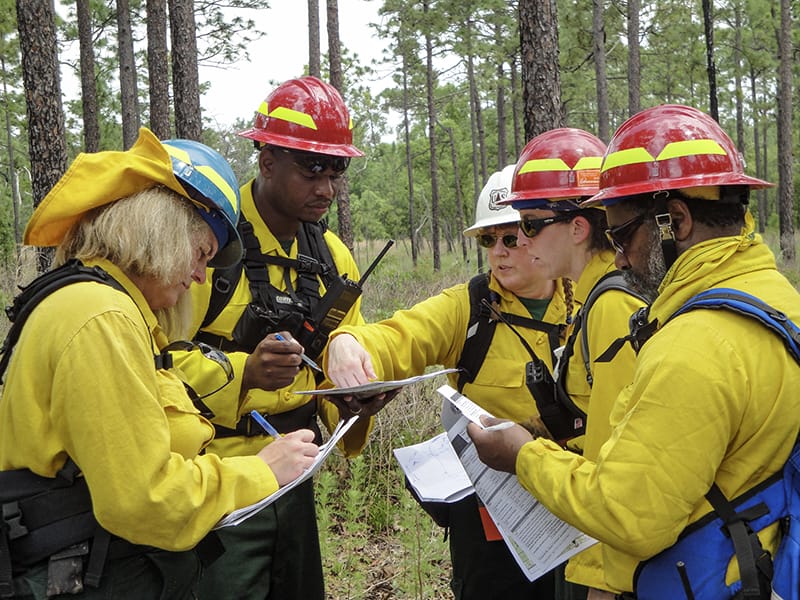
PFTC agency administrators planning a burn.
Tall Timbers and PFTC have a long history of cooperation. When the Center started in 1998, Tall Timbers was one of the earliest organizations to offer support and training for PFTC’s attendees. Since its inception, PFTC has hosted students from across the country and globe to come to the southeastern US to learn about and experience prescribed fire. There have been attendees from 49 of the 50 states (still waiting on that student from Rhode Island), and 18 foreign countries − from Australia to Trinidad.
Today, PFTC holds five 20-day training sessions for fire practitioners, and two 6-day workshops for Agency Administrators such as Refuge Managers, Park Superintendents, and National Forest District Rangers to learn about managing or building an active prescribed fire program. The Center is also engaged in international training, most recently in Australia, Portugal and Mexico.
PFTC Resource Specialist Workshop planning a project
To learn more about the National Interagency Prescribed Fire Training Center visit https://www.nafri.gov/pftc
Good Quail Hatch and Excellent Male Incubation—a Prelude to Good Fall Bird Numbers
By Theron M. Terhune
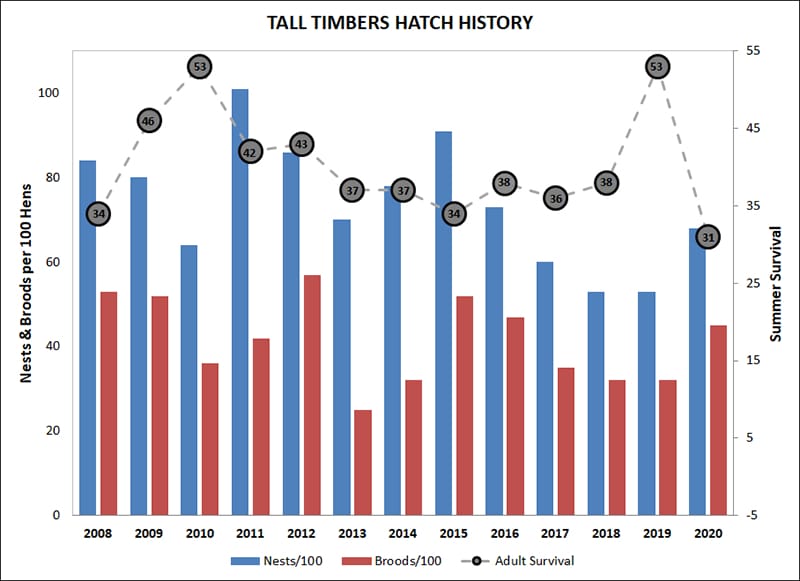
The hatch results are in and they are good—no recount needed! Overall, bobwhite per capita nest and brood production in the Red Hills were moderately above average this year, compared to our historical records. Much of the hatch came from the early (May/June) and mid (July/Aug) season points, with a moderate contribution from the late (Sep/Oct) season hatch. However, adult bobwhite survival in the Red Hills was well below our long-term average.
In contrast to last year, cotton rat numbers seemed to dwindle throughout the breeding season this year, and attrition of our radio-tagged birds paralleled this pattern—adult survival decreased as cotton rat numbers decreased. In fact, this is the lowest adult survival we have seen in the Red Hills over the past 15 years. That said, 2 additional factors provide reason for optimism heading into the 2020–21 hunting season in terms of bobwhite abundance: (1) chick survival and (2) male incubation.
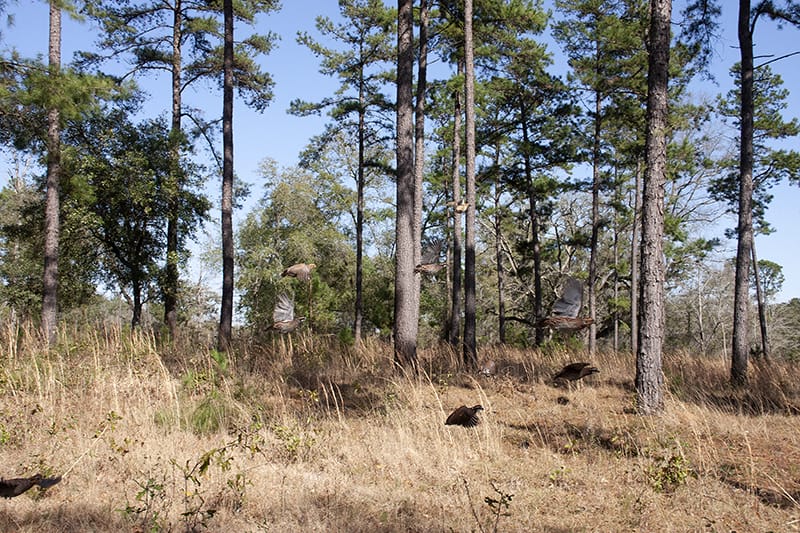
Despite a lot of snake activity, and high loss of bobwhite chicks to snakes this year, overall bobwhite chick survival remained above average; this was evident in scores of mega-broods observed this year which is oftentimes an artifact of the combination of good brood production and good chick survival. Timely rains and good cover conditions produced abundant insect crops and quality protective and foraging cover for broods coming into the fall. Our fall quail trapping efforts, so far, have also indicated good chick survival, especially for late (September and October) hatching chicks resulting in excellent fall recruitment of first year birds. Additionally, we observed that male incubation rates were 29% higher than our long-term average. This is important to fall hunting abundance, because we have recently discovered that male incubation patterns are more predictive of population growth than female incubation patterns. To read more about this, see our article in the latest Quail Call (click here to download). Therefore, high male incubation typically results in population increases. Covey call counts, conducted throughout the Red Hills and Albany area during October and November, confirm excellent male incubation forecasts, quality hatch numbers, and good chick survival, indicative of a moderate population increase (5-10%) in the Southeast.
Although good bobwhite numbers are anticipated this hunting season throughout the region, finding birds could still prove challenging and result in average to below average hunt success. The La Niña weather cycle we are in predicts above average temperatures and below average precipitation during the fall and winter in the Southeast. The warmer, drier weather can present difficult scent conditions for bird dogs, and impact bobwhite movement and behavior. Supplemental feeding can help to keep the birds in good condition during drought periods; keeping bird dogs watered, rotated and fresh should help hunt success during warmer days.
Florida Leaders Visit Red Hills Conservation Florida Forever Project
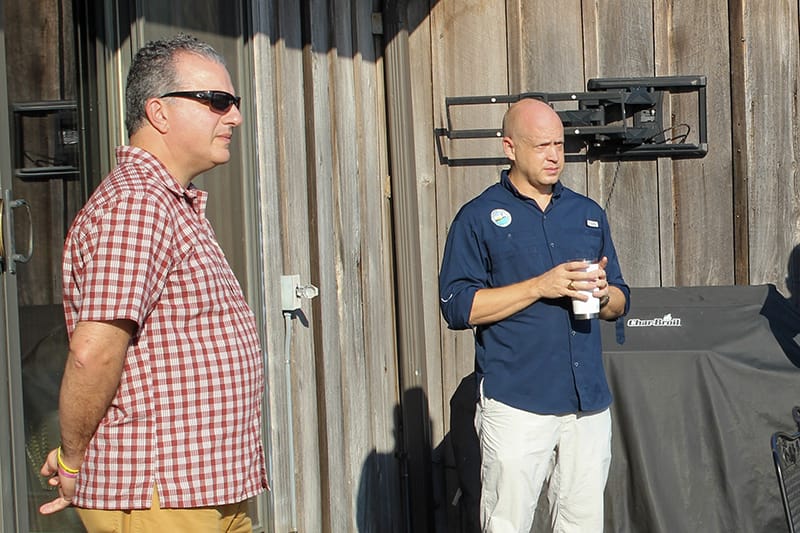
Florida’s Chief Financial Officer (CFO) Jimmy Patronis and Department of Environmental Protection (DEP) Secretary Noah Valenstein joined Tall Timbers’ staff on October 9, 2020, for a tour of private lands included in the Red Hills Conservation Florida Forever Project.
Florida’s Chief Financial Officer (CFO) Jimmy Patronis (at left) and Department of Environmental Protection (DEP) Secretary Noah Valenstein (at right).
Shane Wellendorf, Conservation Coordinator at Tall Timbers, was excited to help host the tour, as he simultaneously works with the state on the possibility of moving forward with the purchase of conservation easements on portions of Red Hills Conservation Project lands. “It’s great to have the opportunity to get Florida’s leadership out on these lands, to see the conservation value and legacy of long-term land stewardship first hand,” explained Wellendorf.
The Red Hills Conservation project was placed on the Florida Forever list in 2019, and includes 16,909 acres from three properties. Tall Timbers helped prepare the application and is working with the landowner and the state to facilitate the purchase of conservation easements, as funding becomes available through the Florida Forever program. This work aligns with Tall Timbers’ strategic goal to permanently protect land in large blocks in the Red Hills and Albany regions, and to compete for conservation dollars to help make that happen when landowners are not in the legal (such as land in a family trust), or financial position to utilize a fully donated conservation easement.
“The Florida Forever Project is crucial to conserving natural lands and waterways and renewing Florida’s commitment to conserve the state’s natural and cultural heritage. This partnership has proven to be great for Florida’s economy and the economic impact from longleaf ecosystems provides a great benefit for our state. I’d like to thank all of the environmental leaders who are working hard to ensure Florida’s natural resources are protected for future generations,” said CFO Jimmy Patronis.
Tall Timbers has long worked with coalitions of partner organizations to advocate for public funding options, to increase the pace of land conservation in Florida and Georgia. The Tall Timbers Board of Trustees supported both the Florida Water and Land Conservation Amendment in 2014, and the Georgia Outdoor Stewardship Amendment in 2018. These efforts help land conservation in both states and now have the opportunity for direct assistance in the Red Hills region.
“The Red Hills Conservation Project, through Florida Forever, is a strategic public partnership that complements decades of private investment to create these large blocks of permanently protected habitat in this incredibly diverse and intact landscape,” explained Tall Timbers President/CEO Dr. Bill Palmer. “We have an opportunity here with willing private landowners, to connect existing protected lands and create large corridors of wildlife habitat, without increasing state land management costs in the future.”
DEP Secretary Valenstein highlighted the importance of coordination to deliver conservation outcomes. “Land conservation has a far-reaching impact on virtually every component of our environment and communities. It is a critical component in our collaborative efforts to ensure our natural resources are protected and remain healthy for generations to come. This property is a great example of the continued coordination among environmental stakeholders that has strengthened our ability to safeguard our state’s conservation lands.”
The M-CORES program, which includes the proposed Suncoast Connector Toll Road in Jefferson County, passed through the Florida Legislature at breakneck speed with little review or analysis. Tall Timbers has a number of concerns given the potential for significant and wide spread impacts. These include fragmenting public and private conservation lands, robbing business from Main Street Monticello, impacting our rivers and other water resources, and making prescribed fire more difficult and costly.
Join us in asking the Jefferson County Board of County Commissioners to OPPOSE the Suncoast Connector toll road and its path through Jefferson County.
Take action now with our easy email form.
Send an email to all five Jefferson County Board of County Commissioners with one click!
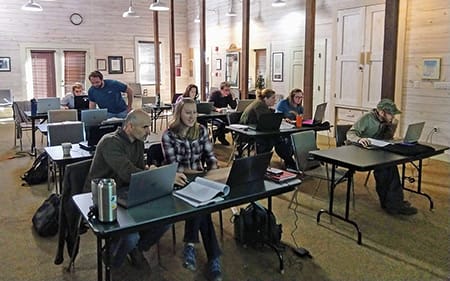
Burn prioritization modeling seminars and fire modeling tools are supported by Wildland Fire Science to train managers in the important planning stages of prescribed fires.
Educating and guiding the next generation of fire researchers and managers is a key goal of Wildland Fire Science and a resource for testing new ideas in fire research.
Tall Timbers hosts the premier fire technology transfer organization—the Southern Fire Exchange. This JFSP funded effort helps connect research to management through webinars, workshops, and support of the Prescribed Fire Science Consortium.
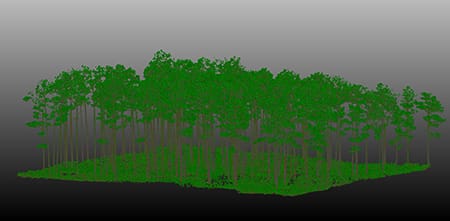
Working with partners in the Prescribed Fire Science Consortium, the program is building nexgen 3-D fuel beds using terrestrial LiDAR and novel sampling techniques to power new fire behavior models for prescribed fire managers. This work links to Tall Timbers work in wildlife habitat usage and ecological forestry.
The Longleaf Legacy landscape prescribed fire burn team arm of Wildland Fire Science works directly with landowners and partners to effectively put fire on the ground and promote prescribed fire throughout the region.
Tall Timbers is leading an effort to map fire regimes at the landscape scale. Staff work with numerous agencies to evaluate fire records and satellite imagery to build this critical conservation database. https://skfb.ly/6DqOY
Tall Timbers hosts the Prescribed Fire Science Consortium, a national network of researchers and managers who promote integrated research and management to advance next generation tools for fire practitioners. https://arcg.is/1DSjDT
We are linking physics and field observations to understand the fluid dynamics of fire behavior surface fire regimes. Our work combines field observations using advanced thermal imaging techniques, laboratory studies, and coupled fire-atmospheric modeling to help managers improve outcomes of managed fire regimes.
Selected Publications authored by Wildland Fire Science staff.
Staff and researchers support Federal fire training by serving as a cadre for NWCG training courses, ranging from basic wildland fire to advanced fire effects.
(PFTC) specializes in training fire fighters the principles and techniques of prescribed fire through practical hands-on experience. https://www.fws.gov/fire/pftc/
Private land owners are the largest source of prescribed fire in the country. These land owners and the culture of fire that was maintained by them during decades of suppression are a part of why Tall Timbers is a world-wide center for prescribed fire science. Workshops and fire training are a critical focus of the Longleaf Legacy Landscape Burn Team and our support of the Georgia Forestry Commission Prescribed Fire Center in Marion County.
The conserved lands of the Greater Red Hills region are found on working, income-producing properties that support agriculture, forestry, and recreational hunting. These properties contribute $272 million annually to local economies and support 2,300 jobs. [link to Planning & Advocacy section] The landowners’ strong stewardship ethic preserves their working lands while replenishing drinking water supplies, protecting water quality, and providing wildlife habitat for dozens of rare and endangered species. Tall Timbers’ conservation easements on these working properties encourage landowners to retain their traditional livelihood by keeping farms in family ownership.
Home to world-class wild quail populations, the Greater Red Hills region contains the largest concentration of gamebird preserves in the United States. These preserves also support the largest community of Red-cockaded woodpeckers on private lands. Indicators of high quality habitat found here include the gopher tortoise, Bachman’s sparrow, fox squirrel, and many amphibians. Tall Timbers’ conservation easements identify and protect the critical habitats of these species.
The region also boasts outstanding aquatic resources. Large river systems, like the Flint/Apalachicola, Ochlockonee, and Aucilla, flow from Georgia and feed into the Gulf of Mexico to support some of the world’s most productive estuaries. Large disappearing sinkhole lakes, like Iamonia, Miccosukee, and Jackson, provide habitat for an array of aquatic species and migratory birds. Tall Timbers’ conservation easements protect these vital watersheds and wetlands that are the lifeblood for the ecological health of the region.
Once dominated by longleaf pine, our pine woodlands support abundant wildlife and local economies. These forests need prescribed fire to stay healthy. Herbert L. Stoddard and his associates Ed and Roy Komarek were pioneers in this emerging scientific field during the mid-20th century. Tall Timbers continues that legacy with applied research on prescribed fire and land management. Today, there is a tremendous need to expand prescribed fire use beyond the Red Hills to ensure ecosystem health and reduce wildfire risk. Additionally, Tall Timbers uses conservation easements to permanently protect private woodlands while balancing the need for economic return from selective timbering.