Prescribed Fire Training Center reaches burning milestone
By Greg Seamon, Fire Training Specialist
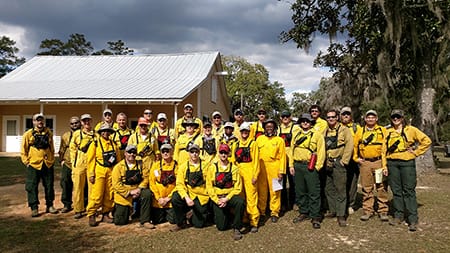
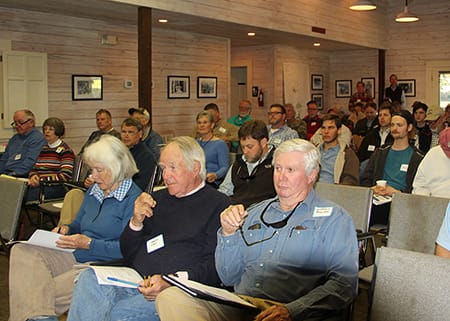
The National Interagency Prescribed Fire Training Center (PFTC) reached an historic milestone on April 16, 2015, with its one millionth acre prescribed burned. Begun in 1998, the Center has been training students from around the globe, offering experiential learning through the hands-on application of prescribed fire throughout the southeastern US. Tall Timber’s provides the Fire Training Specialist at the Center, as well as orientation field trips during the 20-day sessions.
The two modules this April that helped surpass the million-acre achievement were comprised of federal employees from the US Forest Service, the US Fish and Wildlife Service, the National Park Service, a state employee from Pennsylvania and PFTC’s first-ever attendee from Italy. On the day the mark was made, the teams were burning at Arthur R. Marshall Loxahatchee National Wildlife Refuge in Boynton Beach, Florida, and Allen David Broussard Catfish Creek Preserve State Park in Haines City, Florida.
PFTC has trained over 2,100 wildland fire professionals and resource managers in the importance of ecologically-managed prescribed fire. Attendees have participated from all the federal land-managing agencies, as well as numerous state agencies, the Department of Defense, non-governmental organizations, and private companies. There have been students from 49 of the 50 states and 17 countries outside the US. Though the Center does not have any land it manages, it has cooperating agreements with federal and state agencies, as well as with universities and NGO conservation entities, such as Tall Timbers, that allows the training modules to burn at over 250 sites across the southeast.
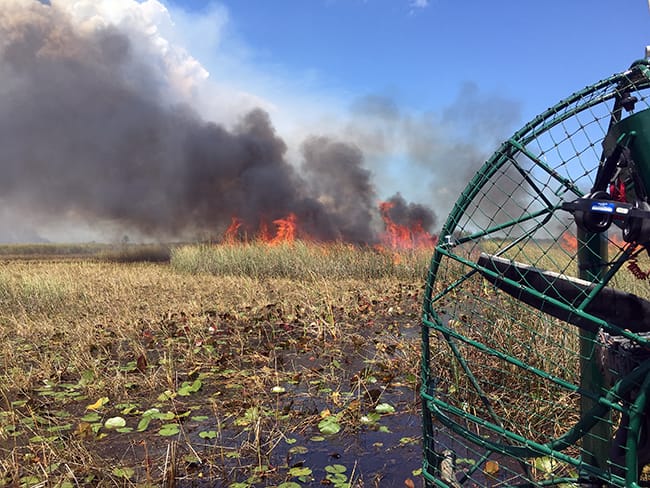
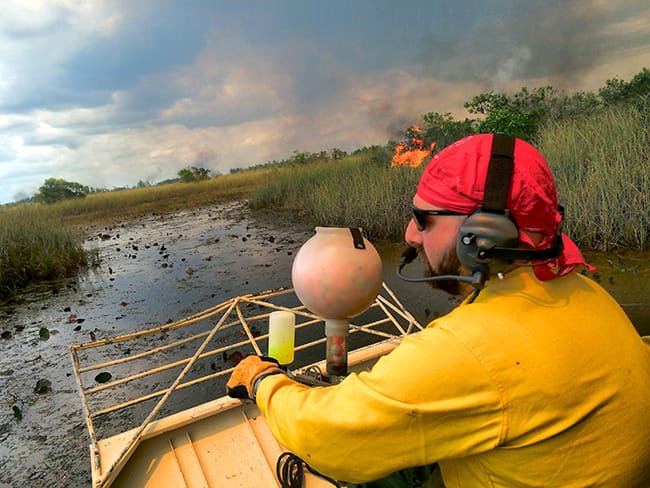
Team 1 burning at Arthur Marshall Loxahatchee National Wildlife Refuge by airboat.
Stefano Macrelli, from Italy, igniting the sawgrass marsh from an airboat at Loxahatchee NWR.
Team 2 Field Coordinator John Cataldo, from Yellowstone National Park, moves a FL box turtle during a burn with the Northwest Florida Water Management District.
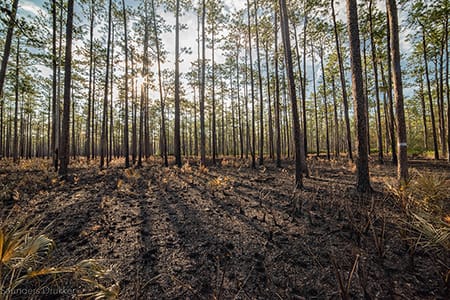
Team 2 burning at Catfish Creek Preserve State Park.
The Tall Timbers eJournal and Firebird publications are two of them
Annual membership gifts help support the day-to-day operations of Tall Timbers and are the lifeblood of our organization. As a charitable non-profit, Tall Timbers relies on the generous financial support of our members to help sustain the important research, conservation and education programs within the organization.
Tall Timbers has two new membership levels, an Associate membership at $35 per year and a Youth membership at only $15 per year. The Associate membership provides a subscription to our new digital magazine the Tall TimberseJournal, the Firebird e-newsletter from the Stoddard Bird Lab, a Tall Timbers decal, and a subscription to the Tall Timbers eNews, as well as invitations to education programs and events. The Youth membership provides a subscription to the Tall Timbers eNews; invitations to education programs and events (must be 18 or younger).
There are many more membership levels and associated perks. If you are not a member, join today!
The partners of the Greater Red Hills Awareness Initiative (GRHAI) contribute articles for the twice monthly column, “Exploring the Red Hills” published in the Tallahassee Democrat. Authors share stories celebrating the cultural, historical, and ecological wonders of the Red Hills. A few summer stories are listed here. Find more blogs and videos at Red Hills Region here.
The Stoddard Bird Lab is collaborating with the Game Bird Lab in hopes of developing a new recipe for enhancing nesting success for ground-nesting birds.
Capsaicin is the active ingredient in hot peppers that can send human noses into to a sneezing conniption fit. Capsaicin has similar effects on other mammals, but it has virtually no such effect on birds. In fact, the pungency of capsaicin is thought to be linked to a strategy of deterring mammal consumption of pepper seeds in favor of bird consumption. As the theory goes, ground-bound mammals are not as effective as birds in dispersing seeds, and their sharp teeth and digestive systems also lower seed viability markedly compared to toothless birds.
Nesting success is one of the limiting factors for ground-nesting bird populations, including Northern Bobwhite and many species of sparrows. Nesting success for the critically endangered Florida Grasshopper Sparrows is extremely low — hovering in the range of 10-20% — and small mammals are thought to be major perpetrators.
Thanks to a grant from the U.S. Fish and Wildlife Service, we’ve been testing whether capsaicin can be used as an effective deterrent for mammalian nest robbers with an eye toward improving the outlook for the Florida Grasshopper Sparrow. Using off-the-shelf technology and quail as a surrogate, we developed a dispenser that sits a few feet above nests and sprays a small dose of concentrated pepper juice every 20 minutes. The spray gently coats the nest and surrounding vegetation, and is hoped to provide a chemical shield for eggs and adults alike.
Data are still being collected, but few nests treated with capsaicin have been taken by mammals. Instead, snakes have been the major threat, indicating that capsaicin is ineffective in deterring another major source of losses. It may also prove difficult to tease out a positive effect of the capsaicin treatment this year, because quail nesting success has been high across most of the property; but we’ll keep stirring the pot in an effort to find a recipe that works.
By Kevin Robertson, PhD, Fire Ecology Program Director
I am happy to introduce Dr. Monica Rother as the new Fire Ecologist in the Fire Ecology Program, replacing Angie Reid who is pursuing a PhD in Australia. Monica recently received her PhD from the University of Colorado where she studied post-fire regeneration of ponderosa pine. Her MS degree is from the University of Tennessee where she used dendrochronology (study of fire scars in trees) to reconstruct historic fire regimes in the Zuni Mountains of New Mexico and their relationship to climate and human habitation.
Monica hit the ground running in May, supervising interns for the Pebble Hill Fire Plots long-term study and coordinating experimental prescribed burns. She has also begun work on a manuscript reviewing the positive and negative effects of soil disturbance on southern pineland plants. She will be learning the local plants in earnest during out various plant community projects this fall. I hope you get to meet her soon.
The M-CORES program, which includes the proposed Suncoast Connector Toll Road in Jefferson County, passed through the Florida Legislature at breakneck speed with little review or analysis. Tall Timbers has a number of concerns given the potential for significant and wide spread impacts. These include fragmenting public and private conservation lands, robbing business from Main Street Monticello, impacting our rivers and other water resources, and making prescribed fire more difficult and costly.
Join us in asking the Jefferson County Board of County Commissioners to OPPOSE the Suncoast Connector toll road and its path through Jefferson County.
Take action now with our easy email form.
Send an email to all five Jefferson County Board of County Commissioners with one click!
Selected Publications authored by Wildland Fire Science staff.
Educating and guiding the next generation of fire researchers and managers is a key goal of Wildland Fire Science and a resource for testing new ideas in fire research.
Tall Timbers hosts the Prescribed Fire Science Consortium, a national network of researchers and managers who promote integrated research and management to advance next generation tools for fire practitioners. https://arcg.is/1DSjDT
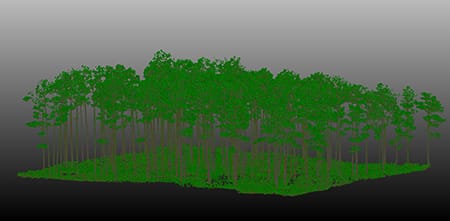
Working with partners in the Prescribed Fire Science Consortium, the program is building nexgen 3-D fuel beds using terrestrial LiDAR and novel sampling techniques to power new fire behavior models for prescribed fire managers. This work links to Tall Timbers work in wildlife habitat usage and ecological forestry.
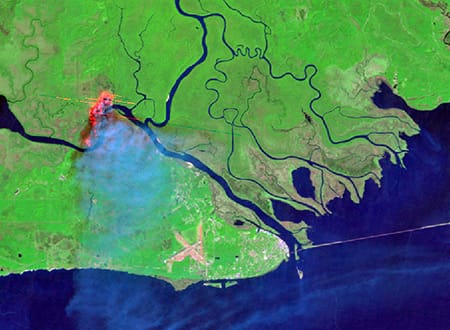
Tall Timbers is leading an effort to map fire regimes at the landscape scale. Staff work with numerous agencies to evaluate fire records and satellite imagery to build this critical conservation database. https://skfb.ly/6DqOY
We are linking physics and field observations to understand the fluid dynamics of fire behavior surface fire regimes. Our work combines field observations using advanced thermal imaging techniques, laboratory studies, and coupled fire-atmospheric modeling to help managers improve outcomes of managed fire regimes.
Burn prioritization modeling seminars and fire modeling tools are supported by Wildland Fire Science to train managers in the important planning stages of prescribed fires.
The conserved lands of the Greater Red Hills region are found on working, income-producing properties that support agriculture, forestry, and recreational hunting. These properties contribute $272 million annually to local economies and support 2,300 jobs. [link to Planning & Advocacy section] The landowners’ strong stewardship ethic preserves their working lands while replenishing drinking water supplies, protecting water quality, and providing wildlife habitat for dozens of rare and endangered species. Tall Timbers’ conservation easements on these working properties encourage landowners to retain their traditional livelihood by keeping farms in family ownership.
Home to world-class wild quail populations, the Greater Red Hills region contains the largest concentration of gamebird preserves in the United States. These preserves also support the largest community of Red-cockaded woodpeckers on private lands. Indicators of high quality habitat found here include the gopher tortoise, Bachman’s sparrow, fox squirrel, and many amphibians. Tall Timbers’ conservation easements identify and protect the critical habitats of these species.
The region also boasts outstanding aquatic resources. Large river systems, like the Flint/Apalachicola, Ochlockonee, and Aucilla, flow from Georgia and feed into the Gulf of Mexico to support some of the world’s most productive estuaries. Large disappearing sinkhole lakes, like Iamonia, Miccosukee, and Jackson, provide habitat for an array of aquatic species and migratory birds. Tall Timbers’ conservation easements protect these vital watersheds and wetlands that are the lifeblood for the ecological health of the region.
Once dominated by longleaf pine, our pine woodlands support abundant wildlife and local economies. These forests need prescribed fire to stay healthy. Herbert L. Stoddard and his associates Ed and Roy Komarek were pioneers in this emerging scientific field during the mid-20th century. Tall Timbers continues that legacy with applied research on prescribed fire and land management. Today, there is a tremendous need to expand prescribed fire use beyond the Red Hills to ensure ecosystem health and reduce wildfire risk. Additionally, Tall Timbers uses conservation easements to permanently protect private woodlands while balancing the need for economic return from selective timbering.
Tall Timbers hosts the premier fire technology transfer organization—the Southern Fire Exchange. This JFSP funded effort helps connect research to management through webinars, workshops, and support of the Prescribed Fire Science Consortium.
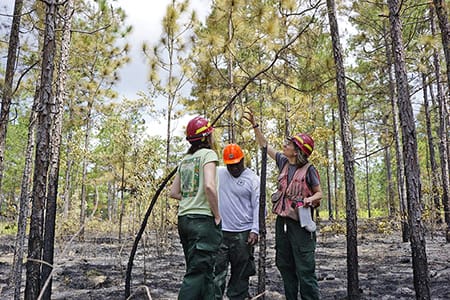
The Longleaf Legacy landscape prescribed fire burn team arm of Wildland Fire Science works directly with landowners and partners to effectively put fire on the ground and promote prescribed fire throughout the region.
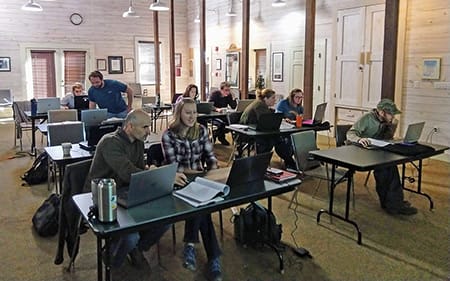
Staff and researchers support Federal fire training by serving as a cadre for NWCG training courses, ranging from basic wildland fire to advanced fire effects.
(PFTC) specializes in training fire fighters the principles and techniques of prescribed fire through practical hands-on experience. https://www.fws.gov/fire/pftc/
Private land owners are the largest source of prescribed fire in the country. These land owners and the culture of fire that was maintained by them during decades of suppression are a part of why Tall Timbers is a world-wide center for prescribed fire science. Workshops and fire training are a critical focus of the Longleaf Legacy Landscape Burn Team and our support of the Georgia Forestry Commission Prescribed Fire Center in Marion County.




 Tall Timbers has two new membership levels, an Associate membership at $35 per year and a Youth membership at only $15 per year. The Associate membership provides a subscription to our new digital magazine the


 I am happy to introduce Dr. Monica Rother as the new Fire Ecologist in the Fire Ecology Program, replacing Angie Reid who is pursuing a PhD in Australia. Monica recently received her PhD from the University of Colorado where she studied post-fire regeneration of ponderosa pine. Her MS degree is from the University of Tennessee where she used dendrochronology (study of fire scars in trees) to reconstruct historic fire regimes in the Zuni Mountains of New Mexico and their relationship to climate and human habitation.