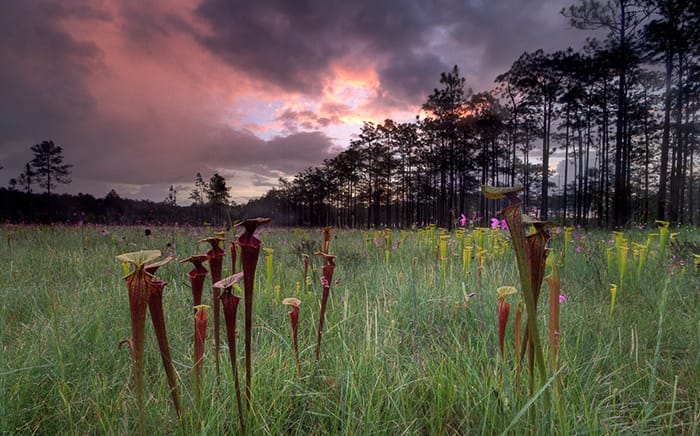
When it comes to native plants in our region’s pinelands, we know surprisingly little about most species. That is why the Fire Ecology Program, with help from Tall Timbers Beadel Fellow Gil Nelson and the University of Florida Small Collections Network, has begun work to develop a wiki-type website to collect information about native plants in the Coastal Plain.
After conducting a survey of plants native to pinelands in the Red Hills Region of northern Florida and southern Georgia, we found that over half of the species have nothing published about them except for a basic description in taxonomy books. Of course there is much more to know about plants, such as how they respond to fire, when they flower and how their seeds are dispersed, what their preferred habitat is, and what pollinators visit them.
Although little has been published, professional biologists and amateur plant enthusiasts alike have a great deal of knowledge about plants from their extensive field experience, often recorded in notes and photographs from years of observation. The contribution of their first-hand knowledge and other resources to a forum where it can be publically shared will be beneficial to many in natural resource fields, including wildlife biologists, ecologists, entomologists, and others.
The primary role of the Fire Ecology Program will be to monitor the website and reach out to plant experts and encourage their contribution through invitation, interviews, and possibly workshops. If you are interested in being a contributor, please contact Kevin Robertson. We look forward to learning from what you have to share.
The partners of the Greater Red Hills Awareness Initiative (GRHAI) regularly contribute articles for the twice monthly column, “Exploring the Red Hills” published in the Tallahassee Democrat. Authors share stories celebrating the cultural, historical, and ecological wonders of the Red Hills. A few spring stories are listed here.
Bringing an Underground Robotic Gopher Tortoise Scope to Life
The Tale of the GT Cruiser
By Kim Sash, Conservation Biologist
Biologists often refer to gopher tortoises as ecosystem engineers. They provide a borrow averaging up to 15 feet in length that up to 350 different species, including insects, birds, reptiles and amphibians, have been documented to use as a refuge. These burrows offer safe havens by providing warmer, safe places in winter and cooler, humid conditions in the summer. The burrows have also been documented to offer refuge for a quail to avoid an avian predator, or a lizard to escape a prescribed fire. This species is also currently listed as a candidate for Federal listing in our portion of its range. Showing that tortoises are doing fine in the Red Hills, and elsewhere in Florida and Georgia, may help preclude their listing as an endangered species. For these reasons, a gopher tortoise survey crew led by Rebecca Zeroth has been out counting gopher tortoises in the Red Hills. As part of the survey, the crew needs to scope every burrow found in order to count tortoises within. Often a gopher tortoise will use multiple burrows, so counting just burrows would lead to an inflated and inaccurate count of tortoises. So for the rest of the summer and into the fall, Rebecca and her crew will be scoping burrows and counting tortoises.
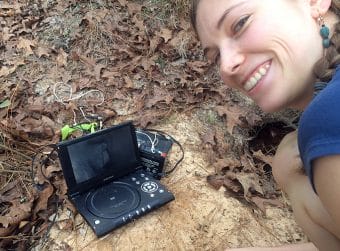
We currently use a “scope” or a stiff hose with a camera mounted on the end that is fed down the borrows, so we can document if a gopher tortoise is inside. This process works fairly well, but the scopes are cumbersome to manipulate and the process can be physically arduous and time consuming. For a long time, I’ve had the dream of building a robot scope. Something sleek and quick that could crawl down a gopher tortoise burrow with a mounted camera and would reveal which creatures call that burrow home. I saw the chance to turn this dream into reality when I heard about a professor at FSU, Dr. Jonathan Clark, who builds robots. I decided to contact Dr. Clark to see if he would like to collaborate on a project to build a robotic gopher tortoise scope.
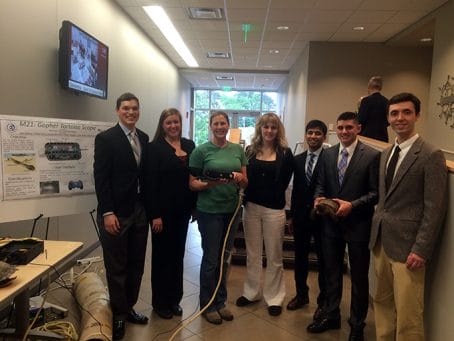
Dr. Clark suggested that this would be a great idea for a FAMU-FSU College of Engineering Senior Design Project. With an industry problem to solve and a bit of financing, the seniors at the engineering school will design and build your dream project. Teams of students choose from a list of potential projects—this year there were 31 total—which included a pedibus, a rotocraft, a solar desalinator, and even a palm fruit harvester. Some of these projects, like those sponsored by NASA, have huge budgets, while others serve niche industries with more limited budgets. The teams of students work on their chosen project for their entire senior year.
Tall Timbers sponsored six students: four mechanical engineers and two electrical engineers. Most of these students had never seen a gopher tortoise before, let alone a gopher tortoise burrow. We started off by scoping a few burrows on Tall Timbers, so they could get a feel for the inside of a burrow and the kind of terrain the robot would have to crawl over, under, and inside. The students then continued to work on the project and have given several midterm presentations. As their sponsor, Tall Timbers was invited to attend these presentations. I could not have been more impressed with the students, their creativity, passion, and intelligence gave me hope for future generations.
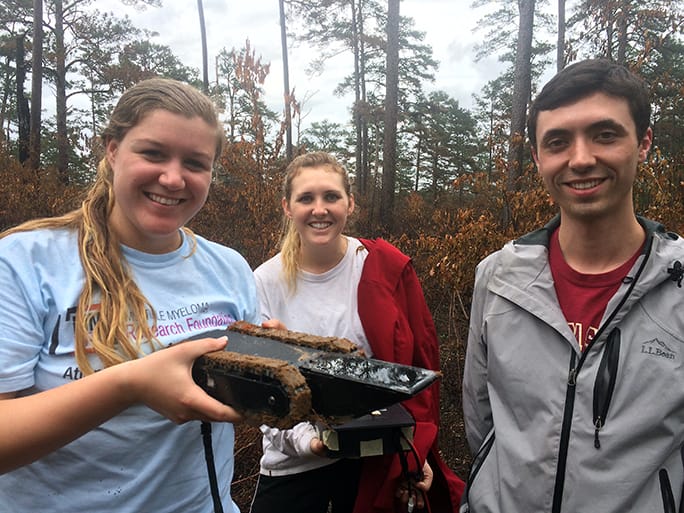
As the semester is winding down, the “GT Cruiser” (I told you they were creative!) has become a reality. While it is still in development and has some kinks to be worked out, the project has become more than just building a gopher tortoise robot scope. I’ve gotten to know these students, admired the work they can do, and have been inspired by their passion and ambition. Little did I know that the gopher tortoise, an ecosystem engineer, would help me to meet some great future engineers who will undoubtedly become successful members of society.
Field testing the GT cruiser; left to right: Jane Bartley, Bridget Leen, Colin Riley
Red-cockaded Woodpeckers pass an important milestone
By Jim Cox, Stoddard Bird Lab Director
The reintroduction of Red-cockaded Woodpeckers passed yet another important milestone this Spring. A young male woodpecker has excavated a natural cavity in an area approximately 300 meters from the nearest group of artificial cavities. This type of territorial budding is rarely observed, but it’s a clear indication of natural population growth and expansion following the initial release of woodpeckers on Tall Timbers in 2006. The new cavity has been excavated in a short-leaf pine in the northwest section of the property. Appropriately, it’s in an area where we’ve been planning to excavate a few artificial cavities to help the population expand, which indicates that woodpeckers and woodpecker biologists can see eye to eye. As a result, Tall Timbers now supports 10 potential breeding groups and has the potential to add one or two more breeding groups before the property will be saturated. Here are the other important milestones that have occurred during reintroduction.
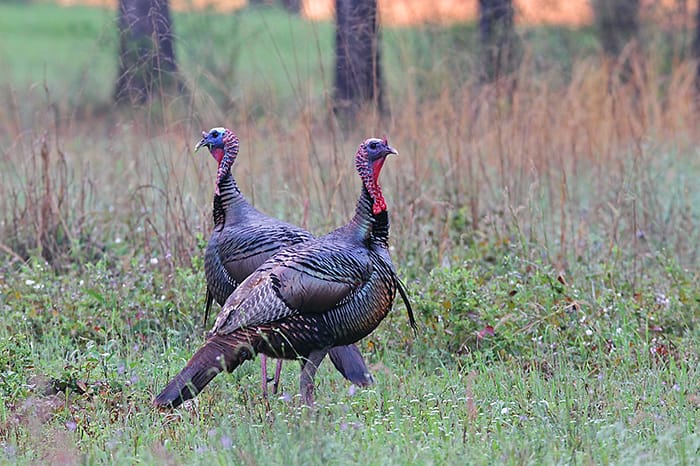
It’s that time of year where the fresh smell of the woods on fire is in the air, and prescribed burning is the focus for most quail managers to keep habitat in check, but for turkeys, breeding is on the mind. As such, springtime is a delightful time of year for the avid turkey hunter in the South, especially when gobbles abound. There is something about that assemblage of syllables, sounding like a cross between a yodel and a clap of thunder, vibrating the trees at daybreak that sends a chill up one’s spine. Indeed, it’s gobbling that makes spring turkey hunting so exciting and worth the pursuit. As most hunters are aware, on some mornings birds gobble their heads off, while other mornings they don’t gobble at all, even when the conditions seem perfect.
Generally, there are two peaks in gobbling: the first typically occurs well before mating begins, and the other during peak incubation. We are currently studying the gobbling activity on multiple sites in Florida, and we have anecdotally observed some interesting patterns such that peaks in gobbling vary from year to year and even site to site. We also know that the timing of these peaks may vary by many factors such as latitude, hunting pressure, weather, or overall bird density. However, it is less clear as to why daily gobbling varies beyond the influence of weather at a particular site from one day to the next.
Hens that are ready to breed typically go to the gobbler—not the other way around. Thus, when hens slip off to lay eggs or begin to incubate a nest a gobbler may “become lonely” and increase their calling behavior or even begin to seek hens out during these times. But, how big and how far are these birds moving?
Our current research using backpack-style GPS transmitters is providing us some insight into gobbler movements. So far, we are observing that gobblers will commonly go on long-distance forays, ostensibly in search of a hen ready to breed. In fact, it is not uncommon for individual gobblers to move as much as 1.5 and 2 miles a day or up to 3–4 miles a week! We have also been studying roost site fidelity to better understand how loyal gobblers are to certain roost areas.
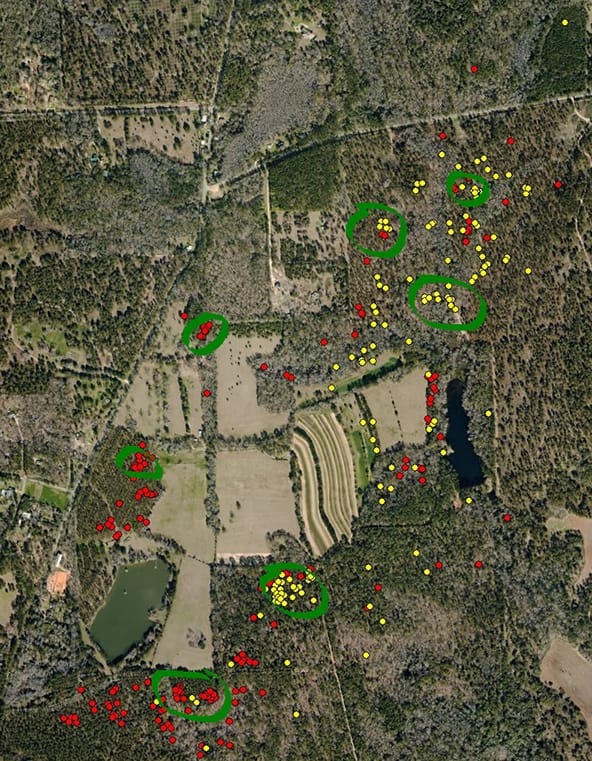
Gobblers seem to exhibit a flexible roost site behavior, whereby individual gobblers have varying roosting strategies. Some show higher roost site fidelity than others, but most seem to have 2–5 primary roost sites that are spatially clustered which they visit frequently and numerous others that are less frequented roost sites and more spatially dispersed. The distance between primary roost site locations vary somewhat but are commonly about 0.4 miles apart, with a total circuit being 1 to 2.5 miles (see Figure 1 below). A pattern we are seeing evolve is that gobblers remain loyal to primary roost-site areas (even the same exact tree) for one to a few days, and alternatively roost somewhat randomly in between on a circuitous movement pattern. Currently, about 15% of our tagged turkey hens are incubating nests, so if you are managing for optimal turkey reproduction, wrapping up burning soon would be ideal.
In summary, part of the answer to why a bird doesn’t gobble on a good day may be because they simply aren’t there—they may be out seeking a receptive hen to breed. However, we have seen that gobblers often will return to the same area, and many times to the same exact tree, where they’ve roosted previously, so there is some truth to being patient, and perhaps persistence can pay off.
Figure 1. Roost site locations for two gobblers (one yellow, one red) during spring 2015, on Tall Timbers. Green-circled regions outline spatial clustering of roost sites which indicates primary roosts sites or areas with high roost site fidelity.
We need your support
If you are interested in wild turkeys please consider donating to this project. GPS units cost more $2000 per unit and last for about 1.5 years. Our goal is to expand monitoring efforts of gobbling activity to multiple sites and multiple years in the Red Hills and other areas of Florida, and continue monitoring nesting activity of tagged wild turkeys on Tall Timbers. Thank you for your support!
The M-CORES program, which includes the proposed Suncoast Connector Toll Road in Jefferson County, passed through the Florida Legislature at breakneck speed with little review or analysis. Tall Timbers has a number of concerns given the potential for significant and wide spread impacts. These include fragmenting public and private conservation lands, robbing business from Main Street Monticello, impacting our rivers and other water resources, and making prescribed fire more difficult and costly.
Join us in asking the Jefferson County Board of County Commissioners to OPPOSE the Suncoast Connector toll road and its path through Jefferson County.
Take action now with our easy email form.
Send an email to all five Jefferson County Board of County Commissioners with one click!
Selected Publications authored by Wildland Fire Science staff.
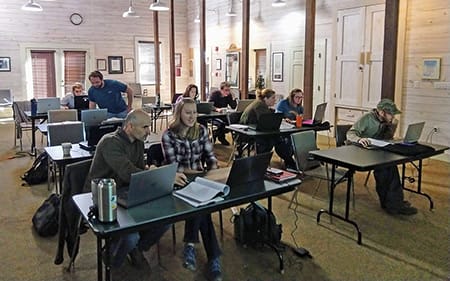
Educating and guiding the next generation of fire researchers and managers is a key goal of Wildland Fire Science and a resource for testing new ideas in fire research.
Tall Timbers hosts the Prescribed Fire Science Consortium, a national network of researchers and managers who promote integrated research and management to advance next generation tools for fire practitioners. https://arcg.is/1DSjDT
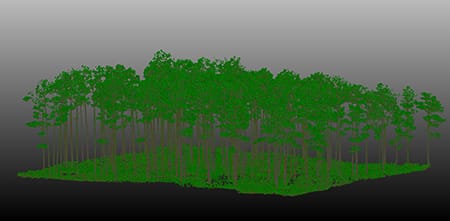
Working with partners in the Prescribed Fire Science Consortium, the program is building nexgen 3-D fuel beds using terrestrial LiDAR and novel sampling techniques to power new fire behavior models for prescribed fire managers. This work links to Tall Timbers work in wildlife habitat usage and ecological forestry.
Tall Timbers is leading an effort to map fire regimes at the landscape scale. Staff work with numerous agencies to evaluate fire records and satellite imagery to build this critical conservation database. https://skfb.ly/6DqOY
We are linking physics and field observations to understand the fluid dynamics of fire behavior surface fire regimes. Our work combines field observations using advanced thermal imaging techniques, laboratory studies, and coupled fire-atmospheric modeling to help managers improve outcomes of managed fire regimes.
Burn prioritization modeling seminars and fire modeling tools are supported by Wildland Fire Science to train managers in the important planning stages of prescribed fires.
The conserved lands of the Greater Red Hills region are found on working, income-producing properties that support agriculture, forestry, and recreational hunting. These properties contribute $272 million annually to local economies and support 2,300 jobs. [link to Planning & Advocacy section] The landowners’ strong stewardship ethic preserves their working lands while replenishing drinking water supplies, protecting water quality, and providing wildlife habitat for dozens of rare and endangered species. Tall Timbers’ conservation easements on these working properties encourage landowners to retain their traditional livelihood by keeping farms in family ownership.
Home to world-class wild quail populations, the Greater Red Hills region contains the largest concentration of gamebird preserves in the United States. These preserves also support the largest community of Red-cockaded woodpeckers on private lands. Indicators of high quality habitat found here include the gopher tortoise, Bachman’s sparrow, fox squirrel, and many amphibians. Tall Timbers’ conservation easements identify and protect the critical habitats of these species.
The region also boasts outstanding aquatic resources. Large river systems, like the Flint/Apalachicola, Ochlockonee, and Aucilla, flow from Georgia and feed into the Gulf of Mexico to support some of the world’s most productive estuaries. Large disappearing sinkhole lakes, like Iamonia, Miccosukee, and Jackson, provide habitat for an array of aquatic species and migratory birds. Tall Timbers’ conservation easements protect these vital watersheds and wetlands that are the lifeblood for the ecological health of the region.
Once dominated by longleaf pine, our pine woodlands support abundant wildlife and local economies. These forests need prescribed fire to stay healthy. Herbert L. Stoddard and his associates Ed and Roy Komarek were pioneers in this emerging scientific field during the mid-20th century. Tall Timbers continues that legacy with applied research on prescribed fire and land management. Today, there is a tremendous need to expand prescribed fire use beyond the Red Hills to ensure ecosystem health and reduce wildfire risk. Additionally, Tall Timbers uses conservation easements to permanently protect private woodlands while balancing the need for economic return from selective timbering.
Tall Timbers hosts the premier fire technology transfer organization—the Southern Fire Exchange. This JFSP funded effort helps connect research to management through webinars, workshops, and support of the Prescribed Fire Science Consortium.
The Longleaf Legacy landscape prescribed fire burn team arm of Wildland Fire Science works directly with landowners and partners to effectively put fire on the ground and promote prescribed fire throughout the region.
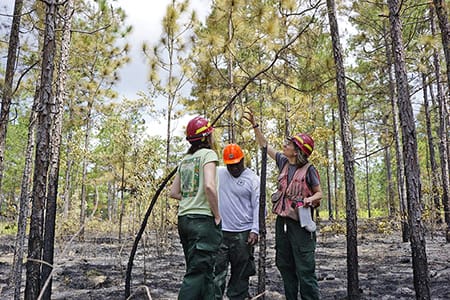
Staff and researchers support Federal fire training by serving as a cadre for NWCG training courses, ranging from basic wildland fire to advanced fire effects.
(PFTC) specializes in training fire fighters the principles and techniques of prescribed fire through practical hands-on experience. https://www.fws.gov/fire/pftc/
Private land owners are the largest source of prescribed fire in the country. These land owners and the culture of fire that was maintained by them during decades of suppression are a part of why Tall Timbers is a world-wide center for prescribed fire science. Workshops and fire training are a critical focus of the Longleaf Legacy Landscape Burn Team and our support of the Georgia Forestry Commission Prescribed Fire Center in Marion County.



 The reintroduction of Red-cockaded Woodpeckers passed yet another important milestone this Spring. A young male woodpecker has excavated a natural cavity in an area approximately 300 meters from the nearest group of artificial cavities. This type of territorial budding is rarely observed, but it’s a clear indication of natural population growth and expansion following the initial release of woodpeckers on Tall Timbers in 2006. The new cavity has been excavated in a short-leaf pine in the northwest section of the property. Appropriately, it’s in an area where we’ve been planning to excavate a few artificial cavities to help the population expand, which indicates that woodpeckers and woodpecker biologists can see eye to eye. As a result, Tall Timbers now supports 10 potential breeding groups and has the potential to add one or two more breeding groups before the property will be saturated. Here are the other important milestones that have occurred during reintroduction.
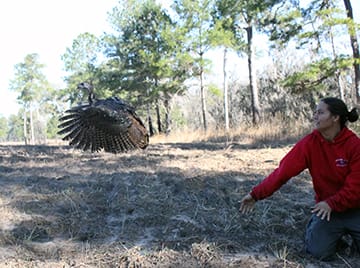 Our current research using backpack-style GPS transmitters is providing us some insight into gobbler movements. So far, we are observing that gobblers will commonly go on long-distance forays, ostensibly in search of a hen ready to breed. In fact, it is not uncommon for individual gobblers to move as much as 1.5 and 2 miles a day or up to 3–4 miles a week! We have also been studying roost site fidelity to better understand how loyal gobblers are to certain roost areas.