Over the past 47 years the Game Bird Program has been capturing, banding and releasing wild quail which marks the longest running band-recapture study of any game bird in the world. Since 1968 more than 28,000 quail birds have been leg-banded. From that dataset we have observed that, on average, annual survival for a population of quail is about 20% in good habitat or that approximately 80% of the population dies each year. Here in the Game Bird Lab, year after year and week after week we pick up radio-tags that once were fitted to a live bobwhite which is a persistent reminder that quail are simply good at dying. I recently heard it put this way: “On average a one year old quail has been dead for quite some time.” Indeed, only a small proportion of quail make it to 1-year of age even amidst high-quality habitat. But last month we discovered that some quail can and do beat the odds.
On Tall Timbers, we recaptured and released a male bobwhite (known in the lab as 091406, see photo) that was initially banded in 2009 making him nearly 6 years old. Alas, these odds are slim – about 1 in 15,000! To put that into perspective there is about a 1 in 3000 chance that you will be struck by lightning in your lifetime or you are 5 times more likely to be struck by lightning in your lifetime than come across a 6-year old quail bird. Our research has helped us to understand what drives quail populations and continues to shed light on how best to manage for these short-lived, illustrious game birds.
During the past few weeks we have seen an upsurge in raptors due to the migration and a resulting dip in bobwhite survival has ensued. This is a common pattern observed each year. Our long-term dataset shows that avian predation increases this time of year (January – March) resulting in lower bobwhite survival (see Figure 1) and another small but noticeable dip in survival during late-November and December both of which are associated with the raptor migration (see gray bars, in Figure 1, indicating relative raptor abundance). However, even after many of the migrating hawks have moved north weekly survival remains low during April, May and June (see Figure 1). This is likely associated with prescribed burning and subsequent increased movement by bobwhites to seek out unburned areas as well as covey break up and the onset of breeding season. As cover begins to respond and raptor numbers remain low survival begins to improve in July for much of the remainder of the year. Delaying some of your prescribed burning until after the raptor migration may help to improve survival. In addition, burning at a small scale (25-100 acre patches) and leaving burned and unburned areas patchily disturbed among upland sites can improve bobwhite survival during this critical time period. Good habitat management is our best defense against predation, and timely application of management may also help to improve a quail’s odds of survival.
As an extreme example of what can happen when burning is overdone, Tall Timbers monitored quail abundance on a property that did extensive burning during February and March, 2014. While the primary objective on this property is not quail management, it is one of the objectives. Increased burning is normally a good thing for quail but it can be overdone. Quail numbers on this property plummeted in 2015. While plantation managers know better than to over burn their properties, it is a good reminder to be cognizant of the size and distribution of burns each spring to maximize the carry- over of birds into the breeding season.
Figure 1. Weekly survival rates of quail on Tall Timbers relative to the overall mean weekly survival (gray line at zero) for the last 10 years combined (2004-2015). Weekly survival rates are overlaid on the bi-weekly raptor count. A point above the gray line indicates that survival is above the weekly average whereas a point falling below the gray line indicates that survival is below the overall weekly average.
Legislation Supporting Land Conservation Moves to U.S. Senate
Tall Timbers applauds the U.S. House of Representatives, which voted to pass the America Gives More Act of 2015 (H.R. 644). The bill, which contained a key incentive for land conservation, passed on February 12 by 279-137, reflecting 67% support. The bipartisan bill was supported by Red Hill’s area congressional representatives Gwen Graham (D-FL-Dist. 2), Sanford D. Bishop, Jr. (D-GA-Dist.2), and Austin Scott (R-GA-Dist.8).
The America Gives More Act makes permanent tax incentives encouraging landowners to place conservation easements on their land to protect important agriculture, natural and scenic resources. The bill now moves to the U.S. Senate.
The highly effective easement incentive, in law since 2006, expired on January 1. The enhanced incentive helps landowners choose conservation by:
Raising the maximum deduction a donor can take for donating a conservation easement from 30% of their adjusted gross income (AGI) in any year to 50%;
Allowing qualified farmers and ranchers to deduct up to 100% of their AGI; and
Increasing the number of years over which a donor can take deductions from 6 to 16 years.
Originally passed in 2006, the enhanced tax incentives have helped landowners nationwide increase the pace of voluntary private land protection through conservation easements by one-third – over a million acres per year.
“Federal lawmakers made clear they share our firm belief that land conservation is good for America and Americans,” said Rand Wentworth, President of the Land Trust Alliance. “As we work with our Senate allies to advance this bipartisan bill, we will continue to emphasize the value of keeping working lands in working hands. The land heritage we share with America’s farmers, ranchers and foresters – and the land heritage we wish to pass on to our children – must be conserved.”
Due to federal and state incentives, Tall Timbers has been able to save nearly 130,000 acres of important farm, forest, and recreational hunting lands. These working lands contain significant natural resource values that benefit the public by providing clean air, clean water, abundant wildlife habitat, and scenic enjoyment. According to Kevin McGorty, Tall Timbers Land Conservancy Director, “We hope Congress and the President will support making these incentives permanent as an important conservation tool for private landowners. It is a great way of keeping land in family ownership while conserving the rural character of the greater Red Hills Region.”
The America Gives More Act additionally includes tax incentives for food donations, facilitates donations from IRA accounts in certain circumstances and simplifies taxes on foundations. The legislation is strongly supported by a broad spectrum of charitable organizations, including Feeding America, Independent Sector, United Way Worldwide, YMCA of the USA and others.
By Juanita Whiddon, Archives & Historic Resources Coordinator
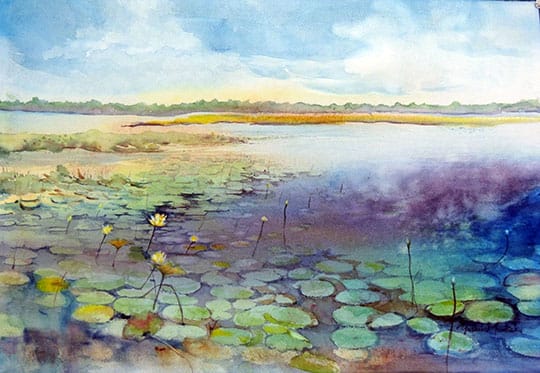
Tall Timbers is proud to announce the official opening of the Webster Art Gallery in the historic Beadel House. The second floor gallery exhibits watercolors from the Tallahassee Area Watercolor Society (TAWS) three times each year. Henry Beadel, who bequeathed his property to establish Tall Timbers Research Station, was not only a conservationist but he was also a watercolorist, so this venue is a good match for the use of this space in his former home.
Lake Iamonia by Yoshiko Murdick was a featured watercolor in the Fall 2014 TAWS exhibit at the Webster Art Gallery.
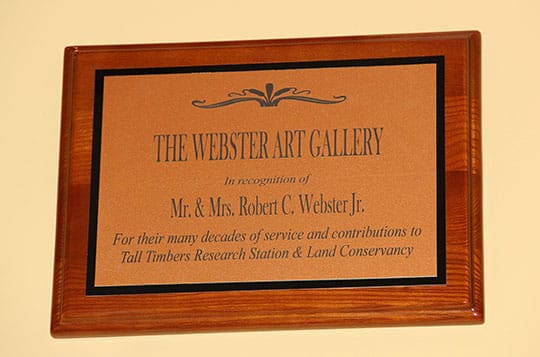
The gallery has been named in honor of Mr. and Mrs. Robert C. Webster Jr. for their many decades of service and contributions to Tall Timbers; they are recognized by a plaque that has been placed at the entrance to the second floor gallery.
Our third exhibit, titled Blossoms, is scheduled to open the first week of March and will remain up until the end of May. We have already received many beautiful entries, and hope you will come to Tall Timbers to see it during one of our monthly Sunday afternoon tours (March 8, April 12 or May 3). Tours begin at 2:15 on the Beadel House porch. Call Juanita Whiddon at 850.893.4153, x236, for other possible dates.
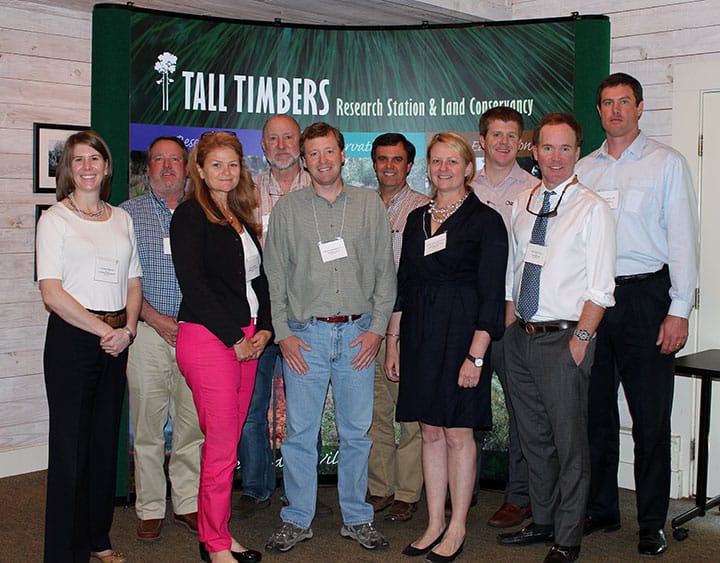
On April 1, Tall Timbers hosted members of the newly created Advancement Committee at a lunch meeting held at the Komarek Science Education Center on the Tall Timbers campus. The Advancement Committee, a sub-committee of the Tall Timbers Board of Directors Development and Communications Committee, is a program that seeks to enlist talented individuals to jointly work to advance the organization’s conservation and research goals. Members of the Advancement Committee will provide outreach within their individual communities and areas of interest to provide new audiences and resources for Tall Timbers.
Pictured L-R: Elizabeth Barron, Eddie Sholar, Cindy Phipps, Lou Hill, Elliott Davenport, David Middleton, Haile McCollum, William Smith, Ben McCollum, Tom Loughlin. Not pictured: Rob Langford, Lisa Phipps, Sid Bigham, Bill D’Alonzo, Northrup Knox.
Rob Langford, Broker Southern Land Realty Tallahassee, FL
William Smith Corporate and Professional Banking Capital City Bank Group Tallahassee, FL
Ben McCollum, Broker The Wright Group Thomasville, GA
Lisa S. Phipps Owner, Artisan Chic Verte Tallahassee, FL
Haile Parker McCollum Owner, Creative Director Fontaine Maury Brand + Design Thomasville, GA
Sid Bigham, III Senior Attorney Florida Department of Environmental Protection Tallahassee, FL
Tom Loughlin, CFP Financial Advisor Signator Investors, Inc. Tampa, FL
Bill D’Alonzo CEO-Retired Friess Associates Wilmington, DE
Elliott Davenport, Jr. The Wings Group, LLC Chattanooga, TN
Louis Hill, M.D. Retired Tallahassee Plastic Surgery Clinic Tallahassee, FL
David Middleton Principal MMHP Investment Advisors Thomasville, GA
By Kevin McGorty, Tall Timbers Land Conservancy Director
The elegant historic main house at Dixie Plantation played host to some 270 dignitaries and guests attending the Red Hills Spring Dinner on April 2. The biennial event celebrates land conservation efforts in the greater Red Hills Region of north Florida and south Georgia. Enjoying the evening were congressional representatives Gwen Graham and Austin Scott, former Congressman Allen Boyd, Florida Agriculture Commissioner Adam Putman and former FSU President T. K. Wetherell.
Cornelia Corbett, Chair of Tall Timbers’ Board, thanked and recognized Rosemary Ripley who represented the Livingston family, and who was a trustee of the Geraldine C.M. Livingston Foundation. In 2013, the Foundation gifted the 9,100 acre estate to Tall Timbers for future research and conservation. Mrs. Ripley thanked Tall Timbers “…for your vision and courage of taking on a project of this magnitude…our hopes and dreams are with you in preserving places like this for future generations.”
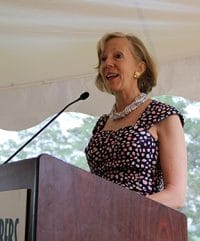
The featured dinner speaker was John Flicker, former president of the National Audubon Society and current president of Prescott College. Mr. Flicker reminisced back 25 years ago to the first dinners of the then Red Hills Conservation Association (now Tall Timbers Land Conservancy). Back then the event was fondly known as the “cold butt dinner” as the attendees sat on metal chairs freezing with the stiff winter wind blowing off Lake Iamonia.
Flicker had a serious message to deliver. He remarked, “As I look ahead at the future of conservation, I don’t think our limiting factor will only be about money. It will be about people and building the next generation of conservation leaders who value land conservation and who have the skills and motivation to carry on the work. Unless we build this new generation of people who make conservation a priority, everything we have fought to accomplish during our lifetimes will be lost.” He went on to say, “Young people today do not grow up on farms. They don’t have the woods behind the barn like I did. They live in cities and they spend increasing amounts of time at computers and iPhones. They learn a lot about the environment in school, more than I did. While they are literate about the environment, they don’t have personal experiences in nature—they lack an emotional connection.”
He offered a series of educational reforms and a new learning model that Prescott College will be offering its students. The new model will integrate digital technology with hands-on direct project experience off campus. He believes more small colleges will be heading this way. Having recently overseen his first graduation as the new college president, Flicker stated, “I always try to remember why I am doing this. It’s about our students. It’s about those values I learned as a kid playing in the woods on the farm. Those are the same values that bring us all back here to this beautiful landscape. It’s why we protect places like this, and why we want your children and grandchildren to experience these same things out in nature and grow up with those same values, so they will carry on after us.”
The evening’s program concluded by honoring Lela and Buck Mitchell of Pine Fair Plantation, Bob Balfour of the Balfour Land Company, and Donna McCollum and Hays Cummins of the Big Bend Wildlands Preserve for recent conservation easement donations to Tall Timbers.
The M-CORES program, which includes the proposed Suncoast Connector Toll Road in Jefferson County, passed through the Florida Legislature at breakneck speed with little review or analysis. Tall Timbers has a number of concerns given the potential for significant and wide spread impacts. These include fragmenting public and private conservation lands, robbing business from Main Street Monticello, impacting our rivers and other water resources, and making prescribed fire more difficult and costly.
Join us in asking the Jefferson County Board of County Commissioners to OPPOSE the Suncoast Connector toll road and its path through Jefferson County.
Take action now with our easy email form.
Send an email to all five Jefferson County Board of County Commissioners with one click!
Selected Publications authored by Wildland Fire Science staff.
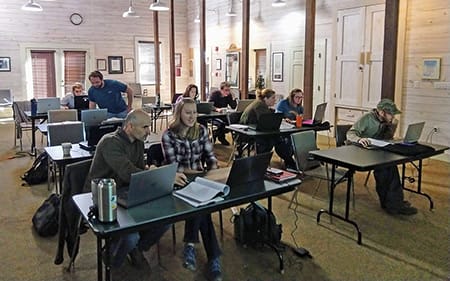
Educating and guiding the next generation of fire researchers and managers is a key goal of Wildland Fire Science and a resource for testing new ideas in fire research.
Tall Timbers hosts the Prescribed Fire Science Consortium, a national network of researchers and managers who promote integrated research and management to advance next generation tools for fire practitioners. https://arcg.is/1DSjDT
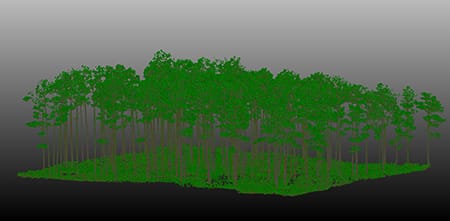
Working with partners in the Prescribed Fire Science Consortium, the program is building nexgen 3-D fuel beds using terrestrial LiDAR and novel sampling techniques to power new fire behavior models for prescribed fire managers. This work links to Tall Timbers work in wildlife habitat usage and ecological forestry.
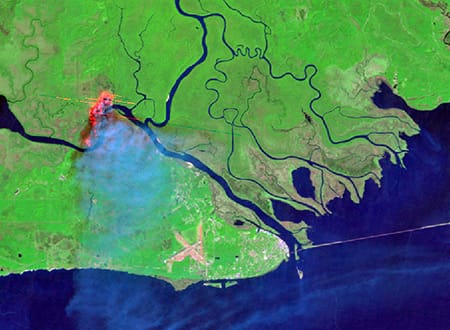
Tall Timbers is leading an effort to map fire regimes at the landscape scale. Staff work with numerous agencies to evaluate fire records and satellite imagery to build this critical conservation database. https://skfb.ly/6DqOY
We are linking physics and field observations to understand the fluid dynamics of fire behavior surface fire regimes. Our work combines field observations using advanced thermal imaging techniques, laboratory studies, and coupled fire-atmospheric modeling to help managers improve outcomes of managed fire regimes.
Burn prioritization modeling seminars and fire modeling tools are supported by Wildland Fire Science to train managers in the important planning stages of prescribed fires.
The conserved lands of the Greater Red Hills region are found on working, income-producing properties that support agriculture, forestry, and recreational hunting. These properties contribute $272 million annually to local economies and support 2,300 jobs. [link to Planning & Advocacy section] The landowners’ strong stewardship ethic preserves their working lands while replenishing drinking water supplies, protecting water quality, and providing wildlife habitat for dozens of rare and endangered species. Tall Timbers’ conservation easements on these working properties encourage landowners to retain their traditional livelihood by keeping farms in family ownership.
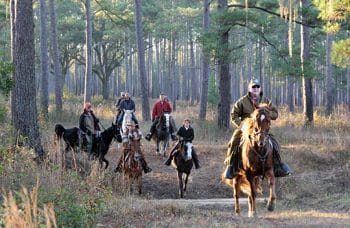
Home to world-class wild quail populations, the Greater Red Hills region contains the largest concentration of gamebird preserves in the United States. These preserves also support the largest community of Red-cockaded woodpeckers on private lands. Indicators of high quality habitat found here include the gopher tortoise, Bachman’s sparrow, fox squirrel, and many amphibians. Tall Timbers’ conservation easements identify and protect the critical habitats of these species.
The region also boasts outstanding aquatic resources. Large river systems, like the Flint/Apalachicola, Ochlockonee, and Aucilla, flow from Georgia and feed into the Gulf of Mexico to support some of the world’s most productive estuaries. Large disappearing sinkhole lakes, like Iamonia, Miccosukee, and Jackson, provide habitat for an array of aquatic species and migratory birds. Tall Timbers’ conservation easements protect these vital watersheds and wetlands that are the lifeblood for the ecological health of the region.
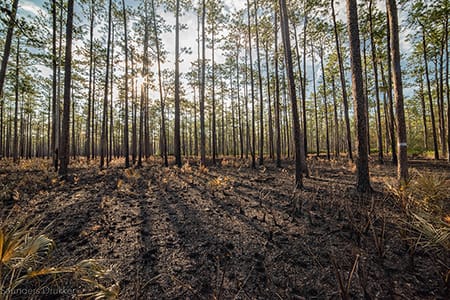
Once dominated by longleaf pine, our pine woodlands support abundant wildlife and local economies. These forests need prescribed fire to stay healthy. Herbert L. Stoddard and his associates Ed and Roy Komarek were pioneers in this emerging scientific field during the mid-20th century. Tall Timbers continues that legacy with applied research on prescribed fire and land management. Today, there is a tremendous need to expand prescribed fire use beyond the Red Hills to ensure ecosystem health and reduce wildfire risk. Additionally, Tall Timbers uses conservation easements to permanently protect private woodlands while balancing the need for economic return from selective timbering.
Tall Timbers hosts the premier fire technology transfer organization—the Southern Fire Exchange. This JFSP funded effort helps connect research to management through webinars, workshops, and support of the Prescribed Fire Science Consortium.
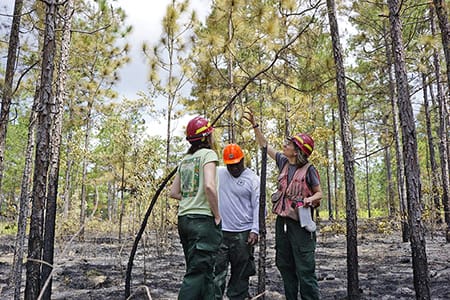
The Longleaf Legacy landscape prescribed fire burn team arm of Wildland Fire Science works directly with landowners and partners to effectively put fire on the ground and promote prescribed fire throughout the region.
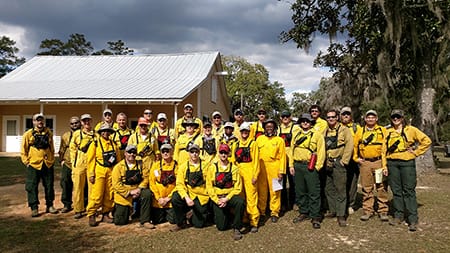
Staff and researchers support Federal fire training by serving as a cadre for NWCG training courses, ranging from basic wildland fire to advanced fire effects.
(PFTC) specializes in training fire fighters the principles and techniques of prescribed fire through practical hands-on experience. https://www.fws.gov/fire/pftc/
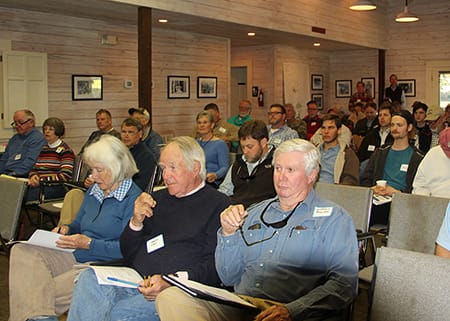
Private land owners are the largest source of prescribed fire in the country. These land owners and the culture of fire that was maintained by them during decades of suppression are a part of why Tall Timbers is a world-wide center for prescribed fire science. Workshops and fire training are a critical focus of the Longleaf Legacy Landscape Burn Team and our support of the Georgia Forestry Commission Prescribed Fire Center in Marion County.


 On Tall Timbers, we recaptured and released a male bobwhite (known in the lab as 091406, see photo) that was initially banded in 2009 making him nearly 6 years old. Alas, these odds are slim – about 1 in 15,000! To put that into perspective there is about a 1 in 3000 chance that you will be struck by lightning in your lifetime or you are 5 times more likely to be struck by lightning in your lifetime than come across a 6-year old quail bird. Our research has helped us to understand what drives quail populations and continues to shed light on how best to manage for these short-lived, illustrious game birds.

 “Federal lawmakers made clear they share our firm belief that land conservation is good for America and Americans,” said Rand Wentworth, President of the Land Trust Alliance. “As we work with our Senate allies to advance this bipartisan bill, we will continue to emphasize the value of keeping working lands in working hands. The land heritage we share with America’s farmers, ranchers and foresters – and the land heritage we wish to pass on to our children – must be conserved.”
 The elegant historic main house at Dixie Plantation played host to some 270 dignitaries and guests attending the Red Hills Spring Dinner on April 2. The biennial event celebrates land conservation efforts in the greater Red Hills Region of north Florida and south Georgia. Enjoying the evening were congressional representatives Gwen Graham and Austin Scott, former Congressman Allen Boyd, Florida Agriculture Commissioner Adam Putman and former FSU President T. K. Wetherell.
 Flicker had a serious message to deliver. He remarked, “As I look ahead at the future of conservation, I don’t think our limiting factor will only be about money. It will be about people and building the next generation of conservation leaders who value land conservation and who have the skills and motivation to carry on the work. Unless we build this new generation of people who make conservation a priority, everything we have fought to accomplish during our lifetimes will be lost.” He went on to say, “Young people today do not grow up on farms. They don’t have the woods behind the barn like I did. They live in cities and they spend increasing amounts of time at computers and iPhones. They learn a lot about the environment in school, more than I did. While they are literate about the environment, they don’t have personal experiences in nature—they lack an emotional connection.”