A third native forest community to consider — shortleaf pine/oak/hickory with its native groundcover
By Dr. Kevin Robertson, Fire Ecology Scientist
Traditionally in the Red Hills region of northern Florida and southern Georgia, frequently burned and thinned pine forests and their groundcover of herbs and shrubs have been categorized as longleaf pine/wiregrass (native) or loblolly/shortleaf pine old-field (post-agriculture) communities. However, certain forests in the region are dominated by shortleaf pine and have no wiregrass, yet they contain many plant species that usually do not become re-established in old-field forests (goat’s rue, bracken fern, running oak, twin-flower, and several others). These forests are similar to native forests in the Piedmont region and in parts of Louisiana, Texas, Arkansas, and Oklahoma.
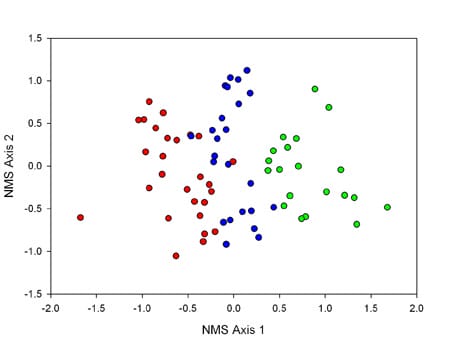
We hypothesized that this third community type represents a native community type referred to in other regions as shortleaf pine-oak-hickory. We compared groundcover plant species composition in 100 square meter plots, tree species composition in 20 meter radius circular plots (1256 m2), and soil characteristics at more than 20 locations in each of the three community types on Tall Timbers Research Station (Florida) and Pebble Hill Plantation (Georgia). Multivariate analysis ((NMS), see scatter plot graph below) showed the three community types to be distinct in their species composition.
Results from Nonmetric multidimensional scaling (NMS) multivariate analysis of 100 m2 plots. Proximity of symbols indicates similarity in species composition and color represents community type, where green is longleaf pine-wiregrass, blue is shortleaf pine-oak-hickory, and red is old-field pine.
Of the total 225 plant species identified, indicator species analysis identified 54 species significantly associated with longleaf pine-wiregrass, 15 species associated with shortleaf pine-oak-hickory, and 25 species associated with old-field community types. Longleaf pine-wiregrass and shortleaf pine-oak-hickory communities showed greater depth of the topsoil than old-field communities, suggesting less of the erosion typically associated with old-field communities. Shortleaf pine-oak-hickory forests also had the highest concentrations of calcium, potassium, magnesium, and manganese of the three community types, which may partly explain the difference in species. These results are consistent with our hypothesis, suggesting that native shortleaf pine/oak/hickory forests should be recognized according to their indicator species and protected from further soil disturbance and conversion to other land uses.
Longleaf pine cone prospects for this fall – well there is always next year
By Dr. Ron Masters, Director of Research
The forecasts for longleaf cone crops are now out for 2011 and 2012. The crop for the Red Hills area is slightly better than last year but still is very poor for this fall, based on cone production from Tall Timbers and the closest sampling areas. Tall Timbers’ cone crop was one of the lowest recorded this year. Across the broader Coastal Plain the longleaf cone crop is rated a high fair. However, there is a lot of variation in cone counts in north Florida and in south Georgia, so your property might have better potential than our sampling. Given the natural variability of longleaf cone production, we would expect that a few areas in the Red Hills might have fair to good production. The likely crop in 2012 will be fair, based on the number of flowers this past spring. However predictions from flowers are not as reliable as cone counts. Often fewer than half will survive to become conelets the following year, as in our case at Tall Timbers this year.
Cone crop estimates from Tall Timbers (7 cones/tree) are well below the southeast regional average (48 cones/tree) for longleaf, and will not provide adequate seed to meet regeneration needs this year (Figure 1). Although some longleaf seed is generally produced each year even in poor years, the seed is highly sought after by quail and other ground foraging birds, as well as small mammals and turkey, because of its excellent nutritional quality. Typically an average of 30 cones/tree, with at least 25 mature (14-16 inch dbh) cone producing trees per acre, is considered to be the minimum requirement for successful regeneration of longleaf. The 46-year regional average is 28 cones/tree. Since 1983, the cone crop has generally been increasing across the region.
Figure 1. A comparison of longleaf cone counts on Tall Timbers (Red Hills) and averaged across the southeast region from Louisiana to North Carolina in 2010 and 2011.
This data is compiled and reported every year by Dr. Dale Brockway, Southern Research Station, U.S. Forest Service stationed in Auburn, AL. The survey samples sites from Louisiana to North Carolina and includes samples from a longleaf area on Tall Timbers Research Station. Each year binocular counts of conelets and flowers are made on 10 selected tree crowns from a single ground location at each of the cooperating sample sites. This long-term data is extremely beneficial as it gives us an understanding of the natural variability in longleaf seed crops across the region, and what we might expect locally for future planning of regeneration in relation to stand management.
Eric Staller, Natural Resources Coordinator, counting longleaf cones on Tall Timbers to determine seed crop for this fall.
Be sure to check the cone crop on your property and specifically in the stands where you may be seeking to develop regeneration. Longleaf cones are large and conspicuous so it is not exactly ‘rocket science’ to get an indication of the cone crop on your trees and in your stands. We recommend that you use this report as a prompt to go take a look at your stands. In years like this, you may want to consider planting containerized seedlings to achieve your regeneration needs, if they are pressing. Or you might consider banking whatever regeneration you get and waiting until next year to do your site preparation.
Florida Congressman Steve Southerland visits Tall Timbers
By Rose Rodriguez, Information Services Manager
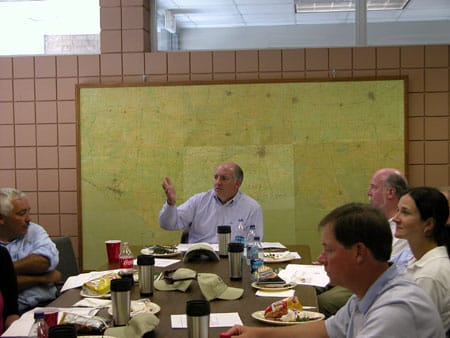
On June 7, Congressman Steve Southerland, who represents Florida’s Second District, visited Tall Timbers, on a fact-finding mission, to learn more about the issues regarding management and conservation of our natural resources that affect north Florida. Congressman Southerland sits on the House Committee for Agriculture, and the subcommittee that includes conservation and forestry, as well as the House Committee on Natural Resources and the subcommittee that deals with wildlife. Key staff from Tall Timbers and Southeast Fire Ecology partners from the US Forest Service and National Park Service, Erica Taecker and Caroline Noble, respectively, attended the working lunch meeting with the Congressman, his legislative staff and guests.
Congressman Steve Southerland, center, at Tall Timbers for a working lunch. L-R, Tim Southerland, Steve Southerland, Shane Southerland (foreground), Erica Taecker and Kevin McGorty.
Executive Director, Lane Green, gave an overview of Tall Timbers and the Red Hills region. The Director of Research, Ron Masters, discussed research conducted at Tall Timbers and forest management in the Red Hills region — the private land model and selective timber harvest. And, Game Bird Program Director, Bill Palmer, discussed the Upland Ecosystem Restoration Project (UERP), a successful public lands management model in Florida coordinated by Tall Timbers.
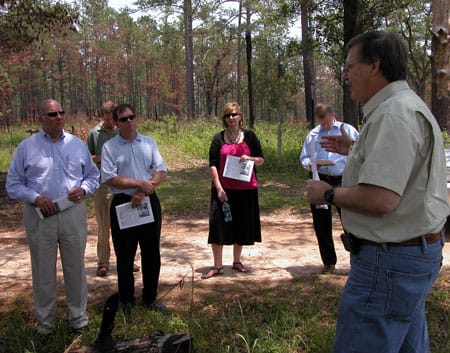
After lunch, Southerland and his staff were taken on a tour of Tall Timbers, with stops at the Stoddard Fire Plots and the Red-cockaded Woodpecker (RCW) cavity cluster trees. At the fire plots, Masters and Palmer discussed the importance of fire, the need for more fire in the Southeast, the causes of species declines, and cost-share/Farm Bill issues. At the cluster of RCW cavity trees, it was stressed that RCWs, a federally endangered species, coexist with game and timber management in the Red Hills, and that using the UERP model, RCWs are compatible with management of public lands.
Congressman Southerland, far left, and his staff listen to Director of Research, Ron Masters, far right, discuss burning frequency at the Stoddard Fire Plots.
After the tour, Land Conservancy Director, Kevin McGorty, discussed conservation easements and the need to make the enhanced easement incentives, which were renewed through 2011 for easement donors, permanent in this 112th Congress.
Photography volunteer, Beate Sass, exhibits photos taken at Tall Timbers
By Rose Rodriguez, Information Services Director
Tall Timbers is fortunate in the dedication and talents of it volunteers. Beate Sass is one of our volunteers who has lent her photographic talents to Tall Timbers on several occasions: Open House, the Naturalists’ Ball, and History and Archaeology Day; she even took the most recent photo of our Board of Trustee for the Annual Report. Of special interest to her, however, are the tenant families who lived on Tall Timbers during its time as a hunting plantation and the stories they have to tell; the Jones Family Tenant Farm; and the architecture and artifacts of the Beadel House, the home of Tall Timbers Research Station benefactor, Henry Beadel. Beate has taken many outstanding photographs of these subjects, creating a portfolio she calls Tall Timbers Plantation.
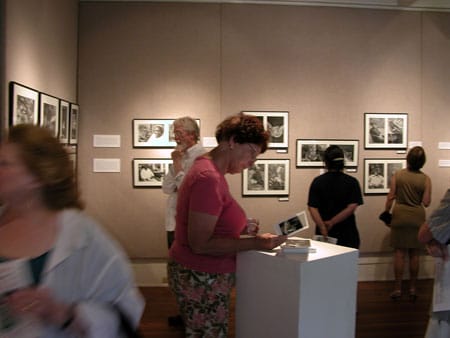
The fine quality of her photography has been recognized by LeMoyne Center for the Visual Arts in Tallahassee. The black and white photos of her Tall Timbers Plantation project were chosen for LeMoyne’s Dog Days – Summer in the South Photographers Interpretation exhibit. The portfolio on exhibit is grouped as follows: Portraits (photos combined into diptychs, with the left panel being of the individual and the right panel of an object special to them); The Jones Family Tenant Farm, The Landscape, and Light, Form and Expression in the Beadel House.
The exhibit opened June 6 and will continue through June 24. To view Beate’s photography, including the photos that are in the LeMoyne exhibit, visit her web site: http://beatesassphotography.com/. For gallery hours and more information about LeMoyne, visit their web site: http://www.lemoyne.org/.
Geraldine Jones Thompson stands in front of her portrait and that of her brother, Richard Jones, at the exhibit opening. Photos by Rose Rodriguez.
Supervise smoke from logging piles, and take extra caution to contain pile fires during these dry conditions.
Conduct post-burn evaluations to determine success of woody control.
Forestry
Finish timber harvests and clean up operations by mid to end of June.
Avoid having heavy equipment in the woods when soils are wet.
Where adequate longleaf cone crops are present continue conducting burns to capture seed fall that will occur later in the year. Some regrowth of understory vegetation will lower seed predation by providing some cover for seed.
Game Bird
Continue to supplemental feed at 1 to 2 bu/ac/yr. Adjust as necessary given weather conditions.
Nest predator management if needed.
Begin to mow roads as needed.
Begin herbicide applications for bicolor and bahia grass control.
Land Management
Continue treating cogon grass infestations as weather permits.
Disk strips to encourage the production of Florida pussley, a highly preferred deer forage.
Get soil tests for fall food plots at least once every two years.
Continue planting summer food plots.
Apply lime according to soil test results.
In most parts of Florida, June is usually the last month to plant aeschynomene (joint vetch), to achieve adequate reseeding in November.
Vertebrate Ecology
Leaving dead trees or snags provides valuable habitat for cavity nesters
One of the loudest songsters in our Pinewoods this time of year is the elusive Bachman’s Sparrow. This endemic sparrow is abundant on sites burned within the past 12 months, but its numbers can be almost halved on sites coming into a 2-year rough. The Bachman’s Sparrow is often thought to have one of the prettiest songs of any songbird, and to hear an example, simply follow this link: http://www.flmnh.ufl.edu/natsci/ornithology/sounds.htm
Lots of fledgling birds wandering the woods. Many use small brushy thickets, so hold off on mowing until late August if possible. Also a good time to keep cats in doors.
Gopher tortoise nesting reaches a peak in early June. Watch for females laying eggs and consider nest protection and predator-proof fencing.
Female free-tailed bats give birth to a single pup from May to June.
Pine snakes lay 5–12 large eggs in a burrow during June or July. The young hatch a couple of months later and start to look for mice and other rodents.
July Management Recommendations
Fire Ecology
If the rains return and prescribed burning is allowed, focus burning efforts on sites with native ground cover. Old field vegetation does not burn well unless the fuel composition is greater than 25% grass cover.
Conduct post-burn evaluations to determine success of woody control.
Forestry
Conduct survival checks on planted pines.
Avoid thinning and logging operations during wet weather.
Game Bird
Supplemental feed at 1-2 bu/ac/yr.
Nest predator management if needed.
Mow roads.
Land Management
Plant chufas.
Plant millet for dove food plots.
Planting by mid-month is usually considered the best time to have most types of millet ready just before the October first phase of dove season in Florida.
Continue planting other summer food plots.
Vertebrate Ecology
It’s hot, but the early phase of shorebird migration occurs later this month with early records for Spotted Sandpipers.
Fledgling red-cockaded woodpeckers start looking for roost cavities to use at night beginning in late July.
Early flowering of some fall flowers commences in late July and will start to attract native butterflies.
Fox squirrels initiate a full tail molt during July-August
Second fox squirrel litters can be initiated in July and August. Older females in good physical condition usually produce litters of 2-5 young twice each year when food supplies are good.
Eastern diamondbacks give live birth to 10-14 young between July and October, but females may not breed every year.
The M-CORES program, which includes the proposed Suncoast Connector Toll Road in Jefferson County, passed through the Florida Legislature at breakneck speed with little review or analysis. Tall Timbers has a number of concerns given the potential for significant and wide spread impacts. These include fragmenting public and private conservation lands, robbing business from Main Street Monticello, impacting our rivers and other water resources, and making prescribed fire more difficult and costly.
Join us in asking the Jefferson County Board of County Commissioners to OPPOSE the Suncoast Connector toll road and its path through Jefferson County.
Take action now with our easy email form.
Send an email to all five Jefferson County Board of County Commissioners with one click!
Selected Publications authored by Wildland Fire Science staff.
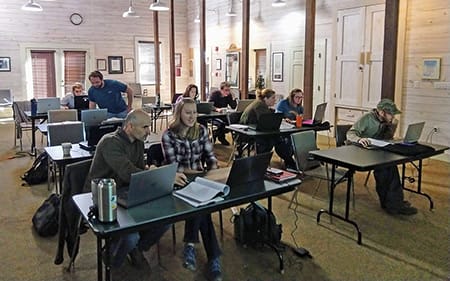
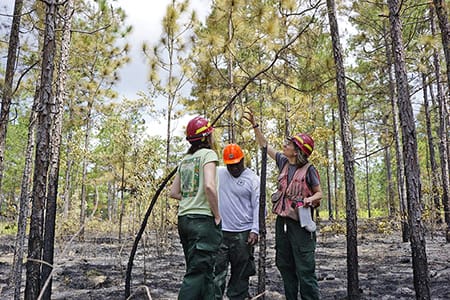
Educating and guiding the next generation of fire researchers and managers is a key goal of Wildland Fire Science and a resource for testing new ideas in fire research.
Tall Timbers hosts the Prescribed Fire Science Consortium, a national network of researchers and managers who promote integrated research and management to advance next generation tools for fire practitioners. https://arcg.is/1DSjDT
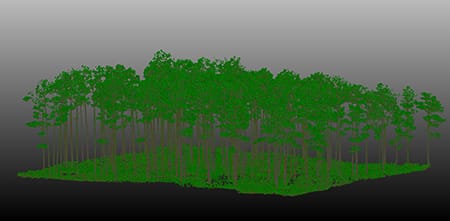
Working with partners in the Prescribed Fire Science Consortium, the program is building nexgen 3-D fuel beds using terrestrial LiDAR and novel sampling techniques to power new fire behavior models for prescribed fire managers. This work links to Tall Timbers work in wildlife habitat usage and ecological forestry.
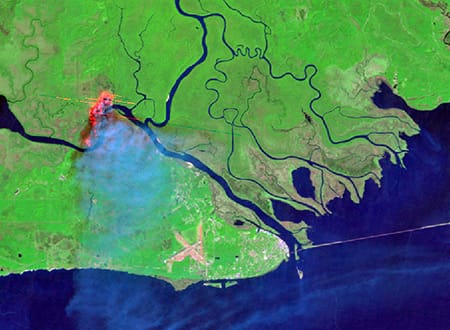
Tall Timbers is leading an effort to map fire regimes at the landscape scale. Staff work with numerous agencies to evaluate fire records and satellite imagery to build this critical conservation database. https://skfb.ly/6DqOY
We are linking physics and field observations to understand the fluid dynamics of fire behavior surface fire regimes. Our work combines field observations using advanced thermal imaging techniques, laboratory studies, and coupled fire-atmospheric modeling to help managers improve outcomes of managed fire regimes.
Burn prioritization modeling seminars and fire modeling tools are supported by Wildland Fire Science to train managers in the important planning stages of prescribed fires.
The conserved lands of the Greater Red Hills region are found on working, income-producing properties that support agriculture, forestry, and recreational hunting. These properties contribute $272 million annually to local economies and support 2,300 jobs. [link to Planning & Advocacy section] The landowners’ strong stewardship ethic preserves their working lands while replenishing drinking water supplies, protecting water quality, and providing wildlife habitat for dozens of rare and endangered species. Tall Timbers’ conservation easements on these working properties encourage landowners to retain their traditional livelihood by keeping farms in family ownership.
Home to world-class wild quail populations, the Greater Red Hills region contains the largest concentration of gamebird preserves in the United States. These preserves also support the largest community of Red-cockaded woodpeckers on private lands. Indicators of high quality habitat found here include the gopher tortoise, Bachman’s sparrow, fox squirrel, and many amphibians. Tall Timbers’ conservation easements identify and protect the critical habitats of these species.
The region also boasts outstanding aquatic resources. Large river systems, like the Flint/Apalachicola, Ochlockonee, and Aucilla, flow from Georgia and feed into the Gulf of Mexico to support some of the world’s most productive estuaries. Large disappearing sinkhole lakes, like Iamonia, Miccosukee, and Jackson, provide habitat for an array of aquatic species and migratory birds. Tall Timbers’ conservation easements protect these vital watersheds and wetlands that are the lifeblood for the ecological health of the region.
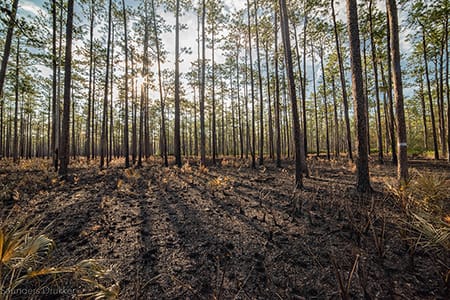
Once dominated by longleaf pine, our pine woodlands support abundant wildlife and local economies. These forests need prescribed fire to stay healthy. Herbert L. Stoddard and his associates Ed and Roy Komarek were pioneers in this emerging scientific field during the mid-20th century. Tall Timbers continues that legacy with applied research on prescribed fire and land management. Today, there is a tremendous need to expand prescribed fire use beyond the Red Hills to ensure ecosystem health and reduce wildfire risk. Additionally, Tall Timbers uses conservation easements to permanently protect private woodlands while balancing the need for economic return from selective timbering.
Tall Timbers hosts the premier fire technology transfer organization—the Southern Fire Exchange. This JFSP funded effort helps connect research to management through webinars, workshops, and support of the Prescribed Fire Science Consortium.
The Longleaf Legacy landscape prescribed fire burn team arm of Wildland Fire Science works directly with landowners and partners to effectively put fire on the ground and promote prescribed fire throughout the region.
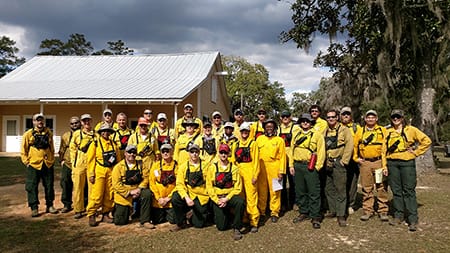
Staff and researchers support Federal fire training by serving as a cadre for NWCG training courses, ranging from basic wildland fire to advanced fire effects.
(PFTC) specializes in training fire fighters the principles and techniques of prescribed fire through practical hands-on experience. https://www.fws.gov/fire/pftc/
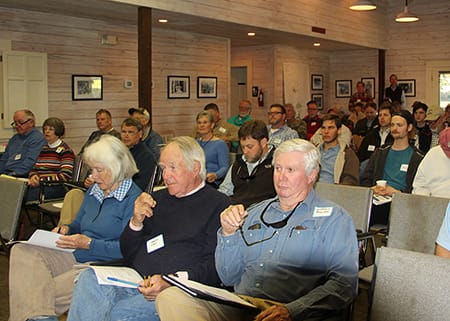
Private land owners are the largest source of prescribed fire in the country. These land owners and the culture of fire that was maintained by them during decades of suppression are a part of why Tall Timbers is a world-wide center for prescribed fire science. Workshops and fire training are a critical focus of the Longleaf Legacy Landscape Burn Team and our support of the Georgia Forestry Commission Prescribed Fire Center in Marion County.



.jpg?strip=all&lossy=1&w=600 "Using binoculars to count cones")
 Tall Timbers is fortunate in the dedication and talents of it volunteers. Beate Sass is one of our volunteers who has lent her photographic talents to Tall Timbers on several occasions: Open House, the Naturalists’ Ball, and History and Archaeology Day; she even took the most recent photo of our Board of Trustee for the Annual Report. Of special interest to her, however, are the tenant families who lived on Tall Timbers during its time as a hunting plantation and the stories they have to tell; the Jones Family Tenant Farm; and the architecture and artifacts of the Beadel House, the home of Tall Timbers Research Station benefactor, Henry Beadel. Beate has taken many outstanding photographs of these subjects, creating a portfolio she calls Tall Timbers Plantation.