The net population trend in the Red Hills last year (2015|16 hunting season) was relatively flat-lined with wide ranging variation throughout the region such that bobwhite abundance was up or down by as much as 30%. Based on early reports from managers combined with covey call counts on numerous properties and radio-telemetry work in the region, we suspect a similar story this hunting season, but for different reasons.
Overall production this year was lower than last year, but male incubation rates were much higher (22% of all males radio-tagged incubated a nest this breeding season) and brood production remained above the long-term average. However, bobwhite carryover was good going into the breeding season and hens were in good condition due to a relatively mild winter. Clutch sizes were 2 to 3 eggs larger compared to long-term averages. Chick survival was also nearly 2x better this year compared to last year, a purported boon to fall recruitment. This has been corroborated by observations of large covey sizes and mixed ages/sizes of birds reported by several managers and dog handlers. A welcomed late hatch was evident but was not as strong compared to banner years of the past – low adult survival during the breeding season resulted in fewer hens making it in August/September and pulling of a last successful clutch. Taken collectively, 2016 was an average reproductive effort. As such, we expect that bobwhite numbers will be similar to last year’s or slightly off from last year, depending on localized conditions, but given more consistent production and improved chick survival throughout the region we expect bobwhite trajectories from property to property to be less variable (±15% from stable).
Native food availability may impact covey behavior and foraging activity during early hunting season. For example, we have observed several coveys feeding on the ample acorn mast produced by live oaks and water oaks over the past couple of weeks. Thus, covey fidelity to the feedline may be lower and/or less intense to start the 2016|17 hunting season. And, dry weather will yield challenging hunting conditions for many during opening weekend of quail season here in the Red Hills. Hunting early to capitalize on moisture from morning dews may help hunting success during these dry periods.
New project to study the benefits of restoring pine-grassland
By Kevin Robertson, PhD, Fire Ecology Program Director
The Fire Ecology Program was recently awarded a grant from the Agriculture and Food Research Initiative of the U.S. Department of Agriculture to study the ecological and societal benefits of restoring pines and frequent fire to land with a history of agriculture. The original longleaf pine-grasslands of southeastern U.S. Coastal Plain have mostly been converted to crop lands, pasture, pine plantation, fire-excluded hardwood forests, or urban development. These changes often bring reduction in ecosystem services, such as clean water yield to rivers and lakes, plant biodiversity, wildlife habitat, pollinators, nutrient retention, and others. Restoration of pine-grasslands, which includes the reintroduction of frequent fire, is expected to reverse the loss of many of these ecosystems services, but there has been little work to measure the effects of such restoration on previously disturbed habitats, or how quickly it results in various benefits over time.
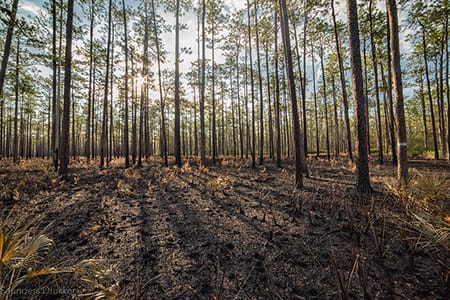
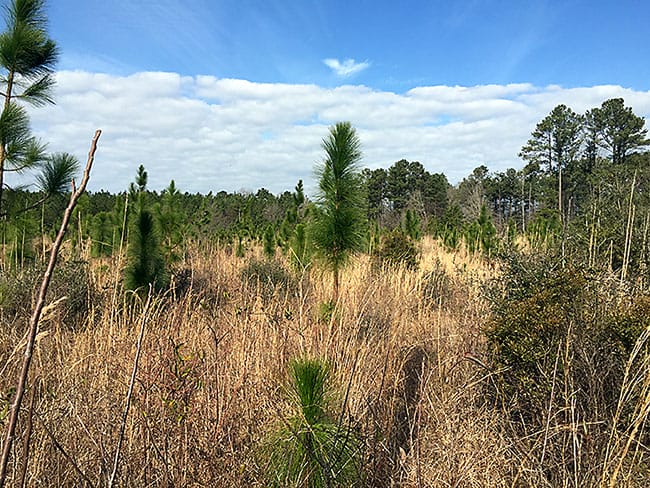
Longleaf pine-grassland ten years after planting and re-introduction of fire. Photo by Kevin Robertson
Funds for the study will be used to hire a field biologist for two years to measure plant species composition, soil characteristics, forest structure, and bee abundance and diversity in areas that vary in time since restoration of pines and fire within and around the Red Hills Region. We will also compare restored areas with crop lands, pasture, unburned pine plantations, and native longleaf pinelands to assess benefits relative to other land uses and assess to what degree historic ecosystem services can be restored with fire and timber management alone.
The project was funded as a “seed grant” to gather preliminary information for a project with broader scope to be potentially funded in the future. The larger project would use the information from the current study to predict effects of restoring 20% of local agroecosystems (landscapes dominated by typical rural land uses) to pine-grassland under different climate and economic scenarios. Look for updates on this new project in future eNews articles.
“Hot” topics for bobwhite: hunt success, weather forecast and burning
By Theron M. Terhune, PhD, Game Bird Program Director
It was so “hot” the other day that for the first time in a long while, I actually opted not to go quail hunting! This season has been a roller coaster of climatic shifts—warm…cold…lots of rain…no rain…hot…dry. And so goes the hunting success for much of the region.
Reports from hunters and managers indicate that quail populations are similar to our predictions from the early fall covey counts; bobwhite abundance is either about the same or moderately down from previous years. Many properties are experiencing a 5-15% reduction in coveys moved per hour compared to previous hunting seasons. However, the narrative may not be as bleak as it seems for a couple of reasons.
First, warmer than average temperatures combined with later than normal hard frosts have created less than ideal hunting conditions and denser cover well into January, making finding and pointing birds more difficult. This negative impact on hunt success alternatively benefits adult survival. In the Albany area, adult survival is well above average, whereas survival in the Red Hills region is similar to or slightly above long-term averages. When weather conditions have been better, however (following rain and/or cool weather), hunting reports were more on par with what we have become accustom to in the Red Hills and Albany regions.
Second, a common theme reported throughout the region, with a handful of exceptions, is that covey sizes are larger than average this hunting season. We are still seeing some coveys with 18–20 or even more birds well into February. Increased covey sizes may result in fewer total coveys, which would dampen overall hunt success in terms of coveys moved per hour. Interestingly, our research on bobwhite chicks shows a potential developing trend linking chick survival with covey size. That is, when chick survival is good, covey size tends to be good. For example, this year coveys sizes are well above average and chick survival, especially during late breeding season, was nearly double that of the previous 2 years. Coveys sizes last hunting season were reportedly smaller than average. In addition, during our January trapping on Tall Timbers, we captured 40% more of our banded chicks than compared to previous years, and on multiple occasions we captured siblings (i.e., hatched from the same clutch and wing-tagged at 11 days of age) still together in the same covey. The variation in chick survival from year to year and site to site is still a puzzle the Game Bird Program is focusing on, with the goal of finding pragmatic management solutions.
Beta (at left) and Gerti (at right), cool off during a hot day’s hunt
Weather forecast and burning for bobwhites
We have observed quite the shift in weather pattern over the course of the past few months, experiencing sporadic activity since September—periods of excessive rainfall and periods of little to no rainfall. In October, Hurricane Matthew rambled through the region dropping copious rainfall throughout much of north Florida. On average, temperatures are higher than normal. La Niña has played a significant weather role over the last few months, especially with regard to high temperatures. NOAA Climate Prediction Center forecasts that frontal passages will be the primary catalyst for rainfall in upcoming months, followed by short periods of cooler temperatures and drier conditions for variable periods of time. NOAA’s prediction is that as the current, weak La Niña weather pattern comes to an end by spring, we will experience above average temperatures, below average rainfall and increased potential for drought conditions. As such, we may see the number of days for prescribed burning decrease.
What does this mean for burning in 2017? There are numerous factors to consider when considering what to burn, when to burn and how to burn, including previous burn history—what was or was not burned last year. Stoddard deemed the bobwhite the “firebird” and for good reason. We often say you can have the application of fire and not have good quail numbers, but you cannot have good quail densities without the proper application of fire. It is one of the pendulums in management, where finding and applying the appropriate balance between frequency, scale, and season can pay huge dividends; whereas swings too far from that balance can have devastating results. This balance is site specific so that every property is different and may require a different burn strategy. An important trade-off every property must consider, however, is maintaining adequate cover for bobwhites for protection from their winged enemies, especially during the raptor migration in March, while getting the burning done prior to potential burn bans associated with drought conditions.
That said, and given the weather forecast, we recommend taking advantage of those good burn days whenever possible, but continue to burn at a small scale (40-60 acre blocks) in a patchy mosaic. We recommend burning conservatively at 45 – 55% of the uplands during late February through April, and if sufficient rainfall occurs, the option to burn additional acreage later in the season will be a bonus. Late-season burns are known to provide exceptional brooding habitat during late summer, especially on sites with higher soil fertility.
Adult survival is crucial to good reproductive output and population increases, so a manager’s goal this time of year should be focused on protecting adults through quality cover management and proper application of fire. Careful burning and maintaining a sound supplemental feeding program is crucial. Although the season is not yet over, it’s never too early to begin preparing for next year’s crop of birds!
Private sports-hunting properties in Florida and Georgia provide unique opportunities for enhancing populations of several iconic species associated with longleaf pine ecosystems. For example, sports-hunting properties in the Red Hills region support the largest population of Red-cockaded Woodpeckers remaining on private lands as well as scores of additional rare species. The Red Hills woodpecker population consists of over 170 breeding groups and has been instrumental in establishing new woodpecker populations on other private properties.
Recent changes in the policies governing woodpecker translocations provide a unique opportunity for using the Red Hills population to help expand woodpecker populations on additional private properties. Prior to 2016, private properties with Safe Harbor Agreements had to accept responsibility for any woodpeckers that biologists translocated onto the property. Safe Harbor Agreements typically reduce the liability a property owner has if woodpeckers increase on their property as a result of beneficial management. However, in cases where a property was geographically isolated from a source population of woodpeckers, the landowner could be doing everything possible to encourage woodpecker growth and expansion, but the management was not likely to provide benefits unless the owner also was willing to accept additional responsibilities for translocated woodpeckers.
This policy change opens up new opportunities for increasing woodpecker populations on dozens of private lands in Georgia and Florida with increasing liability. Tall Timbers has had several property owners ask whether woodpeckers might be moved onto their properties after a Safe Harbor Agreement had been signed. The answer has always been yes IF the landowner was willing to accept additional responsibilities. With this change, no additional responsibilities will be encumbered.
Tall Timbers will be working Georgia Department of Natural Resources and Florida Fish and Wildlife Conservation Commission over the coming month to use this opportunity to expand woodpecker populations on other private lands in Georgia and Florida. We first plan to bolster the Red Hills population by increasing populations on several properties that currently are below carrying capacity. After this is completed, we can consider establishing new populations on other private properties that might help to establish new populations outside the Red Hills region.
If you’d like to hear more about the Safe Harbor Program and the possibilities created by this change in policy, contact Jim Cox: jim@ttrs.org; 850-893-4153 ext.223 or Kim Sash: ksash@ttrs.org; 850-893-4153, ext. 336.
By Dr. Theron M. Terhune, Game Bird Program Director
The 2017 breeding season is in the books, but not without a dramatic late push to the finish line. Despite birds getting out of the gate quickly, with the first nest found on May 1 (about 1 week early than normal), bobwhite per capita production in the Red Hills remained low compared to long-term averages for much of the season. While dodging hurricanes, ample rainfall throughout the summer fueled vegetation growth, which produced above average adult survival, especially in the Albany region.
Good over-winter and breeding season adult survival set the stage for a profitable late hatch. We observed three distinct peaks in hatching this year: an early hatch in late-May to early-June; the primary hatch during July; and a brilliant late hatch in September and early-October (see Figure). For some in the region, the first hatch was poorly timed with a 4+ inch localized rainfall event, which impacted chick survival, whereas others received less than an inch of rainfall, and likely experienced minimal impact on chick survival. The primary hatch was decent, but below average in the Red Hills. The late hatch, however, was one of the strongest we have seen in over a decade!
On Dixie and Tall Timbers combined, 21 nests incubated in September/October resulted in 16 successful clutches (76%). And, on Tall Timbers, 26% of brood production for the entire season occurred in September (see Figure; late hatch circle), nearly double that of long-term averages. We also observed multiple nests hatching in early October, which can improve chances for fall recruitment, and is purportedly linked to some of the better hunting seasons in years past (such as 2003, 2008 and 2012). When combined with good clutch sizes and overall good chick survival this year through the summer, it seems as though production and fall recruitment is above average for most in the Red Hills, and one of the best observed in four years in the Albany region.
Preliminary reports of large covey sizes are also encouraging. Whereas the late hatch bailed out many this year from an at best pedestrian early and primary hatch, for some it may be a late hatch to remember such that the imminent threats of Irma were circumvented with a potential increase of 5-15% in bobwhite abundance this fall. Happy hunting and watch out for those squealers!
The M-CORES program, which includes the proposed Suncoast Connector Toll Road in Jefferson County, passed through the Florida Legislature at breakneck speed with little review or analysis. Tall Timbers has a number of concerns given the potential for significant and wide spread impacts. These include fragmenting public and private conservation lands, robbing business from Main Street Monticello, impacting our rivers and other water resources, and making prescribed fire more difficult and costly.
Join us in asking the Jefferson County Board of County Commissioners to OPPOSE the Suncoast Connector toll road and its path through Jefferson County.
Take action now with our easy email form.
Send an email to all five Jefferson County Board of County Commissioners with one click!
Burn prioritization modeling seminars and fire modeling tools are supported by Wildland Fire Science to train managers in the important planning stages of prescribed fires.
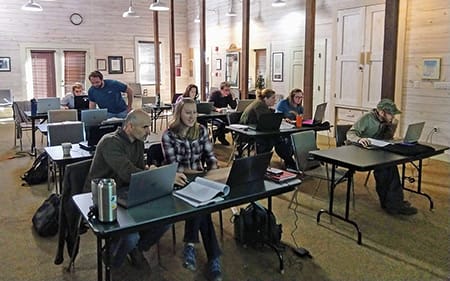
Educating and guiding the next generation of fire researchers and managers is a key goal of Wildland Fire Science and a resource for testing new ideas in fire research.
Tall Timbers hosts the premier fire technology transfer organization—the Southern Fire Exchange. This JFSP funded effort helps connect research to management through webinars, workshops, and support of the Prescribed Fire Science Consortium.
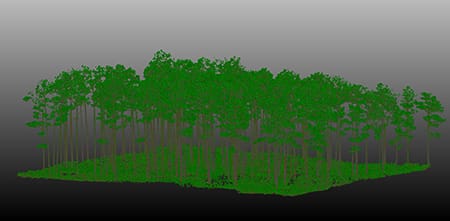
Working with partners in the Prescribed Fire Science Consortium, the program is building nexgen 3-D fuel beds using terrestrial LiDAR and novel sampling techniques to power new fire behavior models for prescribed fire managers. This work links to Tall Timbers work in wildlife habitat usage and ecological forestry.
The Longleaf Legacy landscape prescribed fire burn team arm of Wildland Fire Science works directly with landowners and partners to effectively put fire on the ground and promote prescribed fire throughout the region.
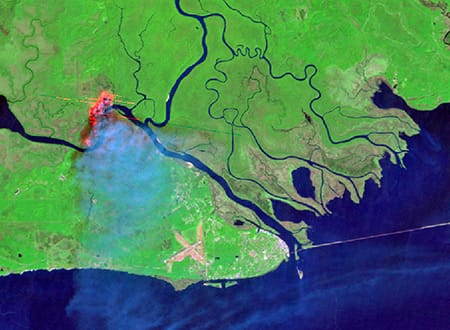
Tall Timbers is leading an effort to map fire regimes at the landscape scale. Staff work with numerous agencies to evaluate fire records and satellite imagery to build this critical conservation database. https://skfb.ly/6DqOY
Tall Timbers hosts the Prescribed Fire Science Consortium, a national network of researchers and managers who promote integrated research and management to advance next generation tools for fire practitioners. https://arcg.is/1DSjDT
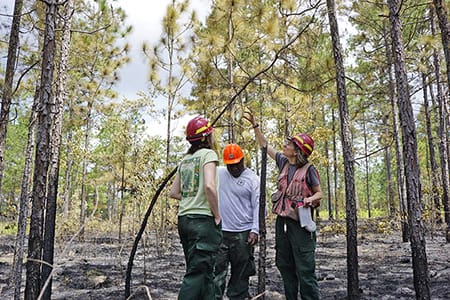
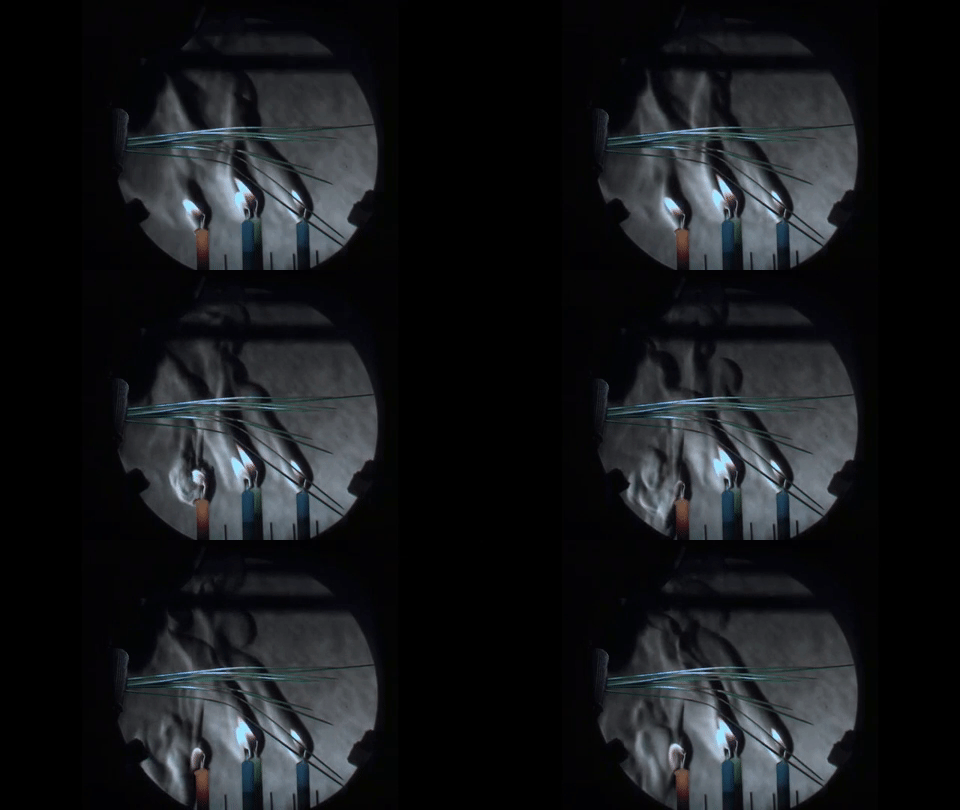
We are linking physics and field observations to understand the fluid dynamics of fire behavior surface fire regimes. Our work combines field observations using advanced thermal imaging techniques, laboratory studies, and coupled fire-atmospheric modeling to help managers improve outcomes of managed fire regimes.
Selected Publications authored by Wildland Fire Science staff.
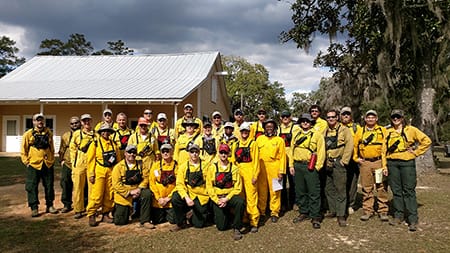
Staff and researchers support Federal fire training by serving as a cadre for NWCG training courses, ranging from basic wildland fire to advanced fire effects.
(PFTC) specializes in training fire fighters the principles and techniques of prescribed fire through practical hands-on experience. https://www.fws.gov/fire/pftc/
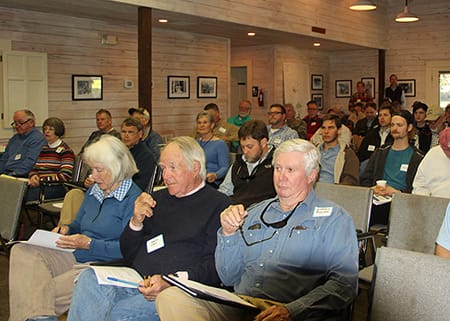
Private land owners are the largest source of prescribed fire in the country. These land owners and the culture of fire that was maintained by them during decades of suppression are a part of why Tall Timbers is a world-wide center for prescribed fire science. Workshops and fire training are a critical focus of the Longleaf Legacy Landscape Burn Team and our support of the Georgia Forestry Commission Prescribed Fire Center in Marion County.
The conserved lands of the Greater Red Hills region are found on working, income-producing properties that support agriculture, forestry, and recreational hunting. These properties contribute $272 million annually to local economies and support 2,300 jobs. [link to Planning & Advocacy section] The landowners’ strong stewardship ethic preserves their working lands while replenishing drinking water supplies, protecting water quality, and providing wildlife habitat for dozens of rare and endangered species. Tall Timbers’ conservation easements on these working properties encourage landowners to retain their traditional livelihood by keeping farms in family ownership.
Home to world-class wild quail populations, the Greater Red Hills region contains the largest concentration of gamebird preserves in the United States. These preserves also support the largest community of Red-cockaded woodpeckers on private lands. Indicators of high quality habitat found here include the gopher tortoise, Bachman’s sparrow, fox squirrel, and many amphibians. Tall Timbers’ conservation easements identify and protect the critical habitats of these species.
The region also boasts outstanding aquatic resources. Large river systems, like the Flint/Apalachicola, Ochlockonee, and Aucilla, flow from Georgia and feed into the Gulf of Mexico to support some of the world’s most productive estuaries. Large disappearing sinkhole lakes, like Iamonia, Miccosukee, and Jackson, provide habitat for an array of aquatic species and migratory birds. Tall Timbers’ conservation easements protect these vital watersheds and wetlands that are the lifeblood for the ecological health of the region.
Once dominated by longleaf pine, our pine woodlands support abundant wildlife and local economies. These forests need prescribed fire to stay healthy. Herbert L. Stoddard and his associates Ed and Roy Komarek were pioneers in this emerging scientific field during the mid-20th century. Tall Timbers continues that legacy with applied research on prescribed fire and land management. Today, there is a tremendous need to expand prescribed fire use beyond the Red Hills to ensure ecosystem health and reduce wildfire risk. Additionally, Tall Timbers uses conservation easements to permanently protect private woodlands while balancing the need for economic return from selective timbering.





 Native food availability may impact covey behavior and foraging activity during early hunting season. For example, we have observed several coveys feeding on the ample acorn mast produced by live oaks and water oaks over the past couple of weeks. Thus, covey fidelity to the feedline may be lower and/or less intense to start the 2016|17 hunting season. And, dry weather will yield challenging hunting conditions for many during opening weekend of quail season here in the Red Hills. Hunting early to capitalize on moisture from morning dews may help hunting success during these dry periods.