Volunteers are the life blood of any non-profit organization and Tall Timbers would like to recognize some of the volunteers that make our organization better. Our first featured volunteer is David Arnold.
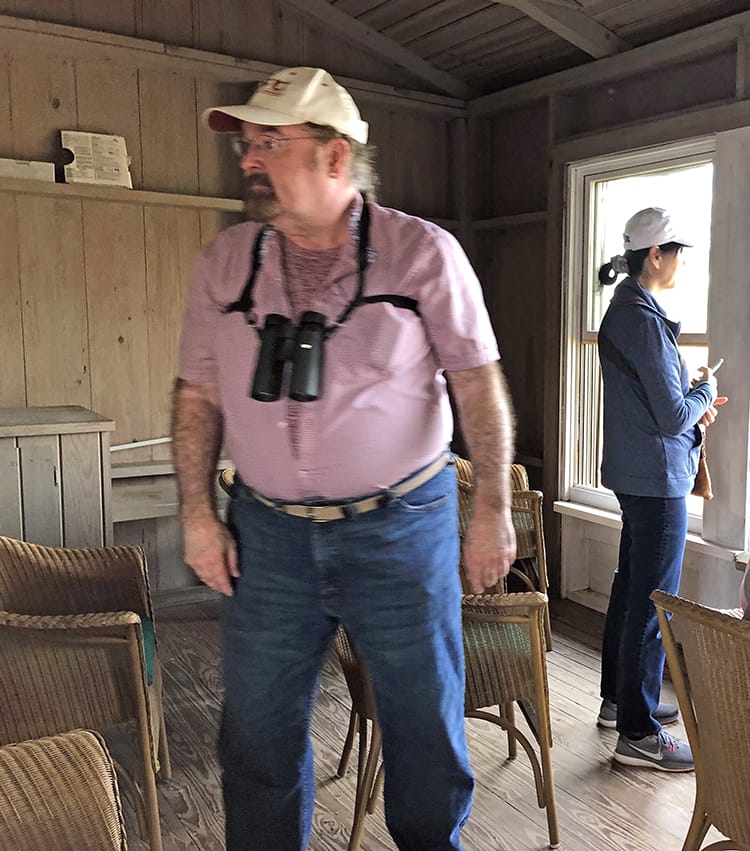
David Arnold at the Gannet Pond Bird Watch with a visitor.
David recently retired from the Florida Fish and Wildlife Conservation Commission (FWC). He came out for a Sunday afternoon Beadel House tour a few years ago and really enjoyed his interaction with the volunteers. He also renewed his acquaintance with Juanita Whiddon, a former FWC co-worker. She asked him to join the group and he came to the next monthly meeting.
As a long-time birder, he was a natural to take over the monthly Sunday afternoon tour stops at the Gannet Pond Bird Watch. David grew up along the Texas Gulf Coast with parents who got into birding when he was a teenager. He is a former president of the Apalachee Audubon Chapter and has also served on the Board of Directors. He enjoys pointing out birds at Tall Timbers to tour visitors, as well as explaining how important it is to have a variety of well-managed habitat types to support a diverse and healthy ecosystem.
David has also studied the history of Tall Timbers; he pitches in with other volunteers for special group tours of Tall Timbers’ historic buildings, and is a big help on volunteer “work days.”
Annual membership gifts help support the day-to-day operations of Tall Timbers and are the lifeblood of our organization. As a charitable nonprofit, Tall Timbers relies on the generous financial support of our members to help sustain the important research, conservation and education programs within the organization. Visit our Donate page to see how you can support Tall Timbers.
Tall Timbers has been busy this fall with fundraising, outreach and education events. Take a look at the events and the event sponsors who made it possible.
Thank you to all our Kate Ireland Memorial Dinner & Auction Sponsors, Attendees and Bidders. The evening was a huge success with over 300 attendees, 130 auction items, and new fundraising records set for the Tall Timbers Foundation. What a great privilege it was to honor Mr. Gene Phipps, a true steward of the Red Hills Region. Be sure to check our website for details on next years event!
Economics Trade-offs and Quail Management
Field Workshop
It was a hot and dusty September day in the woods in central Georgia, but it fit with the theme of making decisions and evaluating trade-offs. For those deciding to brave the heat and dust, the field tour provided a “wealth” of knowledge with a change in pace compared to our typical field days. Participants learned about implementing quail management on a dime by nickeling economic return, while managing multi-use objectives. Bobwhite quail remained a highlight and focal species, but not without first weighing the costs associated with operating expenses, balanced by revenue streams to remain in the black on a shoe-string budget. We greatly thank Queensborough National Bank and Trust for hosting the field day and workshop at Belmont Plantation!
Red Hills Fall Field Day
The 32nd Annual Fall Field Day hosted by Four Oaks Plantation provided more than 275 land owners, managers, and biologists an amazing opportunity to learn what plantation life is all about, but not without first leaving folks with a true understanding of what keeping up with the Jones’ means. A wagon tour of the property afforded breathtaking views of fishing lakes, duck ponds, and quail woods, as well as a glimpse into what world-class management looks like in the Red Hills. The field day was diverse—epitomizing the vast interests of the landowner and showcasing how true dedication, and a conservation ethic provides a rich and eclectic wildlife mecca in a quail-friendly way. As such, a wide array of topics was covered on the tour, where attendees heard about fisheries, deer, turkey, waterfowl, and quail management. Truly a marvelous day in the piney woods on a marvelous property in the Red Hills. Thank you Four Oaks!
South Carolina Bobwhite Funding Partnership Event & Auction
Central Florida Fall Field Day
The rangelands of central Florida provide some of the most unique and ubiquitous restoration potential left in the historic range of Northern Bobwhite Quail. Much like the area surrounding Tallahassee, Thomasville and Albany areas, thousands of acres of undeveloped land exist in central and south Florida. But, unlike the plantation belt of the Red Hills and Albany regions, the ranch lands in central and south Florida present unique challenges, such as overgrazing and water inundation, when managing for bobwhite. In just 3 years, Escape Ranch has experienced a 127% increase in bobwhite abundance, and participants at the field day learned how this was manufactured while touring through palmetto flatwoods, pastureland, and piney woods. In true central Florida fashion, the field tour was abridged by pop-up thundershowers, forcing the wagons to high-tail it back to the tent where we finished out the day. Rain and shine—it was a great day to be in the flatwoods and talking all things quail! A huge thanks to Escape Ranch owners and staff for hosting this magnificent day in the field in central Florida!
The M-CORES program, which includes the proposed Suncoast Connector Toll Road in Jefferson County, passed through the Florida Legislature at breakneck speed with little review or analysis. Tall Timbers has a number of concerns given the potential for significant and wide spread impacts. These include fragmenting public and private conservation lands, robbing business from Main Street Monticello, impacting our rivers and other water resources, and making prescribed fire more difficult and costly.
Join us in asking the Jefferson County Board of County Commissioners to OPPOSE the Suncoast Connector toll road and its path through Jefferson County.
Take action now with our easy email form.
Send an email to all five Jefferson County Board of County Commissioners with one click!
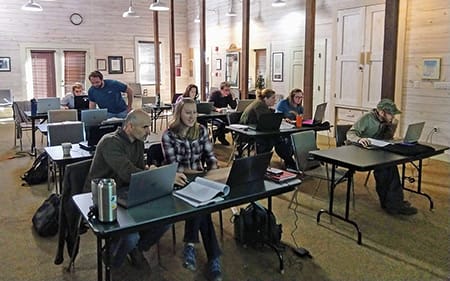
Burn prioritization modeling seminars and fire modeling tools are supported by Wildland Fire Science to train managers in the important planning stages of prescribed fires.
Educating and guiding the next generation of fire researchers and managers is a key goal of Wildland Fire Science and a resource for testing new ideas in fire research.
Tall Timbers hosts the premier fire technology transfer organization—the Southern Fire Exchange. This JFSP funded effort helps connect research to management through webinars, workshops, and support of the Prescribed Fire Science Consortium.
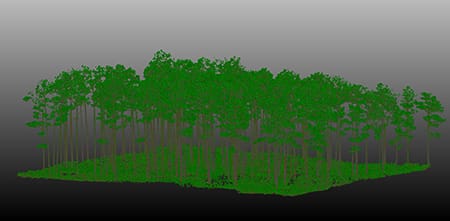
Working with partners in the Prescribed Fire Science Consortium, the program is building nexgen 3-D fuel beds using terrestrial LiDAR and novel sampling techniques to power new fire behavior models for prescribed fire managers. This work links to Tall Timbers work in wildlife habitat usage and ecological forestry.
The Longleaf Legacy landscape prescribed fire burn team arm of Wildland Fire Science works directly with landowners and partners to effectively put fire on the ground and promote prescribed fire throughout the region.
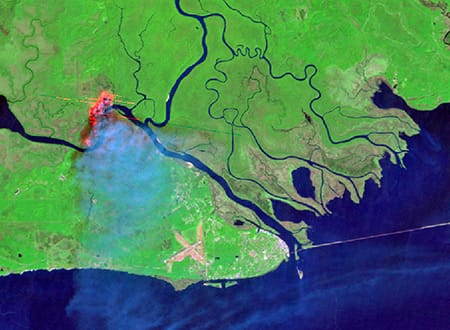
Tall Timbers is leading an effort to map fire regimes at the landscape scale. Staff work with numerous agencies to evaluate fire records and satellite imagery to build this critical conservation database. https://skfb.ly/6DqOY
Tall Timbers hosts the Prescribed Fire Science Consortium, a national network of researchers and managers who promote integrated research and management to advance next generation tools for fire practitioners. https://arcg.is/1DSjDT
We are linking physics and field observations to understand the fluid dynamics of fire behavior surface fire regimes. Our work combines field observations using advanced thermal imaging techniques, laboratory studies, and coupled fire-atmospheric modeling to help managers improve outcomes of managed fire regimes.
Selected Publications authored by Wildland Fire Science staff.
Staff and researchers support Federal fire training by serving as a cadre for NWCG training courses, ranging from basic wildland fire to advanced fire effects.
(PFTC) specializes in training fire fighters the principles and techniques of prescribed fire through practical hands-on experience. https://www.fws.gov/fire/pftc/
Private land owners are the largest source of prescribed fire in the country. These land owners and the culture of fire that was maintained by them during decades of suppression are a part of why Tall Timbers is a world-wide center for prescribed fire science. Workshops and fire training are a critical focus of the Longleaf Legacy Landscape Burn Team and our support of the Georgia Forestry Commission Prescribed Fire Center in Marion County.
The conserved lands of the Greater Red Hills region are found on working, income-producing properties that support agriculture, forestry, and recreational hunting. These properties contribute $272 million annually to local economies and support 2,300 jobs. [link to Planning & Advocacy section] The landowners’ strong stewardship ethic preserves their working lands while replenishing drinking water supplies, protecting water quality, and providing wildlife habitat for dozens of rare and endangered species. Tall Timbers’ conservation easements on these working properties encourage landowners to retain their traditional livelihood by keeping farms in family ownership.
Home to world-class wild quail populations, the Greater Red Hills region contains the largest concentration of gamebird preserves in the United States. These preserves also support the largest community of Red-cockaded woodpeckers on private lands. Indicators of high quality habitat found here include the gopher tortoise, Bachman’s sparrow, fox squirrel, and many amphibians. Tall Timbers’ conservation easements identify and protect the critical habitats of these species.
The region also boasts outstanding aquatic resources. Large river systems, like the Flint/Apalachicola, Ochlockonee, and Aucilla, flow from Georgia and feed into the Gulf of Mexico to support some of the world’s most productive estuaries. Large disappearing sinkhole lakes, like Iamonia, Miccosukee, and Jackson, provide habitat for an array of aquatic species and migratory birds. Tall Timbers’ conservation easements protect these vital watersheds and wetlands that are the lifeblood for the ecological health of the region.
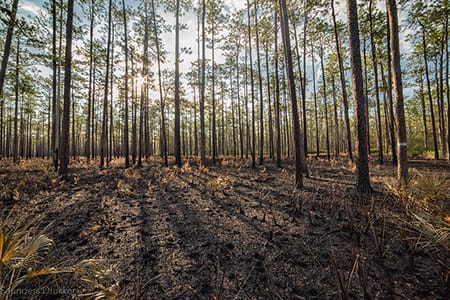
Once dominated by longleaf pine, our pine woodlands support abundant wildlife and local economies. These forests need prescribed fire to stay healthy. Herbert L. Stoddard and his associates Ed and Roy Komarek were pioneers in this emerging scientific field during the mid-20th century. Tall Timbers continues that legacy with applied research on prescribed fire and land management. Today, there is a tremendous need to expand prescribed fire use beyond the Red Hills to ensure ecosystem health and reduce wildfire risk. Additionally, Tall Timbers uses conservation easements to permanently protect private woodlands while balancing the need for economic return from selective timbering.