Tall Timbers staff leads 2011 Ochlockonee River Clean-up
By Neil Fleckenstein, TTLC Planning Coordinator
2011 marked the 10th year that Tall Timbers Land Conservancy (TTLC) staff have participated in the annual Ochlockonee River Clean-up held in Thomas County, Georgia. The TTLC has helped coordinate the last seven events, which have become highly popular with the public. This year approximately 100 volunteers, many of them kids from local schools, joined Tall Timbers, Hands on Thomas County, and Keep Thomas County Beautiful in making this event a great success.
TTLC staff Kevin McGorty, Shane Wellendorf, and Kim Sash provided outstanding support to organizer Neil Fleckenstein throughout the event. Kevin served as the event photographer. Shane rolled up his sleeves and helped Neil and volunteer David Burke sort trash and recyclable materials. Meanwhile, Kim braved teaming hordes of children as she and Pierson Hill brought a variety of snakes with them for show and tell. Never one to miss a chance to support a good cause, former TTLC administrative assistant Ofelia Sivyer showed up bright and early to help with the event.
Of course, cleaning up the Ochlockonee River is the primary focus of this event. Volunteers from all corners of the community, including Boy Scouts and Girl Scouts, school groups, and folks who just wanted to help, descended upon the broad floodplain of the Ochlockonee River near US 19 north of Thomasville (and a second site the day before the “Official” Clean-up). Volunteers removed hundreds of pounds of recyclable materials, such as glass and plastic bottles and aluminum cans as well as an assortment of car and truck tires, and a wide array of items that we will categorize using the highly technical term, “garbage.”
At the end of the day, approximately 1,800 pounds of trash and recyclables were removed. The most common item collected – discarded beer bottles – with Budweiser trouncing Busch in landslide. The most unusual item found? This was an easy call as a local Boy Scout found a pair of coconuts under an oak tree in the woods adjacent to the river.
This has proven to be one of the most popular volunteer events in Thomas County. The Ochlockonee River Clean-up has helped create community awareness and involvement in the preservation of local water resources among hundreds of people, many of them kids and young adults. This event has also provided an opportunity for the public to become more familiar with the work that Tall Timbers does to protect the natural resources of the Red Hills region.
For additional information about the Ochlockonee River Clean-up, contact Neil Fleckenstein, TTLC Planning Coordinator at 850-893-4153, ext. 335.
Georgia Governor Deal freezes state acquisition of conservation easements
By Kevin McGorty, TTLC Director
On November 10, Georgia Governor Nathan Deal submitted a letter to the Georgia State Properties Commission instructing all state agencies and entities within state government to immediately hold all pending requests for action on conservation easements. The Governor’s directive relates to easements that the State would hold (either by Georgia Department of Natural Resources, Georgia Forestry Commission, or Georgia Soil and Water Conservation Commission).
It is believed that the Governor is displeased with state agencies holding easements that could potentially be used to block highway construction planned by other state agencies. In his letter the governor stated, “…it has come to my attention that the current system that allows for real property to be placed in these public entities is open to abuse. This abuse could occur as a result of the underlying law’s lack of clarity and inconsistency in how the program is undertaken.”
The action by the governor does not affect transactions with non-profit land trusts such as Tall Timbers. In addition, the Georgia Conservation Tax Credit Program is unaffected by the governor’s action. Landowners donating conservation easements in 2011 will be eligible for State Tax Credit incentives. Tall Timbers is closing on a number of conservation easements in Georgia this year.
A recent proposal by landowner Jeff Phipps to build a 5.3 mile, two-lane toll road through his Orchard Pond Plantation has gained financial support from the Florida Department of Transportation (DOT). The State Infrastructure Bank at Florida DOT has approved a $10.5 million loan with the remainder of the estimated $17 million project to be funded by Mr. Phipps. The toll road will connect Meridian Road and Old Bainbridge Road.
In a recent article in the Tallahassee Democrat, Mr. Phipps commented that “The reason I’m doing this is I’m afraid the county or some public agency will [build the highway] sometime down the road and it won’t be done properly; [government agencies] tend to do the bare minimum. What we’re hoping to do is put in a lot of good aesthetics and controls."
Tall Timbers shared its concerns with Mr. Phipps that this proposal could directly contribute to sprawling urban growth that could fragment portions of the Red Hills region in Leon County. Mr. Phipps expressed his personal opposition to urban sprawl and described his plan to build what he described as an environmentally friendly road.
Recently, several agencies submitted comments about the proposed toll road to the State Clearinghouse at the Florida Department of Environmental Protection. The Tallahassee-Leon County Planning Department stated that its primary concern is expanding infrastructure outside of the Urban Service Area. The Planning Department noted that the increased service provided by an improvement like the Orchard Pond Toll Road could encourage sprawling development in rural areas, which is inconsistent with the goals of the Comprehensive Plan. The Planning Department offered that this concern could be addressed by prohibiting future roadway and driveway connections to the new toll road.
Tall Timbers also submitted comments to the State Clearinghouse on the proposed road, highlighting the same concerns about the potential for the new road to encourage low density, sprawling growth in the Red Hills. Tall Timbers included suggestions for improving the existing Orchard Pond Road or constructing the new toll road and simultaneously protecting adjacent land with a conservation easement. A conservation easement would help achieve Mr. Phipps goal of an environmentally friendly roadway and would also prevent fragmentation of the landscape.
On November 8, the Leon County Board of Commissioners heard an update on the proposed Orchard Pond Toll Road. Commissioners were generally supportive of the concept. Commissioners Dozier and Maddox both commented on the importance of adhering to the Comprehensive Plan and not encouraging growth outside the Urban Service Area. Validating Tall Timbers concerns that this project could lead to sprawling growth, one commissioner commented that this was a great opportunity to open this rural area of Leon County for more residential, commercial, and school development. He noted that the new road should be four-lanes not two, should be funded in part by the extension of Blueprint 2000, and should not be a tolled facility.
Consultants for the proposed toll road will now focus on the project development and environment study, work on a detailed traffic and revenue study, and eventually move to the design phase of the project. There will be an opportunity for public comment on the project at a hearing in January, 2012.
For additional information, contact Neil Fleckenstein at 850-893-4153, ext. 335.
After recruiting a record of 293 House co-sponsors for the Conservation Easement Incentive Act, more than any other tax bill last year, Congress ran out of time and failed to pass the bill before the incentives expired at the end of 2011.
The legislation to make the incentive permanent (H.R. 1964 and S. 339) is championed by the chairs of the Senate Finance and House Ways & Means Committees, both of whom view it as an important part of their legacy. Therefore, there will be another attempt this year to make the incentives permanent.
Conservation easements donated in 2012 will still be tax deductible and will be treated just like any other non-cash charitable donation — deductible up to 30% of a donor’s income for up to six years.
According to the Land Trust Alliance, potential donors should “run the numbers — some donors, particularly those with larger incomes, will find that the incentive’s expiration makes little difference.” For an update, visit the Alliance’s Website for Frequently Asked Questions and Conservation Donation Rules pages for donated conservation easements.
Tall Timbers will continue to work with the Alliance and numerous other land trusts to encourage Congress to move forward in making the incentives permanent in 2012.
Tall Timbers saves nearly 7,000 acres with new conservation easements
By Kevin McGorty, Land Conservancy Director
Before the 2011 year’s end, Tall Timbers closed on four donated conservation easements totaling nearly 7,000 acres of land. Three of the easements are in the Red Hills.
The largest easement (3,165 acres) is Merrily Plantation which straddles the Georgia-Florida border in Thomas and Jefferson Counties. The property lies at an important geographic interface in the eastern Red Hills region, adding significant connectivity among existing conservation easements. The property has been owned by the Flowers family since the 1940s. Under their stewardship, Merrily Plantation is primarily managed for sustainable timber production, agriculture, and traditional sport hunting and shooting. Throughout the property, many older pine stands were carefully planted by the late William H. Flowers, Jr.; and after decades of quality stewardship, these planted stands have matured into a beautiful open pine forest. Merrily’s lowland habitats include forested wetlands associated with Connell Creek, Linton Lake, and the Aucilla River. Tall Timbers is honored to hold this very significant conservation easement.
In the above photo, some of the Flowers family members gather at Thanksgiving at Merrily Plantation. TOP ROW: (from left to right) Jameson McFadden, Benjamin McCollum, J. V. Shields, Jr., C. Martin Wood III and Guinness McFadden, Jr. SECOND ROW: Knox Miller, Haile McCollum, Anne-Fontaine McFadden, Daphne Flowers Wood, Lisa McFadden and the baby is Oliva McFadden. BOTTOM ROW: Caroline Miller, William McCollum, Eliza Miller, Parker McCollum, and Maury Flowers Shields.
In Leon County, W. Thorpe McKenzie added a 2,477 acre easement tract (formally a portion of Loveridge Plantation) to his beautiful Sunny Hill Plantation. From 1997 to 2000, Mr. McKenzie donated to Tall Timbers four phased conservation easements totaling 5,144 acres. With this newly added tract, Sunny Hill Plantation becomes the largest easement property in the Red Hills. In addition, this new easement provides a linear conservation corridor from the village of Miccosukee (National Register Historic District) north to Thomasville, Georgia, closing the gap between protected and unprotected lands in the Red Hills. The newly acquired tract is a shining example of a well managed, prescribed fire maintained, open pine forest that provides excellent habitat for northern bobwhites and other wildlife dependent upon frequently burned habitats. Additionally, Sunny Hill encompasses a portion of the Dry Creek floodplain, which has been designated as a Special Natural Area. The protection of the creek is important to the health of Lake Miccosukee and the Floridan Aquifer, a primary drinking water source for the region.
Tall Timbers third easement in 2011 was Shade Farm (621 acres) in Gadsden County, Florida. Like its name suggests, the history of land use on the property was primarily farming and agriculture in the 1900’s. Shade tobacco was a huge industry in Gadsden County. In 1946 Quincy, Florida was the third ranking city in Florida in the manufacturing of cigars. The property was purchased in 2005 by a group of ten partners mainly for quail, deer, and turkey hunting and productive forestry. Of significant conservation value are the approximately 173 acres of high quality bottomland forest that provide a buffer to Ziegler Mill and Smith Mill Creeks that flow south into Quincy Creek—once the main water supply for the city of Quincy. The protection of these creeks is important to the water quality of the Ochlockonee River Basin, which supports many species of rare plants and animals.
Outside the Red Hills, Tall Timbers completed a Phase I Easement for Leary Farm (417 acres) bordering Ichawaynochaway Creek in Calhoun County, Georgia. Tall Timbers holds other easements in this section of Southwest Georgia. The property was heavily stripped of timber in the 1950s. Since 1975 – under the DuPre family ownership – plantings of loblolly, slash, and longleaf have been ongoing. Mr. William DuPre IV and his sister Lelia DuPre Reynolds’ management goals for the property include sustainable forestry and wildlife management focusing on northern bobwhite, eastern wild turkey, and whitetail deer. Leary Farm supports high quality bottomland and floodplain forest associated with Ichawaynochaway Creek in the Flint River Basin. Due to the number of rare plant and animal species found in the Flint River watershed, the Georgia Department of Natural Resources has designated the Flint as a high priority watershed throughout its entirety.
With these new easements, Tall Timbers has now protected over 120,000 acres in the Red Hills and Southwest Georgia.
The M-CORES program, which includes the proposed Suncoast Connector Toll Road in Jefferson County, passed through the Florida Legislature at breakneck speed with little review or analysis. Tall Timbers has a number of concerns given the potential for significant and wide spread impacts. These include fragmenting public and private conservation lands, robbing business from Main Street Monticello, impacting our rivers and other water resources, and making prescribed fire more difficult and costly.
Join us in asking the Jefferson County Board of County Commissioners to OPPOSE the Suncoast Connector toll road and its path through Jefferson County.
Take action now with our easy email form.
Send an email to all five Jefferson County Board of County Commissioners with one click!
Burn prioritization modeling seminars and fire modeling tools are supported by Wildland Fire Science to train managers in the important planning stages of prescribed fires.
Educating and guiding the next generation of fire researchers and managers is a key goal of Wildland Fire Science and a resource for testing new ideas in fire research.
Tall Timbers hosts the premier fire technology transfer organization—the Southern Fire Exchange. This JFSP funded effort helps connect research to management through webinars, workshops, and support of the Prescribed Fire Science Consortium.
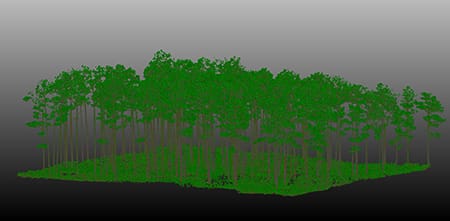
Working with partners in the Prescribed Fire Science Consortium, the program is building nexgen 3-D fuel beds using terrestrial LiDAR and novel sampling techniques to power new fire behavior models for prescribed fire managers. This work links to Tall Timbers work in wildlife habitat usage and ecological forestry.
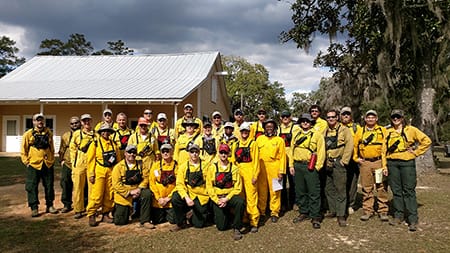
The Longleaf Legacy landscape prescribed fire burn team arm of Wildland Fire Science works directly with landowners and partners to effectively put fire on the ground and promote prescribed fire throughout the region.
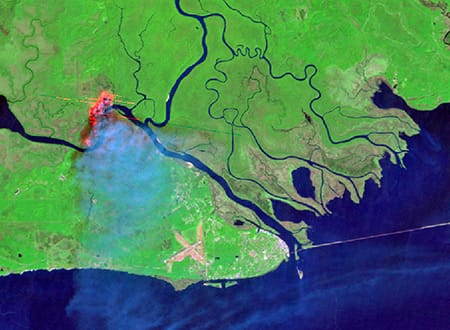
Tall Timbers is leading an effort to map fire regimes at the landscape scale. Staff work with numerous agencies to evaluate fire records and satellite imagery to build this critical conservation database. https://skfb.ly/6DqOY
Tall Timbers hosts the Prescribed Fire Science Consortium, a national network of researchers and managers who promote integrated research and management to advance next generation tools for fire practitioners. https://arcg.is/1DSjDT
We are linking physics and field observations to understand the fluid dynamics of fire behavior surface fire regimes. Our work combines field observations using advanced thermal imaging techniques, laboratory studies, and coupled fire-atmospheric modeling to help managers improve outcomes of managed fire regimes.
Selected Publications authored by Wildland Fire Science staff.
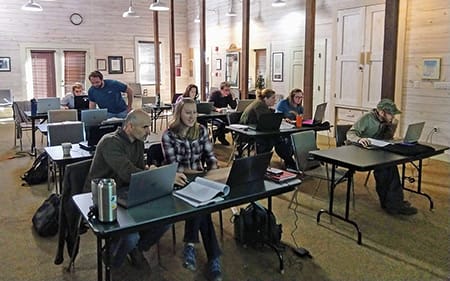
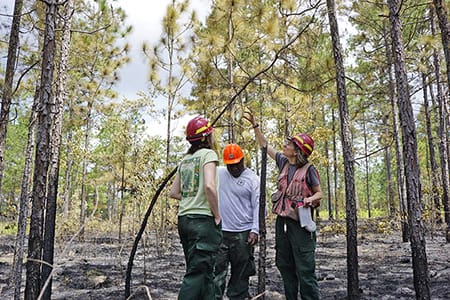
Staff and researchers support Federal fire training by serving as a cadre for NWCG training courses, ranging from basic wildland fire to advanced fire effects.
(PFTC) specializes in training fire fighters the principles and techniques of prescribed fire through practical hands-on experience. https://www.fws.gov/fire/pftc/
Private land owners are the largest source of prescribed fire in the country. These land owners and the culture of fire that was maintained by them during decades of suppression are a part of why Tall Timbers is a world-wide center for prescribed fire science. Workshops and fire training are a critical focus of the Longleaf Legacy Landscape Burn Team and our support of the Georgia Forestry Commission Prescribed Fire Center in Marion County.
The conserved lands of the Greater Red Hills region are found on working, income-producing properties that support agriculture, forestry, and recreational hunting. These properties contribute $272 million annually to local economies and support 2,300 jobs. [link to Planning & Advocacy section] The landowners’ strong stewardship ethic preserves their working lands while replenishing drinking water supplies, protecting water quality, and providing wildlife habitat for dozens of rare and endangered species. Tall Timbers’ conservation easements on these working properties encourage landowners to retain their traditional livelihood by keeping farms in family ownership.
Home to world-class wild quail populations, the Greater Red Hills region contains the largest concentration of gamebird preserves in the United States. These preserves also support the largest community of Red-cockaded woodpeckers on private lands. Indicators of high quality habitat found here include the gopher tortoise, Bachman’s sparrow, fox squirrel, and many amphibians. Tall Timbers’ conservation easements identify and protect the critical habitats of these species.
The region also boasts outstanding aquatic resources. Large river systems, like the Flint/Apalachicola, Ochlockonee, and Aucilla, flow from Georgia and feed into the Gulf of Mexico to support some of the world’s most productive estuaries. Large disappearing sinkhole lakes, like Iamonia, Miccosukee, and Jackson, provide habitat for an array of aquatic species and migratory birds. Tall Timbers’ conservation easements protect these vital watersheds and wetlands that are the lifeblood for the ecological health of the region.
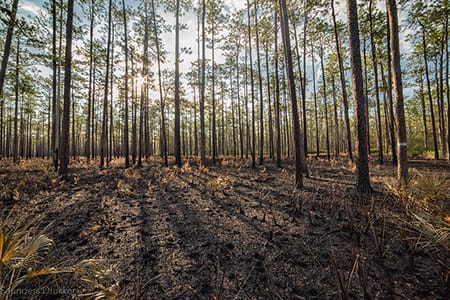
Once dominated by longleaf pine, our pine woodlands support abundant wildlife and local economies. These forests need prescribed fire to stay healthy. Herbert L. Stoddard and his associates Ed and Roy Komarek were pioneers in this emerging scientific field during the mid-20th century. Tall Timbers continues that legacy with applied research on prescribed fire and land management. Today, there is a tremendous need to expand prescribed fire use beyond the Red Hills to ensure ecosystem health and reduce wildfire risk. Additionally, Tall Timbers uses conservation easements to permanently protect private woodlands while balancing the need for economic return from selective timbering.

.jpg?strip=all&w=890 "Clean-up Volunteers")
 Of course, cleaning up the Ochlockonee River is the primary focus of this event. Volunteers from all corners of the community, including Boy Scouts and Girl Scouts, school groups, and folks who just wanted to help, descended upon the broad floodplain of the Ochlockonee River near US 19 north of Thomasville (and a second site the day before the “Official” Clean-up). Volunteers removed hundreds of pounds of recyclable materials, such as glass and plastic bottles and aluminum cans as well as an assortment of car and truck tires, and a wide array of items that we will categorize using the highly technical term, “garbage.”


 In Leon County, W. Thorpe McKenzie added a 2,477 acre easement tract (formally a portion of Loveridge Plantation) to his beautiful Sunny Hill Plantation. From 1997 to 2000, Mr. McKenzie donated to Tall Timbers four phased conservation easements totaling 5,144 acres. With this newly added tract, Sunny Hill Plantation becomes the largest easement property in the Red Hills. In addition, this new easement provides a linear conservation corridor from the village of Miccosukee (National Register Historic District) north to Thomasville, Georgia, closing the gap between protected and unprotected lands in the Red Hills. The newly acquired tract is a shining example of a well managed, prescribed fire maintained, open pine forest that provides excellent habitat for northern bobwhites and other wildlife dependent upon frequently burned habitats. Additionally, Sunny Hill encompasses a portion of the Dry Creek floodplain, which has been designated as a Special Natural Area. The protection of the creek is important to the health of Lake Miccosukee and the Floridan Aquifer, a primary drinking water source for the region.
 Tall Timbers third easement in 2011 was Shade Farm (621 acres) in Gadsden County, Florida. Like its name suggests, the history of land use on the property was primarily farming and agriculture in the 1900’s. Shade tobacco was a huge industry in Gadsden County. In 1946 Quincy, Florida was the third ranking city in Florida in the manufacturing of cigars. The property was purchased in 2005 by a group of ten partners mainly for quail, deer, and turkey hunting and productive forestry. Of significant conservation value are the approximately 173 acres of high quality bottomland forest that provide a buffer to Ziegler Mill and Smith Mill Creeks that flow south into Quincy Creek—once the main water supply for the city of Quincy. The protection of these creeks is important to the water quality of the Ochlockonee River Basin, which supports many species of rare plants and animals.