Simply stated —the World!Miss Kate was the driving force behind the entire “conservation movement” here in the Red Hills. Of course, she had help and lots of it from her friends and neighbors, and Tall Timbers staff and Board, but she was the first to buy in to the concept of protecting the landscape for continuing hunting and traditional rural land uses for present and future generations to enjoy as she had and as her family before her had. Her first project was the 4-laning of Hwy 319 into a gateway parkway through her beloved Red Hills. As you know, the FL Legislature in 1998 named it the Kate Ireland Parkway in her honor and to recognize her efforts.
Miss Kate talking to the media before the 2007 Kate Ireland Parkway burn. Photo by Rose Rodriguez
Her next project was to get the fledgling Red Hills Conservation Association up and running. With her as Chairman, it was going to be successful or else! It was so successful in the first year of operation, 1990, that the Tall Timbers Board suggested a merger of the two groups in 1991 and Miss Kate negotiated a deal that has guided the conservation and research programs of Tall Timbers to even greater success that either probably envisioned. She was among the first to donate perpetual conservation easements on her own land, leading by example as she prowled the neighborhood getting others to follow suit. Today the Tall Timbers Land Conservancy is the most successful land trust in the Southeast with more acres protected than any other regional land trust.
In the 1990s, she turned her attention to jump starting a sluggish game bird program at the Research Station, which has soared since with spheres of influence reaching numerous states in the home range of the Northern Bobwhite Quail’s domain. Her efforts were recognized by Tall Timbers in the naming of the Kate Ireland Model Quail & Conservation Area in her honor.
Kate Ireland at the Model Quail Course entrance with her beloved Labrador retrievers. Photo by Rose Rodriguez
She also was committed to getting the greater Tallahassee/Thomasville community to recognize that the Red Hills Plantation lands were an ecological and economic benefit to the general public by giving generously of her time to speak to community groups, Leadership groups and local officials about her passion for this land, and it worked! She was recognized by both communities with awards and honors for lifetime achievements on numerous occasions. She even donated land for a public park which carries her name on Lake Iamonia.
Miss Kate speaking at the Kate Ireland Park Dedication, 2002. Photo by Rose Rodriguez
She served as Vice Chairman, Chairman and Chairman Emeritus of the Tall Timbers Board for 21 years and was our chief fundraiser and public relations advocate to the Red Hills plantations. She was the consummate fundraiser! On one occasion, a plantation owner remarked to me that he had just been on the most expensive quail hunt ever at Foshalee with Miss Kate! She used every advantage to raise money for Tall Timbers and helped us acquire the resources necessary to carry out our mission.
We will certainly miss her greatly but she has paved the way for us to carry on and continue to go about doing good with her philosophy of, “Live for the Future and Manage Change”. We are proud, honored and blessed that she walked among us. God Bless You Miss Kate!
This E-News edition is dedicated to remembering why Kate Ireland meant "the world" to Tall Timbers and our community.
In these times of financial uncertainty, it is critical that we remain focused on our mission: Promoting good land stewardship through research, conservation and education. For over 50 years now, Tall Timbers has remained at the forefront of critical research in the areas of fire ecology, forestry and wildlife management. Tall Timbers continues to be a vocal advocate for private landowner rights, helping shape public policy decisions on wildlife management, prescribed fire and land conservation. It is our hope that you will continue your investment in the future of Tall Timbers by renewing your annual gift this year.
You can be assured that your financial investment in Tall Timbers is being put to great use. Our research and conservation staff is able to leverage the support of our membership program by finding matching grant dollars from foundations, government agencies and corporate resources to help fund our programs at full capacity. In many cases, for every $1 contributed to our membership program we are able to find an additional $3 to match it from outside sources.
If you have already renewed your membership gift this year, we thank you. If not, you can easily renew online www.talltimbers.org/membership.html. If you know someone who might benefit from our work, please share this link and encourage their support. Our current donors are our best salespeople. With your help we can reach our annual goal of $400,000 by the end of the year.
Thanks as always for your support of the research, conservation and education programs of Tall Timbers.
The Kate Ireland Memorial Golf Tournament and Auction will be held in late September at Glen Arven Country Club in Thomasville, GA. Named in memory of longtime Tall Timbers friend and benefactor, Miss Kate Ireland who passed away earlier this year, this very special event is our largest annual fundraiser and critical to our operating budget. Please make plans to join us again this year for another fun-filled event in beautiful Thomasville.
The silent and live auctions provide you with the opportunity to bid on once in a lifetime trips, hunting and fishing excursions, family vacations, original artwork and much more. Come join the fun at Glen Arven on Sunday evening, September 25.
For the golfers, the challenging and historic Glen Arven course will test your skills on the links with a traditional four-man scramble tournament on Monday morning, September 26.
Last year’s event raised over $120,000 in support of the research, conservation and education programs of Tall Timbers. Formal invitations will be mailed to all Tall Timbers donors in August – but mark your calendars today and save the date!
Thanks to a grant from the Florida Fish and Wildlife Conservation Commission, the Vertebrate Ecology Program recently completed genetic sampling of the brown-headed nuthatch population on Babcock-Webb Wildlife Management Area (WMA) in southwest Florida. Babcock-Webb supports one of the largest expanses of nuthatch habitat remaining south of Orlando, but the nuthatch population is isolated from other neighboring populations, so genetic information will help to determine whether genetic variation within this population has changed as a result of its isolation. Tall Timbers’ staff has developed some impressively efficient netting procedures for this bird that normally spends most of its time high up in the canopy — 35 individuals were netted in only 2.5 days of work!
Jim Cox holds a young nuthatch netted on the Babcock-Webb Wildlife Management Area.
Vertebrate Ecology has initiated new breeding bird counts on Arcadia Plantation that are similar to the counts conducted on Tall Timbers for six years. The expanded work on Arcadia provides a chance to compare subtle differences in the breeding bird communities associated with old-field pinelands on Tall Timbers versus the more extensive area of longleaf pine and native ground cover on Arcadia. The most common bird observed on Arcadia is Bachman’s Sparrow (2.3 individuals per count), which checks in as the eighth most common bird on Tall Timbers (1.6 individuals per count). On the other hand, Northern Cardinal is the most common bird observed on Tall Timbers (2.1 per count) and checks in as the fourth most common bird on Arcadia (1.3 per count). Cardinals are more common on Tall Timbers because of their preference for brushier ground cover. Counts on Tall Timbers also show continued declines for several neotropical migrants that once occurred more regularly on the property (Kentucky Warbler, Wood Thrush, and Louisiana Waterthrush).
Finally, new methods for measuring Bachman’s Sparrow breeding-season productivity are being assessed on the Wade Tract. Young sparrows give distinctive call notes that can be used to estimate the number of young per unit area, just as easily as counts of singing males often are used to estimate the abundance of adults. We are comparing efficient line transect procedures with two more intensive forms of plot-based surveys in hopes of recommending some simple field procedures for measuring productivity for this declining species. Productivity may be a key measure of habitat quality in this species, because other data suggest that well over half the singing males never secure mates.
A third native forest community to consider — shortleaf pine/oak/hickory with its native groundcover
By Dr. Kevin Robertson, Fire Ecology Scientist
Traditionally in the Red Hills region of northern Florida and southern Georgia, frequently burned and thinned pine forests and their groundcover of herbs and shrubs have been categorized as longleaf pine/wiregrass (native) or loblolly/shortleaf pine old-field (post-agriculture) communities. However, certain forests in the region are dominated by shortleaf pine and have no wiregrass, yet they contain many plant species that usually do not become re-established in old-field forests (goat’s rue, bracken fern, running oak, twin-flower, and several others). These forests are similar to native forests in the Piedmont region and in parts of Louisiana, Texas, Arkansas, and Oklahoma.
We hypothesized that this third community type represents a native community type referred to in other regions as shortleaf pine-oak-hickory. We compared groundcover plant species composition in 100 square meter plots, tree species composition in 20 meter radius circular plots (1256 m2), and soil characteristics at more than 20 locations in each of the three community types on Tall Timbers Research Station (Florida) and Pebble Hill Plantation (Georgia). Multivariate analysis ((NMS), see scatter plot graph below) showed the three community types to be distinct in their species composition.
Results from Nonmetric multidimensional scaling (NMS) multivariate analysis of 100 m2 plots. Proximity of symbols indicates similarity in species composition and color represents community type, where green is longleaf pine-wiregrass, blue is shortleaf pine-oak-hickory, and red is old-field pine.
Of the total 225 plant species identified, indicator species analysis identified 54 species significantly associated with longleaf pine-wiregrass, 15 species associated with shortleaf pine-oak-hickory, and 25 species associated with old-field community types. Longleaf pine-wiregrass and shortleaf pine-oak-hickory communities showed greater depth of the topsoil than old-field communities, suggesting less of the erosion typically associated with old-field communities. Shortleaf pine-oak-hickory forests also had the highest concentrations of calcium, potassium, magnesium, and manganese of the three community types, which may partly explain the difference in species. These results are consistent with our hypothesis, suggesting that native shortleaf pine/oak/hickory forests should be recognized according to their indicator species and protected from further soil disturbance and conversion to other land uses.
The M-CORES program, which includes the proposed Suncoast Connector Toll Road in Jefferson County, passed through the Florida Legislature at breakneck speed with little review or analysis. Tall Timbers has a number of concerns given the potential for significant and wide spread impacts. These include fragmenting public and private conservation lands, robbing business from Main Street Monticello, impacting our rivers and other water resources, and making prescribed fire more difficult and costly.
Join us in asking the Jefferson County Board of County Commissioners to OPPOSE the Suncoast Connector toll road and its path through Jefferson County.
Take action now with our easy email form.
Send an email to all five Jefferson County Board of County Commissioners with one click!
Burn prioritization modeling seminars and fire modeling tools are supported by Wildland Fire Science to train managers in the important planning stages of prescribed fires.
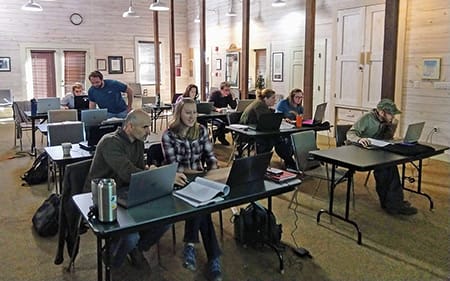
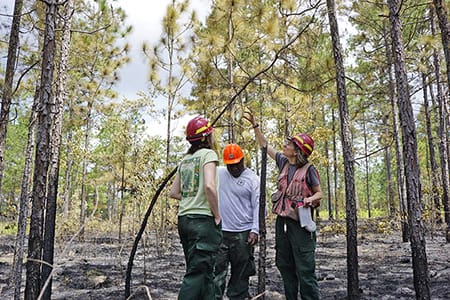
Educating and guiding the next generation of fire researchers and managers is a key goal of Wildland Fire Science and a resource for testing new ideas in fire research.
Tall Timbers hosts the premier fire technology transfer organization—the Southern Fire Exchange. This JFSP funded effort helps connect research to management through webinars, workshops, and support of the Prescribed Fire Science Consortium.
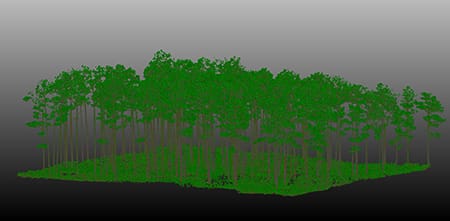
Working with partners in the Prescribed Fire Science Consortium, the program is building nexgen 3-D fuel beds using terrestrial LiDAR and novel sampling techniques to power new fire behavior models for prescribed fire managers. This work links to Tall Timbers work in wildlife habitat usage and ecological forestry.
The Longleaf Legacy landscape prescribed fire burn team arm of Wildland Fire Science works directly with landowners and partners to effectively put fire on the ground and promote prescribed fire throughout the region.
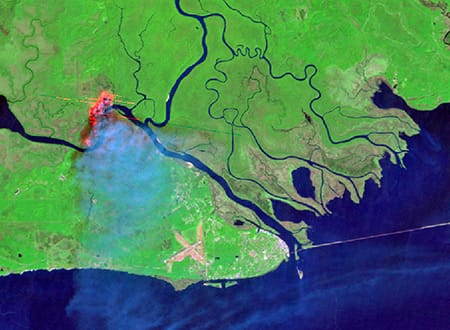
Tall Timbers is leading an effort to map fire regimes at the landscape scale. Staff work with numerous agencies to evaluate fire records and satellite imagery to build this critical conservation database. https://skfb.ly/6DqOY
Tall Timbers hosts the Prescribed Fire Science Consortium, a national network of researchers and managers who promote integrated research and management to advance next generation tools for fire practitioners. https://arcg.is/1DSjDT
We are linking physics and field observations to understand the fluid dynamics of fire behavior surface fire regimes. Our work combines field observations using advanced thermal imaging techniques, laboratory studies, and coupled fire-atmospheric modeling to help managers improve outcomes of managed fire regimes.
Selected Publications authored by Wildland Fire Science staff.
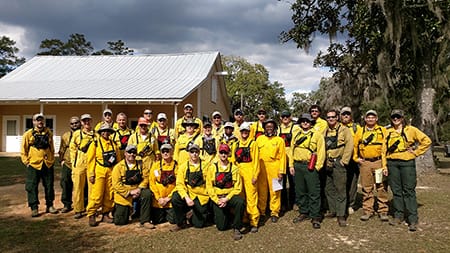
Staff and researchers support Federal fire training by serving as a cadre for NWCG training courses, ranging from basic wildland fire to advanced fire effects.
(PFTC) specializes in training fire fighters the principles and techniques of prescribed fire through practical hands-on experience. https://www.fws.gov/fire/pftc/
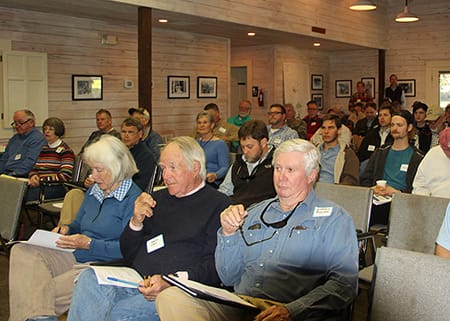
Private land owners are the largest source of prescribed fire in the country. These land owners and the culture of fire that was maintained by them during decades of suppression are a part of why Tall Timbers is a world-wide center for prescribed fire science. Workshops and fire training are a critical focus of the Longleaf Legacy Landscape Burn Team and our support of the Georgia Forestry Commission Prescribed Fire Center in Marion County.
The conserved lands of the Greater Red Hills region are found on working, income-producing properties that support agriculture, forestry, and recreational hunting. These properties contribute $272 million annually to local economies and support 2,300 jobs. [link to Planning & Advocacy section] The landowners’ strong stewardship ethic preserves their working lands while replenishing drinking water supplies, protecting water quality, and providing wildlife habitat for dozens of rare and endangered species. Tall Timbers’ conservation easements on these working properties encourage landowners to retain their traditional livelihood by keeping farms in family ownership.
Home to world-class wild quail populations, the Greater Red Hills region contains the largest concentration of gamebird preserves in the United States. These preserves also support the largest community of Red-cockaded woodpeckers on private lands. Indicators of high quality habitat found here include the gopher tortoise, Bachman’s sparrow, fox squirrel, and many amphibians. Tall Timbers’ conservation easements identify and protect the critical habitats of these species.
The region also boasts outstanding aquatic resources. Large river systems, like the Flint/Apalachicola, Ochlockonee, and Aucilla, flow from Georgia and feed into the Gulf of Mexico to support some of the world’s most productive estuaries. Large disappearing sinkhole lakes, like Iamonia, Miccosukee, and Jackson, provide habitat for an array of aquatic species and migratory birds. Tall Timbers’ conservation easements protect these vital watersheds and wetlands that are the lifeblood for the ecological health of the region.
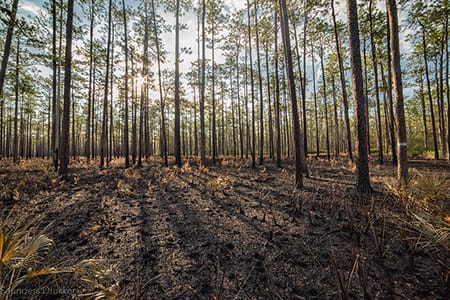
Once dominated by longleaf pine, our pine woodlands support abundant wildlife and local economies. These forests need prescribed fire to stay healthy. Herbert L. Stoddard and his associates Ed and Roy Komarek were pioneers in this emerging scientific field during the mid-20th century. Tall Timbers continues that legacy with applied research on prescribed fire and land management. Today, there is a tremendous need to expand prescribed fire use beyond the Red Hills to ensure ecosystem health and reduce wildfire risk. Additionally, Tall Timbers uses conservation easements to permanently protect private woodlands while balancing the need for economic return from selective timbering.