Nilo Plantation hosted Tall Timbers’ Fall Field Day
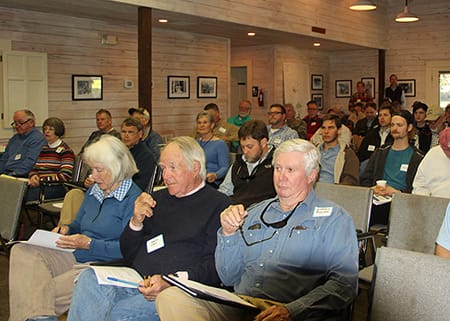
Bill Palmer welcomes the crowd.
Tall Timbers’ Fall Field was back at Nilo Plantation, near Albany, Georgia, where the first field day was held. Interest was high as over 300 attended the event on Friday, Oct. 29. Under the tent, Tall Timbers’ President and CEO Bill Palmer welcomed the attendees. Tall Timbers’ Albany Quail Project director, Clay Sisson and Nilo general manager Garrett Jones spoke about the management history of the property since it was purchased by John Olin in 1954, and which has continued under the ownership of the Williams family—Nilo is Olin spelled backwards.
Clay and Garrett discussed land management activities that began with hardwood cleanup in 1994. They have since incorporated supplemental feeding, predator control and prescribed fire, which has produced some of the highest quail numbers in the region—the average over the past 3 years has been 12 coveys per hour! Also discussed by Tall Timbers’ quail biologists Alex Jackson and Justin Rectenwald was the quail hatch in the Red Hills region (Alex), and in the Albany region (Justin).
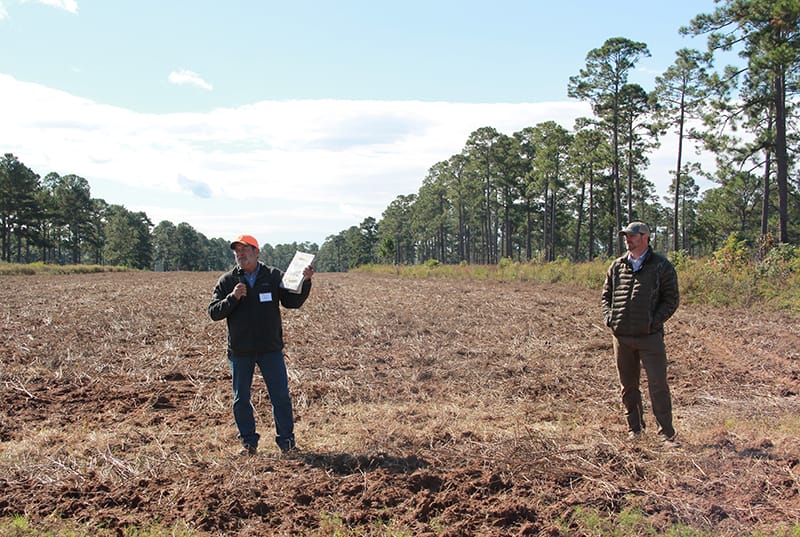
Standing in a peanut field, Garrett Jones discussed the trophy deer program at Nilo.
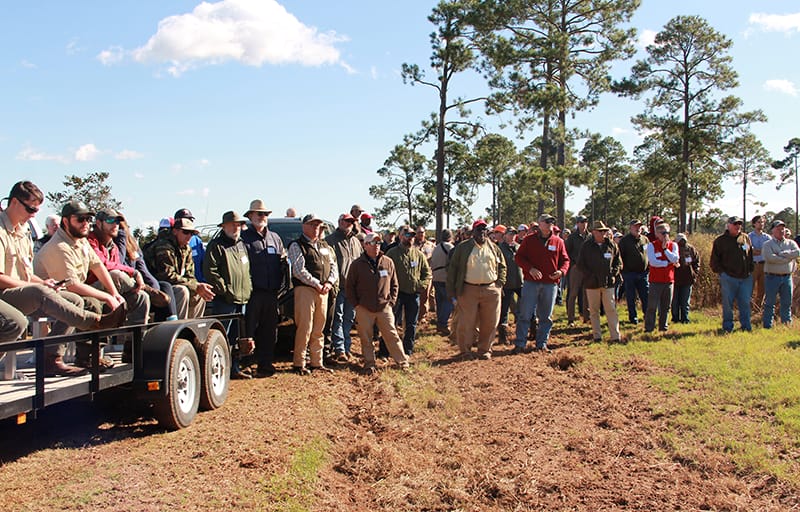
In the field, the topics discussed were: best management practices for wild quail; storm clean-up and reforestation with slash pine after a swath of destruction from a tornado in 2017, and damage from Hurricane Michael in 2018; management for trophy deer; management of early season dove fields; predator control and feral hog trapping, and the Nilo prescribed burning program.
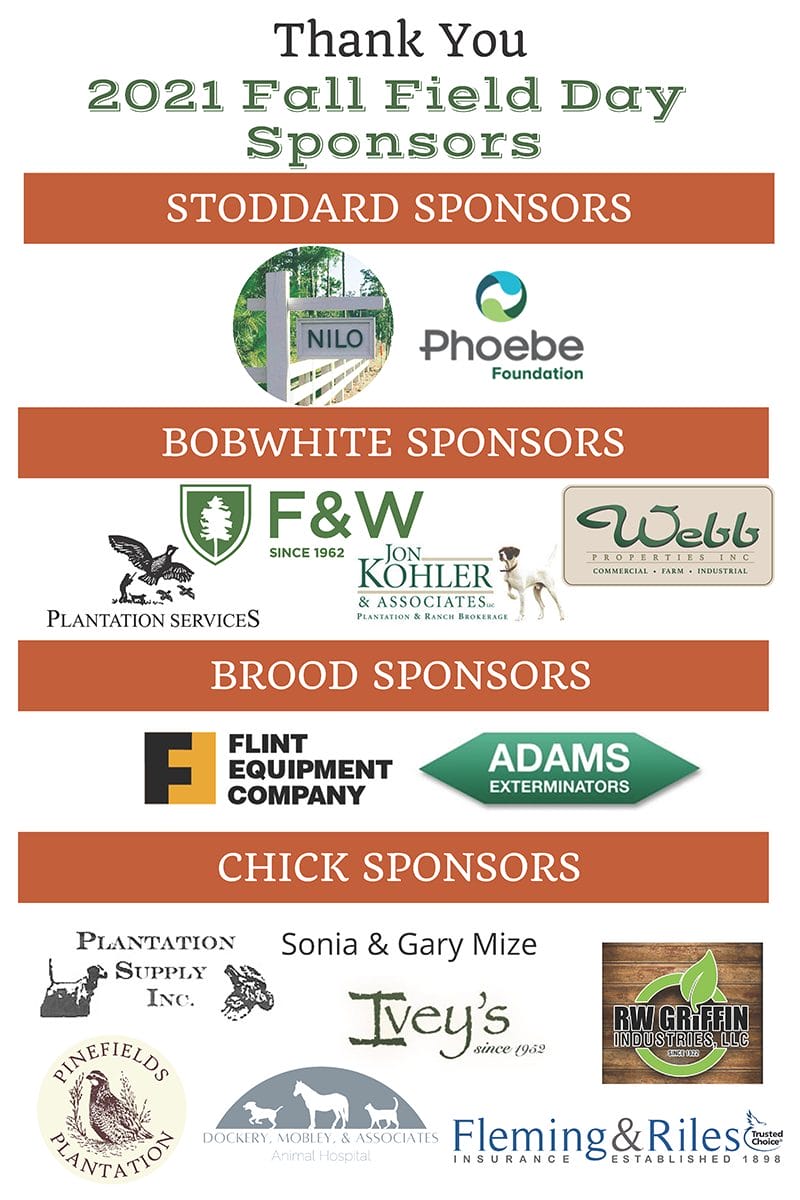
We thank Nilo Plantation for hosting the event. The beauty of the property and its excellent management by Garrett Jones and his team were on display during the wagon tour. Tall Timbers is also thankful for the many sponsors who made Fall Field Day possible.
Tall Timbers’ Albany Quail Project director, Clay Sisson, left, with Garrett Jones, Nilo General Manager.
On the wagon tour stop at a dove field, attendees listen to Garrett Jones discuss management for early dove season.
Tall Timbers’ Dr. Morgan Varner on National Public Radio
On August 31, 2021, the eye-catching headline “To Stop Extreme Wildfires, California Is Learning From … Florida?” brought readers and listeners to NPR Morning Edition coverage by Lauren Sommer. Lauren coordinated with Dr. Morgan Varner, Director of Research and a Senior Scientist at Tall Timbers, on the interview and content for the story. We were pleased with her coverage and thoughtful handling of the topic, including the important role of private landowners in expanding and maintaining the use of prescribed fire.
National Prescribed Fire Training Center moves to Tall Timbers
Cooperation between Tall Timbers and the National Interagency Prescribed Fire Training Center (PFTC) just took a huge stride forward. PFTC is now located at Tall Timbers. The offices and equipment previously located on the grounds of the Tallahassee Airport have been moved to their new home on the Tall Timbers’ campus.
The advantages for both organizations are clear. Trainees that attend PFTC sessions will benefit from exposure to Tall Timbers research, as well as the state-of-the-art land management practiced onsite. Tall Timbers will gain further opportunities to help deliver fire science through training, additional national presence as the home of the National Prescribed Fire Training Center, and added prospects for collaborating on projects. For example, Tall Timbers and PFTC have already started working together to produce a training video on techniques for ignitions in southern pinewoods.
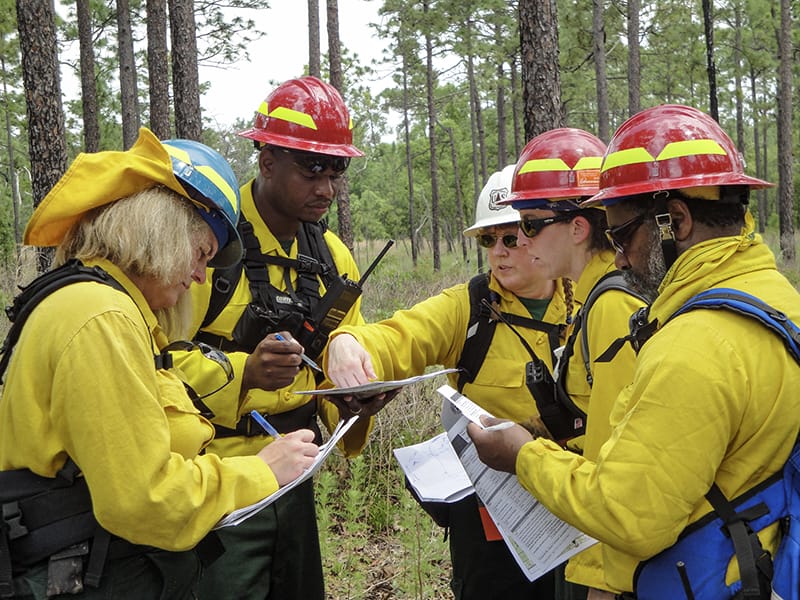
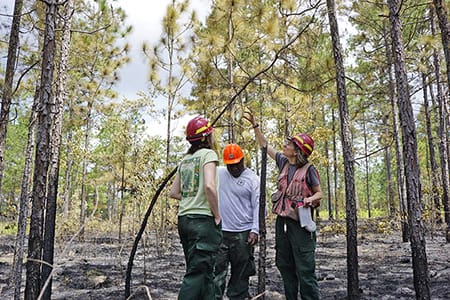
PFTC agency administrators planning a burn.
Tall Timbers and PFTC have a long history of cooperation. When the Center started in 1998, Tall Timbers was one of the earliest organizations to offer support and training for PFTC’s attendees. Since its inception, PFTC has hosted students from across the country and globe to come to the southeastern US to learn about and experience prescribed fire. There have been attendees from 49 of the 50 states (still waiting on that student from Rhode Island), and 18 foreign countries − from Australia to Trinidad.
Today, PFTC holds five 20-day training sessions for fire practitioners, and two 6-day workshops for Agency Administrators such as Refuge Managers, Park Superintendents, and National Forest District Rangers to learn about managing or building an active prescribed fire program. The Center is also engaged in international training, most recently in Australia, Portugal and Mexico.
PFTC Resource Specialist Workshop planning a project
To learn more about the National Interagency Prescribed Fire Training Center visit https://www.nafri.gov/pftc
“Cheeseburger, cheeseburger, cheeseburger.” As I sit here at my kitchen table, I am increasingly annoyed at the persistent reminder that I’m hungry coming from outside. No, the Hamburglar isn’t creeping outside my window. Instead, the source of the noise is a Carolina Wren. This common species nests less than 20 feet from where I now sit, and is clearly interested in letting others know that this is where it’s at.
The Carolina Wren is one of the more common bird species out of the more than 330 species recorded from Leon County, Florida where I live. I’m lucky to live in a place with such high bird diversity, but diversity and abundance are two different things. Though diversity in my area is high, the overall abundance of birds around Tallahassee, and in places all over the country, continues to drop.
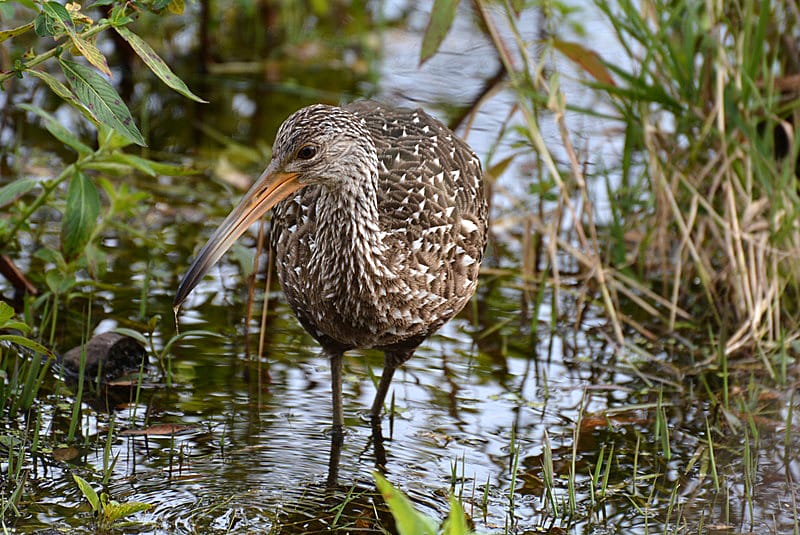
Limpkin. Photo by Heather Levy
The decline of birds in North America is no secret. Since the 1950s, numerous species have declined at such a rate that recent published research on the topic reached international audiences. Habitat reduction and fragmentation seem to be driving this downturn but, to truly assess landscape-wide declines, one must have a baseline to measure against. And, to actually reverse the decline, far more people need to be engaged with birds and their conservation. Recognizing these needs, Tall Timbers applied for and received a $5,000 Cornell Lab of Ornithology Land Trust Grant to carry out a project that would address both.
Tall Timbers, along with its partners, will help to fill in the gaps of bird distribution within Florida and Georgia, while engaging new audiences with bird conservation through the use of eBird. eBird is both a website and mobile app that allows anyone to log the bird species that they observe in a given area during a set period of time. Local Audubon chapter volunteers will teach private landowners the basics of birding and how to log their bird sightings on eBird, in conjunction with land trust staff conducting annual monitoring visits to conservation easement properties. In addition, these local Audubon chapters will have the ability to visit some of the most incredible private conservation land in their respective regions that are normally off limits, to enjoy and record the birds found in these under-surveyed, but critical, conservation lands.
Tall Timbers is partnering with Conservation Florida and Alachua Conservation Trust to connect with private landowners and their lands. Collectively, the three land trusts protect hundreds of thousands of acres that, in many instances, have been birded infrequently, if ever. In addition, the project will allow all three land trusts to partner with their local Audubon chapters that include Apalachee Audubon, Alachua Audubon, Orange Audubon, and West Volusia Audubon. Audubon volunteers will help support land trust staff in their efforts to connect the dots between landowners and their birds.
Partners will use webinars, the free eBird training course offered through the Cornell Lab of Ornithology, easement monitoring visits, and field trips to train both private landowners and/or interested members of the public in the use of eBird, binoculars, and other beginning birding tips. In addition to an opportunity to learn from Audubon volunteers joining land trust staff on property visits, landowners will also have the eBird training course available to them, along with the option for new field guides. Meanwhile, in addition to being able to bird normally-off-limits properties, Audubon volunteers will be gifted with advanced training courses offered by the Cornell Lab of Ornithology.
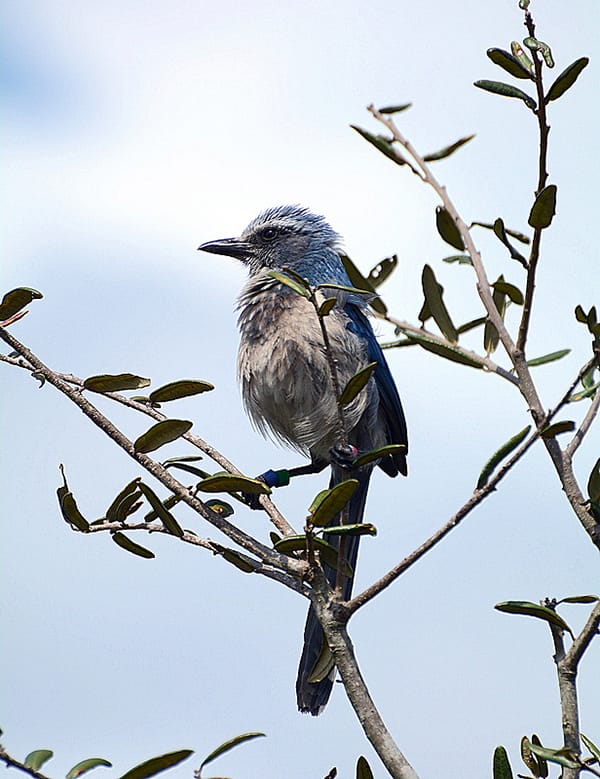
Scrub Jay. Photo by Heather Levy
This project brings measurable benefits to bird conservation in three direct ways. First, it directly records bird occurrences in areas where surveys are a challenge to conduct. Conservation easements, for instance, must have a baseline documentation report, but as any birder knows, one annual visit will not provide a comprehensive list of bird species on a given piece of property. Even if multiple visits do occur, birds come and go, so those less familiar with the appearance or sounds of a particular bird species may never record it. A Henslow’s sparrow may be easy to identify when it sits still, but that quick, brown bird that darts into the underbrush may be impossible to record if someone familiar with the call is not present. For these reasons and more, we believe that equipping private landowners with the means to record observations throughout the year, and connecting local bird experts with these properties will result in a much greater understanding of where declining birds live in Florida and South Georgia.
Another major benefit comes in the form of connecting people to birds. Until people feel personally connected to a problem, they are far less likely to take actions required to solve it. Private landowners will have the tools to foster connections with the bird life on their properties, building a deeper appreciation of their land along the way. These landowners may then help support efforts like eBird and/or local Audubon chapters, if their interest in bird conservation builds.
Finally, this project presents an opportunity to connect people. Land trusts will be able to engage with their landowner partners, while allowing landowners to take pride in the land they’ve worked to conserve, when they show it to either Audubon volunteers, the public, or both. Often, land trusts work in silos in their specific region but this project enables land trusts in a large region to work collaboratively on a single project that supports the respective mission of each land trust.
The connection between people in birds is central to slowing the rapid decline occurring in North American bird populations. While the land trusts involved in this project will remain committed to permanently protecting and managing habitats, this is not enough. More people must feel connected to the problem and must play a role in solving it. This project facilitates that process through the use of an innovative piece of technology and the seemingly simple, but too infrequent, act of building connections between different groups of people. Like a mixed flock landing in the same tree to feed, this project will enable different groups to come together around one resource, and then spread the seeds of conservation to new regions as the project takes flight.
If you are a landowner with an existing conservation easement through Tall Timbers or have an interest in developing one, you can get involved with this project. Please contact Peter Kleinhenz for more information.
On December 4, staff with the Stoddard Bird Lab will rise before dawn and attempt to see as many different species of birds as possible on Tall Timbers. By sunset, we hope to have 90 species on the list. Your pledge for the number of species seen will help us build a Motus tracking system to monitor bird migration in the region. In addition to providing data on species that have been fitted with a small Motus tag elsewhere in North America, we will be tagging species that move into our area in winter, to see where their northern breeding grounds might be and how quickly they get there.
We’ve had one of the best years ever in terms of the research accomplished, reports published, and new projects launched. All of this is made possible through the generous donations that you and many others provide. Help keep the great work going by making a pledge to BirdQuest today.
The M-CORES program, which includes the proposed Suncoast Connector Toll Road in Jefferson County, passed through the Florida Legislature at breakneck speed with little review or analysis. Tall Timbers has a number of concerns given the potential for significant and wide spread impacts. These include fragmenting public and private conservation lands, robbing business from Main Street Monticello, impacting our rivers and other water resources, and making prescribed fire more difficult and costly.
Join us in asking the Jefferson County Board of County Commissioners to OPPOSE the Suncoast Connector toll road and its path through Jefferson County.
Take action now with our easy email form.
Send an email to all five Jefferson County Board of County Commissioners with one click!
Burn prioritization modeling seminars and fire modeling tools are supported by Wildland Fire Science to train managers in the important planning stages of prescribed fires.
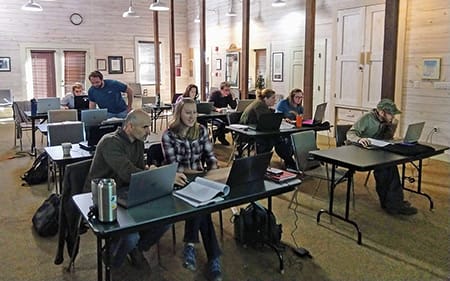
Educating and guiding the next generation of fire researchers and managers is a key goal of Wildland Fire Science and a resource for testing new ideas in fire research.
Tall Timbers hosts the premier fire technology transfer organization—the Southern Fire Exchange. This JFSP funded effort helps connect research to management through webinars, workshops, and support of the Prescribed Fire Science Consortium.
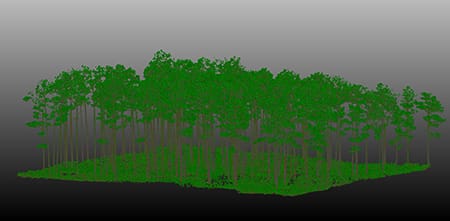
Working with partners in the Prescribed Fire Science Consortium, the program is building nexgen 3-D fuel beds using terrestrial LiDAR and novel sampling techniques to power new fire behavior models for prescribed fire managers. This work links to Tall Timbers work in wildlife habitat usage and ecological forestry.
The Longleaf Legacy landscape prescribed fire burn team arm of Wildland Fire Science works directly with landowners and partners to effectively put fire on the ground and promote prescribed fire throughout the region.
Tall Timbers is leading an effort to map fire regimes at the landscape scale. Staff work with numerous agencies to evaluate fire records and satellite imagery to build this critical conservation database. https://skfb.ly/6DqOY
Tall Timbers hosts the Prescribed Fire Science Consortium, a national network of researchers and managers who promote integrated research and management to advance next generation tools for fire practitioners. https://arcg.is/1DSjDT
We are linking physics and field observations to understand the fluid dynamics of fire behavior surface fire regimes. Our work combines field observations using advanced thermal imaging techniques, laboratory studies, and coupled fire-atmospheric modeling to help managers improve outcomes of managed fire regimes.
Selected Publications authored by Wildland Fire Science staff.
Staff and researchers support Federal fire training by serving as a cadre for NWCG training courses, ranging from basic wildland fire to advanced fire effects.
(PFTC) specializes in training fire fighters the principles and techniques of prescribed fire through practical hands-on experience. https://www.fws.gov/fire/pftc/
Private land owners are the largest source of prescribed fire in the country. These land owners and the culture of fire that was maintained by them during decades of suppression are a part of why Tall Timbers is a world-wide center for prescribed fire science. Workshops and fire training are a critical focus of the Longleaf Legacy Landscape Burn Team and our support of the Georgia Forestry Commission Prescribed Fire Center in Marion County.
The conserved lands of the Greater Red Hills region are found on working, income-producing properties that support agriculture, forestry, and recreational hunting. These properties contribute $272 million annually to local economies and support 2,300 jobs. [link to Planning & Advocacy section] The landowners’ strong stewardship ethic preserves their working lands while replenishing drinking water supplies, protecting water quality, and providing wildlife habitat for dozens of rare and endangered species. Tall Timbers’ conservation easements on these working properties encourage landowners to retain their traditional livelihood by keeping farms in family ownership.
Home to world-class wild quail populations, the Greater Red Hills region contains the largest concentration of gamebird preserves in the United States. These preserves also support the largest community of Red-cockaded woodpeckers on private lands. Indicators of high quality habitat found here include the gopher tortoise, Bachman’s sparrow, fox squirrel, and many amphibians. Tall Timbers’ conservation easements identify and protect the critical habitats of these species.
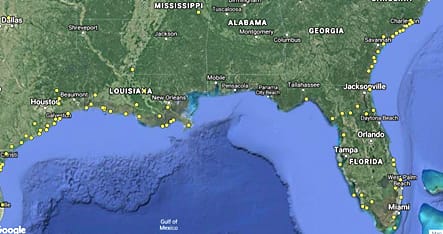
The region also boasts outstanding aquatic resources. Large river systems, like the Flint/Apalachicola, Ochlockonee, and Aucilla, flow from Georgia and feed into the Gulf of Mexico to support some of the world’s most productive estuaries. Large disappearing sinkhole lakes, like Iamonia, Miccosukee, and Jackson, provide habitat for an array of aquatic species and migratory birds. Tall Timbers’ conservation easements protect these vital watersheds and wetlands that are the lifeblood for the ecological health of the region.
Once dominated by longleaf pine, our pine woodlands support abundant wildlife and local economies. These forests need prescribed fire to stay healthy. Herbert L. Stoddard and his associates Ed and Roy Komarek were pioneers in this emerging scientific field during the mid-20th century. Tall Timbers continues that legacy with applied research on prescribed fire and land management. Today, there is a tremendous need to expand prescribed fire use beyond the Red Hills to ensure ecosystem health and reduce wildfire risk. Additionally, Tall Timbers uses conservation easements to permanently protect private woodlands while balancing the need for economic return from selective timbering.



 On August 31, 2021, the eye-catching headline “To Stop Extreme Wildfires, California Is Learning From … Florida?” brought readers and listeners to NPR Morning Edition coverage by Lauren Sommer. Lauren coordinated with Dr. Morgan Varner, Director of Research and a Senior Scientist at Tall Timbers, on the interview and content for the story. We were pleased with her coverage and thoughtful handling of the topic, including the important role of private landowners in expanding and maintaining the use of prescribed fire.