Dixie Davis – New Geospatial Database Administrator
Dixie Davis joined the Tall Timbers’ team August 1st. Dixie takes on the role of Geospatial Database Administrator and will be responsible for GIS server administration, web and mobile applications and database maintenance. Dixie comes to us with over 20 years of geospatial database experience in both the public and private sectors.
Dr. Eric Rowell Joins the Wildland Fire Science Program
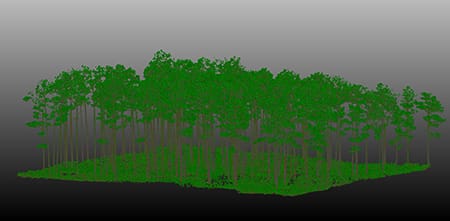
The Tall Timbers’ Wildland Fire Science Program welcomes Dr. Eric Rowell as a Wildland Fire Spatial Scientist to bring terrestrial LiDAR (Light Detection and Ranging) analysis expertise to our growing program. Eric comes to Tall Timbers from The FireCenter at the University of Montana where he studied remote sensing of fuels through the use of terrestrial LiDAR systems. At the FireCenter, Eric collaborated with Prescribed Fire Consortium partners including Tall Timbers to develop fuel models and relate them to fire behavior.
At Tall Timbers, Eric will work on several projects including leading a Department of Defense SERDP Grant that seeks to accurately characterize natural vegetation and fuels in three-dimensional space. Additionally, he will support the development of fuel models that can be used in next generation fire modeling software that can be used to inform managers in prescribed fire decision making.
Eric represents another step forward in creating a world class wildland fire program at Tall Timbers.
Dr. Eric Rowell uses a terretrial LiDAR system to scan a portion of Pebble Hill Plantation in Thomas County, Georgia.
Game Bird Program Receives Park Cities Quail Grant
By Dr. Theron Terhune, Game Bird Program Director
After Texas Quail Unlimited (QU) dissolved their chapters in the early 2000s, a group of quail conservation leaders agreed to form a Quail Coalition following the disbandment. In the past 12 years, the Quail Coalition has grown to 12 chapters and over 3,500 members. The largest chapter, the Park Cities Chapter, is based out of Dallas, Texas and has raised and donated roughly $7 million to quail conservation. Run by a group of Dallas area volunteers passionate about our sporting tradition, the group is able to donate virtually 100% of every dollar raised towards quail research and youth education. The Chapter’s main fundraising effort is an annual banquet which has been deemed by sports writers as “Conservation’s Greatest Night.” The annual banquet, which is held during March in Dallas each year, gathers over 1,000 quail enthusiasts across the country for a night of comradery, hors d’oeuvres, a quail dinner, silent- and live-auction – an effort that netted $1.7 million for quail conservation this year.
In the past, beneficiaries have included the National Bobwhite Conservation Initiative, Rolling Plains Quail Research Ranch and Foundation, Quail Tech Alliance, UNT Quail, Texas Brigades, Wounded Warriors, Texas A&M AgriLife Research and Extension, Texas Tech TIEHH, and Sul Ross Borderlands Research Institute.
This year, the Game Bird Program at Tall Timbers joined this prestigious list by receiving a research grant to further our knowledge of bobwhite chick ecology. The chick ecology study is a collaborative effort between Tall Timbers researchers and collaborators in Florida, Texas, Missouri, and North Carolina. We are excited about this collaboration with Park Cities Quail and look forward to a long-term partnership working together to improve management and conservation efforts for northern bobwhite.
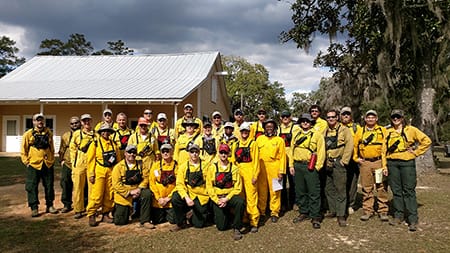
Tall Timbers’ Fire Training Specialist Greg Seamon traveled to Campeche, Mexico as part of the USFS International Forestry Program’s work with the Mexican government on prescribed fire training. While in Campeche, Greg worked with USFS personnel, contractors and the Director of the Prescribed Fire Training Center, Robert Trincado (USFWS) to conduct a training focused on burn plan goals and objectives setting and monitoring for meeting those goals and objectives. Thirty wildland firefighters from across the country, representing CONAFOR (National Forestry Commission of Mexico), CONANP (National Commission for Natural Protected Areas), and ProNatura (Mexico’s largest environmental organization) participated.
The Mexican government passed a bill in June allowing the use of prescribed fire throughout the country for fuels management. This is having a major influence in altering the perception of prescribed fire for management purposes in natural areas. This training was designed to begin the process of setting up natural area managers and those who respond to wildfires to looking at the possibility of fire having a positive outcome.
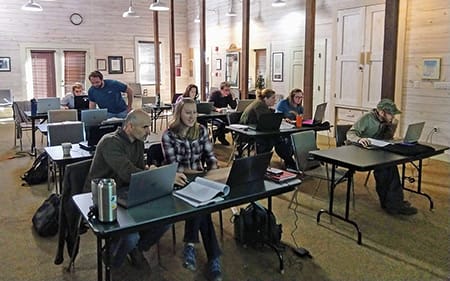
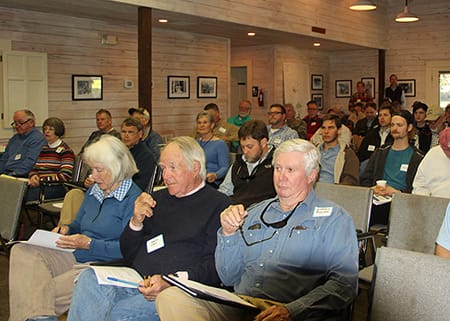
The majority of the attendees had less than three years of prescribed fire experience and for many the only other training had been involved in a Training Exchange in New Mexico organized by the USFS and The Nature Conservancy. This training began with some classroom presentations by participants on the prescribed fire potential in each of their regions and followed with some presentations by the cadre and group exercises and discussions with the students.
Wednesday, July 11, was nationally designated the day of the firefighter and there was special recognition and media surrounding the training and the attendees. In addition, a field trip was taken to set up permanent monitoring plots at a site to be burned the following day. All 30 students participated in gathering pre-burn data in anticipation of the prescribed fire. The students were separated into 5 modules and that night each module wrote an abbreviated burn plan for the site. The cadre chose the best plan for implementation.
On Thursday, the burn was executed with one module conducting the firing, assisted by Greg, two modules handled holding and two modules conducted fire behavior observations and post-burn monitoring. Though the unit was small, 2 hectares (5 acres), the burn resulted in some great training. The students held a thorough AAR (after action review) that focused on all aspects of the burn and what each group observed.
The result of this initial training is to design a follow-up. There is current discussion on what comes next. This initial workshop has defined some needed training in writing burn plans as well as understanding smoke management and fire behavior. It’s hopeful that this was the match that will ignite the prescribed fire community throughout Mexico.
Prescribed Fire Science Consortium Secures Department of Defense Grants
Prescribed Fire Science Consortium led by Tall Timbers’ Wildland Fire Science program secures four Department of Defense SERDP grants to study 3D fuels and fire spread.
Through the Strategic Environmental Research and Development Program (SERDP) the Department of Defense periodically funds environmental research projects to address wide ranging issues from military land management and climate to weapon system use and everything in between. These extremely competitive grants generate solutions to the Department’s environmental challenges reducing costs, environmental risks, and time required to resolve environmental problems while enhancing and sustaining military readiness.
Last October, SERDP released a statement of need requesting proposals of wildland fire research to improve military land use efficiency. The research objectives requested by this statement of need included an understanding of fire processes and fuel characterization in time and space through diverse conditions. The recently organized Prescribed Fire Consortium led by Tall Timbers is uniquely poised to answer all of the objectives laid out in the statement of need, and as such, was successful in securing four grants totaling 6.4 million dollars over the next four years.
These grants include two 3D fuel characterization grants using Terrestrial LiDAR techniques, a fire pattern and processes modeling grant and a grant that ties fuel characterization to modeling and fire processes.
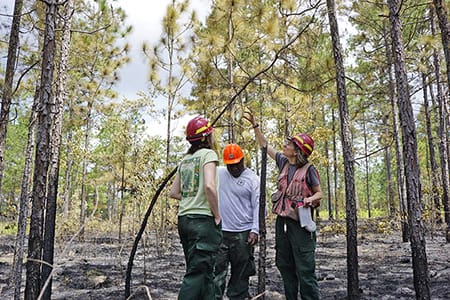
Photo: US Forest Service research scientists test a 3D fuel sampling rig that will help validate remote sensing fuel sampling techniques that will be developed by the SERDP grants.
The M-CORES program, which includes the proposed Suncoast Connector Toll Road in Jefferson County, passed through the Florida Legislature at breakneck speed with little review or analysis. Tall Timbers has a number of concerns given the potential for significant and wide spread impacts. These include fragmenting public and private conservation lands, robbing business from Main Street Monticello, impacting our rivers and other water resources, and making prescribed fire more difficult and costly.
Join us in asking the Jefferson County Board of County Commissioners to OPPOSE the Suncoast Connector toll road and its path through Jefferson County.
Take action now with our easy email form.
Send an email to all five Jefferson County Board of County Commissioners with one click!
Burn prioritization modeling seminars and fire modeling tools are supported by Wildland Fire Science to train managers in the important planning stages of prescribed fires.
Educating and guiding the next generation of fire researchers and managers is a key goal of Wildland Fire Science and a resource for testing new ideas in fire research.
Tall Timbers hosts the premier fire technology transfer organization—the Southern Fire Exchange. This JFSP funded effort helps connect research to management through webinars, workshops, and support of the Prescribed Fire Science Consortium.
Working with partners in the Prescribed Fire Science Consortium, the program is building nexgen 3-D fuel beds using terrestrial LiDAR and novel sampling techniques to power new fire behavior models for prescribed fire managers. This work links to Tall Timbers work in wildlife habitat usage and ecological forestry.
The Longleaf Legacy landscape prescribed fire burn team arm of Wildland Fire Science works directly with landowners and partners to effectively put fire on the ground and promote prescribed fire throughout the region.
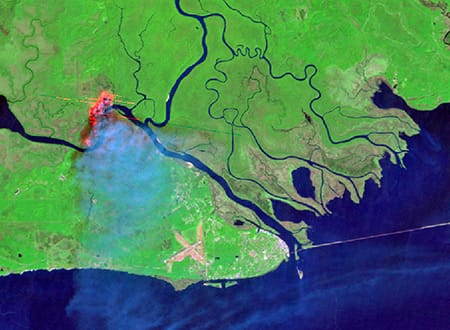
Tall Timbers is leading an effort to map fire regimes at the landscape scale. Staff work with numerous agencies to evaluate fire records and satellite imagery to build this critical conservation database. https://skfb.ly/6DqOY
Tall Timbers hosts the Prescribed Fire Science Consortium, a national network of researchers and managers who promote integrated research and management to advance next generation tools for fire practitioners. https://arcg.is/1DSjDT
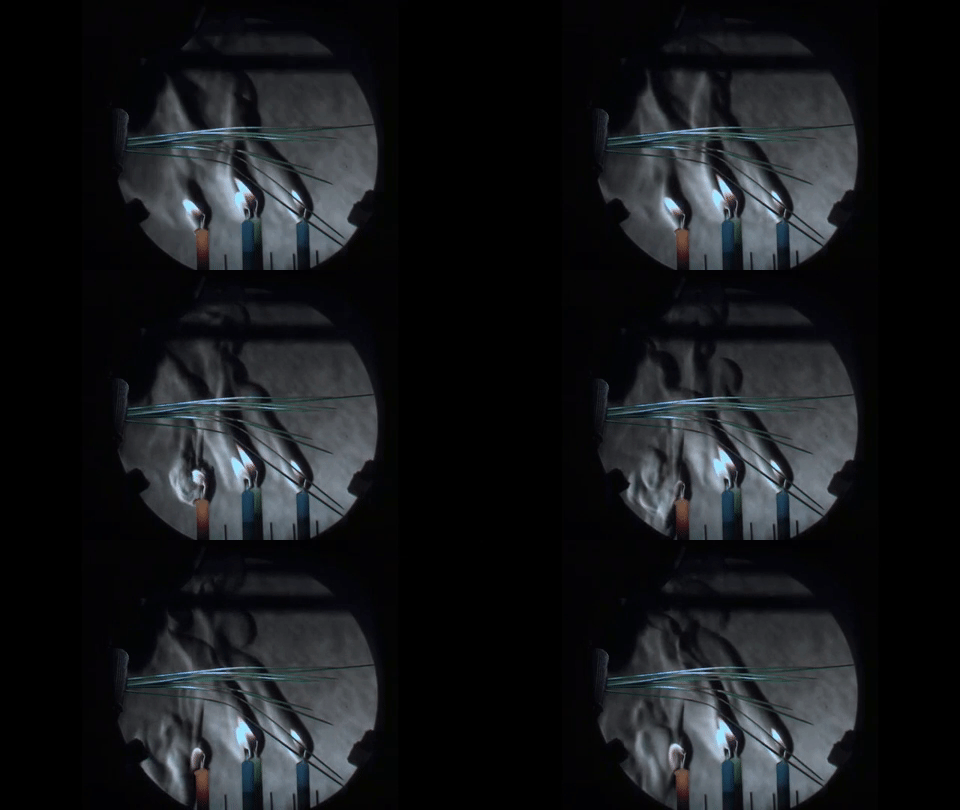
We are linking physics and field observations to understand the fluid dynamics of fire behavior surface fire regimes. Our work combines field observations using advanced thermal imaging techniques, laboratory studies, and coupled fire-atmospheric modeling to help managers improve outcomes of managed fire regimes.
Selected Publications authored by Wildland Fire Science staff.
Staff and researchers support Federal fire training by serving as a cadre for NWCG training courses, ranging from basic wildland fire to advanced fire effects.
(PFTC) specializes in training fire fighters the principles and techniques of prescribed fire through practical hands-on experience. https://www.fws.gov/fire/pftc/
Private land owners are the largest source of prescribed fire in the country. These land owners and the culture of fire that was maintained by them during decades of suppression are a part of why Tall Timbers is a world-wide center for prescribed fire science. Workshops and fire training are a critical focus of the Longleaf Legacy Landscape Burn Team and our support of the Georgia Forestry Commission Prescribed Fire Center in Marion County.
The conserved lands of the Greater Red Hills region are found on working, income-producing properties that support agriculture, forestry, and recreational hunting. These properties contribute $272 million annually to local economies and support 2,300 jobs. [link to Planning & Advocacy section] The landowners’ strong stewardship ethic preserves their working lands while replenishing drinking water supplies, protecting water quality, and providing wildlife habitat for dozens of rare and endangered species. Tall Timbers’ conservation easements on these working properties encourage landowners to retain their traditional livelihood by keeping farms in family ownership.
Home to world-class wild quail populations, the Greater Red Hills region contains the largest concentration of gamebird preserves in the United States. These preserves also support the largest community of Red-cockaded woodpeckers on private lands. Indicators of high quality habitat found here include the gopher tortoise, Bachman’s sparrow, fox squirrel, and many amphibians. Tall Timbers’ conservation easements identify and protect the critical habitats of these species.
The region also boasts outstanding aquatic resources. Large river systems, like the Flint/Apalachicola, Ochlockonee, and Aucilla, flow from Georgia and feed into the Gulf of Mexico to support some of the world’s most productive estuaries. Large disappearing sinkhole lakes, like Iamonia, Miccosukee, and Jackson, provide habitat for an array of aquatic species and migratory birds. Tall Timbers’ conservation easements protect these vital watersheds and wetlands that are the lifeblood for the ecological health of the region.
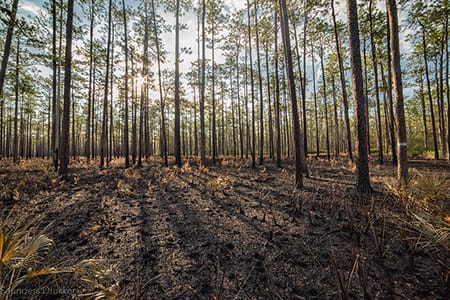
Once dominated by longleaf pine, our pine woodlands support abundant wildlife and local economies. These forests need prescribed fire to stay healthy. Herbert L. Stoddard and his associates Ed and Roy Komarek were pioneers in this emerging scientific field during the mid-20th century. Tall Timbers continues that legacy with applied research on prescribed fire and land management. Today, there is a tremendous need to expand prescribed fire use beyond the Red Hills to ensure ecosystem health and reduce wildfire risk. Additionally, Tall Timbers uses conservation easements to permanently protect private woodlands while balancing the need for economic return from selective timbering.

 Dixie Davis joined the Tall Timbers’ team August 1st. Dixie takes on the role of Geospatial Database Administrator and will be responsible for GIS server administration, web and mobile applications and database maintenance. Dixie comes to us with over 20 years of geospatial database experience in both the public and private sectors.
  The Tall Timbers’ Wildland Fire Science Program welcomes Dr. Eric Rowell as a Wildland Fire Spatial Scientist to bring terrestrial LiDAR (Light Detection and Ranging) analysis expertise to our growing program. Eric comes to Tall Timbers from The FireCenter at the University of Montana where he studied remote sensing of fuels through the use of terrestrial LiDAR systems. At the FireCenter, Eric collaborated with Prescribed Fire Consortium partners including Tall Timbers to develop fuel models and relate them to fire behavior.
.png?strip=all&resize=200%2C186) In the past, beneficiaries have included the National Bobwhite Conservation Initiative, Rolling Plains Quail Research Ranch and Foundation, Quail Tech Alliance, UNT Quail, Texas Brigades, Wounded Warriors, Texas A&M AgriLife Research and Extension, Texas Tech TIEHH, and Sul Ross Borderlands Research Institute.
In the past, beneficiaries have included the National Bobwhite Conservation Initiative, Rolling Plains Quail Research Ranch and Foundation, Quail Tech Alliance, UNT Quail, Texas Brigades, Wounded Warriors, Texas A&M AgriLife Research and Extension, Texas Tech TIEHH, and Sul Ross Borderlands Research Institute.
 The majority of the attendees had less than three years of prescribed fire experience and for many the only other training had been involved in a Training Exchange in New Mexico organized by the USFS and The Nature Conservancy. This training began with some classroom presentations by participants on the prescribed fire potential in each of their regions and followed with some presentations by the cadre and group exercises and discussions with the students.

 Prescribed Fire Science Consortium led by Tall Timbers’ Wildland Fire Science program secures four Department of Defense SERDP grants to study 3D fuels and fire spread.