Tall Timbers Naturalists’ Ball to honor endowment donors
Please join us as we honor all those who have made a personal commitment to the Tall Timbers 50th Anniversary Endowment Campaign at the Tall Timbers Naturalists’ Ball.
This year’s event will be held on Saturday, February 18th at Glen Arven Country Club in Thomasville, GA. All proceeds benefit the Tall Timbers Foundation. For more information and to purchase tickets, please visit http://www.talltimbers.org/support-nb.html
After recruiting a record of 293 House co-sponsors for the Conservation Easement Incentive Act, more than any other tax bill last year, Congress ran out of time and failed to pass the bill before the incentives expired at the end of 2011.
The legislation to make the incentive permanent (H.R. 1964 and S. 339) is championed by the chairs of the Senate Finance and House Ways & Means Committees, both of whom view it as an important part of their legacy. Therefore, there will be another attempt this year to make the incentives permanent.
Conservation easements donated in 2012 will still be tax deductible and will be treated just like any other non-cash charitable donation — deductible up to 30% of a donor’s income for up to six years.
According to the Land Trust Alliance, potential donors should “run the numbers — some donors, particularly those with larger incomes, will find that the incentive’s expiration makes little difference.” For an update, visit the Alliance’s Website for Frequently Asked Questions and Conservation Donation Rules pages for donated conservation easements.
Tall Timbers will continue to work with the Alliance and numerous other land trusts to encourage Congress to move forward in making the incentives permanent in 2012.
One of the best insurance policies ever developed for landowners in the Red Hills region has two new agents at the helm. Joe Burnam (Georgia Department of Natural Resources) and Caly Murphy (Florida Fish and Wildlife Conservation Commission) were hired last summer by their respective agencies to help promote the Safe Harbor Program and guide private landowners in understanding how the program might work on their properties.
Maintenance of mature pine forests and use of frequent fire are hallmarks of quail management in our region. The wonderful pinewoods make the hunt all the more enjoyable, but the stewardship also creates conditions attractive to the endangered Red-cockaded Woodpecker. Lest the woodpecker’s endangered status cause any heartburn, The Safe Harbor Program is designed to ease fears by limiting the regulations that might be applied if the species takes up residence.
“One of the biggest misunderstandings about Safe Harbor Program is that the program is designed for properties that have woodpeckers,” Burnam notes. “The Safe Harbor Program is a good fit for anyone who either burns their property regularly or maintains mature timber stands.” “In fact,” Burnam stresses, “a great time to sign up is when no woodpeckers occur on the property. In that situation, the landowner has guaranteed assurance as far as the woodpecker goes.”
Another reason to consider Safe Harbor is linked to the land-owner assistance programs that often come with the agreements. Over the past six years, over $500,000 has been provided to help local landowners conduct prescribed burns, manage hardwoods using chopping and herbicides, plant native warm-season grasses, and excavate artificial cavities (where desired).
Burnam and Murphy also have deep roots to the region and understand the special nature of Red Hills’ properties. Burnam’s grandfather was the superintendent at Mistletoe Plantation, and he worked on Pebble Hill Plantation for the Game Bird Program as part of his graduate studies at University of Georgia. Murphy graduated from Thomas University and did her senior internship with the Fire Ecology Program at Tall Timbers.
As always, Tall Timbers staff is ready to help answer any questions about the program, but consider giving Caly Murphy or Joe Burnam a direct call to make get this New Year off to a good start.
Winter disking is a land management tool used to disturb the soil, set back plant succession, and maintain a mix of annual and perennial plants, mainly forbs (weedy plants). Research on the Whitcomb plots at Tall Timbers has shown that disking between October and January produced higher percent cover of important bobwhite foods such as ragweed (Ambrosia artemisiifolia) and partridge pea (Cassia fasciculata), as well as a higher percent and higher diversity of phytophagus insects (the insects that quail eat such as ants, spiders, and other predaceous arthropods). Disked fields can be good brood habitat for foraging bird species; they are rich with insects; the bare ground allows for easy movement by the young birds; and the plant structure allows for protection from avian predators. These forb dominated fields provide diversity to a forested landscape and can be essential habitat for cottontail rabbits, deer, bobwhite, turkey, and other songbirds. Depending on the management objectives, soil type, and vegetation type, fields can be entirely disked or partially disked (strip disking). By disking the entire field annually, the manager is maximizing brood habitat, by disking 1/3 – 1/2 of each field every year. A manager can increase brood habitat, while maintaining year around cover and food resources.
Winter disking also has many positive attributes compared to planting food plots. First of all there is the economic aspect; winter disking, where the seed bank is intact, has minimal cost (fuel and tractor maintenance). In areas without an adequate seed bank, (such as abandoned agricultural fields, also referred to as old fields), a winter disked field typically can be perpetuated from one year of planting the desired old field plant species versus planting annual food plots such as sorghum, millets, or sunflower, which require an additional annual cost of seed and fertilizer. Secondly, the old field vegetation has evolved with drought conditions, so in those years that the food plots don’t produce due to lack of rainfall, old field vegetation will still grow and provide wildlife benefits.
Past land use and soil type considerations determine the benefits of winter disked fields. When reclaiming a fallow pasture field, exotic grass control is a necessary first step; fescue, Bermuda, and Bahia grasses are often present and are an impediment to wildlife and old field vegetation. They must be controlled for successful field management to occur. Soil type will determine the amount of brood use. In loamy or clay soils, such as much of the Red Hills region of north Florida and south Georgia, frequently burned upland pine forests with adequate sunlight for groundcover will actually be the preferred quail brood habitat, and winter disked fields will be used the least. In these areas, strip disking may be more beneficial for meeting other habitat needs such as year-round cover and nesting habitat.
Conversely, on sandy, dry soils, such as in the greater Albany area of Georgia, and portions of the Red Hills area where groundcover in the uplands can be sparse, winter disked fields will be the preferred brood habitat and will be highly used. In these areas, disking the entire field annually will improve brood habitat while the native or old field groundcover will provide the nesting and year around cover. Similarly, native wiregrass and longleaf sites, (typically sandy soil and low fertility) the native ground cover will provide excellent nesting and year around high quality habitat, while existing winter disked fields can provide high quality brood habitat. Disking of intact native groundcover is not recommended; these areas have not been disked before, and do not have the appropriate seed bank to respond positively to winter disking. In this situation, brood use in newly disturbed native groundcover will be much less than in recently burned intact native groundcover.
Forbs such as partridge pea, ragweed, mint blue curl, and blackberry (to name a few) can be an important food resource for many birds and mammals. Timing of winter disking will determine what plants will be prevalent. In a study conducted on the Whitcomb plots at Tall Timbers, annual percent plant coverage of ragweed in the Oct/Nov plot was 52%, but was 86% in the Dec/Jan disked plot. Partridge pea had 32% cover in the Oct/Nov disked plot and 12% in the Dec/Jan disked plot. Blackberry was 11% cover in the Oct/Nov disked plot and 43% in the Dec/Jan disked plot. The key to determine when to disk is to watch for when the desired plant species’ seeds mature. However, timing and the amount of rainfall in a given year will also have an effect on the plant community response as seen through sampling of the Whitcomb plots during various years.
Research has shown that size of fields is also an important consideration. Fields smaller than an acre will receive little use by broods; if possible, 2-4 acre fields are preferred. On high quality soils (loamy or clay), one field per 20 acres (10-20%) is a good rule of thumb. On low quality, sandy soils, up to 40% of the landscape kept in fields is beneficial. Field management is just one component of wildlife management. Managing the forest with frequent fire, and thinning to get adequate sunlight to the ground are the most important factors in creating and maintaining high quality, early succession habitat.
During Prescribe Fire Awareness Week (January 22-28 in Florida and February 5-11 in Georgia) and indeed throughout the year, Tall Timbers, the prescribed fire councils in Florida and Georgia, the Florida Forest Service and the Georgia Forestry Commission promote the use of prescribed fire as a safe way to apply a natural process, ensure ecosystem health and reduce wildfire risk. But there is no question, that where there is fire, there is smoke. As we are in a region with large tracts of plantation lands and state and federal forest lands, where prescribed burns are regularly conducted, the resultant smoke and air quality is of concern to many.
Needless to say, breathing smoke is not good for you. However, one of the important goals of prescribed burning is to reduce fuel loads on the landscape so we do not experience large and difficult to control wildfires; these usually produce many times the smoke of a prescribed burn and can have very serious health impacts on the community. In contrast, prescribed burns are generally frequent enough to produce relatively small amounts of smoke, and we choose the conditions, including wind directions away from roads and highly populated areas, and atmospheric stability conditions in which smoke rises quickly and is readily dispersed.
Prescribed burn conducted on the Kate Ireland Parkway in Leon County, FL during Prescribed Fire Awareness Week in 2011.
Although we cannot promise that everyone out there is doing everything just as they should, prescribed fire education and training is always making headway, and prescribed burners continue to get better skilled at reducing impacts to the community. In any case, although we might smell a strong whiff of smoke when someone is burning nearby, the fact is, only a very small percentage (<1%) of the particulate matter (small particles that impact our lungs) in the air that we breath over the course of the year comes from smoke from burning, the great majority of it coming from coal power plants and cars, especially in urban areas.
The amount of smoke in the air is also monitored and regulated. To conduct a prescribed burn, an authorization has to be obtained from the Florida Forest Service (previously Division of Forestry) or the Georgia Forestry Commission, usually the morning of the burn. It is their job to determine whether or not there is already too much burning (or wildfire) going on in a certain area to authorize additional burns. Also, prescribed fires are typically required to be extinguished and mopped up by 5:00 PM to avoid that night time smoke. Again, that does not mean that everyone out there always follows the rules, but they risk stiff penalties if they break them. Finally, there are federal Environmental Protection Agency (EPA) regulations for levels of particulate matter that are allowable in the air on a daily and yearly basis. The state air quality agency has to monitor and make sure that all parts of Florida are "in attainment" of the regulations, and otherwise some sources of pollution have to be shut down, and prescribed fire is the easiest target. The state forestry agency has stay within requirements of the air quality agencies by limiting the amount of smoke released by burning through the burn authorization system. The EPA regulations are actually pretty strict and getting stricter, but Florida’s air quality has continued to improve over time to stay in attainment, with very rare exceptions, and those usually attributable to wildfires.
Unfortunately, sometimes smoke is incorrectly attributed to prescribed fires, when in fact it is from a nearby wildfire. Several times last year I heard on the local radio that smoke in Tallahassee was from a prescribed burn, right in the middle of a burn ban when no one was allowed to burn, and when I called the Florida Forest Service they confirmed it was from a wildfire.
Prescribed burning brings back to our landscape only a fraction of the fire that occurred historically. Some people wonder if lightning strikes were really common enough to maintain frequent fires. In fact, lightning struck and started fires often enough to start fires usually every 1-3 years. However, now with roads, development, and land uses that are not as flammable as the pine grasslands that once covered the area, not as many lightning strikes start fires and those fires are usually easy to contain and put out quickly. However, lightning strikes are still responsible for upwards of half the wildfires in Florida, which is one of the reasons prescribed fire is so important.
The M-CORES program, which includes the proposed Suncoast Connector Toll Road in Jefferson County, passed through the Florida Legislature at breakneck speed with little review or analysis. Tall Timbers has a number of concerns given the potential for significant and wide spread impacts. These include fragmenting public and private conservation lands, robbing business from Main Street Monticello, impacting our rivers and other water resources, and making prescribed fire more difficult and costly.
Join us in asking the Jefferson County Board of County Commissioners to OPPOSE the Suncoast Connector toll road and its path through Jefferson County.
Take action now with our easy email form.
Send an email to all five Jefferson County Board of County Commissioners with one click!
Burn prioritization modeling seminars and fire modeling tools are supported by Wildland Fire Science to train managers in the important planning stages of prescribed fires.
Educating and guiding the next generation of fire researchers and managers is a key goal of Wildland Fire Science and a resource for testing new ideas in fire research.
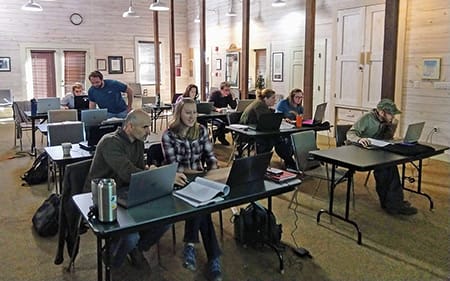
Tall Timbers hosts the premier fire technology transfer organization—the Southern Fire Exchange. This JFSP funded effort helps connect research to management through webinars, workshops, and support of the Prescribed Fire Science Consortium.
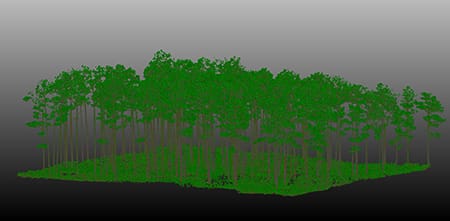
Working with partners in the Prescribed Fire Science Consortium, the program is building nexgen 3-D fuel beds using terrestrial LiDAR and novel sampling techniques to power new fire behavior models for prescribed fire managers. This work links to Tall Timbers work in wildlife habitat usage and ecological forestry.
The Longleaf Legacy landscape prescribed fire burn team arm of Wildland Fire Science works directly with landowners and partners to effectively put fire on the ground and promote prescribed fire throughout the region.
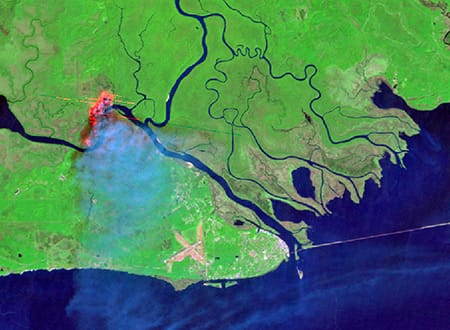
Tall Timbers is leading an effort to map fire regimes at the landscape scale. Staff work with numerous agencies to evaluate fire records and satellite imagery to build this critical conservation database. https://skfb.ly/6DqOY
Tall Timbers hosts the Prescribed Fire Science Consortium, a national network of researchers and managers who promote integrated research and management to advance next generation tools for fire practitioners. https://arcg.is/1DSjDT
We are linking physics and field observations to understand the fluid dynamics of fire behavior surface fire regimes. Our work combines field observations using advanced thermal imaging techniques, laboratory studies, and coupled fire-atmospheric modeling to help managers improve outcomes of managed fire regimes.
Selected Publications authored by Wildland Fire Science staff.
Staff and researchers support Federal fire training by serving as a cadre for NWCG training courses, ranging from basic wildland fire to advanced fire effects.
(PFTC) specializes in training fire fighters the principles and techniques of prescribed fire through practical hands-on experience. https://www.fws.gov/fire/pftc/
Private land owners are the largest source of prescribed fire in the country. These land owners and the culture of fire that was maintained by them during decades of suppression are a part of why Tall Timbers is a world-wide center for prescribed fire science. Workshops and fire training are a critical focus of the Longleaf Legacy Landscape Burn Team and our support of the Georgia Forestry Commission Prescribed Fire Center in Marion County.
The conserved lands of the Greater Red Hills region are found on working, income-producing properties that support agriculture, forestry, and recreational hunting. These properties contribute $272 million annually to local economies and support 2,300 jobs. [link to Planning & Advocacy section] The landowners’ strong stewardship ethic preserves their working lands while replenishing drinking water supplies, protecting water quality, and providing wildlife habitat for dozens of rare and endangered species. Tall Timbers’ conservation easements on these working properties encourage landowners to retain their traditional livelihood by keeping farms in family ownership.
Home to world-class wild quail populations, the Greater Red Hills region contains the largest concentration of gamebird preserves in the United States. These preserves also support the largest community of Red-cockaded woodpeckers on private lands. Indicators of high quality habitat found here include the gopher tortoise, Bachman’s sparrow, fox squirrel, and many amphibians. Tall Timbers’ conservation easements identify and protect the critical habitats of these species.
The region also boasts outstanding aquatic resources. Large river systems, like the Flint/Apalachicola, Ochlockonee, and Aucilla, flow from Georgia and feed into the Gulf of Mexico to support some of the world’s most productive estuaries. Large disappearing sinkhole lakes, like Iamonia, Miccosukee, and Jackson, provide habitat for an array of aquatic species and migratory birds. Tall Timbers’ conservation easements protect these vital watersheds and wetlands that are the lifeblood for the ecological health of the region.
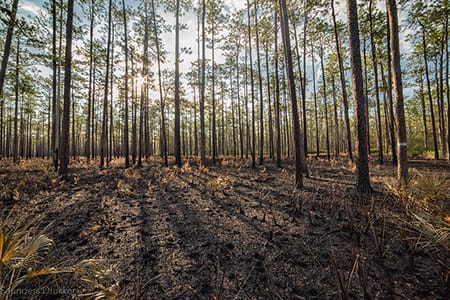
Once dominated by longleaf pine, our pine woodlands support abundant wildlife and local economies. These forests need prescribed fire to stay healthy. Herbert L. Stoddard and his associates Ed and Roy Komarek were pioneers in this emerging scientific field during the mid-20th century. Tall Timbers continues that legacy with applied research on prescribed fire and land management. Today, there is a tremendous need to expand prescribed fire use beyond the Red Hills to ensure ecosystem health and reduce wildfire risk. Additionally, Tall Timbers uses conservation easements to permanently protect private woodlands while balancing the need for economic return from selective timbering.