Bahia and Bermuda grass are invasive, exotic, sod forming grasses which develop into low-quality habitat for bobwhite and other wildlife. Due to past land management practices, predominantly disking, mowing, chopping and thinning, sod forming grasses planted to hold roads have been able to invade the uplands jeopardizing the quality of ground cover. On many landscapes native grasses are preferred since they are the primary fuels carrying the frequent fires necessary to provide quality wildlife habitat. Therefore, the goal of recent research at Tall Timbers was to find the best methods to eliminate sod forming grasses from upland habitats.
The main focus of the research was to determine the best selective herbicide or combination of herbicides that specifically controls the problem sod-forming grasses and still allows the preferred native grasses and beneficial weeds to reestablish in the treated areas. In a perfect world we would like to mow or burn the area in the spring and then apply herbicide about a month later when the grass has re-sprouted and prior to seed head maturation to minimize the future seed source. However, in most established areas the seed source already exists so the application of herbicide can take place under the right conditions when time allows. The appropriate conditions for herbicide applications should occur when plants are actively growing and drought conditions should be avoided. Most importantly for applications to be fully effective apply a minimum of 30 minutes before a rain, this allows time for the herbicide to dry on the plant.
A total of 26 different treatments utilizing 8 different herbicides with multiple combinations, and concentrations were tested. Treatments were applied during June – August 2013, on three sites in Leon and Jefferson Counties in Florida. All treatment areas were surveyed using GPS, and photo points were taken prior to spraying, at 2-months post spraying, and at 1-year post application to determine efficacy of Bahia/Bermuda control and negative impacts on native grasses and forbs. All treatments were sprayed via a tractor and boom-less sprayer with 28-36 gal H2O and 21-32 oz non-ionic surfactant/acre. The common label for Sethoxydim is Poast®, and can be used; however Poast® has a higher percent active ingredient then the Sethoxydim SPC® we used, so the rates will be lower.
The following herbicide treatments showed the best one year control (>80% of target grass was killed):
Bahia – The best herbicide/combinations included:
Metsulfuron (Escort® @1.5-2oz/acre), or
Sethoxydim (Sethoxydim SPC® @24-34 oz/acre), or
Metsulfuron + Aminopyralid (Opensight® @1.6 – 3.5 oz/acre), or
Imazaquin (Septor 70 DG® @ 5oz/acre)
Adding Imazapic (3.2-13oz Plateau®) to any of these options increased Bahia control by inhibiting seed germination.
Bermuda – The best herbicide/combination included:
Sethoxydim (Sethoxydim SPC® @ 34 oz acre), or
Clethodim (Intensity 1® @ 44oz/acre), or
Adding Imazapic (3.2-13oz Plateau®) to any of these optionswill increase Bermuda control by inhibiting seed germination.
Bahia & Bermuda – The best herbicide/combinations included:
Sethoxydim SPC® @ 34oz/acre, or
Escort® @1.5-2oz/acre + Sethoxydim SPC® @24-34 oz/acre, or
13oz Plateau®+2oz Escort®+44 oz Intensity 1®
The three herbicides that were NOT EFFECTIVE in controlling sod-forming grasses include:
Bahia grass has a few more control options than Bermuda, and they all can be purchased without a pesticide applicators license. The selectivity was very similar between the successful Bahia treatments; virtually all the native grasses were retained while different treatments controlled a slightly different suite of forbs.
Septor 70 DG® @ 5oz/acre, and Opensight® @1.6-3 oz/acre worked well on Bahia, but also negatively affected many natives such as Goat’s rue (Tephrosia spicata), Sensitive briar (Mimosa quadrivalvis), and quality quail plants such as Lespedeza, Partridge pea (Cassia fasculata), Beggars lice (Desmodium sps), and Ragweed (Ambrosia artemisiifolia).
Sethoxydim SPC® @34 oz/acre had >90% control, and also controls nut grass, while not controlling the beggars lice, lespedeza, rag weed, partridge pea, Goat’s rue and sensitive briar.
An important lesson learned from this experiment is thorough inspection of a site is needed before herbicide application takes place; you need to identify your target species. Our experience at Tall Timbers suggests that Bermuda is often mixed in with the Bahia, and goes unnoticed until it is released. The recognition of both species of sod forming grass will be treated differently than if just one species existed.
Further testing will be conducted using different concentrations of Sethoxydim SPC®, and Sethoxydim SPC® + Plateau®, as that mixture suggests high control of both Bahia and Bermuda while minimizing impacts to important forbs. Imazapyr (Arsenal®) is a viable alternative to control Bahia and Bermuda, however, it is extremely hard on most grasses, and due to its soil activity cannot be sprayed under desirable hardwood species. Bermuda controllers include Sethoxydim SPC® @ 34oz/acre, and Clethodim @ 44oz/acre, which we tested, and Imazapyr and Fuazifop which we did not. Both Clethodim and Fuazifop do require an applicator license. While the 13oz Plateau®+2oz Escort®+44 oz Intensity 1® treatment did control >90% of Bahia and >80% Bermuda, it controlled too much of the beneficial vegetation leaving the ground barren and therefore is not a suggested control based on our goals.
Based on our current research and objectives at this time we recommend:
Bahia grass control – Sethoxydim SPC® @ 24-30 oz/acre or Metsulfuron @ 2-3.5oz/acre
Bermuda grass control – Sethoxydim SPC® @ 30-34 oz/acre
To minimize germination – Plateau® @ 4-6oz/acre can be added to either chemical
Effects of fuel and weather on fire behavior in longleaf pine-wiregrass communities
By Kevin Robertson, PhD, Fire Ecology Program Director
Upon wrapping up the ninth year of work at the Pebble Hill Fire Plots long-term research project on fire in longleaf pine-wiregrass communities, we have completed the first set of analyses examining the complex relationships among fire regime (1-4 year fire intervals in May-September for growing season burns and January-February for dormant season burns), fuel characteristics, and fire behavior. Our primary interest for this part of the project was to determine how time since fire changes the fuel bed, which leads to changes in fire behavior. This kind of information helps us predict what effects prescribed fire and wildfire have on fuel consumption, smoke production, and effects on plants and wildlife habitat.
We analyzed our data using Structural Equation Modeling, which is a method for analyzing multiple complex relationships among variables at the same time to better interpret how the system works as a whole. One of our preliminary findings was that the moisture of dead fine fuels, such as dead grasses and pine needle litter, does not have a strong influence on how much or how fast the fuel is consumed, although it appears to affect how fast fire spreads. Apparently the moisture in dead fine fuel is driven off by pre-heating prior to combustion as the fire approaches, such that the combustion processes themselves are similar regardless of initial moisture. Considering that this community type has an abundance of fine fuels in the form of grass and pine needles, this result helps explain why it is so flammable even under conditions of high relatively humidity and following very recent rain.
We also found that time since fire, which corresponds to fine fuel accumulation over time, surprisingly did not have a strong overall effect on reaction intensity, which is how fast heat is released per area of ground within the flaming front. This observation is in contrast to the typical prediction by fire behavior models such as BEHAVE, which is that reaction intensity increases with higher fuel loads. The lack of overall effect appears to be because of the canceling influences of higher fuel loads and total heat released tending to increase reaction intensity, while greater density of the fuel bed with time since fire and fuel accumulation tend to decrease reaction intensity. These results suggest that even relatively high fine fuel loads in pine savannahs following several years of fire exclusion, which is typical of restoration burns, can be managed with appropriate ignition techniques to minimize reaction intensity and associated tree crown scorch and rate of smoke production.
Our results will be used to evaluate and suggest improvements to fire behavior models where needed in order to provide more accurate fire behavior and effects predictions for fire practitioners. Our ultimate goal is to more effectively use fire to restore and maintain healthy pine communities and reduce wildfire risk in a manner protects public health and safety.
Less is Moore — a Re-examination of Two Woodland Period Sites of the North Florida Gulf Coast
Dr. Lou Hill will be giving an archaeology presentation, Thursday, October 9, at the E. V. Komarek Science Education Center at Tall Timbers. There will be a light social from 6:30 – 7:00 PM. The presentation begins at 7:00 PM. Dr. Hill will talk about early trading in the area and the connection to the pottery he examined in the Tall Timbers archaeology collection.
PFTC/Tall Timbers Impact on Prescribed Fire around the World
By Greg Seamon, Fire Training Specialist
The mission of National Prescribed Fire Training Center (PFTC) is to maintain a center of excellence for prescribed fire, with an emphasis on actual field experience, in order to increase skills and knowledge and build confidence in the application of prescribed fire. PFTC began in 1998 from a conversation among some southeastern prescribed fire practitioners and grew with support from all the federal land management agencies, a number of state agencies and important non-governmental organizations including Tall Timbers. Tall Timbers has hosted PFTC field trips from the very beginning, including the 20-day sessions and the Resource Specialist Workshops. Additionally Tall Timbers has an agreement with PFTC to provide support for a Fire Training Specialist co-located between PFTC and the Station.
Through the 2014 fiscal year, PFTC has hosted 2,148 attendees for their 20-day sessions, Agency Administrators Workshops, Resource Specialist Workshops, and Fire Management Officer Workshops. Included in those students have been a number of international participants. There have been participants from sixteen countries outside the US (Table 1). These fire practitioners come to PFTC for a number of reasons. In some cases, the Dominican Republic is one example, there is no prescribed fire activity and the participants attend to learn about the possibility of initiating controlled burns. In other instances, Australia is a good example; the attendees are interested in the training program and the potential for organizing a similar center in their country. Twenty-two attendees from the last six years were contacted to follow-up on their prescribed fire experiences in the southeast and how those experiences have changed how they view prescribed fire in their own countries. The results are interesting.
Of the twenty-two international students contacted, ten responded. All were overwhelmingly positive about their training at PFTC and travels throughout the southeastern US. Carlos Rossa from Portugal, a 2011 attendee, stated, “It was one of the most profound experiences in my life, not only regarding the learning on fire management and prescribed fire, but also having the opportunity of meeting people from a different culture that made me feel so welcome.” Some of the important take home lessons for these students are the organization and planning that goes into implementing prescribed burns. Andre Chalabi, a 2013 participant from British Columbia, Canada, reported that he is using a spreadsheet burn plan format that he picked up from Big Cypress National Preserve in south Florida. Juan Jose Fernandez Ortiz from Spain is using the information he gained on contingency planning and smoke management to incorporate those elements into his agency’s burn plans for the first time ever. A number of the students have taken a burn organizer and a fire effects data book and adapted them to fit their fuels and agencies.
Joshua Bull, Managing Director for Firelands Consultancy in Queensland, Australia, noted a number of differences between prescribed fire in the US and Australia. He felt that our attention to smoke management and policy was an important message. He especially felt that the talk on smoke on roads was relevant to his area. This was echoed by Matt Wellington, also from Queensland. In addition, Matt commented that there was no training in Australia that offered the scale and “real life” burning provided through PFTC.
Quite a few participants remarked on how the training had opened up their fire careers. Colleen Ross, the first Canadian to attend PFTC in 2011, stated that participating in PFTC “opened up a door to opportunity.” She has helped get four more of her colleagues into the sessions, two of those members now sit on a prescribed burning committee and she is part of the provincial prescribed fire council. Matt Corbett from Ontario, Canada said, “To this day I pass the torch and share my experiences. I brought back to my country and province enhanced skills that are transferable, allowing me to assist with cultivating a viable prescribed fire program.”
PFTC asks each module during the sessions to compile a list of take-home messages from their training. A small smattering of those from this group include: remembering that flexibility is key in prescribed fire; we pick the day to burn in conjunction with fire science, weather forecasts and art; take a minute and make a plan, don’t make a plan a minute; be patient, let the fire do the work while maintaining operational momentum.
In summary, PFTC welcomes international participation with any of the trainings. The background of the attendees adds so much to the learning experience. Carlos Rossa from Portugal ended his comments with, “the program at PFTC is unique in the world and should be followed by other countries, namely in Europe. It is inspiring how, with such a slim structure in terms of human resources, you can accomplish so much in terms of results. I still carry the hope of returning to Florida to attend another session at PFTC.”
Join us as we celebrate the bounty of the Red Hills region. Make plans now to attend this unique culinary event as we present true farm-to-fork dining from the harvest of the Red Hills region.
Then participate in a lively silent and live auction as we present world class art, unparalleled hunting and fishing opportunities and unique offerings from around the world.
Tall Timbers 17th Annual
Kate Ireland Memorial Dinner & Auction
Benefiting the Research and Conservation programs of Tall Timbers
Sunday, September 21, 2014
6:30 PM
Pebble Hill Plantation-Uno Hill Barn
Thomas County, GA
To purchase tickets click here. To sponsor the event or donate an item for the auction, contact Dale Fuller, Director of Development at 850.893.4153, x343 or dfuller@ttrs.org.
You can view and bid on many of the items on our online auction, which is now open. Visit 32auctions.com/talltimbers.
The M-CORES program, which includes the proposed Suncoast Connector Toll Road in Jefferson County, passed through the Florida Legislature at breakneck speed with little review or analysis. Tall Timbers has a number of concerns given the potential for significant and wide spread impacts. These include fragmenting public and private conservation lands, robbing business from Main Street Monticello, impacting our rivers and other water resources, and making prescribed fire more difficult and costly.
Join us in asking the Jefferson County Board of County Commissioners to OPPOSE the Suncoast Connector toll road and its path through Jefferson County.
Take action now with our easy email form.
Send an email to all five Jefferson County Board of County Commissioners with one click!
Burn prioritization modeling seminars and fire modeling tools are supported by Wildland Fire Science to train managers in the important planning stages of prescribed fires.
Educating and guiding the next generation of fire researchers and managers is a key goal of Wildland Fire Science and a resource for testing new ideas in fire research.
Tall Timbers hosts the premier fire technology transfer organization—the Southern Fire Exchange. This JFSP funded effort helps connect research to management through webinars, workshops, and support of the Prescribed Fire Science Consortium.
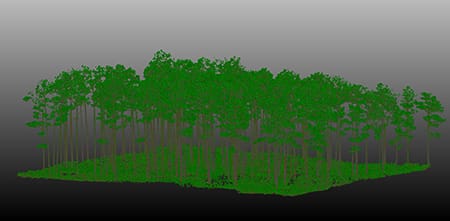
Working with partners in the Prescribed Fire Science Consortium, the program is building nexgen 3-D fuel beds using terrestrial LiDAR and novel sampling techniques to power new fire behavior models for prescribed fire managers. This work links to Tall Timbers work in wildlife habitat usage and ecological forestry.
The Longleaf Legacy landscape prescribed fire burn team arm of Wildland Fire Science works directly with landowners and partners to effectively put fire on the ground and promote prescribed fire throughout the region.
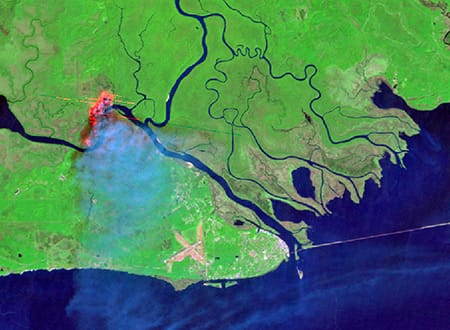
Tall Timbers is leading an effort to map fire regimes at the landscape scale. Staff work with numerous agencies to evaluate fire records and satellite imagery to build this critical conservation database. https://skfb.ly/6DqOY
Tall Timbers hosts the Prescribed Fire Science Consortium, a national network of researchers and managers who promote integrated research and management to advance next generation tools for fire practitioners. https://arcg.is/1DSjDT
We are linking physics and field observations to understand the fluid dynamics of fire behavior surface fire regimes. Our work combines field observations using advanced thermal imaging techniques, laboratory studies, and coupled fire-atmospheric modeling to help managers improve outcomes of managed fire regimes.
Selected Publications authored by Wildland Fire Science staff.
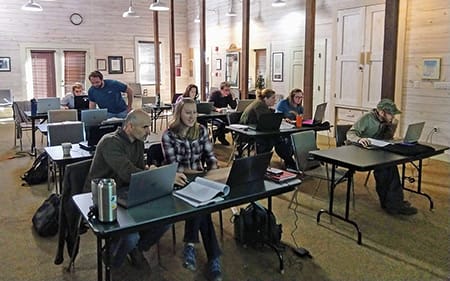
Staff and researchers support Federal fire training by serving as a cadre for NWCG training courses, ranging from basic wildland fire to advanced fire effects.
(PFTC) specializes in training fire fighters the principles and techniques of prescribed fire through practical hands-on experience. https://www.fws.gov/fire/pftc/
Private land owners are the largest source of prescribed fire in the country. These land owners and the culture of fire that was maintained by them during decades of suppression are a part of why Tall Timbers is a world-wide center for prescribed fire science. Workshops and fire training are a critical focus of the Longleaf Legacy Landscape Burn Team and our support of the Georgia Forestry Commission Prescribed Fire Center in Marion County.
The conserved lands of the Greater Red Hills region are found on working, income-producing properties that support agriculture, forestry, and recreational hunting. These properties contribute $272 million annually to local economies and support 2,300 jobs. [link to Planning & Advocacy section] The landowners’ strong stewardship ethic preserves their working lands while replenishing drinking water supplies, protecting water quality, and providing wildlife habitat for dozens of rare and endangered species. Tall Timbers’ conservation easements on these working properties encourage landowners to retain their traditional livelihood by keeping farms in family ownership.
Home to world-class wild quail populations, the Greater Red Hills region contains the largest concentration of gamebird preserves in the United States. These preserves also support the largest community of Red-cockaded woodpeckers on private lands. Indicators of high quality habitat found here include the gopher tortoise, Bachman’s sparrow, fox squirrel, and many amphibians. Tall Timbers’ conservation easements identify and protect the critical habitats of these species.
The region also boasts outstanding aquatic resources. Large river systems, like the Flint/Apalachicola, Ochlockonee, and Aucilla, flow from Georgia and feed into the Gulf of Mexico to support some of the world’s most productive estuaries. Large disappearing sinkhole lakes, like Iamonia, Miccosukee, and Jackson, provide habitat for an array of aquatic species and migratory birds. Tall Timbers’ conservation easements protect these vital watersheds and wetlands that are the lifeblood for the ecological health of the region.
Once dominated by longleaf pine, our pine woodlands support abundant wildlife and local economies. These forests need prescribed fire to stay healthy. Herbert L. Stoddard and his associates Ed and Roy Komarek were pioneers in this emerging scientific field during the mid-20th century. Tall Timbers continues that legacy with applied research on prescribed fire and land management. Today, there is a tremendous need to expand prescribed fire use beyond the Red Hills to ensure ecosystem health and reduce wildfire risk. Additionally, Tall Timbers uses conservation easements to permanently protect private woodlands while balancing the need for economic return from selective timbering.