Fall Field Day at Dixie Plantation — October 24, 2014
By Theron Terhune, Game Bird Program Director
The infamous boll weevil brought hardship to many in the 1920s but this misfortune paved the way for the Livingston family to purchase and establish what is today known as Dixie Plantation. Dixie is an diverse 9,100-acre property located in Jefferson County, Florida and situated on the outer banks of the Aucilla River. The gift of Dixie to Tall Timbers, by the Geraldine C. M. Livingston Foundation in December 2013, provides a unique opportunity for understanding bobwhite ecology on a working hunting plantation. The “Livingston way” is rooted in traditional quail hunting, whereby high regard is given to wild bobwhites and bird dogs.
Dixie has been historically managed for bobwhites through conversion of agricultural land to forest lands with an emphasis on regeneration of longleaf pine. However, small scale farming still exists and is an important, economic staple for its everyday operation. In the 1930s, Dixie became home for the Continental Championship Field Trials and is recognized by the field trial community as one of the premiere field trial sites in the country, acclaimed for its preponderance of wild birds. The stalwart conservation ethic and precedent set by the Livingston family provide the underpinnings of how Tall Timbers will use the property in the future. As such, our objectives at Dixie include: quail management and hunting; abiding by an existing conservation easement; historical preservation; education and training; hosting bird dog field trials; and research that contributes to the mission of Tall Timbers.
In March, we radio-tagged 50 bobwhites on Dixie to begin collecting baseline demographic data in the core bobwhite research area. We will continue year-round monitoring of radio-tagged birds to evaluate aspects related to the use of cotton fields by quail, the efficiency of all age field trial dogs in locating wild quail coveys, along with the effects of field trials on subsequent hunting quality, and a study to determine the driving forces behind the “new ground effect” of an intensive upland hardwood removal. This hardwood removal has already begun on Dixie and we will measure quail demographics before, during, and after this work is done on the core study area. We are excited about the work at Dixie and look forward to sharing the beautiful landscape and rich history with you during our Fall Field Day on Friday, Oct. 24.
At left, the main house at Dixie Plantation; at right Dixie longleaf pine forest. Photos by Rose Rodriguez
Watching your kid stepping out the front door for good can break a parent’s heart. The big step can also be cause for subdued celebration, depending on the kid of course.
Animals don’t have such emotional fits during this major milestone in life, but knowing how young animals leave home and settle within the surrounding landscape is a critical part of wildlife management. Dispersal affects population growth, genetic integration, colonization of available habitat, and the stability of small populations. It’s also one of the least studied aspects of population dynamics for small songbirds.
Songbird enthusiasts would love to know as much as game bird biologists know about this critical period in life, but the radio transmitters needed to follow juvenile movements exhaustively are simply not yet available. Songbird enthusiasts suffer from radio envy as a result. For example, the transmitters available for brown-headed nuthatches last only 16-24 days before the battery goes dead. That’s about 2% of the normal lifespan of these birds, and this brief snapshot may provide as many false leads as it does useful information, not to mention the fact that the transmitters are expensive.
The Stoddard Bird Lab has devised some new field procedures to help assess dispersal in nuthatches. Nuthatches respond to recorded calls strongly and will fly in from 100 m away to investigate a fake nuthatch blasting from an audio speaker. Once they’re close, trained eyes can usually get a look at the legs and determine whether or not the individual is banded. If you then look at the legs in a spotting scope, you can actually any color bands that were applied and know exactly which juvenile nuthatch is responding to the recorded lure.
We’ve been performing this type of sampling within territories that had successful nests and then at hundreds of random points that are distributed through Tall Timbers and at least 200 meters away from successful nests. The sampling near successful nests lets us know which individuals are staying close to home, while the random points allow us to pick up individuals that have made the decision to launch off in search of new beginnings.
It turns out that the decision to leave comes surprisingly early in life for a nuthatch. In 2012, we found a marked juvenile female in early May at a random point that was more than two miles south of her nest site. She fledged in late March, which means she’d made the decision to leave the home turf with about 30 days of experience under her wings. Many young are still being fed by their parents at this at this point, but this young nuthatch had decided that a better future lay somewhere else. (See video: http://youtu.be/foyxk4eQyV0)
Other observations of dispersing females piled up during the first few years of monitoring and suggested it was rare to find females in their natal territories more than two months after the individuals fledged. As Springsteen might say, if he ever sang about birds, these babies were born to fly.
Females also seemed to make a sudden jump from their natal territories and then settle in new areas with other nuthatch family groups. We keep encountering some dispersing females at different random points within a 20-acre area that may be a mile or so from their original nests. These females are mixed in with marked adults and juvenile males that have stayed closer to home, and the females seem to be shifting among neighboring territories assessing the local conditions.
We also have observed marked males physically grooming the dispersing females, perhaps as a means of inviting them to stay. The grooming consists of using the beak to scratch around the head and neck of the recipient. The birds being scratched close their eyes and often tilt their beaks skyward to expose additional areas under the neck. The activity can go on for five minutes in some cases, and though we can’t say the birds really “enjoy” it, we pretty sure they don’t hate the massage, either.
Unlike females, many juvenile males decide to stay home for extended periods and frequently help mom and dad raise young the following breeding season. This type of cooperative breeding behavior was well known and represented a reason for studying nuthatches in the first place, but we also documented more than a dozen young males in random points away from successful nests. Unlike some of their brothers who stay to help, these males decided to fly the coop.
When we compared the nestling weights of the males who stayed versus the weights of those who fled, there was a tendency for the dispersing males to have lower nestling weights. Just as with human wrestlers, nestling weight is a good indicator of an individual’s social status and competitive abilities. We have not yet secured enough information on how brothers interact with one another after they leave the nest, but the differences in weight suggest that larger males may out-compete their smaller siblings in some way, so the smaller males decide to leave.
Thanks to these field techniques, we are monitoring one of the interesting phases of the annual cycle with precision, and finding out that the social life of this small songbird is extremely complex. There are lots of decisions being made in some really dynamic social settings. At times, there seem to be parallels with human societies, but we’re also very confident that we’ll never see a tear in the eye of a proud nuthatch parent when a son or daughter leaves home.
Assessing reproduction at the breeding season midpoint is our first reliable indicator for forecasting fall recruitment and getting an idea of hunting population levels. There are, of course, several routes to decent fall recruitment, such as a very good early hatch followed by a moderate hatch, or a moderate early hatch and a stellar late hatch. In either case, adult bobwhite survival is tightly linked to the extent of reproductive output. To put this into context, reproductive output last season (2013) was not nearly as good as the previous season (2012), but thanks to great overwinter survival, as high as 72% − the highest ever recorded in Albany area during 21 years of year-round telemetry − the end result was a fall population increase. On Tall Timbers, last year’s breeding season started off with good bird numbers (similar to Albany’s) thanks to overwinter carryover, but we observed a lower than average early hatch, and we greatly benefitted from a stellar late hatch, which was the result of good breeding season survival. The upshot is that “dead hens don’t lay eggs,” but as seen in the past, there is more than one way to produce good fall numbers. This theme seems to hold true for this year’s hatch, at least at the midpoint of the season.
This year nest production is lower than normal on our Albany study site, which is a direct result of lower breeding season survival (see Figure 1). However, the good news is that we are coming off two very good reproductive seasons and decent overwinter survival, so population levels coming into this year are as high as they have been in quite some time. Therefore, it may be another year where the higher number of available breeders may help to offset the lower per capita production. Looking back at 20+ years of research in the Albany area and Red Hills (see years 2004, 2007, and 2011 on Figure 2), it is apparent that the ebb and flow of quail demographics (survival and reproduction) is cyclical even on exceptionally managed sites. Without these long-term datasets, we would be inept at understanding the natural biological cycles of quail populations. Some of our research going forward will be geared toward better understanding these long-term trends, identifying the common biological principles linked to those trends, and understanding how all that translates into improved management action. For now, however, we are optimistic for a good late push of nesting activity in August and September.
On Tall Timbers, nest production is slightly above average, but brood production is way below normal (Figure 1). This is a result of nest success being the lowest it has been in the last 15 years on Tall Timbers. In South Carolina we have observed identical nest production; however, brood production is nearly three times that observed on Tall Timbers (see Figure 1). Predator indices on these sites indicate that predator abundance is roughly four times as high on Tall Timbers, compared to our study site in South Carolina. This underscores the importance of continued predation management for consistent year to year reproductive output; we suspect that properties employing a steady predation management program in the Red Hills are experiencing a good hatch.
On all our study sites, including those in the Red Hills and Albany area, we have observed several pairs and heard plenty of whistling activity over the past couple of weeks, and more recently we have seen an uptick in radio-tagged hens initiating and incubating nests, suggesting that a second wave of nesting is underway. We are hopeful that this late season push will result in a much needed late hatch and produce more birds recruited into the fall population. In years past, nest initiation and incubation of nests occur well in to September; and hatches in the Red Hills and Albany areas are common during late September and early October. If possible, delaying mowing or chopping to early or mid-October when cutting hunting lanes (grid-blocking) may optimize late season success by reducing the chances of disrupting nests late in the season, and potentially improving survival of late-hatching chicks.
Renewed Accreditation awarded by the Land Trust Accreditation Commission
Tall Timbers Research Station & Land Conservancy has achieved renewed land trust accreditation from the Land Trust Accreditation Commission, an independent program of the Land Trust Alliance, of which Tall Timbers is a member. “This achievement demonstrates our commitment to permanent land conservation that benefits the entire community,” says Kevin McGorty, Director, of the Tall Timbers Land Conservancy. “Our land trust is a stronger organization today having gone through the rigorous accreditation renewal process.”
Tall Timbers has saved over 126,000 acres through donated conservation easements. These easements protect critical upland wildlife habitat and wetland ecosystems that improve water quality in the greater Red Hills and Albany regions. Tall Timbers conservation easements protect miles of scenic canopy roads, valuable watersheds and working landscapes which would not be possible without the generosity and stewardship ethic of area land owners.
Tall Timbers was awarded renewed accreditation this August and is one of only 280 land trusts from across the country that is now accredited. Accredited land trusts are authorized to display a seal indicating to the public that they meet national standards for excellence, uphold the public trust and ensure that conservation efforts are permanent. The seal is a mark of distinction in land conservation.
“Tall Timbers is one of the first land trusts to achieve renewed accreditation, a significant achievement for the land trust and significant major milestone for the accreditation program. They are an important member of the 280 accredited land trusts that protect more than half of the 20,645,165 acres currently owned in fee or protected by a conservation easement held by a land trust,” said Commission Executive Director Tammara Van Ryn. “Accreditation renewal, which must be completed every five years, provides the public with an assurance that accredited land trusts continue to meet exceedingly high standards for quality.”
Each land trust that achieved renewed accreditation submitted extensive documentation and underwent a rigorous review. “Through accreditation renewal land trusts are part of an important evaluation and improvement process that verifies their operations continue to be effective, strategic and in accordance with strict requirements,” said Van Ryn. “Accredited organizations have engaged citizen conservation leaders and improved systems for ensuring that their conservation work is permanent.”
According to the Land Trust Alliance, conserving land helps ensure clean air and drinking water; safe, healthy food; scenic landscapes and views; recreational places; and habitat for the diversity of life on earth. In addition to health and food benefits, conserving land increases property values near greenbelts, saves tax dollars by encouraging more efficient development, and reduces the need for expensive water filtration facilities. Across the country, local citizens and communities have come together to form more than 1,700 land trusts to save the places they love. Community leaders in land trusts throughout the country have worked with willing landowners to save over 47 million acres of farms, forests, parks and places people care about, including land transferred to public agencies and protected via other means. Strong, well-managed land trusts provide local communities with effective champions and caretakers of their critical land resources, and safeguard the land through the generations.
According to Tall Timbers’ President and CEO, Dr. William E. Palmer, “We are proud to display the accreditation seal as it furthers our mission to foster exemplary land stewardship through research, conservation and education.”
The Land Trust Alliance (LTA) is a national conservation group that works to save the places people love by strengthening conservation throughout America. It works to increase the pace and quality of conservation by advocating favorable tax policies, training land trusts in best practices and working to ensure the permanence of conservation in the face of continuing threats. More information about the LTA can be found at www.landtrustalliance.org.
The Tall Timbers eJournal and Firebird publications are two of them
Annual membership gifts help support the day-to-day operations of Tall Timbers and are the lifeblood of our organization. As a charitable non-profit, Tall Timbers relies on the generous financial support of our members to help sustain the important research, conservation and education programs within the organization.
Tall Timbers has two new membership levels, an Associate membership at $35 per year and a Youth membership at only $15 per year. The Associate membership provides a subscription to our new digital magazine the Tall TimberseJournal, the Firebird e-newsletter from the Stoddard Bird Lab, a Tall Timbers decal, and a subscription to the Tall Timbers eNews, as well as invitations to education programs and events. The Youth membership provides a subscription to the Tall Timbers eNews; invitations to education programs and events (must be 18 or younger).
New editions of the Tall TimberseJournal and Firebird e-newsletter will be published this spring. These will only be sent to members at the Associate level and above. Don’t miss out on these two publications, if your are not a member, join today!
The M-CORES program, which includes the proposed Suncoast Connector Toll Road in Jefferson County, passed through the Florida Legislature at breakneck speed with little review or analysis. Tall Timbers has a number of concerns given the potential for significant and wide spread impacts. These include fragmenting public and private conservation lands, robbing business from Main Street Monticello, impacting our rivers and other water resources, and making prescribed fire more difficult and costly.
Join us in asking the Jefferson County Board of County Commissioners to OPPOSE the Suncoast Connector toll road and its path through Jefferson County.
Take action now with our easy email form.
Send an email to all five Jefferson County Board of County Commissioners with one click!
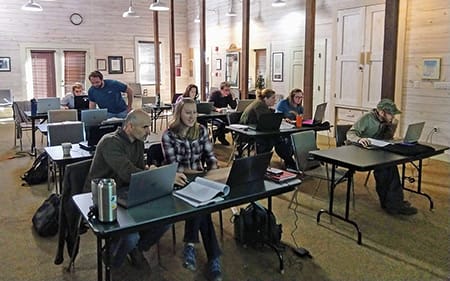
Burn prioritization modeling seminars and fire modeling tools are supported by Wildland Fire Science to train managers in the important planning stages of prescribed fires.
Educating and guiding the next generation of fire researchers and managers is a key goal of Wildland Fire Science and a resource for testing new ideas in fire research.
Tall Timbers hosts the premier fire technology transfer organization—the Southern Fire Exchange. This JFSP funded effort helps connect research to management through webinars, workshops, and support of the Prescribed Fire Science Consortium.
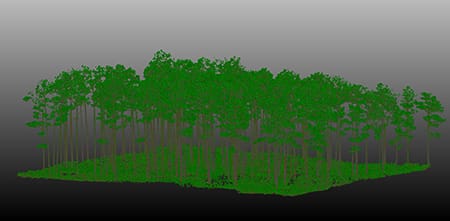
Working with partners in the Prescribed Fire Science Consortium, the program is building nexgen 3-D fuel beds using terrestrial LiDAR and novel sampling techniques to power new fire behavior models for prescribed fire managers. This work links to Tall Timbers work in wildlife habitat usage and ecological forestry.
The Longleaf Legacy landscape prescribed fire burn team arm of Wildland Fire Science works directly with landowners and partners to effectively put fire on the ground and promote prescribed fire throughout the region.
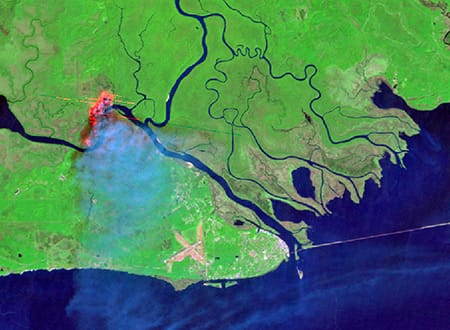
Tall Timbers is leading an effort to map fire regimes at the landscape scale. Staff work with numerous agencies to evaluate fire records and satellite imagery to build this critical conservation database. https://skfb.ly/6DqOY
Tall Timbers hosts the Prescribed Fire Science Consortium, a national network of researchers and managers who promote integrated research and management to advance next generation tools for fire practitioners. https://arcg.is/1DSjDT
We are linking physics and field observations to understand the fluid dynamics of fire behavior surface fire regimes. Our work combines field observations using advanced thermal imaging techniques, laboratory studies, and coupled fire-atmospheric modeling to help managers improve outcomes of managed fire regimes.
Selected Publications authored by Wildland Fire Science staff.
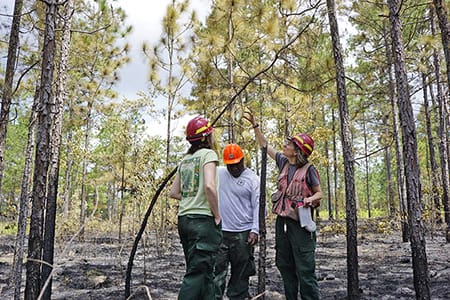
Staff and researchers support Federal fire training by serving as a cadre for NWCG training courses, ranging from basic wildland fire to advanced fire effects.
(PFTC) specializes in training fire fighters the principles and techniques of prescribed fire through practical hands-on experience. https://www.fws.gov/fire/pftc/
Private land owners are the largest source of prescribed fire in the country. These land owners and the culture of fire that was maintained by them during decades of suppression are a part of why Tall Timbers is a world-wide center for prescribed fire science. Workshops and fire training are a critical focus of the Longleaf Legacy Landscape Burn Team and our support of the Georgia Forestry Commission Prescribed Fire Center in Marion County.
The conserved lands of the Greater Red Hills region are found on working, income-producing properties that support agriculture, forestry, and recreational hunting. These properties contribute $272 million annually to local economies and support 2,300 jobs. [link to Planning & Advocacy section] The landowners’ strong stewardship ethic preserves their working lands while replenishing drinking water supplies, protecting water quality, and providing wildlife habitat for dozens of rare and endangered species. Tall Timbers’ conservation easements on these working properties encourage landowners to retain their traditional livelihood by keeping farms in family ownership.
Home to world-class wild quail populations, the Greater Red Hills region contains the largest concentration of gamebird preserves in the United States. These preserves also support the largest community of Red-cockaded woodpeckers on private lands. Indicators of high quality habitat found here include the gopher tortoise, Bachman’s sparrow, fox squirrel, and many amphibians. Tall Timbers’ conservation easements identify and protect the critical habitats of these species.
The region also boasts outstanding aquatic resources. Large river systems, like the Flint/Apalachicola, Ochlockonee, and Aucilla, flow from Georgia and feed into the Gulf of Mexico to support some of the world’s most productive estuaries. Large disappearing sinkhole lakes, like Iamonia, Miccosukee, and Jackson, provide habitat for an array of aquatic species and migratory birds. Tall Timbers’ conservation easements protect these vital watersheds and wetlands that are the lifeblood for the ecological health of the region.
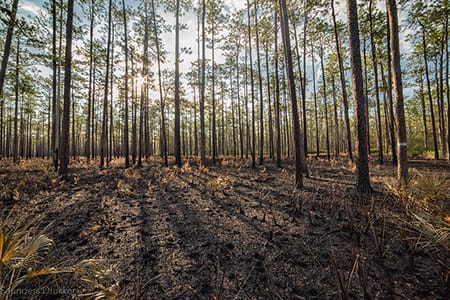
Once dominated by longleaf pine, our pine woodlands support abundant wildlife and local economies. These forests need prescribed fire to stay healthy. Herbert L. Stoddard and his associates Ed and Roy Komarek were pioneers in this emerging scientific field during the mid-20th century. Tall Timbers continues that legacy with applied research on prescribed fire and land management. Today, there is a tremendous need to expand prescribed fire use beyond the Red Hills to ensure ecosystem health and reduce wildfire risk. Additionally, Tall Timbers uses conservation easements to permanently protect private woodlands while balancing the need for economic return from selective timbering.



 Tall Timbers has two new membership levels, an Associate membership at $35 per year and a Youth membership at only $15 per year. The Associate membership provides a subscription to our new digital magazine the