Game Bird Seminar and Fall Field Day held at Tall Timbers November 1 and 2
The Game Bird Seminar was held Thursday, Nov. 1, and marked 10 years since the last seminar in 2008. The following day, Nov. 2, was Tall Timbers’ popular Fall Field Day, and also marked 10 years since a field day was hosted at Tall Timbers. Unfortunately, like 10 years ago, the weather was wet and windy during most of the field day talks under the tent, and the wagon tour planned for the afternoon had to be cancelled.
Game Bird Seminar
In the spirit of past seminars, we had an invited Stoddard Game Bird Lecturer, Dr. Brad Dabbert from the Quail Tech Alliance and Texas Tech University to open the presentations. He shared some of the great research he is conducting in Texas. Another Texan, John McLaughlin from Texas Game and Fish discussed “Weather Impacts on Bobwhite Chick Survival.”
Dr. Brad Dabbert, the Stoddard Game Bird Lecturer, was the first presenter.
The seminar was organized into two sessions by similar topic: Northern Bobwhite Demographics and Hunting Success, and Current Hot Topics & Chick Ecology.
Session 1 topics:
Efficacy of the Predator Index to Evaluate Predator Level Impacts on Bobwhite Demographics
Impact of Predation Management on Bobwhite Demographics and Populations
Industry Standard for Predation Management on Private Hunting Plantations in the Southeast
Session 2 topics:
Foraging Behavior of Bobwhite Coveys in Relation to Hunting Pressure
Vegetation and Predator Interactions Affect Northern Bobwhite Behavior
Grid-blocking Impacts on Hunt Success and Quail Demographics
Factors Influencing Covey Detection and Bobwhite Hunt Success
Red-imported Fire Ants and Bobwhites in Georgia and Florida
Weather Impacts on Bobwhite Chick Survival
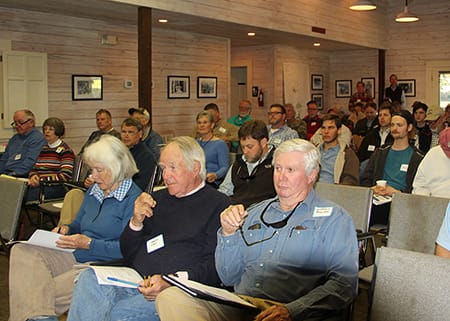
Seminar attendees
Attendess listen to presentations under the tent.
Fall Field Day
Those in attendance were welcomed to Tall Timbers by Bill Palmer, Tall Timbers’ President/CEO. The much anticipated hatch report was given by Theron Terhune, Tall Timbers’ Game Bird Program Director and Clay Sisson, the Director of the Albany Quail Project and research at Dixie Plantation.
The theme for the presentations under the tent was Long-term Sustainability of the Red Hills and Bobwhite Population Recovery. The following were the topics presented. A panel discussion followed these presentations.
Longleaf Legacy Landscape: Tall Timbers’ Strategy for Putting Fire on the Back Forty, presented by Bill Palmer, PhD
Managing Native Ground and Wiregrass Communities for Bobwhite, presented by Robbie Green, Plantations Manager, Millcreek Holdings, LLP
Contribution of the Red Hills & Albany Areas to Bobwhite Population Recovery,presented by Clay Sisson
Translocation Success Stories and the Future of Translocation, presented by Theron Terhune
Fall Field Day attendees listen to a presentation.
At left, Robbie Green, Plantation Manager for Millcreek Holdings. At right, attendees under the tent.
Thanks to these sponsors and the many others who made the 2018 Game Bird Seminar and Fall Field Day possible:
Quail Enthusiasts Brave the Weather to Attend the Carolina Fall Field Day
By Paul Grimes, Game Bird Biologist, Carolina Regional Quail Project
October 26, 2018 in Heath Springs, South Carolina was a cold, rainy, wet day. But that didn’t stop the 125 quail enthusiasts from the Carolinas who attended the Tall Timbers’ Carolina Fall Field Day event at Heatherstone Farm.
Heatherstone Farm is a unique property managed for wild quail in upstate South Carolina, where careful attention and focus have been given to achieve optimal habitat conditions for wild birds. Attendees enjoyed presentations centered on adapting quail management techniques to the unique challenges of the Carolinas, along with quail chick ecology and other current research conducted in the Tall Timbers’ Game Bird Program. Presentations were followed by a panel discussion where Tall Timbers’ biologists responded to specific questions and comments by attendees.
Special thanks goes to the owner, Mr. Tom Ewing and to David Gantt of Springdale Land and Game Management, LLC for hosting the Tall Timbers’ Carolina Fall Field Day under less than favorable weather conditions, and for the incredible contributions they continue to make towards conservation and wild quail management in the Carolinas.
At left, Heatherstone Farms landowner, Tom Ewing; at right, David Gantt of Springdale Land and Game Managment
At left, field day attendees; at right, Paul Grimes, game bird biologist for the Carolina Regional Quail Project gave the attendees an update on quail research in the region
L-R: landowner Tom Ewing, Game Bird Program Director, Theron Terhune, and David Ganett of Springdale Land and Game Management answer questions during the panel discussion
Attendees wait for a break in the weather to tour the property listen to the panel discussion
Wagon tour stop. Paul Grimes discussed land management that has been conducted to improve habitat for wild quail. Unfortunatley, the wet weather curtailed the wagon tour.
By Kevin Robertson, PhD, Fire Ecology Program Director
Anthony “T.J.” Laucevicius, an intern from Gallaudet University in Washington DC, spent most of his summer with the Fire Ecology Program by remapping experimental plot of wiregrass (A. stricta var. beyrichiana), established by Dr. Bruce Means in 1981, when Means was the Tall Timbers’ research director. At that time, a total of 160 plants were transplanted from places where land was being cleared for right-of-way expansions in the local area. In 1999, Dr. Means hired Trina Cassels Mitchell to remap the plots, and during the summer of 2018, T.J. mapped them again, for a 37-year perspective on wiregrass reproduction and growth.
We have learned a lot from the remapping. Although wiregrass reproduction and lateral expansion is slow, it has steadily filled in the area in between the original rows of plants, helped by periodic burns in the “lightning season” (April‒July), which is required for wiregrass to flower. Its population has quadrupled, and its rate of lateral spread appears to be about one meter per decade. Wiregrass clumps continue to grow in diameter until they begin to break up into individual clones, which then each take on the circular shape and continue to grow. They also showed evidence of competitive exclusion, meaning that initially dense bunches of seedlings tend to self-thin over time, ultimately resulting in the 4‒6 wiregrass tussocks per m2 that has been widely observed in nature. The results suggest that, although wiregrass is slow, it does have the capacity to reclaim ground over time, if soil disturbance is excluded and frequent fire, including some April‒July burns, is maintained. T.J. is an author on a paper submitted to the journal Ecological Restoration recording the results of this case study.
T.J. Laucevicius and Dr. Bruce Means at the wiregrass plots Means established in 1981.
New Population of Red-cockaded Woodpeckers on Dixie Plantation Established
By Jim Cox, Stoddard Bird Lab Director
Just before the Thanksgiving break, staff with the Stoddard Bird Lab completed the first phase of work needed to establish a new population of Red-cockaded Woodpeckers on Dixie Plantation. With help from Georgia DNR biologists Joe Burnam, Zach Henshaw, and Phil Spivey, 7 juvenile male and female woodpeckers were captured on properties in the Red Hills region, transported to Dixie, and released the following morning.
This is the second attempt to establish a new woodpecker population in the Red Hills region using translocation. A similar effort initiated on Tall Timbers Research Station in 2006, has now grown from zero to 14 breeding territories, and provided an important hub of active woodpecker territories in the southwest corner of the Red Hills region.
Similar growth on Dixie over the next few years could yield another hub of 10-12 breeding territories in the southeast corner of the region, and help to stabilize other nearby woodpecker populations.
“We’ll be monitoring where these woodpeckers settle over the next week or so and then conduct another move of 2-3 individuals,” says Rob Meyer, woodpecker conservation specialist at Tall Timbers.
“We’re especially hopeful a lone male will take over one of the clusters of cavity trees we excavated and claim the territory as his own,” Meyer adds. “We can then capture and relocate a female to the territory and increase the chances of having a breeding group significantly established.”
The work is being performed under a Safe Harbor Agreement that Dixie Plantation has with the State of Florida. The Longleaf Stewardship Fund of the National Fish and Wildlife Foundation is providing financial support for this initial phase of reintroduction work. The Longleaf Stewardship Fund supports recovery of iconic species such as the Red-cockaded Woodpecker through habitat enhancement and active management.
Photo: Red-cockaded Woodpecker caught at night and released in the morning on Dixie Plantation.
By Kevin Robertson, PhD, Fire Ecology Program Director
When Dr. William Platt established a long-term study of the Woodyard Hammock old-growth beech-magnolia forest on Tall Timbers in 1978, he had hurricanes in mind. He was interested in how tropical storms would contribute to perpetuation of this ancient forest by knocking over or snapping some of the canopy trees and thereby letting light into treefall gaps, where the next generation of trees would compete for light as they grow. Eight years after setting up the 12-acre study plot, it took a direct hit from Hurricane Kate, a category 3 hurricane, which created many treefall gaps and overall increased open sky by about 60%. During the following two decades tree numbers went from about 10,000 to almost 20,000, and since then have returned to near pre-hurricane levels as trees outcompete each other in the gaps.
This fall we had just began our biennial census of each tree 2 cm in diameter or greater, when Hurricane Michael made a glancing blow to the Tallahassee area, toppling trees but not equaling the damage of Kate, or Michael’s terrible damage further west. Even so, we have recorded tip-ups or snapped trunks of about 60 trees that were in the canopy or subcanopy. This damage, combination with that from hurricanes Irma in 2017 and Hermine in 2016, will no doubt initiate another wave of recruits that will influence the forest’s structure and composition for decades, maybe centuries.
An interesting lesson we are learning from Woodyard Hammock is how seedlings growing very slowly under the forest canopy before gaps are created, called “advanced regeneration,” influence the future composition of the forest by becoming the trees that fill the gaps when they form. More specifically, we are learning that the composition of the advanced regeneration changes considerably over the years, which can drive the community one way or the other when a storm creates gaps. For example, when Hurricane Kate hit, there was a preponderance of seedlings of hophornbeam (Ostrya virginiana), which dominated the gaps during the following two decades. Now hophornbeam seedlings are scarce, but seedlings of southern magnolia (Magnolia grandiflora), American beech (Fagus grandifolia), and sweetgum (Liquidambar styraciflua) are abundant, increasing their odds in the newly formed gaps. As the long-term study continues into the future, we will see who the winners are.
L-R: Intern Gianna Tarquinio and Field Ecologist Allie Snyder conduct the Woodyard Hammock biennial tree census after Hurricane Michael.
Seedling of southern magnolia and acorn of swamp chestnut oak
The M-CORES program, which includes the proposed Suncoast Connector Toll Road in Jefferson County, passed through the Florida Legislature at breakneck speed with little review or analysis. Tall Timbers has a number of concerns given the potential for significant and wide spread impacts. These include fragmenting public and private conservation lands, robbing business from Main Street Monticello, impacting our rivers and other water resources, and making prescribed fire more difficult and costly.
Join us in asking the Jefferson County Board of County Commissioners to OPPOSE the Suncoast Connector toll road and its path through Jefferson County.
Take action now with our easy email form.
Send an email to all five Jefferson County Board of County Commissioners with one click!
Selected Publications authored by Wildland Fire Science staff.
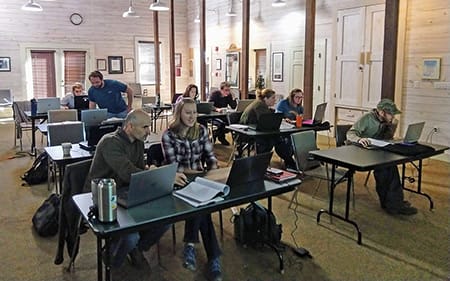
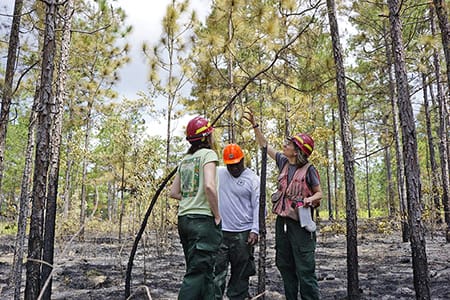
Educating and guiding the next generation of fire researchers and managers is a key goal of Wildland Fire Science and a resource for testing new ideas in fire research.
Tall Timbers hosts the Prescribed Fire Science Consortium, a national network of researchers and managers who promote integrated research and management to advance next generation tools for fire practitioners. https://arcg.is/1DSjDT
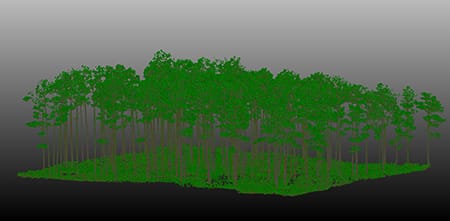
Working with partners in the Prescribed Fire Science Consortium, the program is building nexgen 3-D fuel beds using terrestrial LiDAR and novel sampling techniques to power new fire behavior models for prescribed fire managers. This work links to Tall Timbers work in wildlife habitat usage and ecological forestry.
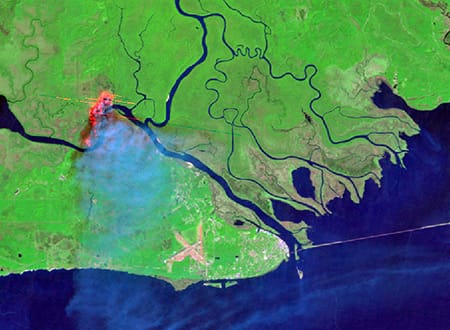
Tall Timbers is leading an effort to map fire regimes at the landscape scale. Staff work with numerous agencies to evaluate fire records and satellite imagery to build this critical conservation database. https://skfb.ly/6DqOY
We are linking physics and field observations to understand the fluid dynamics of fire behavior surface fire regimes. Our work combines field observations using advanced thermal imaging techniques, laboratory studies, and coupled fire-atmospheric modeling to help managers improve outcomes of managed fire regimes.
Burn prioritization modeling seminars and fire modeling tools are supported by Wildland Fire Science to train managers in the important planning stages of prescribed fires.
The conserved lands of the Greater Red Hills region are found on working, income-producing properties that support agriculture, forestry, and recreational hunting. These properties contribute $272 million annually to local economies and support 2,300 jobs. [link to Planning & Advocacy section] The landowners’ strong stewardship ethic preserves their working lands while replenishing drinking water supplies, protecting water quality, and providing wildlife habitat for dozens of rare and endangered species. Tall Timbers’ conservation easements on these working properties encourage landowners to retain their traditional livelihood by keeping farms in family ownership.
Home to world-class wild quail populations, the Greater Red Hills region contains the largest concentration of gamebird preserves in the United States. These preserves also support the largest community of Red-cockaded woodpeckers on private lands. Indicators of high quality habitat found here include the gopher tortoise, Bachman’s sparrow, fox squirrel, and many amphibians. Tall Timbers’ conservation easements identify and protect the critical habitats of these species.
The region also boasts outstanding aquatic resources. Large river systems, like the Flint/Apalachicola, Ochlockonee, and Aucilla, flow from Georgia and feed into the Gulf of Mexico to support some of the world’s most productive estuaries. Large disappearing sinkhole lakes, like Iamonia, Miccosukee, and Jackson, provide habitat for an array of aquatic species and migratory birds. Tall Timbers’ conservation easements protect these vital watersheds and wetlands that are the lifeblood for the ecological health of the region.
Once dominated by longleaf pine, our pine woodlands support abundant wildlife and local economies. These forests need prescribed fire to stay healthy. Herbert L. Stoddard and his associates Ed and Roy Komarek were pioneers in this emerging scientific field during the mid-20th century. Tall Timbers continues that legacy with applied research on prescribed fire and land management. Today, there is a tremendous need to expand prescribed fire use beyond the Red Hills to ensure ecosystem health and reduce wildfire risk. Additionally, Tall Timbers uses conservation easements to permanently protect private woodlands while balancing the need for economic return from selective timbering.
Tall Timbers hosts the premier fire technology transfer organization—the Southern Fire Exchange. This JFSP funded effort helps connect research to management through webinars, workshops, and support of the Prescribed Fire Science Consortium.
The Longleaf Legacy landscape prescribed fire burn team arm of Wildland Fire Science works directly with landowners and partners to effectively put fire on the ground and promote prescribed fire throughout the region.
Staff and researchers support Federal fire training by serving as a cadre for NWCG training courses, ranging from basic wildland fire to advanced fire effects.
(PFTC) specializes in training fire fighters the principles and techniques of prescribed fire through practical hands-on experience. https://www.fws.gov/fire/pftc/
Private land owners are the largest source of prescribed fire in the country. These land owners and the culture of fire that was maintained by them during decades of suppression are a part of why Tall Timbers is a world-wide center for prescribed fire science. Workshops and fire training are a critical focus of the Longleaf Legacy Landscape Burn Team and our support of the Georgia Forestry Commission Prescribed Fire Center in Marion County.