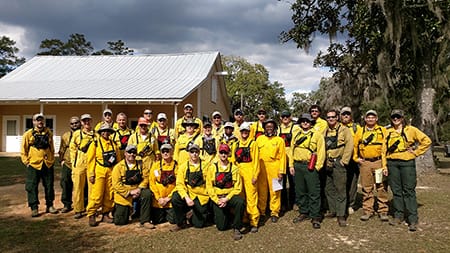
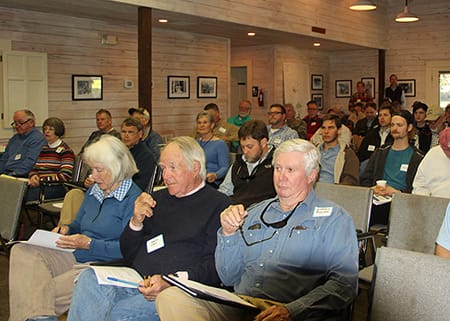
Tall Timbers, with support from NRCS: Working Lands for Wildlife, has created three Prescribed Burn Associations (PBAs) with the goal of increasing landowner involvement with prescribed fire at the application level. PBAs are landowner-driven, nonprofit organizations that interface landowners with training opportunities to help manage their local natural resources, with an overall goal of landowner driven fire application within their communities.
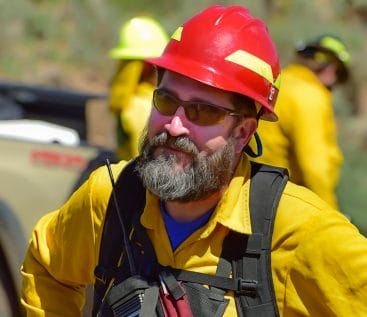
Tall Timbers staff conduct a pre-burn brief with local landowners.
The three active Tall Timbers PBAs are located in Central Alabama, Northwest Florida and Southwest Georgia. Each PBA location was chosen for a variety of reasons, including assisting application of fire on NRCS-funded acres and/or areas with a high probability to aid recovering populations of bobwhite quail, as well as other species of high conservation value.
John McGuire, Director of the Private Lands Fire Initiative at Tall Timbers, seeks to use PBAs to give landowners more place-based education and outreach on how, and why, prescribed fire is applied in their landscapes.
The Private Lands Burn Team led by Jeremiah Cates is also part of this initiative and has been instrumental is assisting the PBAs with landowner outreach and fire application. Jeremiah and the team have burned approximately 5000 acres this year, along with continually training natural resources professionals on how to conduct safer and better burns.
Over the last year, the three PBAs have been hard at work helping carry on the conservation mission of Tall Timbers.
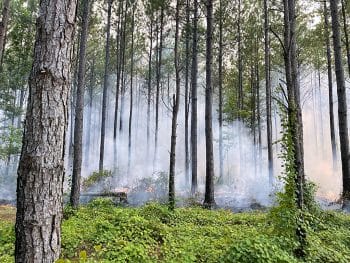
A growing season prescribed burn that occurred in two-year rough in central Alabama
The Central Alabama PBA, coordinated by Lee Stuckey, has forged new relationships with the public and private sector thanks to Lee’s efforts in recruiting. This includes partnerships with local Research Conservation and Development (RC&D) contacts, as well as great success connecting US Military veterans with prescribed fire training.
The Northwest Florida PBA, coordinated by Jeremy Martin, has been busy conducting landowner prescribed burns around the Panhandle.
These burns were funded by Tall Timbers and grants. Jeremy, who came to Tall Timbers from the Florida Fish and Wildlife Conservation Commission, has decades of experience in private lands consulting in the area, and fills the niche that a PBA needs to effectively consult with local landowners.
The Northwest Florida PBA, coordinated by Jeremy Martin, has been busy conducting landowner prescribed burns around the Panhandle.
The Southwest Georgia PBA, new as of June 2022, is coordinated by George Jensen, who has sought to use the PBA to aid the next generations of prescribed fire managers. George works closely with local colleges to help train private landowners and students alike in how to use prescribed fire.
The Southwest Georgia PBA has also partnered with the Golden Triangle RC&D; this has been crucial to getting this organization off the ground.
Over the next year, all three PBAs seek new landowners who want to get involved in their local communities and be more involved with land management decision-making on their properties. The Private Lands Fire Initiative will continue to share the flame with landowners who are involved in these PBAs and aid in their fire application where needed.
Drones, or Unmanned Aircraft Systems, continue to shine as unique and cost effective tools in natural resource management. These precise flyers can carry a wide variety of payloads to support both research and prescribed fire operations.
Within the next year, Tall Timbers hopes to have the capacity to further support its staff with high-resolution aerial LiDAR vegetation and terrain mapping, a cutting-edge development in drone technology.
Over the summer, the Tall Timbers Geospatial Center received several drones from various projects that no longer needed them. The acquisition of these out-of-use aircraft allows the Center an additional cost-effective method to expand its research, outreach, and land monitoring capabilities, forming a newly reorganized drone program.
This program looks to overhaul these drones and combine them with new products to better implement projects from a bird’s eye view.
So far, the drone program has made over $40,000 of drone equipment airworthy again. With every successful drone refurbish, the Tall Timbers Geospatial Center gains the capacity to provide services to our staff and partners. These services include capturing DSLR quality pictures from the air, supporting fire staff with aerial thermal video, and assisting research with infrared and multispectral imagery—often used to identify differences in plant species, type, and stress.
Comparison of a true color (left) and thermal photograph (right) captured by a Zenmuse XT2 thermal camera
While the program is just getting off the ground, these upcycled drones have already been used on various Tall Timbers projects, including extension forestry events and prescribed fire. We look forward to seeing how this new program takes flight.
Project Investigators: Kyle Magdziuk, Justin Rectenwald, Alex Jackson, Clay Sisson, Bill Palmer, and James Martin, originally published in the 2022 edition of Quail Call.
Tall Timbers recently conducted a survey to determine the “industry standard” for dog training regimes on managed properties in the Albany and Red Hills regions. We recognize the importance of dog training to the success of quail hunting operations as one respondent from the survey emphasized by stating, “Quality quail hunts require quality bird dogs, which requires quality dog work.” We agree!
However, the consequences of dog work on quail demographics have not yet been adequately quantified; this lack of clarity may be causing undue restrictions on training. This survey has improved our understanding of the level and timing of the training being conducted and considerations taken to limit its effect on bobwhite behavior and demographics.
Using these results as a guide, we aim to produce practical and reliable information, so that land managers can implement this essential component of the quail hunting tradition, and maximize the use of the property with complete confidence. The survey was generously completed by the dog-handler and/or land manager on 34 properties: 21 from the Albany region and 13 from the Red Hills, covering approximately 196,740 and 80,100 acres, respectively. Across all properties, respondents reported training 0-12 (6 on average) new or young dogs each year.
The average years of experience for respondents was approximately 29 years, one of them being a fourth-generation dog-handler! In addition to asking general questions about each property, we asked each property specifically about its pre, during, and post hunting season dog training regimes.
These responses revealed some variation in dog training practices. We break it down for you by season as follows. One of the busiest times of the season for land managers is right before the start of hunting season; this busy season is no different for the dog-handlers.
Figure 1: Pre-season training start dates and post-season training cessation dates for each survey respondent that specified both in the survey (28 of 34 respondents). Start and end dates are indicated by the blue and red dots, respectively.
Virtually every property that responded indicated they worked dogs during this time period. Most properties started training between October 10 and 15 (Figure 1). The start dates were dependent on weather, with many properties specifying they waited to start training until nighttime temperatures did not exceed 50° or until after the first frost. Pre-season training averaged 3 days per week, with 68% of respondents indicating they used all the property’s half-day hunt courses for training purposes. Most (65–70%) of the respondents indicated they trained no more than twice on any course prior to the season (Figure 2, left of vertical dotted line).
Figure 2: The maximum number of training sessions on any given half-day hunt course during the pre (red), during (green), and post (blue) seasons, represented by a cumulative proportion of 34 properties.
Many respondents reported they used the pre-season to locate coveys, however many also suggested that this is not the highest of priorities. Generally, pre-season training is used to prepare and condition the dogs for the upcoming hunting season (Figure 3).
Figure 3: The summary of the agree/disagree table at the end of the dog training survey. Each statement was weighted on a scale of 1 (strongly disagree) to 5 (strongly agree)
During the hunting season, dog training is practiced by 26 of the 34 survey respondents. Similar to the pre-season, 65- 70% of properties trained no more than twice on any course during the hunting season (Figure 2, left of the vertical dotted line). Interestingly, almost all of these properties trained dogs on hunt courses that were very recently hunted. A lot of the respondents indicated that they like to keep these courses on a rotating schedule of about 10-14 days, and avoided training on courses that are scheduled to be hunted soon. This makes sense as it maximizes the amount of time in between hunts in order to keep courses “fresh.” Practically all (97%) of the survey respondents indicated they used the post-season to train dogs.
By and large, this period is used to start preparing younger or new dogs for the following hunting season. Post-season training averaged 3 days per week, with most (65%) properties designating all hunt courses on the property for training purposes, which helps to reduce the pressure on any single course. Unlike pre and during season training, however, approximately 65% of respondents used a hunt course more than twice for post-season training purposes, with the average being 3 (Figure 2, right of the vertical dotted line).
So when does training cease on these properties? Many properties specified they quit when they began seeing an increase in the amount of breeding pairs, but much like the pre-season it mostly depended on the weather (Figure 3).
Most of the cessation dates during post-season training were between April 10 and April 15, but some properties trained all the way to the end of April (Figure 1).
Due to the highest intensity of training during this time period, and the potential to impact survival and/or reproductive output, our initial research focused on post-season training. We took these survey results into careful consideration when we developed the methods for our field studies. In Albany, we are in the second year of field work using 4 total hunt courses where 2 of them are being used for post-season training purposes 3 times each (the industry standard) in year 1 and in the second year, the treatments are reversed. The encounter rates during trials, survival, and reproduction of all radio-collared birds in those hunt courses are being monitored. From 140 interactions during 2 seasons, our preliminary observations indicate low encounter rates with only 40% resulting in flushes, 20% being passed by, and 40% never being encountered at all.
Using the results from the survey, we started a field experiment this past spring to simulate the potential implications of post-season dog work. We took a sub-set of all radio-collared hens on Tall Timbers and Livingston Place and assigned them to 3 experimental groups: control, moderate, and intensive. The hens in the control group received no pressure from dogs, while hens in the moderate and intensive groups were pressured with dogs at the average (3) and maximum (6) frequency that a hunt course would be used during post-season training. We used the cooler morning hours (preferred by managers, Figure 3), to intentionally disturb these hens to the point where an evasive response was elicited, such as run or flush.
Given the low encounter rates determined in Albany, by design these methods are on the extreme side of disturbance to see if a physiological response can be elicited. If there isn’t, then that shows the “industry standard” in dog training practices are indeed sustainable! Beginning on March 8, we spent 33 days, recorded 323 total contacts, and monitored the survival of 154 total birds between Tall Timbers and Livingston Place.
All disturbances finished between April 18 (a few days after average cessation), and April 28 (a few days before the latest date a property will train). We accomplished 3 rounds of fecal collection, a noninvasive technique to analyze stress hormones.
These samples will be used to measure differences in chronic stress levels, since elevated stress levels have been shown to affect reproduction and the survival of offspring in other avian species. Currently, we monitor nesting behavior and collect a single egg from the clutch of any female bird used during post-season training simulations. The eggs will be used to analyze any differences in maternal stress concentrations within the egg yolks.
The end result of intensive dog training. Photo by Alex Jackson.
We greatly appreciate and thank all of the properties that took the time to participate in this survey. Please stay tuned as we will report more detailed results, including our findings on survival and reproduction as they become available.
The Fire Ecology Lab continues a long-standing collaboration with Dr. Yuch Ping Hsieh’s lab at the Florida A&M University (FAMU) Center for Water Resources. In one study, we are using a new method developed by Dr. Hsieh to test rates of soil microbial respiration, which is a key driver of ecosystem carbon cycling and carbon sequestration.
Whereas in the past such measurements required incubating soil and its microbes for days or weeks, his new method measures respiration rates in minutes, using a chemical indicator of the amount of carbon dioxide emitted from fresh samples. We are using the technique to compare soil microbial respiration among Tall Timbers Stoddard Plots burned at 1, 2, or 3-year intervals or unburned since 1960, to learn more about fire’s effects on this important ecosystem process.
1-year interval Stoddard Plot being burned in March.
Another project involving the Hsieh lab seeks to test a new method for measuring soil erosion. There are reasons to believe that the traditional use of erosion plots, or large, sloping troughs of soil sprinkled with water, greatly overestimate soil erosion on actual hill slopes.
Instead, the Hsieh lab seeks to use “mesh markers,” or pieces of mesh pressed closely to the ground, to measure soil displacement. The markers will be picked up after rain events and the amount of soil on them weighed, which will be used in equations that predict movement of soil on the slope.
Erosion is being measured in an unburned area (the 23-acre NB66 plot on Tall Timbers), and an adjacent area that is burned every other year. The goal is to test the new method and to learn about how prescribed fire effects soil erosion.
Erosion is being measured in an unburned area (the 23-acre NB66 plot on Tall Timbers), and an adjacent area that is burned every other year. The goal is to test the new method and to learn about how prescribed fire effects soil erosion.
Tall Timbers Fire Ecology intern Haleigh Morgan (near) and FAMU scientist Glynnis Bugna (far) run lab analyses on soil samples to measure soil microbial respiration.
The effort has been assisted by FAMU scientist Dr. Glynnis Bugna and Fire Ecology intern Haleigh Morgan.
This summer, Tall Timbers accepted a position on the Theodore Roosevelt Conservation Partnership Policy Council, a national non-profit coalition of conservation organizations and related outdoor entities that works to guarantee quality areas for hunting and fishing for all Americans.
Dr. Morgan Varner, Tall Timbers’ Director of Research and Senior Scientist, will serve as the official Policy Council Representative. Varner’s acumen and knowledge will help in specific discussions on forest and fire ecology, as well as land management and conservation. Whit Fosburgh, TRCP’s President and CEO, says, “Tall Timbers brings unique expertise to the Policy Council through its focus on forest and fire ecology, land stewardship, research, and education.”
Dr. Morgan Varner participating in a large scale prescribed fire research burn.
Today, the need for management of fire-dependent flora and fauna is growing rapidly. According to Fosburgh, “Now more than ever we need to address the management of fire-dependent ecosystems, and their fish and wildlife species.”
As the Policy Council Representative, Varner hopes to bring Tall Timbers’ perspective on prescribed fire as a critical process for wildlife and biodiversity conservation, in addition to its ability to reduce wildfire risks.
The TRCP, which was founded in 1999, works to increase federal funding aimed at conservation, in addition to preserving access to these areas for fishing enthusiasts and hunters. The mission behind the group is inspired by a 1912 quote by Theodore Roosevelt: “There can be no greater issue than that of conservation in this country.”
During his tenure as a politician, largely faced by making conservation a top-tier national issue, Roosevelt strived to safeguard hunting grounds and fishing holes for future generations. The group strives to carry out that goal each and every day. Per Fosburgh, “The Policy Council’s 62 partner organizations share a commitment to conservation and working together to develop and promote positions advancing fish and wildlife policy and ensuring the public’s access to quality places to hunt and fish.”
As the liaison between Tall Timbers and the Theodore Roosevelt Conservation Partnership, Varner expressed, “I’m excited about solidifying support for prescribed fire as a prudent practice that everyone who values time outside can get behind. Tall Timbers is actively working to reestablish our national voice on fire policy, so partnering with TRCP and their well-established ability to amplify the collective voice of conservationists is really a natural fit.”
Varner continued, “I get that prescribed fire can be a complex topic, and we absolutely recognize this as we work to deliver the research and applications needed for the future of fire training and decision support, along with the funding and markets to increase prescribed fire use and its multiple benefits.”
Fosburgh added, “The Theodore Roosevelt Conservation Partnership is thrilled to have Tall Timbers as the newest member of the TRCP Policy Council…. The TRCP looks forward to working more closely with Tall Timbers to strengthen our shared objectives.”
The M-CORES program, which includes the proposed Suncoast Connector Toll Road in Jefferson County, passed through the Florida Legislature at breakneck speed with little review or analysis. Tall Timbers has a number of concerns given the potential for significant and wide spread impacts. These include fragmenting public and private conservation lands, robbing business from Main Street Monticello, impacting our rivers and other water resources, and making prescribed fire more difficult and costly.
Join us in asking the Jefferson County Board of County Commissioners to OPPOSE the Suncoast Connector toll road and its path through Jefferson County.
Take action now with our easy email form.
Send an email to all five Jefferson County Board of County Commissioners with one click!
Burn prioritization modeling seminars and fire modeling tools are supported by Wildland Fire Science to train managers in the important planning stages of prescribed fires.
Educating and guiding the next generation of fire researchers and managers is a key goal of Wildland Fire Science and a resource for testing new ideas in fire research.
Tall Timbers hosts the premier fire technology transfer organization—the Southern Fire Exchange. This JFSP funded effort helps connect research to management through webinars, workshops, and support of the Prescribed Fire Science Consortium.
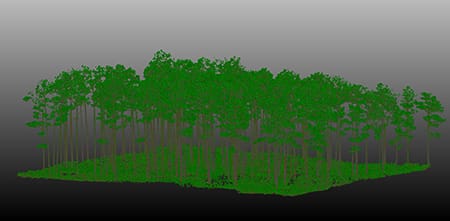
Working with partners in the Prescribed Fire Science Consortium, the program is building nexgen 3-D fuel beds using terrestrial LiDAR and novel sampling techniques to power new fire behavior models for prescribed fire managers. This work links to Tall Timbers work in wildlife habitat usage and ecological forestry.
The Longleaf Legacy landscape prescribed fire burn team arm of Wildland Fire Science works directly with landowners and partners to effectively put fire on the ground and promote prescribed fire throughout the region.
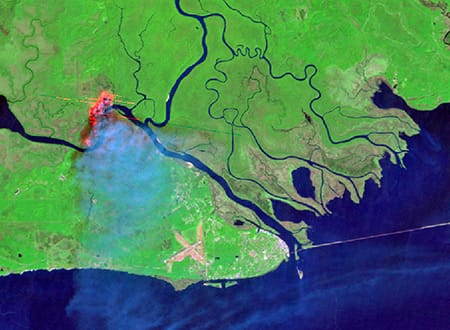
Tall Timbers is leading an effort to map fire regimes at the landscape scale. Staff work with numerous agencies to evaluate fire records and satellite imagery to build this critical conservation database. https://skfb.ly/6DqOY
Tall Timbers hosts the Prescribed Fire Science Consortium, a national network of researchers and managers who promote integrated research and management to advance next generation tools for fire practitioners. https://arcg.is/1DSjDT
We are linking physics and field observations to understand the fluid dynamics of fire behavior surface fire regimes. Our work combines field observations using advanced thermal imaging techniques, laboratory studies, and coupled fire-atmospheric modeling to help managers improve outcomes of managed fire regimes.
Selected Publications authored by Wildland Fire Science staff.
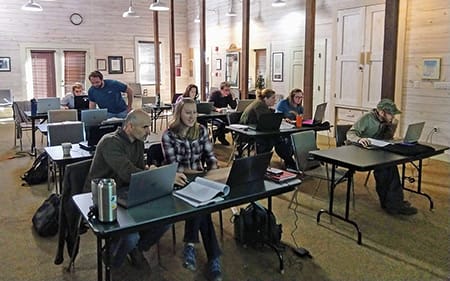
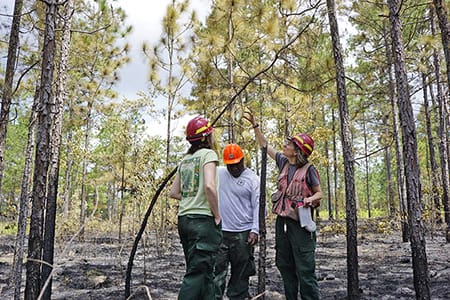
Staff and researchers support Federal fire training by serving as a cadre for NWCG training courses, ranging from basic wildland fire to advanced fire effects.
(PFTC) specializes in training fire fighters the principles and techniques of prescribed fire through practical hands-on experience. https://www.fws.gov/fire/pftc/
Private land owners are the largest source of prescribed fire in the country. These land owners and the culture of fire that was maintained by them during decades of suppression are a part of why Tall Timbers is a world-wide center for prescribed fire science. Workshops and fire training are a critical focus of the Longleaf Legacy Landscape Burn Team and our support of the Georgia Forestry Commission Prescribed Fire Center in Marion County.
The conserved lands of the Greater Red Hills region are found on working, income-producing properties that support agriculture, forestry, and recreational hunting. These properties contribute $272 million annually to local economies and support 2,300 jobs. [link to Planning & Advocacy section] The landowners’ strong stewardship ethic preserves their working lands while replenishing drinking water supplies, protecting water quality, and providing wildlife habitat for dozens of rare and endangered species. Tall Timbers’ conservation easements on these working properties encourage landowners to retain their traditional livelihood by keeping farms in family ownership.
Home to world-class wild quail populations, the Greater Red Hills region contains the largest concentration of gamebird preserves in the United States. These preserves also support the largest community of Red-cockaded woodpeckers on private lands. Indicators of high quality habitat found here include the gopher tortoise, Bachman’s sparrow, fox squirrel, and many amphibians. Tall Timbers’ conservation easements identify and protect the critical habitats of these species.
The region also boasts outstanding aquatic resources. Large river systems, like the Flint/Apalachicola, Ochlockonee, and Aucilla, flow from Georgia and feed into the Gulf of Mexico to support some of the world’s most productive estuaries. Large disappearing sinkhole lakes, like Iamonia, Miccosukee, and Jackson, provide habitat for an array of aquatic species and migratory birds. Tall Timbers’ conservation easements protect these vital watersheds and wetlands that are the lifeblood for the ecological health of the region.
Once dominated by longleaf pine, our pine woodlands support abundant wildlife and local economies. These forests need prescribed fire to stay healthy. Herbert L. Stoddard and his associates Ed and Roy Komarek were pioneers in this emerging scientific field during the mid-20th century. Tall Timbers continues that legacy with applied research on prescribed fire and land management. Today, there is a tremendous need to expand prescribed fire use beyond the Red Hills to ensure ecosystem health and reduce wildfire risk. Additionally, Tall Timbers uses conservation easements to permanently protect private woodlands while balancing the need for economic return from selective timbering.