Celebrating and conserving one of “America’s Last Great Places”
By Georgia Ackerman
The Greater Red Hills Awareness Initiative was launched last November at Tall Timbers with the overarching goal of broadening public awareness about the matchless, revered American landscape known as the Red Hills. This public awareness about the ecology, history and culture of the Red Hills begins at home with us, the residents of the Region. For example, did you know that we live in a place designated by The Nature Conservancy as one of “America’s Last Great Places?” This eco-region stretching from Thomasville to Tallahassee, nicknamed the land between two rivers, is rich in biological diversity, historic resources, and scenic beauty and public recreational opportunities. Can you name our two rivers flowing to the east and west of the Region or perhaps, where these rivers begin or end? Correct! Both Ochlockonee and Aucilla rivers originate in Georgia and meander to the gulf serving as a lifeline between coastal and northern wild lands.
2013 map of Plantations and protected lands within the Red Hills and Southwest Georgia regions. Map by Kim Sash.
Over the past few months, Tall Timbers, along with other organizations and community leaders from Georgia and Florida, has worked collaboratively to communicate more fully on existing public outreach activities and plan some new, exciting awareness events and undertakings. It seems that there are limitless choices to help us celebrate the history, culture, and ecology of this enchanted place in which we live. Additionally, here are a just few new opportunities evolving in the coming weeks planned by Initiative partners:
Exploring the Red Hills blog in the Tallahassee Democrat with writers sharing stories about a favorite regional experience;
Red Hills Speakers Bureau with experts in fields of history, culture, and ecology of our Region; and
Red Hills Second Saturday series with guest educators at rotating venues throughout the Region.
By increasing awareness and appreciation for the remarkable resources of our distinctive landscape, we can simultaneously celebrate and conserve what makes the Red Hills Region truly unique.
Georgia Ackerman is Project Manger of the Greater Red Hills Awareness Initiative at Tall Timbers Research Station and Land Conservancy. She greatly enjoys exploring the trails and waterways of the Region. Georgia can be reached at gackerman@ttrs.org or 850-893-4153, ext 345.
Recent Sustainable Tallahassee story in Tallahassee Democrat
By Theron Terhune, PhD, Game Bird Program Director
The previous couple of hunting seasons (2011/12 and 2012/13) were tough, but the story for this hunting season was much more satisfying. Many factors during the past couple of years such as high over-winter survival and good hatches contributed to overall ample bird numbers at the start of the 2013/14 hunting season. This combined with cold and wet weather throughout the winter made for good hunting conditions for much of the season. However, the colder winter weather also brought with it a significant hawk migration. We observed higher than average hawk numbers during January and April (see Figure 1) compared to long-term trends as well as an increased number of Cooper’s hawk mortalities on radio-tagged birds at the peaks. This underscores the importance of effective burn timing and scale to minimize overall avian predation on bobwhites during the burning season. Burning in small blocks, 40 -75 acres, and staggering burns through time increases available cover in an area, gives cover a chance to rebound following a burn, and reduces bobwhite movement while increasing their chance for survival.
Figure 1. Raptor survey results for Tall Timbers during 2008 – 2013 (running 7-year average) and the first part of 2014.
A plethora of rainfall over the past 4-6 weeks has provided for a quick rebound in cover on recently burned sites which may lighten the potential impact of migrating hawks and other sources of predation on bobwhites. Despite higher than average hawk numbers this winter, bobwhite survival remains about average to only slightly below average, and we have managed to carry about half of last year’s birds into this breeding season. Based on bird behavior of radio-tagged individuals, covey break up is ongoing, and we suspect pairing and nest building is right around the corner, if not already underway. With a little rain, good management and some luck it is shaping up to be a strong hatch this year.
Art and Archaeology Day at the Jones Family Tenant Farm
By Juanita Whiddon, Archivist and Historical Resources Manager
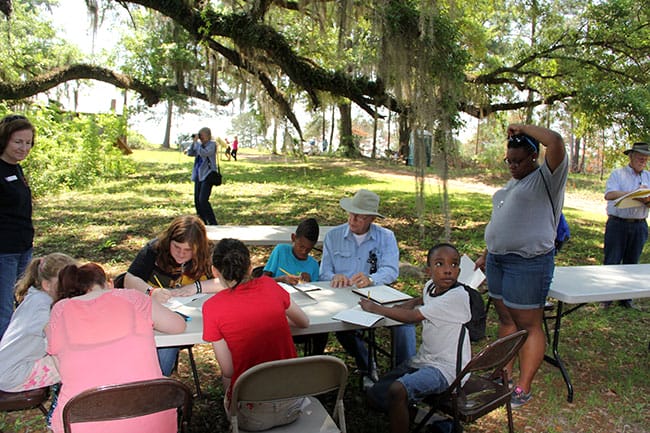
Tall Timbers Research Station & Land Conservancy partnered with the Tallahassee Watercolor Society (TAWS) to host a group of approximately 30 students on April 26 for Art and Archaeology Day. The group enjoyed an interactive learning experience, combining science and art at the Jones Family Tenant Farm site. Working with project archaeologist, Ross Morell, students learned how to excavate artifacts from the site. At another station, they recorded artifacts in their journals with the assistance of TAWS volunteers. They also toured the farm house, corn crib, and syrup-making operation on the property with volunteers from Tall Timbers Historic Resources program.
Dig site at the Tenant Farm.
At the cleaning station, examining object found at the dig site.
Students sketching with Tallahassee Watercolor Society volunteers at the art station.
Turkey hunters raise funds for Tall Timbers Game Bird Program
On March 27, the annual GA/FL Turkey Invitational Kick-off Dinner was held for the ninth year in a row at scenic Osceola Plantation, near Thomasville, Georgia. Dr. James Earl Kennamer, a leading wild turkey scientist and long-time Coordinator of Conservation Programs for the National Wild Turkey Federation (NWTF) talked some turkey to the crowd, stating that even if you don’t kill a turkey “it’s an honor to be in their presence.”
The next morning, the promise of rain didn’t deter over 50 teams from taking to the woods in search of a winning gobbler. Judge Ricky Lackey, NWTF Biologist, conducted the weigh-in at Seminole Plantation. As usual, there were memorable moments ranging from missed chances to one contestant bagging a season limit with one shot! Team Chace Wheeler and Bubba White won the overall invitational with a “boss” gobbler from Foshalee Plantation. Team Stephen Demott and Randy Floyd took second place, while third place went to perennial winners and 3-time champions Walter Hatchett and Travis Sherman.
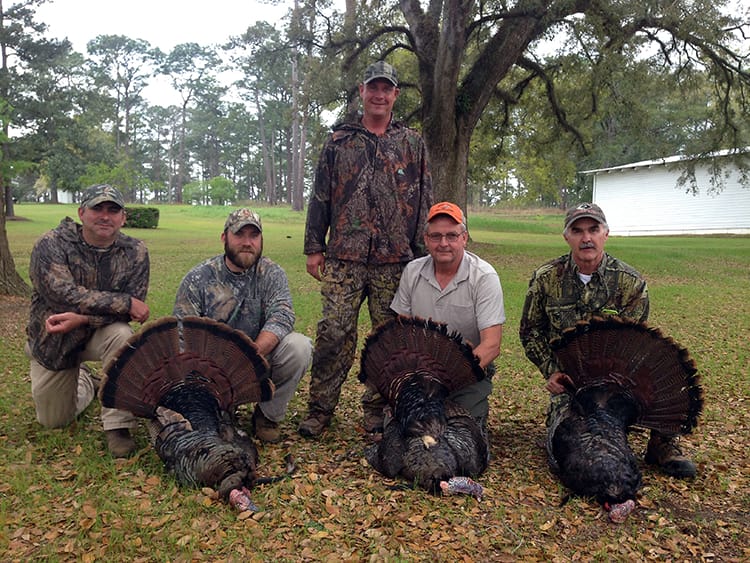
Above, first place winners, L-R, Bubba White and Chace Wheeler. Below, L-R, first place winners, Bubba White and Chace Wheeler; standing, 3rd place winner, Travis Sherman; 2nd place winner, Randy Floyd; far right, 3rd place winner Walter Hatchett.
We had 12 youth teams this year. Christopher Watt won the Youth Division for a third time. This year the winning youth team took home a Mossberg SA20 Bantam shotgun donated by South Georgia Outdoors! Hillman Smith was a close second with a tremendous turkey that won the Calcutta, a whopping 24 pounds, 7 ounces!
Above, L-R, 3rd Place Youth Division winner Grant Gatson with his father Greg Gatson behind him; center Jason Loper with Youth Division winner, Christopher Watt at far right.
Thanks to Osceola and Seminole Plantations for their hospitality and to steering committee members John Daniels, Bryan Knox and Robbie Green for helping pull together a great year! The committee is considering a Friday dinner/Saturday event next year to attract even greater youth participation.
Tall Timbers acquires Dixie Plantation – expands its research and conservation efforts in the region
Tall Timbers Research & Land Conservancy is proud to announce it has acquired Dixie Plantation as a gift from the Geraldine C. M. Livingston Foundation. In 2013, the trustees of the Livingston Foundation approached Tall Timbers, about accepting the donation of Dixie Plantation and their foundation assets. The transaction was approved by the Livingston family, Geraldine C. M. Livingston Foundation Trustees and the Suwanee River Water Management District, who holds the conservation easement on the property, as well as the Tall Timbers Board of Trustees. This is the largest gift ever to Tall Timbers since its founder, Mr. Henry Beadel, donated his 2400-acre property and endowed the institution in 1958. Dixie Plantation will be operated by DP Research LLC, a fully-owned affiliate of Tall Timbers Research, Inc.
The history of Dixie Plantation dates from the early nineteenth century. It was first settled as a cotton plantation in 1819-20 by General William Bailey and his family, and named The Cedars. In 1919, it was purchased by a group of Macon, Georgia businessmen and renamed Georgia-Florida Farm where cotton was farmed. In 1926, a group from New York City, who planned to colonize the land with small farmers from Iowa, purchased the property. This plan proved unworkable, and by the late 1920s one of the group, Gerald M. Livingston, bought out the others. He re-named the 7500-acre property Dixie Plantation.
Gerald Livingston continued to add acreage until his death in 1950, at which time his wife, Eleanor R. Livingston, took control of the approximately 18,0000- acre propertys, almost evenly divided between Florida and Georgia, and continued to manage it as a quail hunting plantation for family and guests. Upon the death of Eleanor in 1977, ownership of the Florida half of Dixie was passed to her daughter Geraldine C. M. Livingston, and the Georgia portion was left to the rest of the family, including her daughter Mary Livingston Ripley and her four grandchildren. Geraldine lived on Dixie until her death in 1994, when the ownership of Dixie was left to the Geraldine C. M. Livingston Foundation to be operated as a charitable organization dedicated to wildlife management and stewardship. The trustees of the Livingston Foundation have maintained the historical integrity of the main house and grounds, and have annually hosted the Continental Field Trials and other public events. The Foundation Trustees placed almost the entire 9,000 acres in a conservation easement with the Suwannee River Water Management District, which ensures that Geraldine’s conservation interests will continue to be carried out in perpetuity.
The Continental Field Trial will continue at Dixie Plantation, where it has been held since 1937, when it was moved there by Gerald Livingston, during his tenure as President of the Continental. This year marked the 119th running of this prestigious pointing dog field trial that attracts participants from across the country. This trial is significant because Dixie Plantation has wild bobwhites providing a true opportunity for the field of 146 “derby and open” dogs entered to demonstrate their drive and talents.
An important feature of Dixie is its historic main house. The 14,000+ square foot house was designed in 1936,by John Russell Pope, the foremost classical architect of the twentieth century, and built between 1938 and 1940. Mr. Pope designed the Jefferson Memorial, the National Archives and the National Gallery of Art. The Livingston home was the last personal residence designed by Pope, who died prior to its completion.
Tall Timbers, founded in 1958, is a world-renowned research station focusing on fire ecology and wildlife management in the Southeastern United States. The addition of 9,000 acres of land will allow Tall Timbers to expand its research and conservation efforts in the region and better provide science-based management to private and public land managers. This gift fits both the original vision of the founders of Tall Timbers and is aligned with Tall Timbers’ expertise in northern bobwhite quail management and fire ecology, and our accredited Land Trust.
Dixie Plantation Photo Gallery
Entrance gate to Dixie mansion; visitors drive under a live oak allee to the main house.
Trophy Room – Painting over fireplace is of champion Shores Brownie Doone.
The Trophy Room
Gun Room
View of Windom Lake from the rear terrace.
Statue of Midnight Sun as seen looking west from the mansion. Midnight Sun was a Tennessee Walking Horse Champion sold to Mrs. Eleanor Livingston and her daughter Geraldine in 1957. Geraldine Livingston commissioned a life size statue of Midnight Sun and presented it to her mother on her birthday in 1972.
Longleaf pine forest on Dixie.
Wetlands on Dixie
Live oak allee leads from the front gate to the main house.
All photos by Rose Rodriguez, except the 2009 Continental Open Derby winners, which is from the Dixie Archives.
The M-CORES program, which includes the proposed Suncoast Connector Toll Road in Jefferson County, passed through the Florida Legislature at breakneck speed with little review or analysis. Tall Timbers has a number of concerns given the potential for significant and wide spread impacts. These include fragmenting public and private conservation lands, robbing business from Main Street Monticello, impacting our rivers and other water resources, and making prescribed fire more difficult and costly.
Join us in asking the Jefferson County Board of County Commissioners to OPPOSE the Suncoast Connector toll road and its path through Jefferson County.
Take action now with our easy email form.
Send an email to all five Jefferson County Board of County Commissioners with one click!
Selected Publications authored by Wildland Fire Science staff.
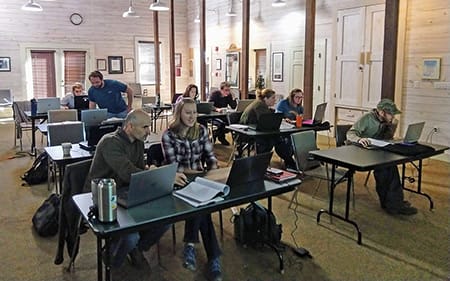
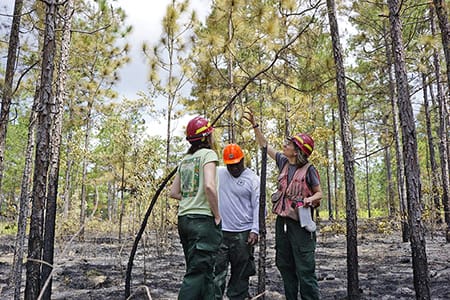
Educating and guiding the next generation of fire researchers and managers is a key goal of Wildland Fire Science and a resource for testing new ideas in fire research.
Tall Timbers hosts the Prescribed Fire Science Consortium, a national network of researchers and managers who promote integrated research and management to advance next generation tools for fire practitioners. https://arcg.is/1DSjDT
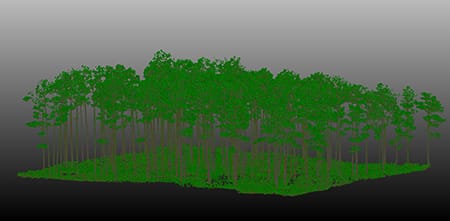
Working with partners in the Prescribed Fire Science Consortium, the program is building nexgen 3-D fuel beds using terrestrial LiDAR and novel sampling techniques to power new fire behavior models for prescribed fire managers. This work links to Tall Timbers work in wildlife habitat usage and ecological forestry.
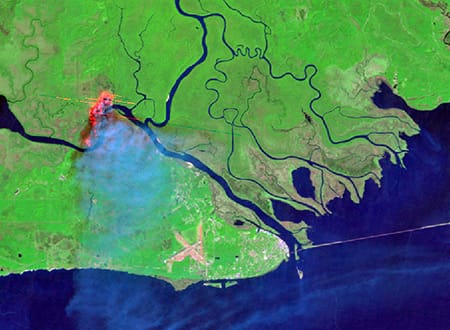
Tall Timbers is leading an effort to map fire regimes at the landscape scale. Staff work with numerous agencies to evaluate fire records and satellite imagery to build this critical conservation database. https://skfb.ly/6DqOY
We are linking physics and field observations to understand the fluid dynamics of fire behavior surface fire regimes. Our work combines field observations using advanced thermal imaging techniques, laboratory studies, and coupled fire-atmospheric modeling to help managers improve outcomes of managed fire regimes.
Burn prioritization modeling seminars and fire modeling tools are supported by Wildland Fire Science to train managers in the important planning stages of prescribed fires.
The conserved lands of the Greater Red Hills region are found on working, income-producing properties that support agriculture, forestry, and recreational hunting. These properties contribute $272 million annually to local economies and support 2,300 jobs. [link to Planning & Advocacy section] The landowners’ strong stewardship ethic preserves their working lands while replenishing drinking water supplies, protecting water quality, and providing wildlife habitat for dozens of rare and endangered species. Tall Timbers’ conservation easements on these working properties encourage landowners to retain their traditional livelihood by keeping farms in family ownership.
Home to world-class wild quail populations, the Greater Red Hills region contains the largest concentration of gamebird preserves in the United States. These preserves also support the largest community of Red-cockaded woodpeckers on private lands. Indicators of high quality habitat found here include the gopher tortoise, Bachman’s sparrow, fox squirrel, and many amphibians. Tall Timbers’ conservation easements identify and protect the critical habitats of these species.
The region also boasts outstanding aquatic resources. Large river systems, like the Flint/Apalachicola, Ochlockonee, and Aucilla, flow from Georgia and feed into the Gulf of Mexico to support some of the world’s most productive estuaries. Large disappearing sinkhole lakes, like Iamonia, Miccosukee, and Jackson, provide habitat for an array of aquatic species and migratory birds. Tall Timbers’ conservation easements protect these vital watersheds and wetlands that are the lifeblood for the ecological health of the region.
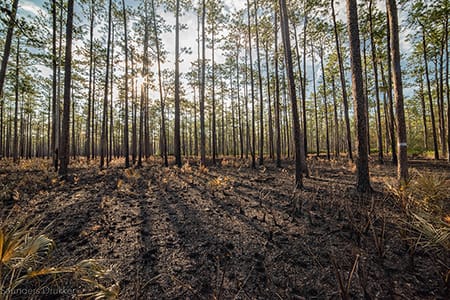
Once dominated by longleaf pine, our pine woodlands support abundant wildlife and local economies. These forests need prescribed fire to stay healthy. Herbert L. Stoddard and his associates Ed and Roy Komarek were pioneers in this emerging scientific field during the mid-20th century. Tall Timbers continues that legacy with applied research on prescribed fire and land management. Today, there is a tremendous need to expand prescribed fire use beyond the Red Hills to ensure ecosystem health and reduce wildfire risk. Additionally, Tall Timbers uses conservation easements to permanently protect private woodlands while balancing the need for economic return from selective timbering.
Tall Timbers hosts the premier fire technology transfer organization—the Southern Fire Exchange. This JFSP funded effort helps connect research to management through webinars, workshops, and support of the Prescribed Fire Science Consortium.
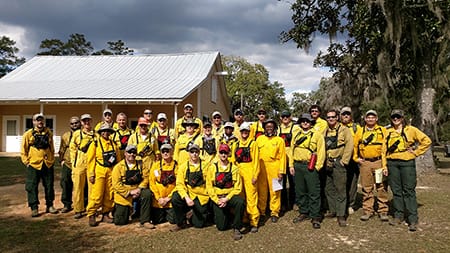
The Longleaf Legacy landscape prescribed fire burn team arm of Wildland Fire Science works directly with landowners and partners to effectively put fire on the ground and promote prescribed fire throughout the region.
Staff and researchers support Federal fire training by serving as a cadre for NWCG training courses, ranging from basic wildland fire to advanced fire effects.
(PFTC) specializes in training fire fighters the principles and techniques of prescribed fire through practical hands-on experience. https://www.fws.gov/fire/pftc/
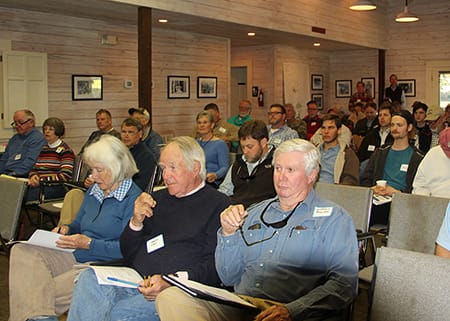
Private land owners are the largest source of prescribed fire in the country. These land owners and the culture of fire that was maintained by them during decades of suppression are a part of why Tall Timbers is a world-wide center for prescribed fire science. Workshops and fire training are a critical focus of the Longleaf Legacy Landscape Burn Team and our support of the Georgia Forestry Commission Prescribed Fire Center in Marion County.

.jpg?strip=all&lossy=1&w=1)





 Gerald Livingston continued to add acreage until his death in 1950, at which time his wife, Eleanor R. Livingston, took control of the approximately 18,0000- acre propertys, almost evenly divided between Florida and Georgia, and continued to manage it as a quail hunting plantation for family and guests. Upon the death of Eleanor in 1977, ownership of the Florida half of Dixie was passed to her daughter Geraldine C. M. Livingston, and the Georgia portion was left to the rest of the family, including her daughter Mary Livingston Ripley and her four grandchildren. Geraldine lived on Dixie until her death in 1994, when the ownership of Dixie was left to the Geraldine C. M. Livingston Foundation to be operated as a charitable organization dedicated to wildlife management and stewardship. The trustees of the Livingston Foundation have maintained the historical integrity of the main house and grounds, and have annually hosted the Continental Field Trials and other public events. The Foundation Trustees placed almost the entire 9,000 acres in a conservation easement with the Suwannee River Water Management District, which ensures that Geraldine’s conservation interests will continue to be carried out in perpetuity.
 The Continental Field Trial will continue at Dixie Plantation, where it has been held since 1937, when it was moved there by Gerald Livingston, during his tenure as President of the Continental. This year marked the 119th running of this prestigious pointing dog field trial that attracts participants from across the country. This trial is significant because Dixie Plantation has wild bobwhites providing a true opportunity for the field of 146 “derby and open” dogs entered to demonstrate their drive and talents.