Tall Timbers monitoring implementation of Florida Amendment 1 Funds
By Kevin McGorty, Tall Timbers Land Conservancy Director
As the Florida Legislature begins its 2015 session in March, debate has already started over how to spend the billions of dollars that will be generated over the next 20 years from doc stamp fees on real estate transactions. In November, 75 percent of voters passed a constitutional amendment dedicating funds to acquire and manage conservation lands, restore and protect water resources, provide areas for recreation and keep ranches, farms, and forests as part of Florida’s rural landscape. Tall Timbers joined other leading conservation organizations in endorsing the Florida Water and Land Conservation Amendment, advocating for the expanded use of conservation easements as a way of keeping working lands in working hands.
This Legislature session will decide on the budget and the rules for Amendment 1 funding. The conservation coalition that sponsored the Amendment recommended first year funding at $170 million for Florida Forever land acquisition projects, $170 million for Everglades restoration, $115 million for land management, $60 million for springs protection, $39 million for Rural Family Land projects, $30 million for beach management, and $173 million to reduce debt service from previous bonds. Other state leaders, however, are recommending improving municipal water and waste-water systems. Local governments like the City of Tallahassee are calling for funding to expand sewer services to rural areas to decrease the number of septic tanks that impact springs. While the Amendment represents less than 1 percent of state funding, the competition for funds will be intense.
In January, Dixie Plantation hosted the 120th running of the Continental Field Trials. Since 1937, Dixie Plantation has proudly teamed with the Continental Field Trial Club to host the Annual Continental Open Derby and All-Age Championship Field Trials.
Embedded in the famed Red Hills Plantation Belt, Dixie is in the perfect location for the field trials, with over 6,000 of its 9,100 acres intensively managed for wild quail. In addition to prescribed burning, hardwood clean-up, seasonal disking, and other land management techniques; quail are fed year round and nests predators are kept in check. High density wild quail populations are a high priority for the field trials as well as hunting. Today the Continental Field Trials are recognized nationally as one of the premier wild quail trials in the country.
The Continental Field Trials are held the third Monday of January each year. There are two trials held back to back. The Continental Open Derby Championship is run first, followed by the Continental Open All-Age Championship. Winning the Continental Open All-Age trial entitles the dog to compete in the National Field Trial Championship, the highest honor a bird dog can attain.
The objective is for pointing dogs, primarily English Pointers and Setters, to locate coveys of quail and to point steady to wing and shot (the dogs freeze in that position as the handler flushes the birds and a blank shot is fired). The dogs are judged on their ability to find birds and their style and enthusiasm in doing so. In the Continental trials they run one-hour heats initially; those that qualify for call-backs run one hour and fifty minutes. This is a true test of stamina.
For more information about Dixie Plantation and the Continental Field Trials click here.
2015 Continental All-Age Championship Winners
Front row: Luke Eisenhart & Tommy Davis with Continental Champion Erin’s Wild Justice- Mark Haynes with Continental Runner-Up Champion Miller’s Dialing In Back rows: Tammy Eisenhart, Mike Sweet, Ed Mayhew, Randy Floyd, Gary Lester, Larron Copeland, Bart Goodson, Eddie Sholar, Gloria Hagan, Alpha “Too” Bright, Doug Vaughn (Judge), Tommy Stargell, Clay Sisson, Harold Ray (Judge), Aimee Atkins, John Thompson. Photo courtesy of Chris Mathan.
2015 Continental Derby Championship Winners
Front row: Luke Eisenhart and Tommy Davis with Champion Dunn’s Tried and True; Willis Wright and Tom Shenker with Runner-Up Champion Bayou Meta Jim. Back row: Ferrell Miller, Will Dunn, Reeves Lane, Ed Epp (Judge), Dr. Ron Deal (Judge), Bernie Matthys, Ronnie Spears, Alpha (Too) Bright, Randy Floyd. Photo by Rose Rodriguez
The partners of the Greater Red Hills Awareness Initiative (GRHAI) regularly contribute articles for the twice monthly column, “Exploring the Red Hills” published in the Tallahassee Democrat. Authors share stories celebrating the cultural, historical, and ecological wonders of the Red Hills. A few are listed here.
Monticello Opera House. Courtesy of Jefferson County Tourism Development Council
WFSU-TV recently produced a three-segment EcoShakespeare series exploring connections of culture and ecology during Shakespeare’s lifetime. Filmed against a scenic Red Hills backdrop, the series also examines current conservation issues in our region.
To view the EcoShakespeare segment on longleaf pine forests click here.
Puck and Oberon from Shakespeare’s A Midsummer Night’s Dream filmed at Tall Timbers for WFSU’s EcoShakespeare series. Photo by Georgia Ackerman
Georgia Ackerman, project manager of the Red Hills Awareness Initiative, likes to bike commute to work at Tall Timbers because it’s a great way to observe wildlife. See her blog in the Tallahassee Democrat, “The Benefits of Slow.”
Do you have a favorite Red Hills place to explore? You can share your photos on our Facebook page. #redhillsregion.
To sign up for the Red Hills Happenings, an activity newsletter for residents, email Georgia Ackerman.
The lives of young animals are often shrouded in secret. Young animals rarely call attention to themselves and frequently are difficult to see simply because they are much smaller than adults. For many species, it’s a time in life to stay low, out of sight of predators, and simply try to get by until such time as you’re ready to act more like an adult.
Tom Radzio, a Ph.D. candidate at Drexel University, has been unearthing the rich, dark secrets of juvenile living for one of the most charismatic reptiles found in our pinewoods: the deep-digging Gopher Tortoise. Adults typically live for decades unless they’re killed by dogs, coyotes, or cars, but young tortoises face a broad host of threats ranging from predatory snakes to birds and small mammals.
To avoid these predators, juveniles can’t simply use the large burrows that adults use. Large burrows are often visited by snakes and other potential predators of young tortoises. Instead, Radzio has found young tortoises excavating burrows within hours of hatching. “They get right to it, often placing their first burrow under a small dead log and digging relentlessly like their lives depend on it.” Radzio says.
On the flip side of this need for shelter is the need for food and growth. For a gopher tortoise, that means getting your cold-blooded body up to a preferred temperature of around 90°F, a proposition that can be difficult to pull off in a deep, damp burrow.
Instead, juvenile tortoises spend lots of time basking in the sunlight, basically exposing themselves to help warm their bodies to a preferred temperature so that food can be processed and growth can occur.
Using video cameras and miniature data loggers, Radzio has found that young tortoises bask extensively right in front of the burrow entrance. In fact, the young tortoises take advantage of about 90% of opportunities they have over the course of a day to raise their body temperatures to their preferred temperature.
“When we go out into the field, we almost never see them out of their burrows, but the video tells a different story. They bask and move in and out of burrows all day long to keep a high body temperature, but hide just before we can see them,” Radzio notes.
Hatchlings also are very wary and use vibrations to detect potential predators, often hiding in response to putatively to non-threatening animals, such as curious Sherman Fox Squirrels.
The research suggests that the amount of sunlight reaching the ground near juvenile burrows is quite important to juvenile tortoises. Increased shading of the area surrounding burrows can take place as a result of fire suppression, over-stocked timber, and other land management practices. These practices obviously lower quail numbers as well, but also could reduce juvenile tortoise growth rates with potentially adverse population-level consequences.
Figure 1a & b. Hatchlings are very wary and use vibrations to detect potential predators. Sometimes they even hide in response to non-threatening animals, such as curious Sherman Fox Squirrels.
Figure 2a & b. The drive to bask is strong in young tortoises. Here a recently hatched tortoise emerges from its burrow to bask just 6 minutes after being visited by a Coachwhip (snake), a common predator of young tortoises.
Figure 3. American Toad enjoying an abandoned juvenile tortoise burrow on Arcadia Plantation.
Over the past 47 years the Game Bird Program has been capturing, banding and releasing wild quail which marks the longest running band-recapture study of any game bird in the world. Since 1968 more than 28,000 quail birds have been leg-banded. From that dataset we have observed that, on average, annual survival for a population of quail is about 20% in good habitat or that approximately 80% of the population dies each year. Here in the Game Bird Lab, year after year and week after week we pick up radio-tags that once were fitted to a live bobwhite which is a persistent reminder that quail are simply good at dying. I recently heard it put this way: “On average a one year old quail has been dead for quite some time.” Indeed, only a small proportion of quail make it to 1-year of age even amidst high-quality habitat. But last month we discovered that some quail can and do beat the odds.
On Tall Timbers, we recaptured and released a male bobwhite (known in the lab as 091406, see photo) that was initially banded in 2009 making him nearly 6 years old. Alas, these odds are slim – about 1 in 15,000! To put that into perspective there is about a 1 in 3000 chance that you will be struck by lightning in your lifetime or you are 5 times more likely to be struck by lightning in your lifetime than come across a 6-year old quail bird. Our research has helped us to understand what drives quail populations and continues to shed light on how best to manage for these short-lived, illustrious game birds.
During the past few weeks we have seen an upsurge in raptors due to the migration and a resulting dip in bobwhite survival has ensued. This is a common pattern observed each year. Our long-term dataset shows that avian predation increases this time of year (January – March) resulting in lower bobwhite survival (see Figure 1) and another small but noticeable dip in survival during late-November and December both of which are associated with the raptor migration (see gray bars, in Figure 1, indicating relative raptor abundance). However, even after many of the migrating hawks have moved north weekly survival remains low during April, May and June (see Figure 1). This is likely associated with prescribed burning and subsequent increased movement by bobwhites to seek out unburned areas as well as covey break up and the onset of breeding season. As cover begins to respond and raptor numbers remain low survival begins to improve in July for much of the remainder of the year. Delaying some of your prescribed burning until after the raptor migration may help to improve survival. In addition, burning at a small scale (25-100 acre patches) and leaving burned and unburned areas patchily disturbed among upland sites can improve bobwhite survival during this critical time period. Good habitat management is our best defense against predation, and timely application of management may also help to improve a quail’s odds of survival.
As an extreme example of what can happen when burning is overdone, Tall Timbers monitored quail abundance on a property that did extensive burning during February and March, 2014. While the primary objective on this property is not quail management, it is one of the objectives. Increased burning is normally a good thing for quail but it can be overdone. Quail numbers on this property plummeted in 2015. While plantation managers know better than to over burn their properties, it is a good reminder to be cognizant of the size and distribution of burns each spring to maximize the carry- over of birds into the breeding season.
Figure 1. Weekly survival rates of quail on Tall Timbers relative to the overall mean weekly survival (gray line at zero) for the last 10 years combined (2004-2015). Weekly survival rates are overlaid on the bi-weekly raptor count. A point above the gray line indicates that survival is above the weekly average whereas a point falling below the gray line indicates that survival is below the overall weekly average.
The M-CORES program, which includes the proposed Suncoast Connector Toll Road in Jefferson County, passed through the Florida Legislature at breakneck speed with little review or analysis. Tall Timbers has a number of concerns given the potential for significant and wide spread impacts. These include fragmenting public and private conservation lands, robbing business from Main Street Monticello, impacting our rivers and other water resources, and making prescribed fire more difficult and costly.
Join us in asking the Jefferson County Board of County Commissioners to OPPOSE the Suncoast Connector toll road and its path through Jefferson County.
Take action now with our easy email form.
Send an email to all five Jefferson County Board of County Commissioners with one click!
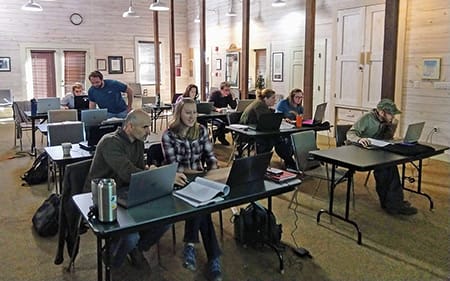
Burn prioritization modeling seminars and fire modeling tools are supported by Wildland Fire Science to train managers in the important planning stages of prescribed fires.
Educating and guiding the next generation of fire researchers and managers is a key goal of Wildland Fire Science and a resource for testing new ideas in fire research.
Tall Timbers hosts the premier fire technology transfer organization—the Southern Fire Exchange. This JFSP funded effort helps connect research to management through webinars, workshops, and support of the Prescribed Fire Science Consortium.
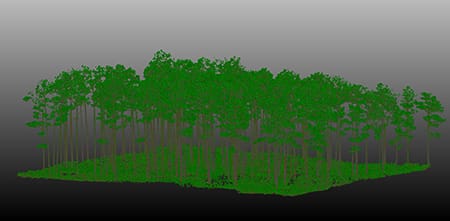
Working with partners in the Prescribed Fire Science Consortium, the program is building nexgen 3-D fuel beds using terrestrial LiDAR and novel sampling techniques to power new fire behavior models for prescribed fire managers. This work links to Tall Timbers work in wildlife habitat usage and ecological forestry.
The Longleaf Legacy landscape prescribed fire burn team arm of Wildland Fire Science works directly with landowners and partners to effectively put fire on the ground and promote prescribed fire throughout the region.
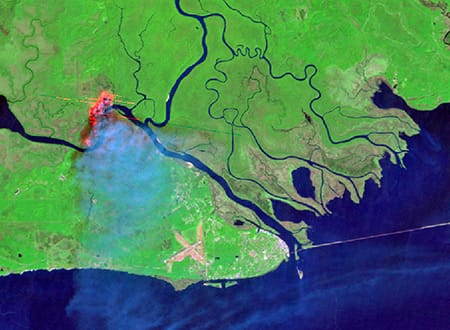
Tall Timbers is leading an effort to map fire regimes at the landscape scale. Staff work with numerous agencies to evaluate fire records and satellite imagery to build this critical conservation database. https://skfb.ly/6DqOY
Tall Timbers hosts the Prescribed Fire Science Consortium, a national network of researchers and managers who promote integrated research and management to advance next generation tools for fire practitioners. https://arcg.is/1DSjDT
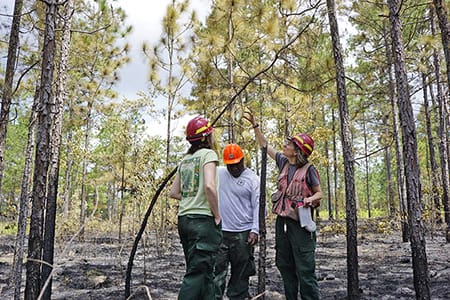
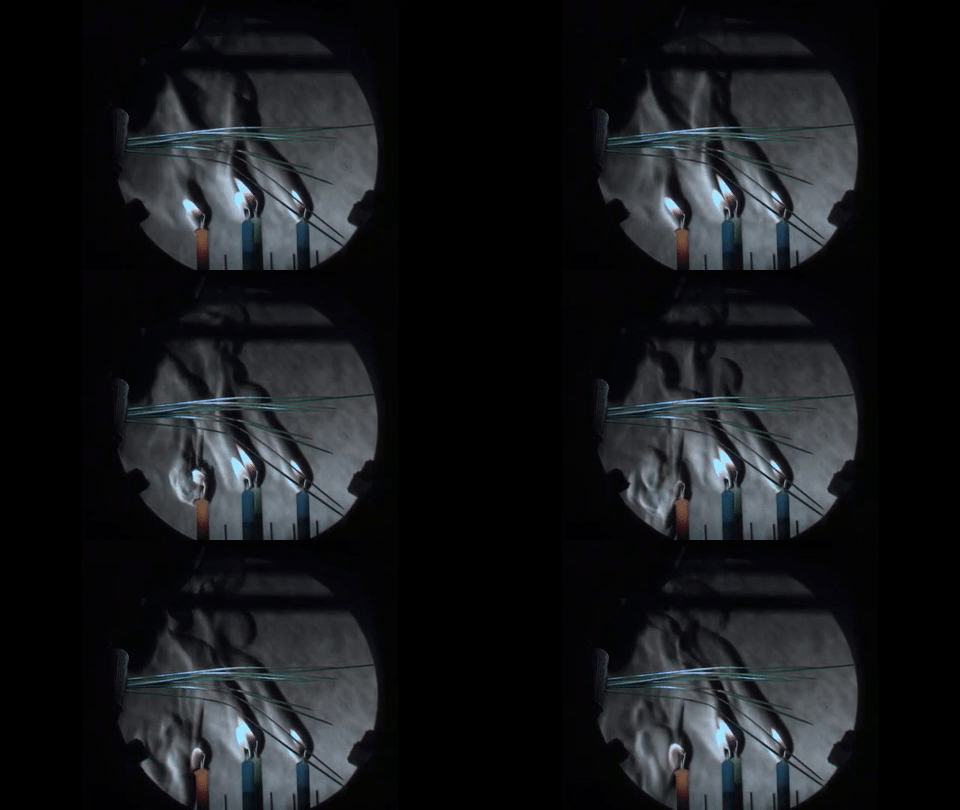
We are linking physics and field observations to understand the fluid dynamics of fire behavior surface fire regimes. Our work combines field observations using advanced thermal imaging techniques, laboratory studies, and coupled fire-atmospheric modeling to help managers improve outcomes of managed fire regimes.
Selected Publications authored by Wildland Fire Science staff.
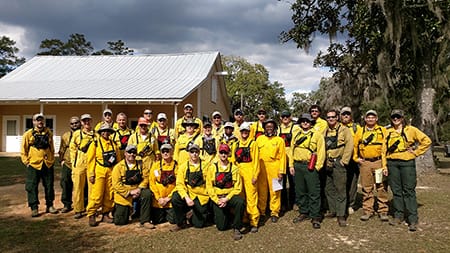
Staff and researchers support Federal fire training by serving as a cadre for NWCG training courses, ranging from basic wildland fire to advanced fire effects.
(PFTC) specializes in training fire fighters the principles and techniques of prescribed fire through practical hands-on experience. https://www.fws.gov/fire/pftc/
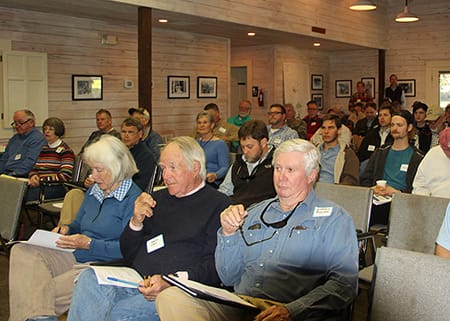
Private land owners are the largest source of prescribed fire in the country. These land owners and the culture of fire that was maintained by them during decades of suppression are a part of why Tall Timbers is a world-wide center for prescribed fire science. Workshops and fire training are a critical focus of the Longleaf Legacy Landscape Burn Team and our support of the Georgia Forestry Commission Prescribed Fire Center in Marion County.
The conserved lands of the Greater Red Hills region are found on working, income-producing properties that support agriculture, forestry, and recreational hunting. These properties contribute $272 million annually to local economies and support 2,300 jobs. [link to Planning & Advocacy section] The landowners’ strong stewardship ethic preserves their working lands while replenishing drinking water supplies, protecting water quality, and providing wildlife habitat for dozens of rare and endangered species. Tall Timbers’ conservation easements on these working properties encourage landowners to retain their traditional livelihood by keeping farms in family ownership.
Home to world-class wild quail populations, the Greater Red Hills region contains the largest concentration of gamebird preserves in the United States. These preserves also support the largest community of Red-cockaded woodpeckers on private lands. Indicators of high quality habitat found here include the gopher tortoise, Bachman’s sparrow, fox squirrel, and many amphibians. Tall Timbers’ conservation easements identify and protect the critical habitats of these species.
The region also boasts outstanding aquatic resources. Large river systems, like the Flint/Apalachicola, Ochlockonee, and Aucilla, flow from Georgia and feed into the Gulf of Mexico to support some of the world’s most productive estuaries. Large disappearing sinkhole lakes, like Iamonia, Miccosukee, and Jackson, provide habitat for an array of aquatic species and migratory birds. Tall Timbers’ conservation easements protect these vital watersheds and wetlands that are the lifeblood for the ecological health of the region.
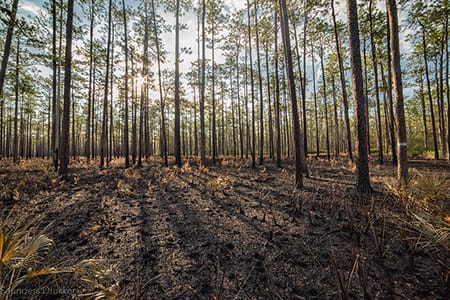
Once dominated by longleaf pine, our pine woodlands support abundant wildlife and local economies. These forests need prescribed fire to stay healthy. Herbert L. Stoddard and his associates Ed and Roy Komarek were pioneers in this emerging scientific field during the mid-20th century. Tall Timbers continues that legacy with applied research on prescribed fire and land management. Today, there is a tremendous need to expand prescribed fire use beyond the Red Hills to ensure ecosystem health and reduce wildfire risk. Additionally, Tall Timbers uses conservation easements to permanently protect private woodlands while balancing the need for economic return from selective timbering.



 On Tall Timbers, we recaptured and released a male bobwhite (known in the lab as 091406, see photo) that was initially banded in 2009 making him nearly 6 years old. Alas, these odds are slim – about 1 in 15,000! To put that into perspective there is about a 1 in 3000 chance that you will be struck by lightning in your lifetime or you are 5 times more likely to be struck by lightning in your lifetime than come across a 6-year old quail bird. Our research has helped us to understand what drives quail populations and continues to shed light on how best to manage for these short-lived, illustrious game birds.