#GivingTuesday is a global day of giving fueled by the power of social media and collaboration. Observed on the Tuesday following Thanksgiving and the widely recognized shopping events Black Friday and Cyber Monday, #GivingTuesday kicks off the charitable season, when many focus on their holiday and end-of-year giving. We hope that you will consider a year-end-gift to Tall Timbers in support of Wildlife and Wildlands! Click HERE to donate.
18th Annual Kate Ireland Memorial Dinner & Auction
Presented by The Kate Ireland Foundation, North Florida Animal Hospital and Four Oaks Plantation, the 18th Annual Kate Ireland Memorial Dinner & Auction was held Sunday evening, September 20 at Pebble Hill Plantation’s Uno Hill Barn, in Thomas County, Georgia.
The festivities kicked off with a cocktail reception where guests perused auction items. This year’s live auction featured a first of its kind shotgun—the Tall Timbers Longleaf Gun—for which Tall Timbers commissioned Scottish bespoke gun maker David McKay Brown to create. The gun is a 28-gauge round-action side-by-side, embellished with a classic scroll intertwined with longleaf pine motifs (cones, needles, foliage). The engravings also include a still life of bobwhite designed by collaborating artist C. D. Clarke. Italy’s Mirko Agnellini engraved the gun.
Over 230 guests dined “family style” on a sumptuous dinner prepared with fare from the Red Hills featuring sorghum glazed quail prepared by Liam’s Restaurant.
Named in honor of one of Tall Timbers’ most treasured supporters, the Kate Ireland Memorial Dinner & Auction is a fundraising event held annually benefitting Tall Timbers Foundation, Inc., for Tall Timbers research and conservation programs. This event attracts bidders not only from within the Red Hills Region, but due to auction items unique to this event, our auction attracts a national audience. Each year the auction features an inspiring collection of world class artwork, unparalleled hunting and fishing opportunities, and unique offerings from the Red Hills Region and beyond.
The event raised over $200,000 with support of the presenting sponsors along with our event sponsors, guests, and auction participants and donors. Thank you!
U.S. Environmental Protection Agency and others raise concerns about proposed Sabal Trail Pipeline
By Neil Fleckenstein, Land Conservancy Planning Coordinator
On October 26, 2015 the U.S. Environmental Protection Agency (EPA) released its review of the proposed Sabal Trail natural gas pipeline. This pipeline is slated to begin in Alabama and run through southwest Georgia for nearly 200 miles before entering Florida, terminating in Osceola County. Of particular interest to Tall Timbers is the portion of the pipeline route that winds its way through Dougherty, Colquitt, and Brooks Counties, avoiding most quail hunting properties while directly impacting several others.
The EPA’s review, which can be found here, outlines a number of “potentially significant environmental issues” related to drinkingwater supplies, wetlands, conservation areas, minority communities, and air quality. Of particular concern to the EPA is the proposed pipeline route over the vulnerable Floridan Aquifer, the sole source of drinking water for millions of residents of Southwest Georgia and Florida. The EPA states that the proposed pipeline is “expected to have significant impacts to karst areas in the state of Georgia and Florida and represents a potential threat to groundwater (and surface water) resources.” Accordingly, the EPA requested that the Federal Energy Regulatory Commission (FERC) develop an alternative route avoiding the fragile Floridan Aquifer. In its statement, the EPA rated the Draft Environmental Impact Statement’s preferred route as “EO-2,” a designation meaning the Agency has environmental objections to a significant part of the proposed route.
The EPA also discussed the sinkhole-prone nature of the karst geology underlying Dougherty County and the resulting threat for land subsidence, potentially leading to a failure of the pipeline. Another major concern expressed by the agency was the location of a proposed compressor station near Albany, Georgia. The proposed station has become a flashpoint as it is the only compressor station that is located in an urban area along the route. The location, near a low-income, largely minority residential community, has led to pointed questions and criticism from several members of Georgia’s Congressional delegation including Representatives Sanford Bishop, Hank Johnson, David Scott, and John Lewis.
Given its many concerns, the EPA has requested that the FERC fully and objectively evaluate an alternative route to avoid the vulnerable Floridan Aquifer, as well as minimize the impact to wetlands, conservation features, and low income communities.
Tall Timbers, while not taking a formal position on the Sabal Trail pipeline, provided comments to the FERC. Tall Timbers raised several of the same concerns discussed in the EPA’s response to the Draft EIS including the vulnerability of the karst geology in Dougherty County and the resulting potential for adverse impacts to sole source drinking water supplies. Tall Timbers and others questioned why the FERC required much more stringent geotechnical analysis of a proposed pipeline in a similar area of extensive karst geology and sinkhole terrain in Pennsylvania.
In that instance, FERC required the builders of the Atlantic Sunrise Pipeline in Pennsylvania to provide detailed surveys of suspected karst features, ground-truthing, and extensive mapping of sinkhole vulnerable zones for the entire pipeline. By comparison, the Draft Environmental Impact Statement for the Sable Trail project includes the review of only 11 karst features along 300 miles of pipeline route, including analysis of only two sinkhole features.
Tall Timbers also raised the potential for ground subsidence leading to pipeline failure. In fact, more than 300 sinkholes formed in the area of the proposed pipeline following flooding in 1994. More recently, 23 sinkholes developed at the Albany municipal well field following droughts between 2003 and 2007. Other issues raised included potential impacts to springs, many of which are unmapped in Southwest Georgia and provide a direct connection to the aquifer. Finally, Tall Timbers raised the possibility of negative impacts associated with horizontal drilling at crossing points along the Flint and Ochlockonee Rivers. Notably, the Flint River is a Georgia High Priority Water and a Georgia Protected River Corridor, vital to the local communities that have grown up along the River.
The FERC is reviewing the comments submitted by the public including those provided by attorneys representing a number of organizations with conservation interests in Southwest Georgia such as the Flint Riverkeeper, the Chattahoochee Riverkeeper, and the Sierra Club, as well as large and small landowners throughout the proposed project area. The review and subsequent FERC response could take one or more months.
For more information about this issue, please contact Red Hills Planning Coordinator Neil Fleckenstein at Neil@ttrs.org or 850-893-4153, ext. 335.
If killing exotic plants—like Cuban Bullhead Sedge— is your business, business is good
By Kim Sash
About five years ago an exotic plant biologist described his job to me: “Killing is my business, and business has been good.” Unfortunately in the five years since that conversation, I’m sure he’d still say “business is good.” Although success is continually being made against exotics, in the Red Hills we typically function at control levels and rarely reach total eradiation. Knowing what to look for is half the battle, and fighting an exotic species before they become established leads to the most success.
One exotic species that I’ve noticed a lot more of lately in the Red Hills is Cuban Bullhead sedge, Oxycaryum (also known as Cuban bulrush or burhead sedge). This aquatic species can reproduce in two ways, by seed or vegetatively through rhizome growth, making it a bigger challenge to control. Because it can spread by rhizomes Oxycaryum breaks off into floating mats, these tussocks clog waterways and also reduce open water. Tussocks can be extremely expensive and labor intensive to control, and by reducing open water it limits landing areas for ducks and foraging areas for wading birds.
The dominate grass seen in this photo, above left, is Oxycaryum (Cuban Bullhead sedge) in Gannett Pond on Tall Timbers. We first noticed this plant in the pond in late 2014. At right, close up of Oxycaryum showing the spreading rhizomes.
In my quest to learn more about this exotic plant, I recently rode an airboat with FWC Biologist, Derek Fussell, on Lake Iamonia in Leon County, Florida to look for Oxycaryum. With little effort we found it in plentiful amounts. It is prevalent along the shoreline, and was mostly seen in the mud flats at the edge of the maidencane and the water. Fussell is mapping the Oxycaryum and having crews spray it when the plant is actively growing. Fussell said, “They have had good results with a combination of 2-4,D and Diquat together and have just this year sprayed with glyphosate (7.5 pints/acre) and Flumioxazin (4oz/acre) and thus far the results look good.” In 2013-2014, 1,614.34 acres were treated in Florida public waters. This includes 335 acres in Lake Iamonia, 26 acres in Lake Jackson, and 141 acres in Lake Miccosukee.
Management techniques on private lands are less studied. FWC or their contractors typically spray from an airboat in order to get to the shorelines where Oxycaryum is most prevalent. On smaller ponds drawing down the water and then spraying or burning and then spraying may be a more feasible option. When Lake Iamonia floods, water from the lake overflows on Tall Timbers and into Gannett Pond, we assume this is how our pond got infested with Oxycaryum. Tall Timbers land manager, Eric Staller, will be treating Gannett Pond next spring, and we can update folks with what we found works the best. In the meantime, the best defense against this plant is to know what to look for and to attack it early before it gets established.
Photo above right, Kim Sash and Derek Fussell patrolling Lake Iamonia for Oxycaryum.
Big Push to Pass Conservation Easement Incentive Act (S.330)
Land Trusts throughout the nation are making a big push for Congress to pass the Conservation Easement Incentive Act (S.330). Currently the bill has 49 Senate cosponsors — evenly divided between Democrats and Republicans — including support from Senators Bill Nelson of Florida and Johnny Isakson of Georgia.
S. 330 would make permanent key tax incentives for private landowners who donate conservation easements. Since the incentives were enacted in 2006, they have been extended regularly, but only temporarily, by Congress. Just such a limited extension was approved by the Senate Finance Committee in July. Land trusts believe that it is time to improve on that, by making these powerful conservation provisions permanent, and giving landowners certainty to plan and conserve.
Passed overwhelmingly by the House of Representatives, as part of a charities tax package in February, S. 330 also enjoys broad organizational support:
CONSERVATIONISTS: The Nature Conservancy, Conservation Fund, Trust for Public Land, Theodore Roosevelt Conservation Partnership, Wilderness Society, Land Trust Alliance.
FARMERS & FORESTERS: American Farm Bureau Federation, National Cattlemen’s Beef Association, American Forest Foundation, National Alliance of Forest Owners, American Farmland Trust, Hardwood Federation.
HUNTERS & FISHERS: National Rifle Association, National Sports Shooting Foundation, Ducks Unlimited, Izaak Walton League, Pheasants Forever, Quail Forever, Mule Deer Foundation.
HISTORIC PRESERVATIONISTS: National Trust for Historic Preservation, Civil War Trust, Scenic America.
Tall Timbers supports the Enhanced Easements Incentives as they have helped permanently conserve nearly 130,000 acres of forestland, scenic landscapes, and wildlife habitat in the greater Red Hills Region.
The incentives are good public policy because:
Tax incentives are a cost-effective way to protect land. By encouraging donated easements, every dollar of tax incentives leverages $2.80 worth of conservation.
The budget impact is small. This incentive has widespread, lasting impact on land conservation but only a minor impact on the federal budget—$1.2 billion over ten years.
This incentive makes the tax system fairer. The enhanced incentive allows working farmers and ranchers, as well as forest landowners with modest incomes, to realize more of the value of the tax deduction.
Easements are a voluntary, private-sector approach to conservation. Landowners and community-supported nonprofits take the lead, rather than the government.
The goal is to get all Senators to cosponsor this important legislation! Please contact the Capitol Switchboard at 202-224-3121. But don’t just leave a message at the front desk, ask to speak with the senate staffer who handles tax issues.
Thank you for your support and help in getting this important federal legislation across the finish line.
About the photo: Sisters Jane Preyer and Kathleen Reid-Scott (pictured above), and their brother Dr. James Reid III, donated a conservation easement to Tall Timbers for their family’s forestland that protects the Ochlockonee River Watershed. For landowners, donating a conservation easement is a way to conserve places they love. It’s also a major financial decision. When landowners donate a conservation easement, they give up part of the value of their property — often their family’s biggest asset. Tax incentives offset some of that loss in property value, making conservation a viable option for more landowners.
The M-CORES program, which includes the proposed Suncoast Connector Toll Road in Jefferson County, passed through the Florida Legislature at breakneck speed with little review or analysis. Tall Timbers has a number of concerns given the potential for significant and wide spread impacts. These include fragmenting public and private conservation lands, robbing business from Main Street Monticello, impacting our rivers and other water resources, and making prescribed fire more difficult and costly.
Join us in asking the Jefferson County Board of County Commissioners to OPPOSE the Suncoast Connector toll road and its path through Jefferson County.
Take action now with our easy email form.
Send an email to all five Jefferson County Board of County Commissioners with one click!
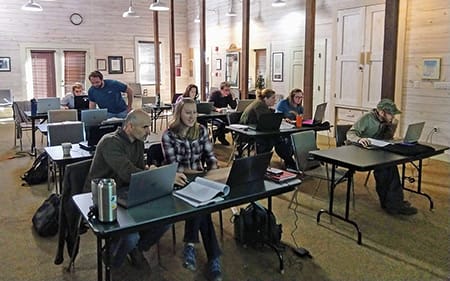
Burn prioritization modeling seminars and fire modeling tools are supported by Wildland Fire Science to train managers in the important planning stages of prescribed fires.
Educating and guiding the next generation of fire researchers and managers is a key goal of Wildland Fire Science and a resource for testing new ideas in fire research.
Tall Timbers hosts the premier fire technology transfer organization—the Southern Fire Exchange. This JFSP funded effort helps connect research to management through webinars, workshops, and support of the Prescribed Fire Science Consortium.
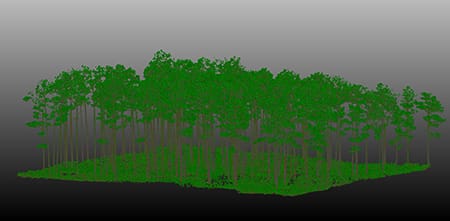
Working with partners in the Prescribed Fire Science Consortium, the program is building nexgen 3-D fuel beds using terrestrial LiDAR and novel sampling techniques to power new fire behavior models for prescribed fire managers. This work links to Tall Timbers work in wildlife habitat usage and ecological forestry.
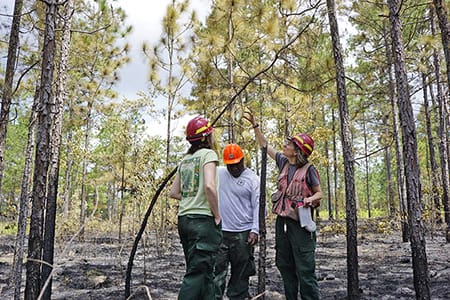
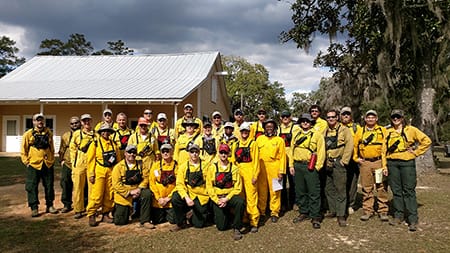
The Longleaf Legacy landscape prescribed fire burn team arm of Wildland Fire Science works directly with landowners and partners to effectively put fire on the ground and promote prescribed fire throughout the region.
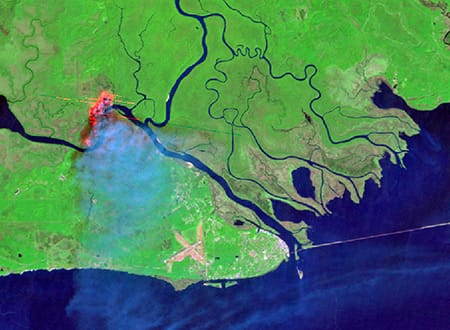
Tall Timbers is leading an effort to map fire regimes at the landscape scale. Staff work with numerous agencies to evaluate fire records and satellite imagery to build this critical conservation database. https://skfb.ly/6DqOY
Tall Timbers hosts the Prescribed Fire Science Consortium, a national network of researchers and managers who promote integrated research and management to advance next generation tools for fire practitioners. https://arcg.is/1DSjDT
We are linking physics and field observations to understand the fluid dynamics of fire behavior surface fire regimes. Our work combines field observations using advanced thermal imaging techniques, laboratory studies, and coupled fire-atmospheric modeling to help managers improve outcomes of managed fire regimes.
Selected Publications authored by Wildland Fire Science staff.
Staff and researchers support Federal fire training by serving as a cadre for NWCG training courses, ranging from basic wildland fire to advanced fire effects.
(PFTC) specializes in training fire fighters the principles and techniques of prescribed fire through practical hands-on experience. https://www.fws.gov/fire/pftc/
Private land owners are the largest source of prescribed fire in the country. These land owners and the culture of fire that was maintained by them during decades of suppression are a part of why Tall Timbers is a world-wide center for prescribed fire science. Workshops and fire training are a critical focus of the Longleaf Legacy Landscape Burn Team and our support of the Georgia Forestry Commission Prescribed Fire Center in Marion County.
The conserved lands of the Greater Red Hills region are found on working, income-producing properties that support agriculture, forestry, and recreational hunting. These properties contribute $272 million annually to local economies and support 2,300 jobs. [link to Planning & Advocacy section] The landowners’ strong stewardship ethic preserves their working lands while replenishing drinking water supplies, protecting water quality, and providing wildlife habitat for dozens of rare and endangered species. Tall Timbers’ conservation easements on these working properties encourage landowners to retain their traditional livelihood by keeping farms in family ownership.
Home to world-class wild quail populations, the Greater Red Hills region contains the largest concentration of gamebird preserves in the United States. These preserves also support the largest community of Red-cockaded woodpeckers on private lands. Indicators of high quality habitat found here include the gopher tortoise, Bachman’s sparrow, fox squirrel, and many amphibians. Tall Timbers’ conservation easements identify and protect the critical habitats of these species.
The region also boasts outstanding aquatic resources. Large river systems, like the Flint/Apalachicola, Ochlockonee, and Aucilla, flow from Georgia and feed into the Gulf of Mexico to support some of the world’s most productive estuaries. Large disappearing sinkhole lakes, like Iamonia, Miccosukee, and Jackson, provide habitat for an array of aquatic species and migratory birds. Tall Timbers’ conservation easements protect these vital watersheds and wetlands that are the lifeblood for the ecological health of the region.
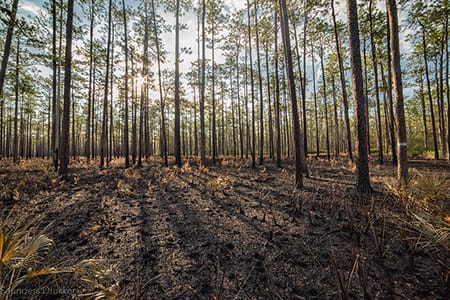
Once dominated by longleaf pine, our pine woodlands support abundant wildlife and local economies. These forests need prescribed fire to stay healthy. Herbert L. Stoddard and his associates Ed and Roy Komarek were pioneers in this emerging scientific field during the mid-20th century. Tall Timbers continues that legacy with applied research on prescribed fire and land management. Today, there is a tremendous need to expand prescribed fire use beyond the Red Hills to ensure ecosystem health and reduce wildfire risk. Additionally, Tall Timbers uses conservation easements to permanently protect private woodlands while balancing the need for economic return from selective timbering.


 The festivities kicked off with a cocktail reception where guests perused auction items. This year’s live auction featured a first of its kind shotgun—the Tall Timbers Longleaf Gun—for which Tall Timbers commissioned Scottish bespoke gun maker David McKay Brown to create. The gun is a 28-gauge round-action side-by-side, embellished with a classic scroll intertwined with longleaf pine motifs (cones, needles, foliage). The engravings also include a still life of bobwhite designed by collaborating artist C. D. Clarke. Italy’s Mirko Agnellini engraved the gun.


 On October 26, 2015 the U.S. Environmental Protection Agency (EPA) released its review of the proposed Sabal Trail natural gas pipeline. This pipeline is slated to begin in Alabama and run through southwest Georgia for nearly 200 miles before entering Florida, terminating in Osceola County. Of particular interest to Tall Timbers is the portion of the pipeline route that winds its way through Dougherty, Colquitt, and Brooks Counties, avoiding most quail hunting properties while directly impacting several others.

 In my quest to learn more about this exotic plant, I recently rode an airboat with FWC Biologist, Derek Fussell, on Lake Iamonia in Leon County, Florida to look for Oxycaryum. With little effort we found it in plentiful amounts. It is prevalent along the shoreline, and was mostly seen in the mud flats at the edge of the maidencane and the water. Fussell is mapping the Oxycaryum and having crews spray it when the plant is actively growing. Fussell said, “They have had good results with a combination of 2-4,D and Diquat together and have just this year sprayed with glyphosate (7.5 pints/acre) and Flumioxazin (4oz/acre) and thus far the results look good.” In 2013-2014, 1,614.34 acres were treated in Florida public waters. This includes 335 acres in Lake Iamonia, 26 acres in Lake Jackson, and 141 acres in Lake Miccosukee.
 Land Trusts throughout the nation are making a big push for Congress to pass the Conservation Easement Incentive Act (S.330). Currently the bill has 49 Senate cosponsors — evenly divided between Democrats and Republicans — including support from Senators Bill Nelson of Florida and Johnny Isakson of Georgia.