Amendment 1 Sponsors Gather in Tallahassee to Celebrate 5-Year Anniversary; Encourage Legislature to Fully Fund Florida Forever
This time five years ago, Florida voters overwhelmingly approved the Water and Land Conservation Amendment (“Amendment 1”) and effectively added it to the state constitution. With about 75% approval across the state, Florida voters sent a clear message they wanted dedicated funds to protect Florida’s water, wildlife habitat, natural areas, and parks, now and for future generations.
With a straightforward allocation of 33% of documentary stamp taxes directed to the Land Acquisition Trust Fund, the self-implementing constitutional mandate was intended to restore funding to existing programs like Florida Forever, Florida’s Community Trust Program, The Rural & Family Lands Protection Program and Everglades restoration.
While protecting Florida’s land and water was the #1 goal of the ballot initiative, the campaign was a testament to the power of democracy. Unfortunately, the Florida Legislature has redirected most of the annual funding to support agency operational expenses previously covered by general revenue.
Where do we go from here? The passage of Amendment 1 was a monumental success, but the work isn’t done. The Florida Legislature must finish the job:
Florida’s population is growing and our one-of-kind natural resources are coming under immense development pressure. Legislators need to protect these key tracts before they are lost forever. The best way to do that is by fully funding Florida Forever and the other land conservation programs.
Florida Forever was signed into law by Governor Jeb Bush in 1999, reauthorized by the Florida Legislature in 2008, and until 2009 received $300 million annually. When funded, Florida Forever was highly successful in acquiring lands that protect the water quality of rivers, lakes, and springs, wildlife habitat, and provide healthy outdoor recreation opportunities for all Floridians. We want to see Florida Forever funding restored and take full advantage of this tried-and-true conservation program.
Many priority tracts identified for conservation under Florida Forever remain unprotected and are vulnerable to poorly planned development. If we do not fully fund Florida Forever now, we stand to lose two million acres of precious water and land, including outstanding lands in the Red Hills region.
Tall Timbers has joined other conservation, ranching, forestry and sportsmen’s communities to collectively support Florida’s proud tradition of land conservation funding. We urge you to take action now by contacting Governor DeSantis and your Florida state representatives to support full funding of Florida’s land conservation programs.
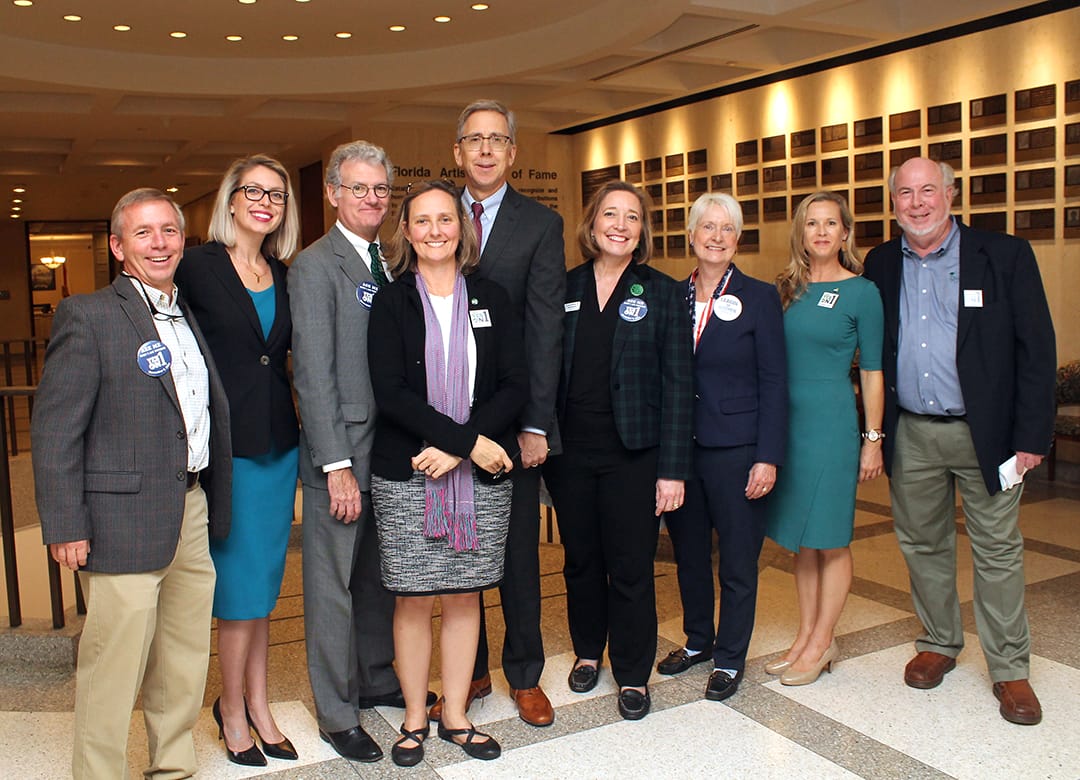
PHOTO CAPTION: Tall Timbers staff Shane Wellendorf (L) and Kevin McGorty (R) join other conservation leaders in celebration of the 5th anniversary of Amendment 1 at the Florida Capitol. Photo courtesy Florida Conservation Voters, who sponsored the press conference.
Tall Timbers has been busy this fall with fundraising, outreach and education events. Take a look at the events and the event sponsors who made it possible.
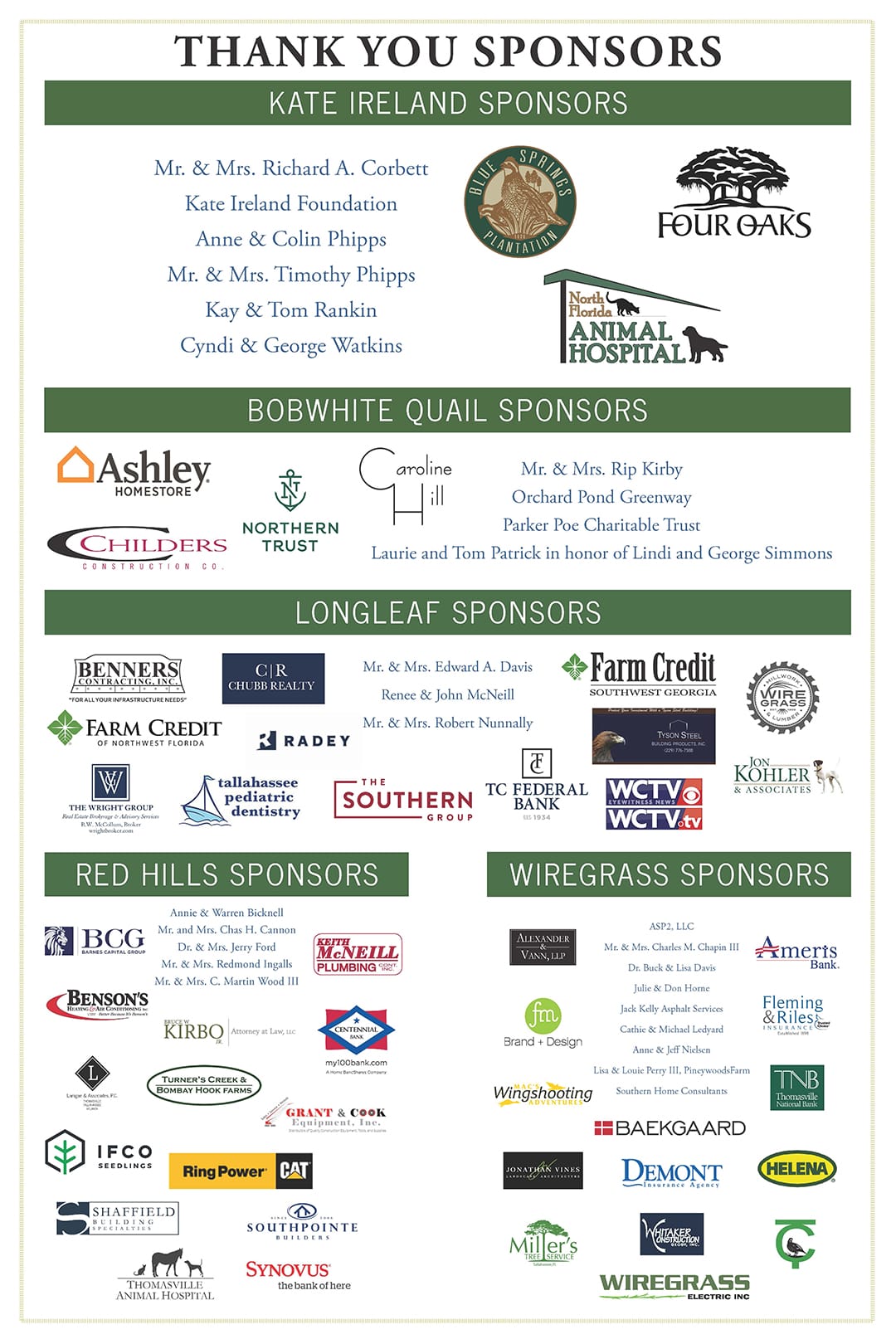
Thank you to all our Kate Ireland Memorial Dinner & Auction Sponsors, Attendees and Bidders. The evening was a huge success with over 300 attendees, 130 auction items, and new fundraising records set for the Tall Timbers Foundation. What a great privilege it was to honor Mr. Gene Phipps, a true steward of the Red Hills Region. Be sure to check our website for details on next years event!
Economics Trade-offs and Quail Management
Field Workshop
It was a hot and dusty September day in the woods in central Georgia, but it fit with the theme of making decisions and evaluating trade-offs. For those deciding to brave the heat and dust, the field tour provided a “wealth” of knowledge with a change in pace compared to our typical field days. Participants learned about implementing quail management on a dime by nickeling economic return, while managing multi-use objectives. Bobwhite quail remained a highlight and focal species, but not without first weighing the costs associated with operating expenses, balanced by revenue streams to remain in the black on a shoe-string budget. We greatly thank Queensborough National Bank and Trust for hosting the field day and workshop at Belmont Plantation!
Red Hills Fall Field Day
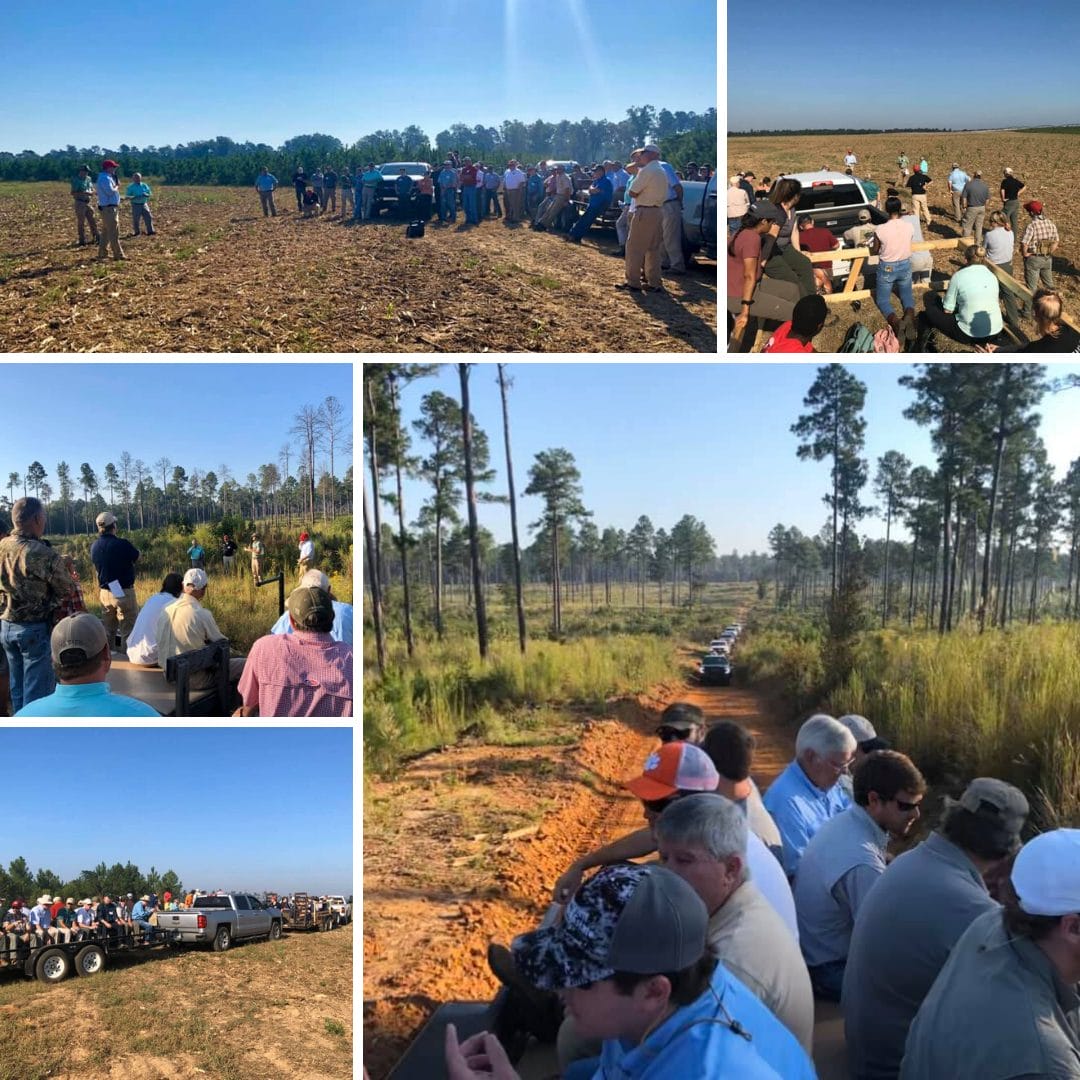
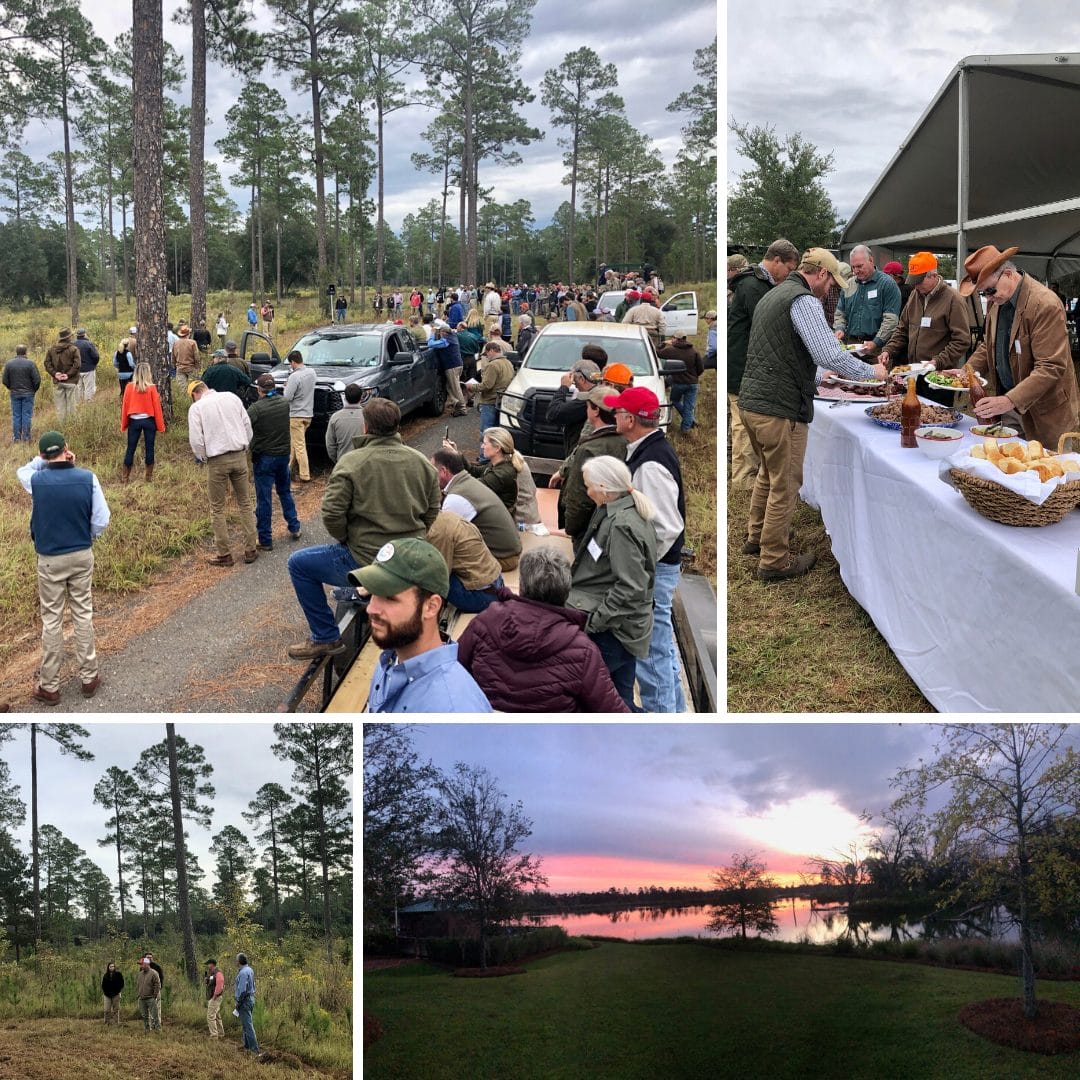
The 32nd Annual Fall Field Day hosted by Four Oaks Plantation provided more than 275 land owners, managers, and biologists an amazing opportunity to learn what plantation life is all about, but not without first leaving folks with a true understanding of what keeping up with the Jones’ means. A wagon tour of the property afforded breathtaking views of fishing lakes, duck ponds, and quail woods, as well as a glimpse into what world-class management looks like in the Red Hills. The field day was diverse—epitomizing the vast interests of the landowner and showcasing how true dedication, and a conservation ethic provides a rich and eclectic wildlife mecca in a quail-friendly way. As such, a wide array of topics was covered on the tour, where attendees heard about fisheries, deer, turkey, waterfowl, and quail management. Truly a marvelous day in the piney woods on a marvelous property in the Red Hills. Thank you Four Oaks!
South Carolina Bobwhite Funding Partnership Event & Auction
Central Florida Fall Field Day
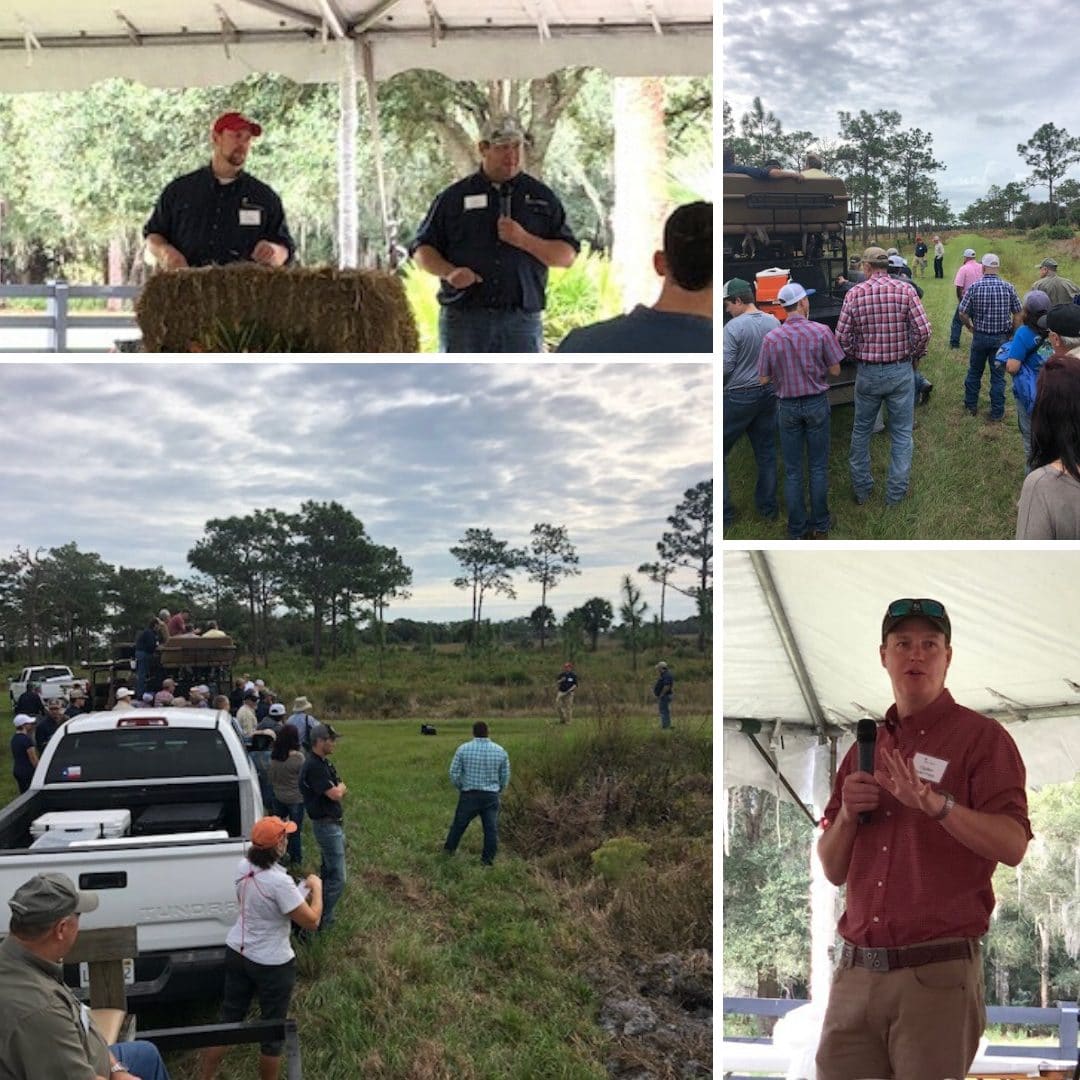
The rangelands of central Florida provide some of the most unique and ubiquitous restoration potential left in the historic range of Northern Bobwhite Quail. Much like the area surrounding Tallahassee, Thomasville and Albany areas, thousands of acres of undeveloped land exist in central and south Florida. But, unlike the plantation belt of the Red Hills and Albany regions, the ranch lands in central and south Florida present unique challenges, such as overgrazing and water inundation, when managing for bobwhite. In just 3 years, Escape Ranch has experienced a 127% increase in bobwhite abundance, and participants at the field day learned how this was manufactured while touring through palmetto flatwoods, pastureland, and piney woods. In true central Florida fashion, the field tour was abridged by pop-up thundershowers, forcing the wagons to high-tail it back to the tent where we finished out the day. Rain and shine—it was a great day to be in the flatwoods and talking all things quail! A huge thanks to Escape Ranch owners and staff for hosting this magnificent day in the field in central Florida!
New study —
What plants return when fire is re-introduced?
It has long been know that when fire is excluded from fire-dependent pine communities of the southeastern U.S. for more than about a decade, the herbaceous community all but disappears and gives way to woody vegetation. But is it gone forever? It has been casually observed that when prescribed fire is re-introduced into long fire-excluded native pine communities, many native species suddenly appear, seemingly too quickly to be a result of seed dispersal from other native sites. It seems that at least some native plants survive either as root stock or seeds in the soil, but this phenomenon of plant community re-emergence has hardly been studied in pine communities.
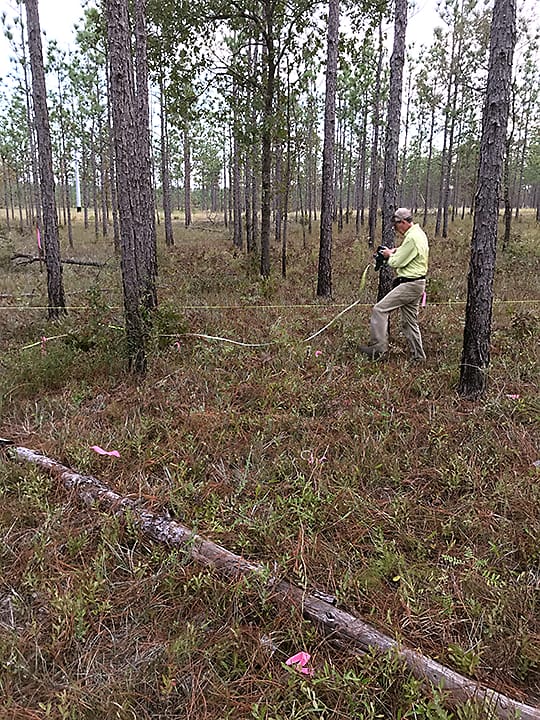
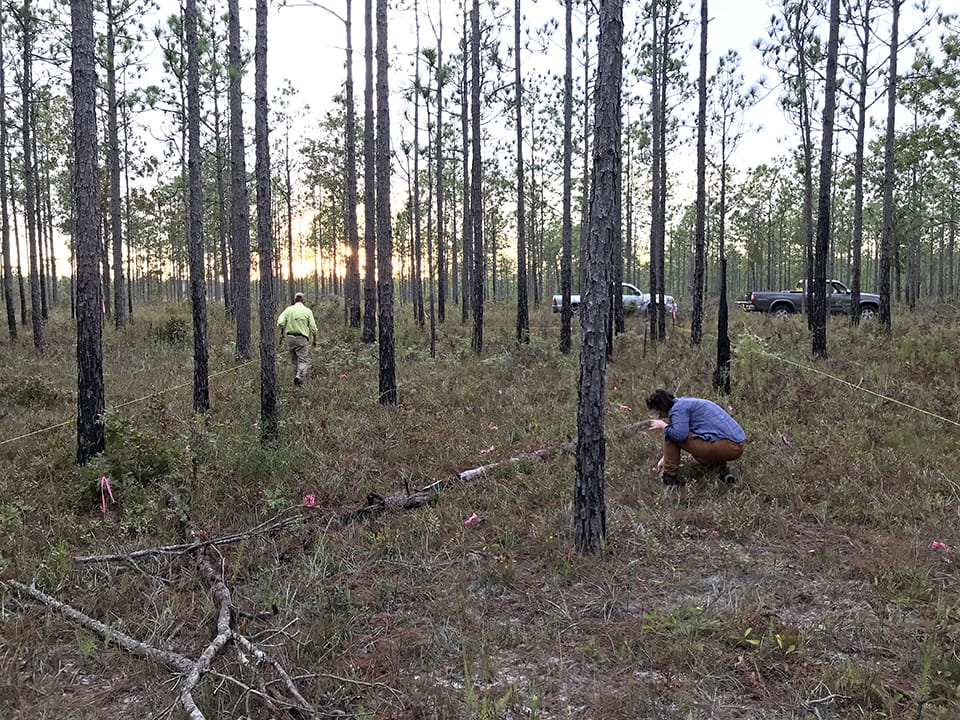
This fall the Fire Ecology Program began a study to quantify re-emergence of native plants upon re-introduction of fire to long fire-excluded native pine communities. Our approach has been to find such locations where prescribed fire is planned in the near future, set up pre-fire plots and census the vegetation, collect soil samples and try and germinate any seeds that are still viable, and then wait for fire to begin systematically observing the results. When new plants are found, we plan to excavate a subsample of them to determine whether they re-sprouted from surviving root stock or else appear to have germinated from seeds.
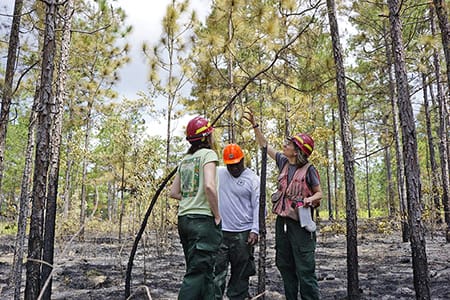
Fire Ecologist Cinnamon Dixon in a pre-fire plot in long fire-excluded pine flatwoods on the St. Joseph Buffer Preserve near Port St. Joseph, Florida.
So far we have established plots in pine flatwoods of the St. Joseph Buffer Preserve, Plank Road State Forest, and the Florida State University Coastal and Marine Laboratory, pine sandhills of Natural Bridge State Park and Ordway-Swisher Biological Station, and a mountain longleaf site near Weogufka, Alabama. We expect that the results of the study will reveal that, even if native pine communities have been fire-excluded for decades, there may be more to their biodiversity than meets the eye, and it may not be too late to bring back with fire.
Morgan Varner and Kevin Hiers were tapped by the Joint Fire Science Program to lead a national strategic workshop in Salt Lake City, UT (Oct 28-30) on how to improve and institutionalize scientist-manager co-production of actionable fire science. Scientist-manager collaboration or “co-production” is a new buzz word for how Tall Timbers and a few others have generated actionable science in the past. Co-production as a research model involves scientists and managers collaborating from idea conception, experimental design, data collection, interpreting results and transitioning the results to on-the-ground outcomes.
Co-production between fire managers and scientists is a method used by Tall Timbers since its inception and is now being embraced by the broader fire science community. Photo by Ellen Eberhardt, US Forest Service.
The workshop’s participants were scientists from federal agencies (USDA Forest Service, US Geological Survey), universities (Idaho, Utah State, Northern Arizona, Oregon State, Alaska), the Southern Fire Exchange, NGOs (Center for Natural Lands Management), and managers from across federal and state agencies (National Park Service, USDA Forest Service, US Fish & Wildlife Service, Bureau of Land Management, Bureau of Indian Affairs, and New Jersey Fire Service), the Joint Fire Science Program, and Australia’s Bushfire & Natural Hazards CRC.
This team is working on a report from the workshop that charts business models for the Joint Fire Science Program and other extramural funders. Another intended output is identifying how co-production can work within agencies and in current and future manager-scientist collaborations. A manuscript on the challenges and opportunities related to coproduction in fire science is underway with the participants. Tall Timbers was recognized as a national leader in this approach and will lead these efforts.
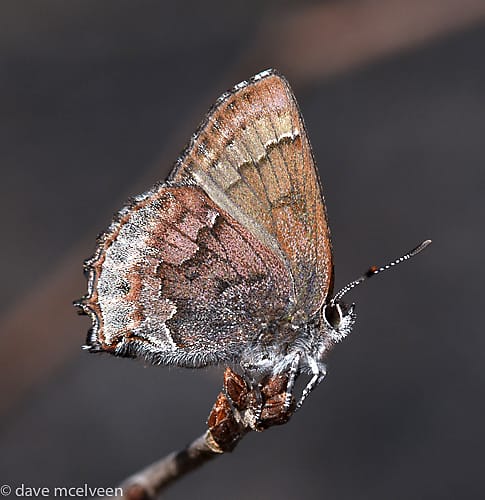
The seeds are sown, and now we eagerly await the results of a new experiment aimed at restoring habitat for a rare butterfly. The Frosted Elfin butterfly has faced range-wide declines for decades from pesticides, lack of prescribed fire, and overall habitat loss. But hope for the Frosted Elfin is not lost, as research takes a new, greener direction.
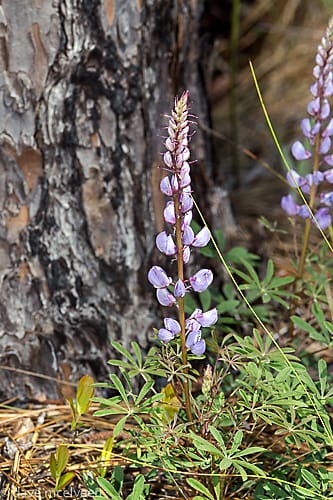
Sundial Lupine in bloom
Associate researcher with the Stoddard Bird Lab, Dave McElveen, has spent years investigating the butterflies and has turned his attention to the plant that this species needs the most. The Sundial Lupine is a modest yet beautiful flower and is the only host plant for the Frosted Elfin’s larvae. The lupine however, is sensitive to hardwood encroachment from the lack of disturbances such as prescribed fire. When an area isn’t burned for over four years or more, the lupine declines and with it, the Frosted Elfin.
“So once the lupine is gone, how do we get it back?” asks Dave, “and what is the best way to propagate and establish lupine to the areas where it once was, so that we can bring back the Frosted Elfin?” After all, the flower stands at a little over a foot tall so dispersing its bulky seed across the landscape is a long and arduous endeavor. It would be easier if people could disperse the seeds instead or maybe even plant a piece of the lupine itself. These plants have a rhizome, an underground root that grows parallel to the surface. These long roots occasionally shoot up new stems as it slowly creeps along the ground. Once the rhizome is long enough it can be divided into multiple plants that can then be moved to other locations. So which is better? Planting seeds or planting rhizome cuttings?
Information on how to grow and plant this curious flower is few and far between, so Dave acquired the help of Tall Timbers’ resident horticulturalist, Jenny Taylor. With Jenny’s green thumb and sage advice, they developed a plan to see which planting method is best but also when to plant. Each plant has its own particular germination time, which typically corresponds to fall or spring. So to solve that, seeds and rhizomes will be planted in fall and spring, creating four study plots total.
Lucky for Dave and Jenny, Apalachicola National Forest’s Munson Hills Unit provides an ideal study area as it’s home to one of the largest populations of lupine and Frosted Elfin’s left today. This provides a source of seeds and rhizomes from a robust population to use for the project, which will require planting about 150 of these native flowers.
This fall season marks the first stage of planting for the project. With the help of Bird Lab Woodpecker Specialist Rob Meyer, the first seeds were sown into the soil at the study plot in late October this year. Using a small weeder and with some mild back discomfort, each seed was gently pushed into the sandy soil by hand. Later, in early November, Dave and Jenny hope to find rhizomes to plant by going to patches of lupine that had bloomed earlier in the year. This flower however, recedes after it blooms in spring, and for most of the year lies dormant below ground. This means Dave and Jenny will need to go on a subterranean scavenger hunt to find the lupine in its dormant state. Once they collect the cuttings, they will return to the plots to hand sow each rhizome—just like they did for the seeds.
Dave measures where to place each seed in the plot
Dave and Jenny planting Lupine at sunset
Like most gardening, reaping the benefits will take time. The second half of the plantings will take place next spring, but perhaps by then, some of these fall plants may reach the surface to tell us how they did. Until spring, we will remain hopeful and wait patiently for the first flowers to emerge. The information learned from these plots at Munson Hills will help to inform land managers across the region on how best to reunite this once common duo of flower and butterfly.
The M-CORES program, which includes the proposed Suncoast Connector Toll Road in Jefferson County, passed through the Florida Legislature at breakneck speed with little review or analysis. Tall Timbers has a number of concerns given the potential for significant and wide spread impacts. These include fragmenting public and private conservation lands, robbing business from Main Street Monticello, impacting our rivers and other water resources, and making prescribed fire more difficult and costly.
Join us in asking the Jefferson County Board of County Commissioners to OPPOSE the Suncoast Connector toll road and its path through Jefferson County.
Take action now with our easy email form.
Send an email to all five Jefferson County Board of County Commissioners with one click!
Selected Publications authored by Wildland Fire Science staff.
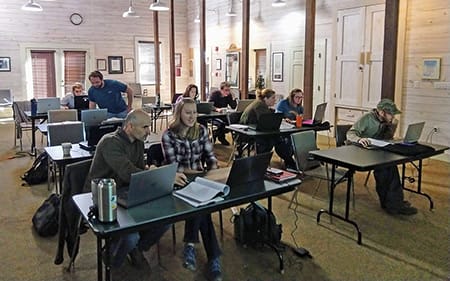
Educating and guiding the next generation of fire researchers and managers is a key goal of Wildland Fire Science and a resource for testing new ideas in fire research.
Tall Timbers hosts the Prescribed Fire Science Consortium, a national network of researchers and managers who promote integrated research and management to advance next generation tools for fire practitioners. https://arcg.is/1DSjDT
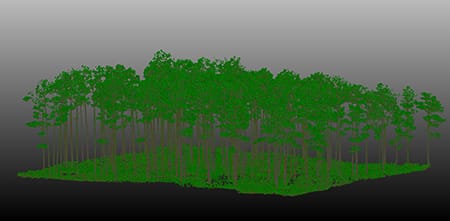
Working with partners in the Prescribed Fire Science Consortium, the program is building nexgen 3-D fuel beds using terrestrial LiDAR and novel sampling techniques to power new fire behavior models for prescribed fire managers. This work links to Tall Timbers work in wildlife habitat usage and ecological forestry.
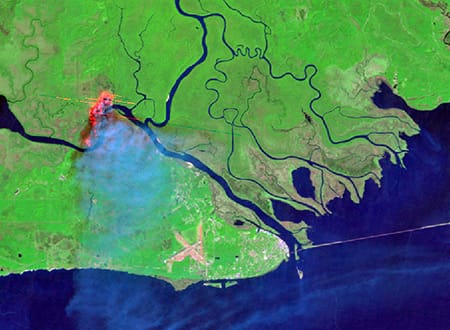
Tall Timbers is leading an effort to map fire regimes at the landscape scale. Staff work with numerous agencies to evaluate fire records and satellite imagery to build this critical conservation database. https://skfb.ly/6DqOY
We are linking physics and field observations to understand the fluid dynamics of fire behavior surface fire regimes. Our work combines field observations using advanced thermal imaging techniques, laboratory studies, and coupled fire-atmospheric modeling to help managers improve outcomes of managed fire regimes.
Burn prioritization modeling seminars and fire modeling tools are supported by Wildland Fire Science to train managers in the important planning stages of prescribed fires.
The conserved lands of the Greater Red Hills region are found on working, income-producing properties that support agriculture, forestry, and recreational hunting. These properties contribute $272 million annually to local economies and support 2,300 jobs. [link to Planning & Advocacy section] The landowners’ strong stewardship ethic preserves their working lands while replenishing drinking water supplies, protecting water quality, and providing wildlife habitat for dozens of rare and endangered species. Tall Timbers’ conservation easements on these working properties encourage landowners to retain their traditional livelihood by keeping farms in family ownership.
Home to world-class wild quail populations, the Greater Red Hills region contains the largest concentration of gamebird preserves in the United States. These preserves also support the largest community of Red-cockaded woodpeckers on private lands. Indicators of high quality habitat found here include the gopher tortoise, Bachman’s sparrow, fox squirrel, and many amphibians. Tall Timbers’ conservation easements identify and protect the critical habitats of these species.
The region also boasts outstanding aquatic resources. Large river systems, like the Flint/Apalachicola, Ochlockonee, and Aucilla, flow from Georgia and feed into the Gulf of Mexico to support some of the world’s most productive estuaries. Large disappearing sinkhole lakes, like Iamonia, Miccosukee, and Jackson, provide habitat for an array of aquatic species and migratory birds. Tall Timbers’ conservation easements protect these vital watersheds and wetlands that are the lifeblood for the ecological health of the region.
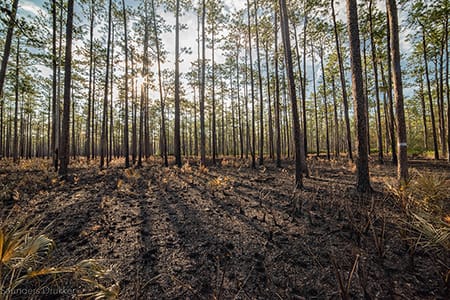
Once dominated by longleaf pine, our pine woodlands support abundant wildlife and local economies. These forests need prescribed fire to stay healthy. Herbert L. Stoddard and his associates Ed and Roy Komarek were pioneers in this emerging scientific field during the mid-20th century. Tall Timbers continues that legacy with applied research on prescribed fire and land management. Today, there is a tremendous need to expand prescribed fire use beyond the Red Hills to ensure ecosystem health and reduce wildfire risk. Additionally, Tall Timbers uses conservation easements to permanently protect private woodlands while balancing the need for economic return from selective timbering.
Tall Timbers hosts the premier fire technology transfer organization—the Southern Fire Exchange. This JFSP funded effort helps connect research to management through webinars, workshops, and support of the Prescribed Fire Science Consortium.
The Longleaf Legacy landscape prescribed fire burn team arm of Wildland Fire Science works directly with landowners and partners to effectively put fire on the ground and promote prescribed fire throughout the region.
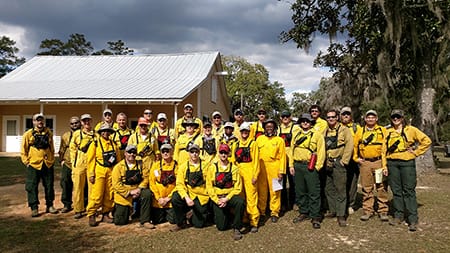
Staff and researchers support Federal fire training by serving as a cadre for NWCG training courses, ranging from basic wildland fire to advanced fire effects.
(PFTC) specializes in training fire fighters the principles and techniques of prescribed fire through practical hands-on experience. https://www.fws.gov/fire/pftc/
Private land owners are the largest source of prescribed fire in the country. These land owners and the culture of fire that was maintained by them during decades of suppression are a part of why Tall Timbers is a world-wide center for prescribed fire science. Workshops and fire training are a critical focus of the Longleaf Legacy Landscape Burn Team and our support of the Georgia Forestry Commission Prescribed Fire Center in Marion County.