Tall Timbers working to protect the Red Hills from Florida’s massive toll road plan
Tall Timbers and many other conservation organizations are working overtime to understand and respond to the ramifications of Florida Senate bill 7068, which authorized the creation of the Multi-Use Corridors of Regional Economic Significance program (M-CORES). The ultimate outcome of this program could be the building of three new toll roads spanning approximately 340 miles across Florida. This would be the largest highway expansion in Florida since the President Eisenhower Interstate Highway System of the 1950s.
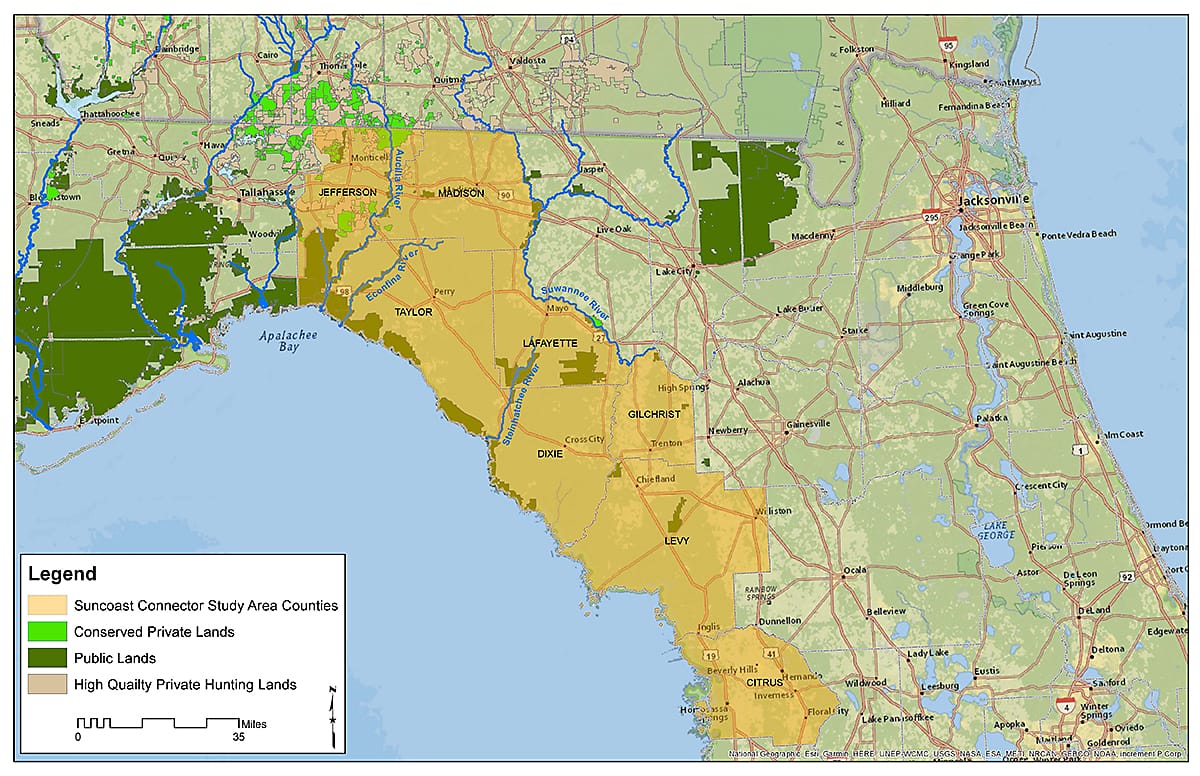
Of greatest concern to Tall Timbers is the proposed Suncoast Connector toll road, which would connect with other toll roads and the Florida Turnpike in central Florida and extend northward through Jefferson County in the Red Hills. Tall Timbers believes this proposed toll road will encourage sprawling growth in rural communities, fragment or destroy private and public conservation lands, and adversely affect critical wildlife habitat in the Red Hills region and other rural landscapes.
Suncoast Connector Counties
Tall Timbers is proactively responding to this threat by: hiring a consulting group to help represent our conservation interests; conducting research on key environmental, economic, and cultural resource issues to influence the outcome of this process; engaging with dozens of conservation organizations around the state; and working closely with landowners, other interested individuals, and partner organizations in Jefferson County and other Red Hills communities who are concerned about this sweeping proposal.
On August 1, the Florida Department of Transportation appointed a 42-member Suncoast Connector Task Force to evaluate design features and the need to acquire conservation lands that may mitigate the impact of project construction on the quality and quantity of water resources, wildlife habitat, and farmland. The Task Force consists of representatives from numerous state agencies, transportation organizations, local governments, and various stakeholder groups (economic development, trucking, farming, utilities, and the environmental community).
Tall Timbers will closely monitor and interact with the Task Force throughout its 14-month term to inform members about the Red Hills region and the Big Bend, where so much private and public investment has already permanently protected large, contiguous blocks of forestland and sensitive natural resources.
Ultimately, the Task Force will summarize the results of its analysis in a final report to the Governor, Legislature, and the Secretary of the Department of Transportation by October 1, 2020.
Tall Timbers’ Board recognizes the seriousness of this threat and is engaged in an aggressive fundraising campaign. If you would like to support our effort, please contact Crystal Davis Rice at 850-545-2162 or email Crystal. For additional information about this issue, contact Neil Fleckenstein at 850-728-6235 or email Neil.
Safe Harbor Program Workshop Planned in the Albany Region
Private properties provide habitat for over 90% of the rare species found in the United States. Rare species on private lands have often led to some contentious battles, but a number of new programs now exist that benefit rare species and property owners collectively.
The Safe Harbor Program is one such program enjoying great popularity in the Red Hills region. The program is designed to promote growth of the imperiled Red-cockaded Woodpecker without infringing on private property rights. Over 140,000 acres are now enrolled in the program in the Red Hills region. The Red Hills woodpecker population has grown by about 15% as a result, and provided enhanced security for this iconic symbol of southern forests.
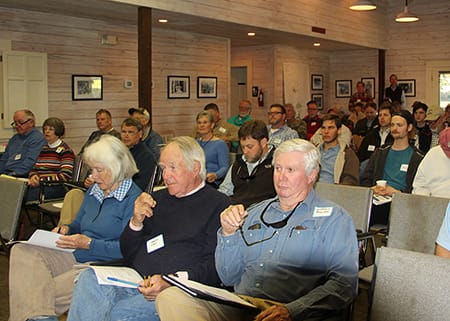
Tall Timbers is partnering with the Jones Ecological Research Center and Georgia DNR to host a special workshop to introduce landowners in the Albany region to the Safe Harbor Program. The number of reasons landowners sign up for the program are as varied as the landowners themselves. The goal of the workshop is to outline program mechanics through a field tour and short presentations. The many positives that often accompany this rare woodpecker will also be discussed.
The workshop takes place at the Jones Center at Ichuaway on Thursday, October 10 from 9-1. Registration is required to help plan for logistics and distribute materials beforehand. To register, please email Amy Allen; or call 850-893-4153 x249.
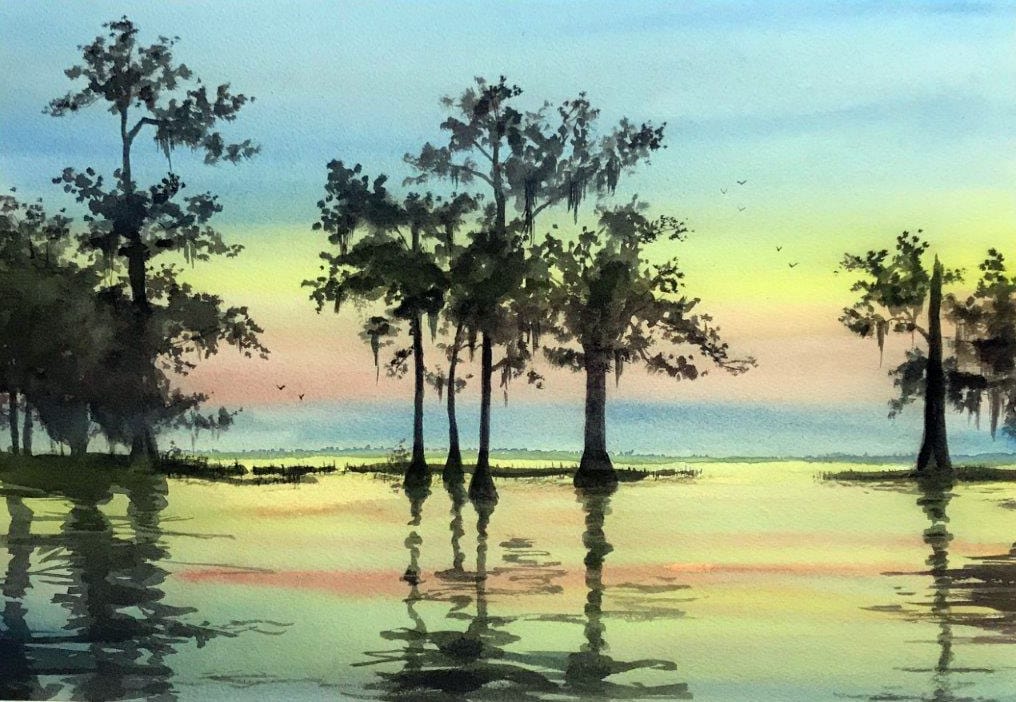
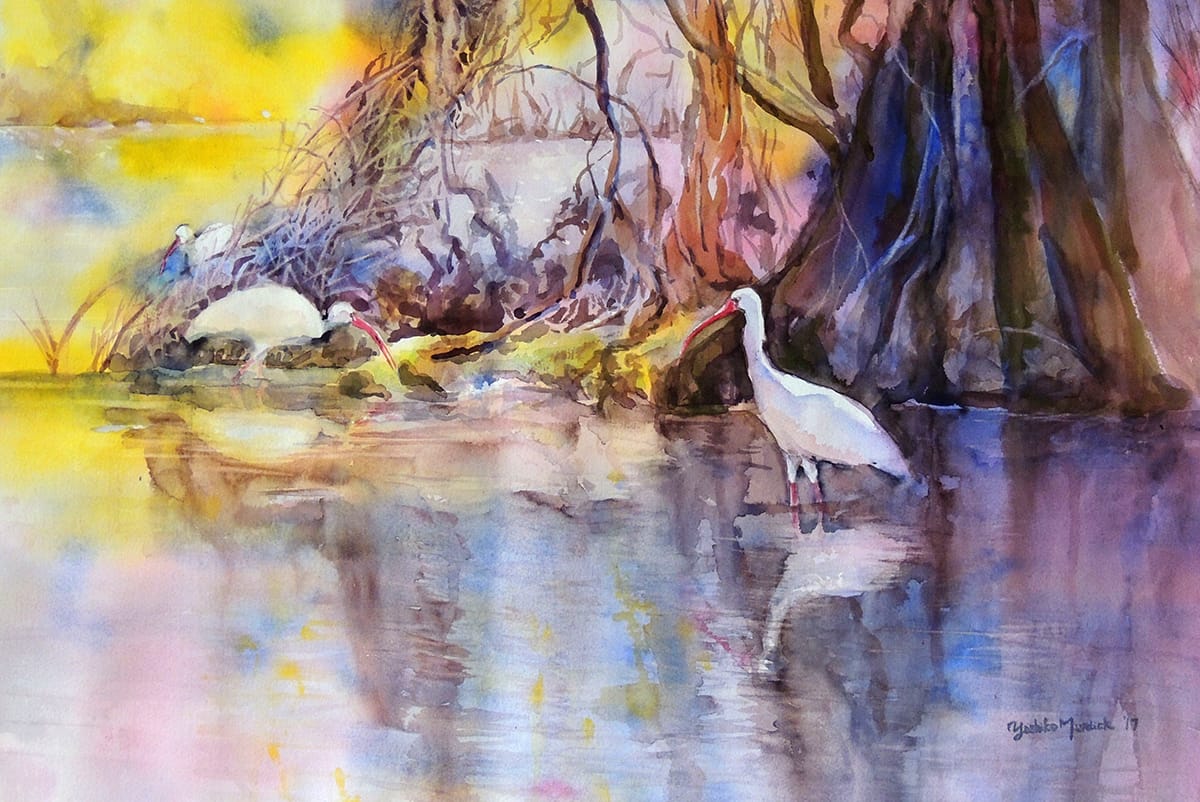
A new watercolor exhibit, Scenes from the Red Hills VI, opens at the Webster Gallery, September 8 and will be up until November 22. The artist represented are members of the Tallahassee Area Watercolor Society. The Webster Gallery is located in the historic Beadel House at Tall Timbers. The public is invited to view these paintings every Tuesday and Thursday afternoons from 2:00 ‒ 4:00, and Sunday afternoons: September 8, October 6, & November 3. Special tour groups can be arranged by contacting Juanita Whiddon at 850-566-3390.
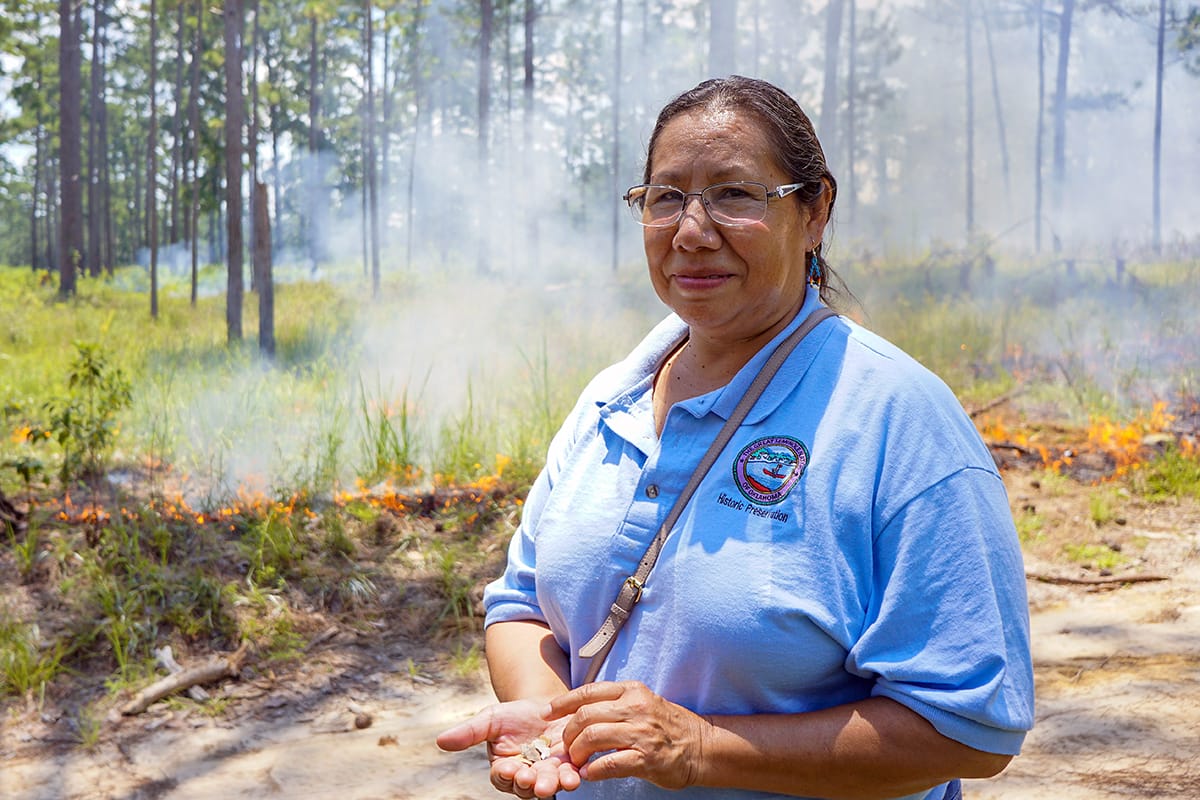
Brigita Leader, Seminole Nation of Oklahoma Historic Preservation Office, pauses during a prescribed fire to share the stone flakes found at Tall Timbers.
Reconnecting to Land and Fire
This summer Tall Timbers was honored with the opportunity to welcome members of the Seminole Nation of Oklahoma back to their ancestral lands and share the latest in prescribed fire science. This pairing of sacred places and modern science is an intentional approach detailed by Theodore Isham and Brigita Leader in a grant awarded by the Cultural Resources Fund to the Seminole Nation of Oklahoma. Prescribed fire was a natural topic for the project, given the deep connection between Native Americans and stewardship of the land with fire.
Eight college-aged participants traveled with staff from the Seminole Historic Preservation Office to join Tall Timbers for a series of field activities, lectures, and cultural exchange. The goals of our guests included experiencing their ancestral landscape and learning more about science, technology, engineering, and math (STEM) practices with a connection to the traditional identity of the Seminole Nation. This concept that traditional identity and science are not mutually exclusive was a core concept of the visit.
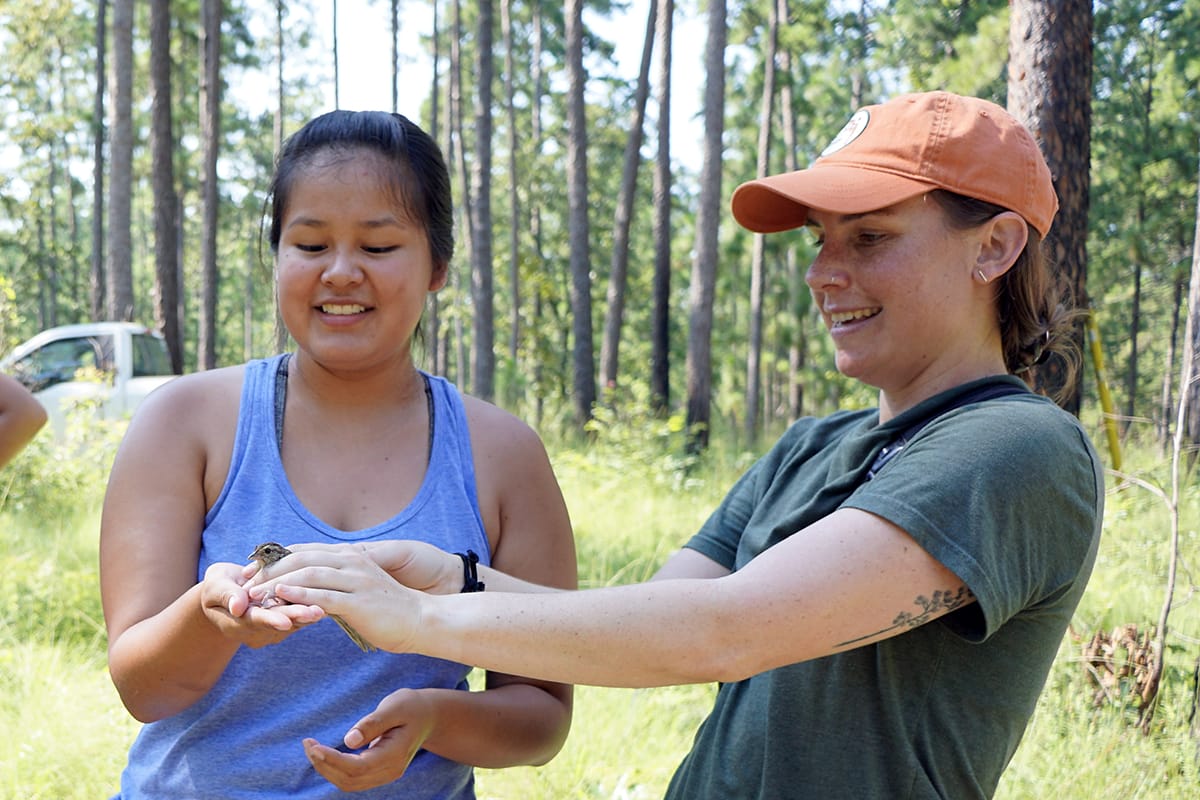
Mary Mack Gray, Tall Timbers Stoddard Bird Lab, transfers a Bachman’s Sparrow to, Caitlin Fixico Seminole Nation of Oklahoma, for release after banding and measuring.
After watching prescribed fire in a longleaf pine-wiregrass restoration area at Tall Timbers, the students started sharing stories about family members back in Oklahoma who continue the practice of burning vegetation in their yards and ceremonial grounds. One of the students, Caitlin Fixico, laughed as she explained that “I didn’t really think about it being good for the environment until now, it’s just what Auntie has always done.”
The group concluded their stay in the Tallahassee area with a half-day float trip down the Wacissa River on kayaks with the always helpful guide services of Harry Smith from Harry Smith Outdoors. David Ward from the Aucilla Research Institute joined to share more about the profound history of humans in the Aucilla-Wacissa basin.
The Aucilla Research Institute has been a major proponent of research at the Page-Ladson site that has yielded explicit evidence of human habitation, including a stone knife and mastodon tusk, dated at over 14,500 years old. Participants were struck by the beauty of this river and the remarkable history of native people there.
The weight of human history and ecological assets in the Aucilla-Wacissa basin also drive Tall Timbers land conservation work in the area. Current projects include promoting alternatives to a proposed toll road and seeking funding through Florida Forever for a conservation easement that would permanently protect the privately owned Page-Ladson cultural site and the natural resources surrounding it.
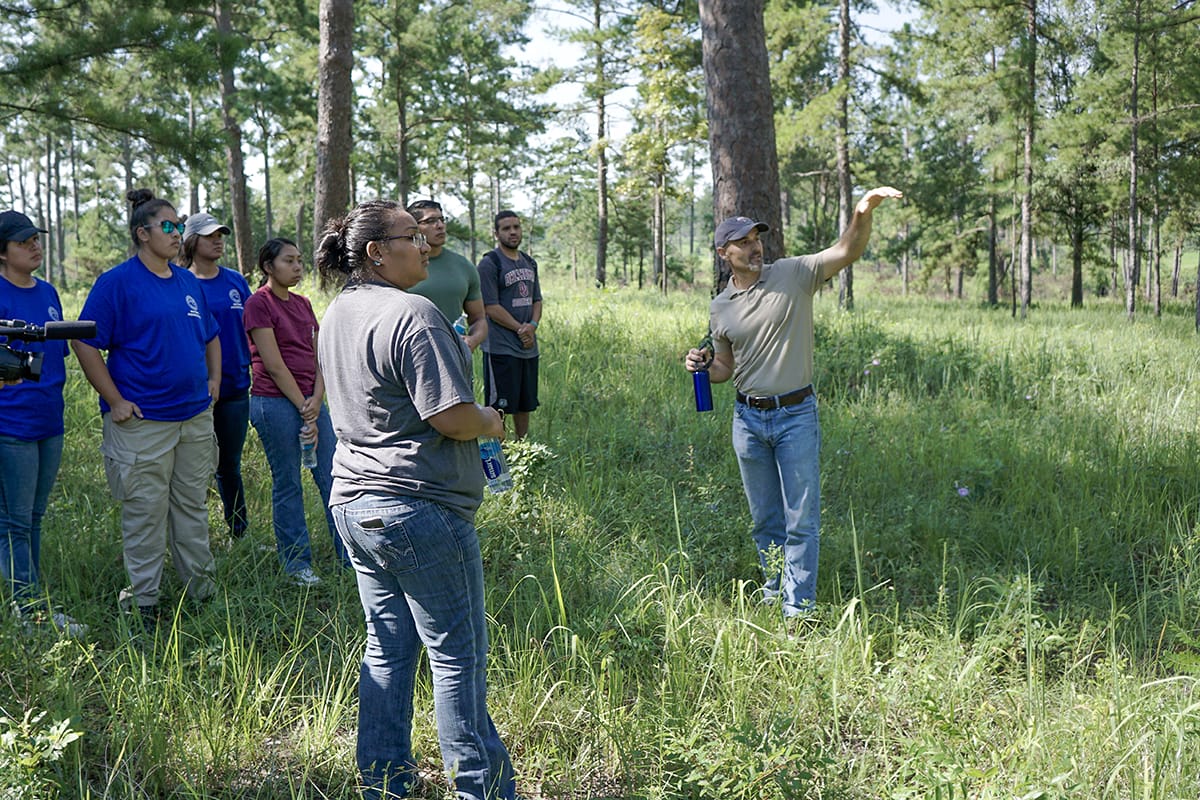
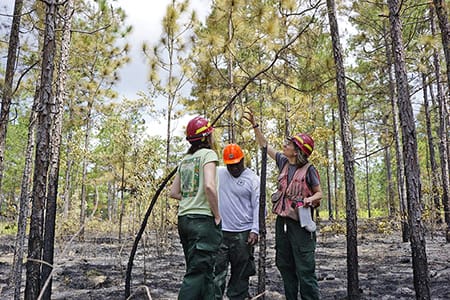
Kevin Hiers, Tall Timbers Wildland Fire Science Program, leads a field discussion on prescribed fire effects.
As with so many of our projects, a team of Tall Timbers staff members pulled together to deliver a quality program. Thanks to Kevin Hiers, Dr. Eric Rowell, Scott Pokswinski, La’Portia Perkins, Dr. Kevin Robertson, Rob Meyer, Mary Mack Gray, Matt Snider, and Brian Wiebler. A special thanks to Rachel Smith, wife of Dr. Eric Rowell, for consulting on this project to bring a native perspective to our planning, and a wonderful thoughtfulness regarding cultural traditions during the visit.
We look forward to future opportunities to collaborate with Native Americans, as learning certainly goes both ways in such exchanges. We are each developing a new lens to look at the forest. The little dwarf willow is now also Mekko Hoyenecv, a sacred plant used to reduce pain and inflammation. Flakes of stone on a path are signs of the native hunters and original stewards of the pine savannas we love. As Kevin Hiers, Wildland Fire Scientist, commented, “I want to burn with Caitlin’s Auntie! Just think of the traditional knowledge passed down that informs her decisions about burning.”
The Seminoles, and the tribes that formed them, have a rich and difficult history in Florida. Your journey to learn more about this part of American history can begin with simple internet search. Also consider the book Ticks and Politics published by Tall Timbers Press, for a photographic look at the work of Roy Komarek with the Seminole Tribe of Florida during the early 1940s.
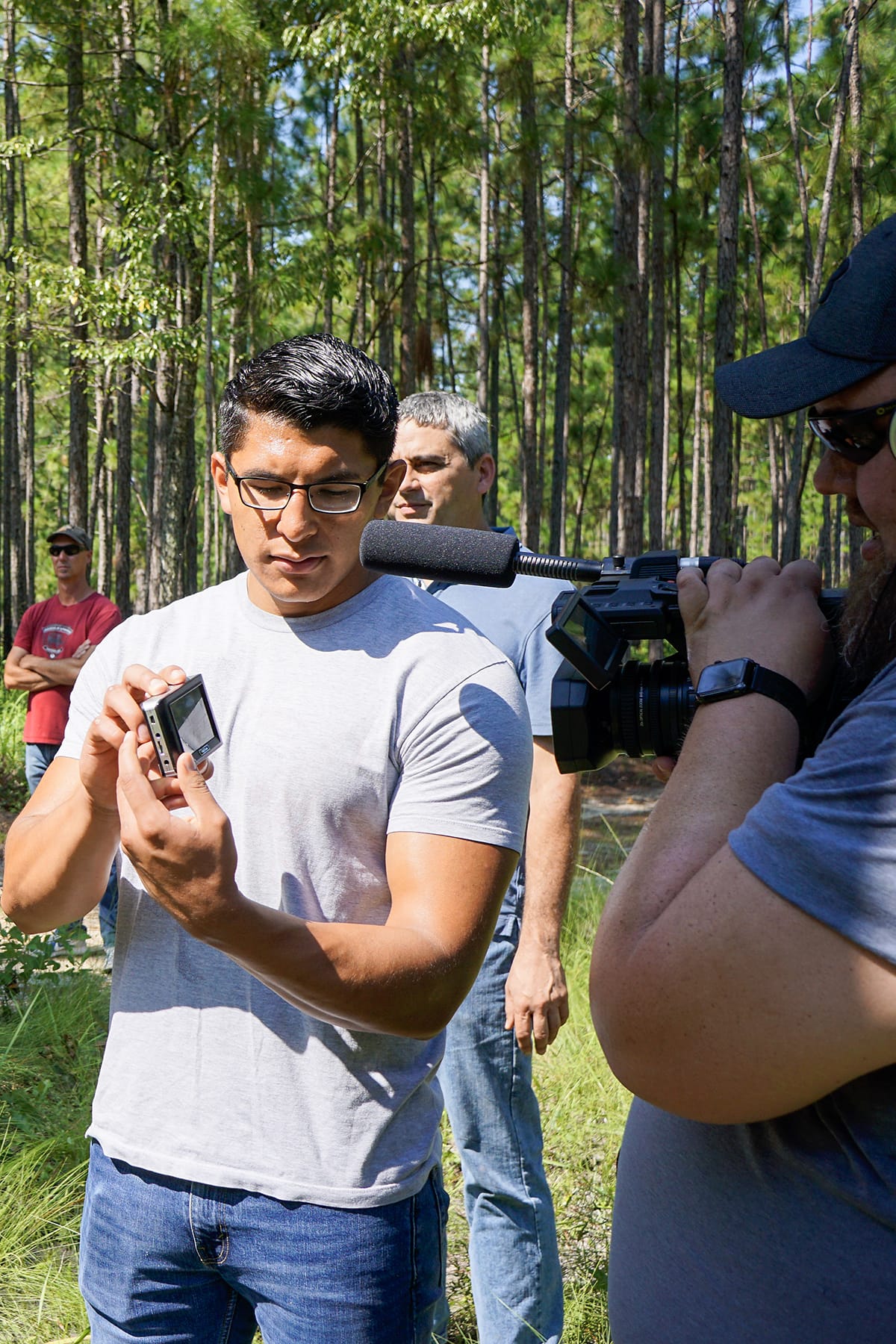
Randy Ahhaitty, Seminole Nation of Oklahoma, shows off a live video feed of three southern flying squirrels napping in a red-cockaded woodpecker cavity. Rob Meyer, Tall Timbers Stoddard Bird Lab, mans the camera on a long pole peeping into the cavity and transmitting the image as he explains that while the tiny squirrels are certainly the cutest cavity kleptoparasite around, they can be an issue for expanding the red-cockaded woodpecker nesting opportunities.
With the recent passing of Board member George W. Willson, Floridians and the Tall Timbers community have lost one of the most accomplished land conservationists in the state.
George has been attributed with saving nearly one million acres of environmentally sensitive land from the Keys to the Panhandle. “Probably nobody that’s has ever been involved in land acquisition in Florida has done more than George Willson. He spent four decades fighting to preserve Florida’s ecology,” said Estus Whitfield, former principal environmental advisor to four Florida governors.
With laser precision of his Marine Corps training, George was the consummate “deal maker,” negotiating fairly with private landowners to save incredible tracts of land from development threat. As Director of Land Acquisition for the Florida chapter of The Nature Conservancy (TNC) from 1984-1999, he was in command in securing vast properties, like the 18,000-acre Walton County tracts that later became Topsail Hill Preserve State Park and Point Washington State Forest.
After leaving TNC, George became Vice-President for Conservation Lands at the St. Joe Company. As Florida’s largest landowner, the company transferred from its portfolio to the State key holdings for public benefit and enjoyment.
Since 1989, George had a long association with Tall Timbers. He was one of the founding members of the Red Hills Conservation Association, the precursor of today’s Tall Timbers Land Conservancy. He was instrumental in guiding Tall Timbers to become one of the nation’s leading accredited land trusts.
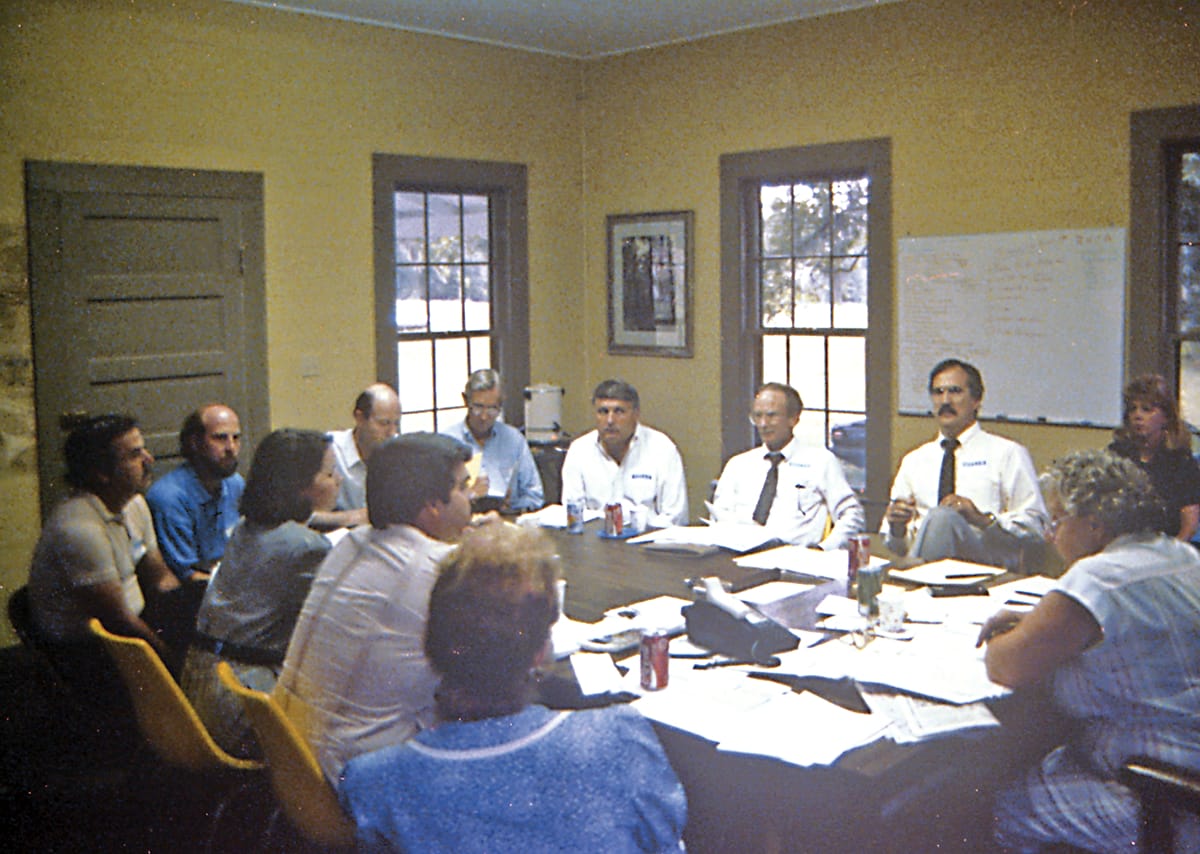
Consortium meeting of the Red Hills Conservation Association at Tall Timbers, c. 1989. George Willson pictured third from left in white shirt.
A walking encyclopedia on land conservation transactions, George was a generous mentor to our organization. His spirit will live on and his lasting legacy will be enjoyed by this and future generations who experience the special natural places he so dedicatedly saved and loved.
The M-CORES program, which includes the proposed Suncoast Connector Toll Road in Jefferson County, passed through the Florida Legislature at breakneck speed with little review or analysis. Tall Timbers has a number of concerns given the potential for significant and wide spread impacts. These include fragmenting public and private conservation lands, robbing business from Main Street Monticello, impacting our rivers and other water resources, and making prescribed fire more difficult and costly.
Join us in asking the Jefferson County Board of County Commissioners to OPPOSE the Suncoast Connector toll road and its path through Jefferson County.
Take action now with our easy email form.
Send an email to all five Jefferson County Board of County Commissioners with one click!
Selected Publications authored by Wildland Fire Science staff.
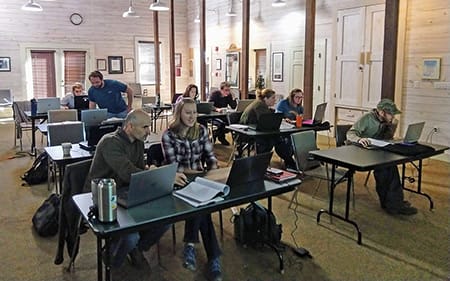
Educating and guiding the next generation of fire researchers and managers is a key goal of Wildland Fire Science and a resource for testing new ideas in fire research.
Tall Timbers hosts the Prescribed Fire Science Consortium, a national network of researchers and managers who promote integrated research and management to advance next generation tools for fire practitioners. https://arcg.is/1DSjDT
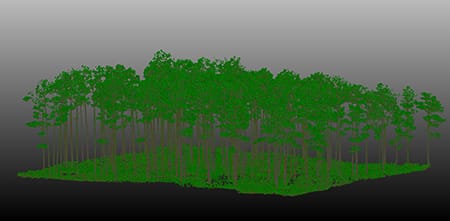
Working with partners in the Prescribed Fire Science Consortium, the program is building nexgen 3-D fuel beds using terrestrial LiDAR and novel sampling techniques to power new fire behavior models for prescribed fire managers. This work links to Tall Timbers work in wildlife habitat usage and ecological forestry.
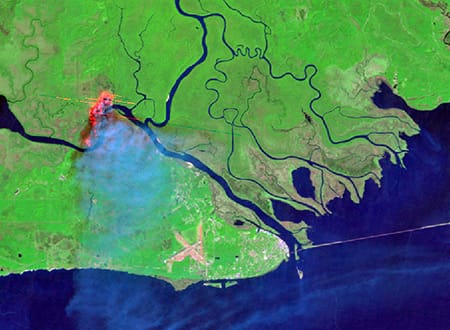
Tall Timbers is leading an effort to map fire regimes at the landscape scale. Staff work with numerous agencies to evaluate fire records and satellite imagery to build this critical conservation database. https://skfb.ly/6DqOY
We are linking physics and field observations to understand the fluid dynamics of fire behavior surface fire regimes. Our work combines field observations using advanced thermal imaging techniques, laboratory studies, and coupled fire-atmospheric modeling to help managers improve outcomes of managed fire regimes.
Burn prioritization modeling seminars and fire modeling tools are supported by Wildland Fire Science to train managers in the important planning stages of prescribed fires.
The conserved lands of the Greater Red Hills region are found on working, income-producing properties that support agriculture, forestry, and recreational hunting. These properties contribute $272 million annually to local economies and support 2,300 jobs. [link to Planning & Advocacy section] The landowners’ strong stewardship ethic preserves their working lands while replenishing drinking water supplies, protecting water quality, and providing wildlife habitat for dozens of rare and endangered species. Tall Timbers’ conservation easements on these working properties encourage landowners to retain their traditional livelihood by keeping farms in family ownership.
Home to world-class wild quail populations, the Greater Red Hills region contains the largest concentration of gamebird preserves in the United States. These preserves also support the largest community of Red-cockaded woodpeckers on private lands. Indicators of high quality habitat found here include the gopher tortoise, Bachman’s sparrow, fox squirrel, and many amphibians. Tall Timbers’ conservation easements identify and protect the critical habitats of these species.
The region also boasts outstanding aquatic resources. Large river systems, like the Flint/Apalachicola, Ochlockonee, and Aucilla, flow from Georgia and feed into the Gulf of Mexico to support some of the world’s most productive estuaries. Large disappearing sinkhole lakes, like Iamonia, Miccosukee, and Jackson, provide habitat for an array of aquatic species and migratory birds. Tall Timbers’ conservation easements protect these vital watersheds and wetlands that are the lifeblood for the ecological health of the region.
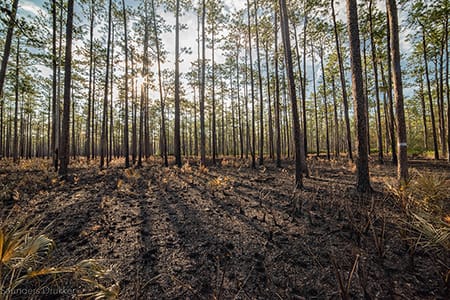
Once dominated by longleaf pine, our pine woodlands support abundant wildlife and local economies. These forests need prescribed fire to stay healthy. Herbert L. Stoddard and his associates Ed and Roy Komarek were pioneers in this emerging scientific field during the mid-20th century. Tall Timbers continues that legacy with applied research on prescribed fire and land management. Today, there is a tremendous need to expand prescribed fire use beyond the Red Hills to ensure ecosystem health and reduce wildfire risk. Additionally, Tall Timbers uses conservation easements to permanently protect private woodlands while balancing the need for economic return from selective timbering.
Tall Timbers hosts the premier fire technology transfer organization—the Southern Fire Exchange. This JFSP funded effort helps connect research to management through webinars, workshops, and support of the Prescribed Fire Science Consortium.
The Longleaf Legacy landscape prescribed fire burn team arm of Wildland Fire Science works directly with landowners and partners to effectively put fire on the ground and promote prescribed fire throughout the region.
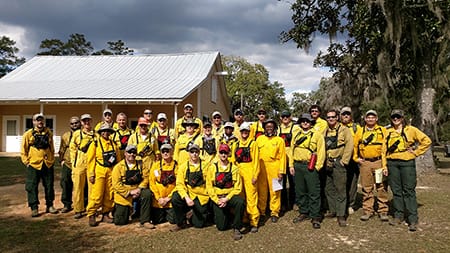
Staff and researchers support Federal fire training by serving as a cadre for NWCG training courses, ranging from basic wildland fire to advanced fire effects.
(PFTC) specializes in training fire fighters the principles and techniques of prescribed fire through practical hands-on experience. https://www.fws.gov/fire/pftc/
Private land owners are the largest source of prescribed fire in the country. These land owners and the culture of fire that was maintained by them during decades of suppression are a part of why Tall Timbers is a world-wide center for prescribed fire science. Workshops and fire training are a critical focus of the Longleaf Legacy Landscape Burn Team and our support of the Georgia Forestry Commission Prescribed Fire Center in Marion County.