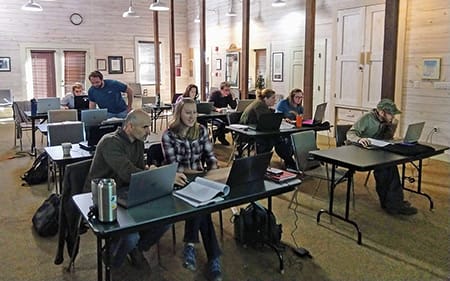
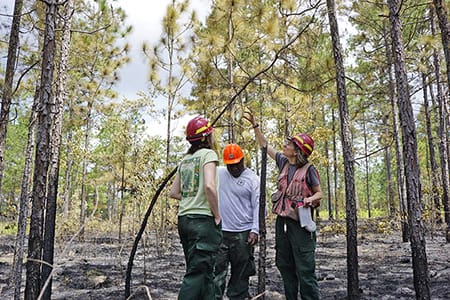
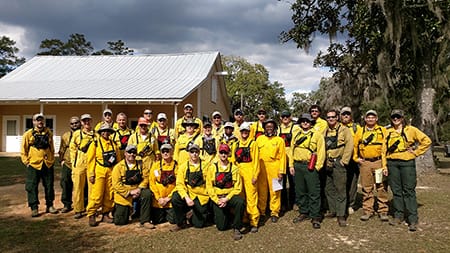
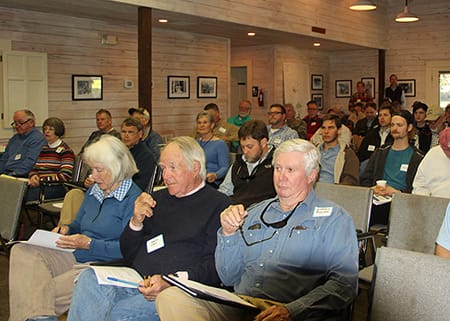
From October 16-18 Tall Timbers hosted the second Fire Summit to update the current strategic plans for prescribed fire in Florida and Georgia to 2020. In 2008, the two states met at Tall Timbers to develop the first Strategic Plan 2008-2020 for prescribed fire for each state. Five years later, prescribed fire leaders from both public and private agencies again convened to discuss progress since 2008, and to make changes that were needed in the 2020 plan. This time around, prescribed fire leaders were also invited from South Carolina and Alabama to observe, so they could go back to their respective states and use this same process to develop strategic plans of their own.
Both Florida and Georgia reported significant progress in increasing acreage burned, training of certified burners and conducting prescribed fire outreach to the public, using the One Message Many Voices concepts and products — Prescribed fire is a safe way to apply a natural process, ensure ecosystem health and reduce wildfire risk. Both states agreed to amend their plans to stress more public education and outreach, including the use of social media; support more science-based research on smoke emissions; call for more incentives for private landowners to burn; and work closely with the new Southeastern Longleaf Pine Initiative to double the amount of that tree species across the region, from 3.5 to 8 million acres by 2025. More longleaf will require more prescribed fire use in the coming years.
The Summit was coordinated by Tall Timbers Executive Director Lane Green and facilitated by Joe Michaels, who were both involved in Fire Summit I. Attendees felt the Summit was very productive and that they accomplished what they intended. Revised 2020 Strategic Plans for Prescribed Fire will be available in both Florida and Georgia in January 2013.
At left, Tall Timbers Executive Director Lane Green; at right facilitator Joe Michaels.
The 2012 quail hatch in the Albany area and Red Hills was much improved over last year when we were in the middle of a record drought! It all started with a mild winter which kept migratory hawk numbers below normal and overwinter quail survival above normal. This, along with relatively light harvests last year, resulted in a good carry-over of birds from the fall population. Good adult survival combined with an early spring and adequate rainfall got the nesting season off early with the first nests hatching in early May and our latest nests hatching in mid-October. Weather conditions were nearly ideal in the Albany Area all summer and similarly in the Red Hills, except for excessive rainfall associated with Tropical Strom Debbie in July.
The resulting hatch was impressive. On Tall Timbers areas, 68 nests hatched for every 100 hens entering the season! This is 57% greater than in 2011 and above our long-term average (Figure 1). Our hatch was very similar to that of 2009 which was an outstanding quail year in the Red Hills. In Albany, nesting and hatches per hen were up 30% over last year and well over the long-term average (Figure 2). While judging population changes from one demographic parameter can be unreliable, when nesting season length, nesting rates, nesting success, adult and chick survival are at or above long-term averages, population increases are likely!
Figure 1. Number of broods hatched per 100 hens and cock birds on our fed sites on Tall Timbers.
Figure 2. Number of nests and broods per 100 hens entering the nesting season shows an increasing trend in chick production.
We completed covey call counts on our study areas and other properties. In Albany, call counts are revealing populations making a strong recovery from last year with solid increases in the number of coveys and large covey sizes. On Tall Timbers our population was 37% greater this year than last year (Figure 3). Similar increases have been observed in covey call counts on plantation properties. Overall, we are predicting populations our study populations have increased by 30% and perhaps more. Through sound management, including habitat, supplemental feeding, predation management, and modest harvest rates combined with nearly ideal weather, our populations appear to have rebounded from the worst drought on record in 2011. The importance of each of these practices cannot be overstated to maintaining bobwhite populations through time.
Autumn bobwhite densities on Tall Timbers 2007-2012.
At present the combination of heavy cover, a preponderance of young birds and very dry conditions are moderating the numbers seen during pre-season woods work and dog training. Dry weather is common this time of year, but the long-term forecast is predicting a cooler than normal and wetter than normal winter, which should improve covey finds this season over last.
Today is you last chance to vote for Operation Outdoors; we need your vote!
For their Future Forward Grant Contest,SportDOG Brand® has chosen the conservation project that Tall Timbers Outreach & Education Coordinator, Dr. Theron Terhune proposed, along with Dr. James Martin at Mississippi State University. Tall Timbers’ project,Operation Outdoors, was nominated as 1 of 7 projects to choose from to receive a $25,000 grant. The project receiving the most votes will be awarded the grant. To win the grant contest, we need your vote today, and every day until November 30.
About Operation Outdoors
The Operation Outdoors grant request is for developing and planning an intensive semester of outdoor education for young adults at the college/university level. Grant funds, if awarded, will go towards paying for travel of project planning partners (i.e., from Clemson University, Mississippi State University, Washington College, etc.), for course development, and to undergraduate students and young adults to offset costs incurred for university classes, such as Upland Avian Ecology, when visiting the field site. Project Outdoors allow students to visit field research stations, participate in research and learn about practical habitat management without paying the out-of-pocket expenses associated with field site visits.
You can start voting today and can vote once every day until November 30. You can also vote at the SportDOG™ contest page on their website: www.sportdog.com/FFF.
Voting for Operation Outdoors enhances conservation and natural resource education for young adults by bringing them into the outdoors for a practical, hands-on research and education experience at Tall Timbers. The intent of the project is to foster the integration of hunting and game management into education. The ultimate goal of this project is to conserve and protect upland and grassland ecosystems, the species inhabiting them, and retaining the hunting legacy. Students will leave the program as effective upland bird biologists, well-versed in habitat management, and the ability to educate others on these topics. We believe this will have a cascading effect such that our culture of upland hunting will be preserved for future generations. PLEASE vote for Operation Outdoors!
Why did SportDOG™ have a contest?
SportDOG™ and their families enjoy many of the same hunting opportunities and outdoor activities as their customers. As a result, they recognize the importance of wise conservation and habitat-enhancement initiatives. SportDOG supports conservation efforts by contributing time and funding to projects that ensure hunters will have wild places to hunt wild game for generations to come. From habitat-enhancement projects at the local level to partnerships with some of the most proactive and respected national conservation organizations, SportDOG is proud to contribute.
Something really serious is in the works that may greatly affect land conservation and charitable giving, and we wanted to be sure you knew about it.
With the “fiscal cliff” looming, both Congress and the President are considering limiting the charitable deductions people can take on their taxes. This could effectively eliminate tax incentives for donated conservation easements and could greatly reduce all charitable giving. According to the Land Trust Alliance, the average tax payer who itemized in 2010 claimed $22,233 in deductions for mortgage interest and state, local, and property taxes alone. A cap would leave little tax incentives for charitable giving and certainly not for gifts on the scale of land or easements. A recent United Way poll showed that 79% of Americans oppose limiting charitable deductions. For more background information on the proposal see the Land Trust Alliance Policy Action.
Rand Wentworth, President of the Alliance, said that the proposed cap would be devastating to land conservation in America. Today, 1,700 land trusts depend on charitable giving incentives that have enabled the nation to save more than 47 million acres of wildlife habitat, agricultural lands and open space. Many of these conservation lands provide clean drinking water, sources for fresh foods, and serve as parks and refuges to restore our spirit and experience nature. In the greater Red Hills Region of southwest Georgia and north Florida, conservation easements are protecting the quality of life we all enjoy.
The single best action you can take right now is to pick up the phone and call your representatives and senators in Congress (202-224-3121) and tell them to preserve the charitable giving incentive. While Tall Timbers works with other conservation organizations on this issue, we depend on our supporters to voice their opinion to our elected leaders in Washington D.C.
Thank you for all of your support.
Lane Green, Executive Director
Tall Timbers Research Station & Land Conservancy
What is the economic impact of Red Hills working rural lands?
Tall Timbers to undertake much needed study
By Neil Fleckenstein, TTLC Planning Coordinator
Tall Timbers has a long and successful history of working with landowners and other partners to protect the Red Hills from threats that would fragment the landscape and jeopardize the use of prescribed fire, which is essential for these working rural lands. These threats have included sprawling residential development, pipelines, toll roads, landfills, and even interstate extensions. Our efforts to protect the region’s working lands have often focused on the importance of the Red Hills for its wildlife habitat and its role protecting drinking water quality, water supply and fresh air.
However, as the country continues to experience difficult economic times, increasingly the message that truly resonates with many of the elected officials and others who make important decisions that directly affect the Red Hills can be summed up in one word: “jobs.” Unfortunately, a comprehensive analysis of employment and economic impact associated with Red Hills working lands has never been undertaken [a limited study of a portion of Thomas County was completed in 1994]. Therefore, demonstrating the region’s significant economic and job-related benefits for our communities is vitally important to ensure the future sustainability of the Red Hills region.
Tall Timbers will address this long overdue need through the Red Hills Economic Impact Analysis Project. The goal of this project is to estimate the direct and indirect economic impact and employment associated with approximately 325,000 acres of working rural lands in the Red Hills region.
Working with economists at Florida State University, we have determined that the best way to gather the information we need is through a survey of approximately 110 owners of large Red Hills’ properties. This survey, which will be mailed on January 9, 2013, will inquire about the costs of operating and maintaining working rural properties in the Red Hills, employment associated with these properties, and certain aspects of land management. It is critically important that we receive a high response rate for the survey so that we can accurately capture the total economic impact of Red Hills working lands.
Of course, we understand the highly personal and private nature of some of the information we are asking for. That is why we cannot emphasize enough that the survey will be completely anonymous and ALL information collected will remain strictly confidential. Absolutely no information about any individual properties or landowners will be revealed and information discussed in any report derived from the survey will be presented only at the county or regional level. Finally, no information regarding per acre costs will be published.
Recently, Tall Timbers and a number of Red Hills residents who themselves will participate in this effort, have begun reaching out to fellow landowners to discuss the Red Hills Economic Impact Analysis Project. If you are one of those landowners, we hope you will join some of your friends, neighbors, and colleagues in supporting this ground breaking project that will help us conserve and protect the Red Hills.
If you have any questions about this project, please feel free to contact me (neil@ttrs.org) or Tall Timbers President/CEO Dr. Bill Palmer (bill@ttrs.org) at 850-893-4153.
The M-CORES program, which includes the proposed Suncoast Connector Toll Road in Jefferson County, passed through the Florida Legislature at breakneck speed with little review or analysis. Tall Timbers has a number of concerns given the potential for significant and wide spread impacts. These include fragmenting public and private conservation lands, robbing business from Main Street Monticello, impacting our rivers and other water resources, and making prescribed fire more difficult and costly.
Join us in asking the Jefferson County Board of County Commissioners to OPPOSE the Suncoast Connector toll road and its path through Jefferson County.
Take action now with our easy email form.
Send an email to all five Jefferson County Board of County Commissioners with one click!
Burn prioritization modeling seminars and fire modeling tools are supported by Wildland Fire Science to train managers in the important planning stages of prescribed fires.
Educating and guiding the next generation of fire researchers and managers is a key goal of Wildland Fire Science and a resource for testing new ideas in fire research.
Tall Timbers hosts the premier fire technology transfer organization—the Southern Fire Exchange. This JFSP funded effort helps connect research to management through webinars, workshops, and support of the Prescribed Fire Science Consortium.
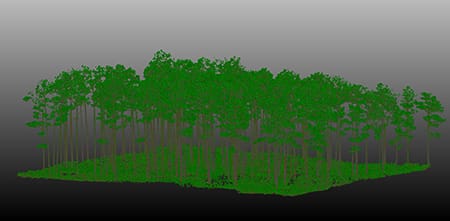
Working with partners in the Prescribed Fire Science Consortium, the program is building nexgen 3-D fuel beds using terrestrial LiDAR and novel sampling techniques to power new fire behavior models for prescribed fire managers. This work links to Tall Timbers work in wildlife habitat usage and ecological forestry.
The Longleaf Legacy landscape prescribed fire burn team arm of Wildland Fire Science works directly with landowners and partners to effectively put fire on the ground and promote prescribed fire throughout the region.
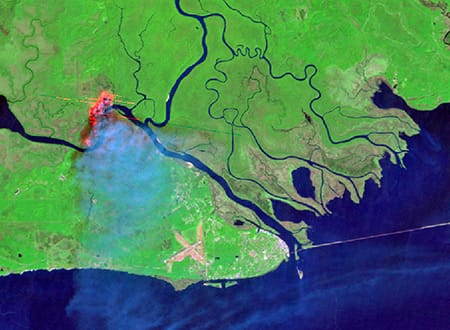
Tall Timbers is leading an effort to map fire regimes at the landscape scale. Staff work with numerous agencies to evaluate fire records and satellite imagery to build this critical conservation database. https://skfb.ly/6DqOY
Tall Timbers hosts the Prescribed Fire Science Consortium, a national network of researchers and managers who promote integrated research and management to advance next generation tools for fire practitioners. https://arcg.is/1DSjDT
We are linking physics and field observations to understand the fluid dynamics of fire behavior surface fire regimes. Our work combines field observations using advanced thermal imaging techniques, laboratory studies, and coupled fire-atmospheric modeling to help managers improve outcomes of managed fire regimes.
Selected Publications authored by Wildland Fire Science staff.
Staff and researchers support Federal fire training by serving as a cadre for NWCG training courses, ranging from basic wildland fire to advanced fire effects.
(PFTC) specializes in training fire fighters the principles and techniques of prescribed fire through practical hands-on experience. https://www.fws.gov/fire/pftc/
Private land owners are the largest source of prescribed fire in the country. These land owners and the culture of fire that was maintained by them during decades of suppression are a part of why Tall Timbers is a world-wide center for prescribed fire science. Workshops and fire training are a critical focus of the Longleaf Legacy Landscape Burn Team and our support of the Georgia Forestry Commission Prescribed Fire Center in Marion County.
The conserved lands of the Greater Red Hills region are found on working, income-producing properties that support agriculture, forestry, and recreational hunting. These properties contribute $272 million annually to local economies and support 2,300 jobs. [link to Planning & Advocacy section] The landowners’ strong stewardship ethic preserves their working lands while replenishing drinking water supplies, protecting water quality, and providing wildlife habitat for dozens of rare and endangered species. Tall Timbers’ conservation easements on these working properties encourage landowners to retain their traditional livelihood by keeping farms in family ownership.
Home to world-class wild quail populations, the Greater Red Hills region contains the largest concentration of gamebird preserves in the United States. These preserves also support the largest community of Red-cockaded woodpeckers on private lands. Indicators of high quality habitat found here include the gopher tortoise, Bachman’s sparrow, fox squirrel, and many amphibians. Tall Timbers’ conservation easements identify and protect the critical habitats of these species.
The region also boasts outstanding aquatic resources. Large river systems, like the Flint/Apalachicola, Ochlockonee, and Aucilla, flow from Georgia and feed into the Gulf of Mexico to support some of the world’s most productive estuaries. Large disappearing sinkhole lakes, like Iamonia, Miccosukee, and Jackson, provide habitat for an array of aquatic species and migratory birds. Tall Timbers’ conservation easements protect these vital watersheds and wetlands that are the lifeblood for the ecological health of the region.
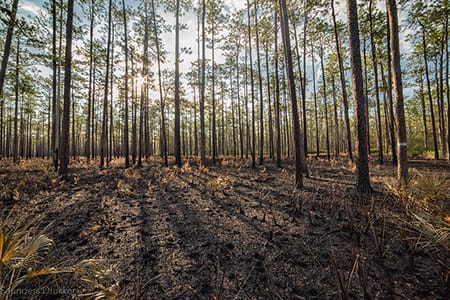
Once dominated by longleaf pine, our pine woodlands support abundant wildlife and local economies. These forests need prescribed fire to stay healthy. Herbert L. Stoddard and his associates Ed and Roy Komarek were pioneers in this emerging scientific field during the mid-20th century. Tall Timbers continues that legacy with applied research on prescribed fire and land management. Today, there is a tremendous need to expand prescribed fire use beyond the Red Hills to ensure ecosystem health and reduce wildfire risk. Additionally, Tall Timbers uses conservation easements to permanently protect private woodlands while balancing the need for economic return from selective timbering.


.jpg?strip=all&w=1080)