New collaborative work on the bird that launched Stoddard’s career
By Jim Cox, Stoddard Bird Lab Director
While it’s well known that Herbert Stoddard was a leading game bird biologist, it seems less commonly known that he also was one of the top bird scientists in North America. Not only did he receive the most prestigious award that the American Ornithologists’ Union has to offer (The Brewster Award), his study of the birds striking the WCTV tower was one of the first formal study launched at Tall Timbers and was the project to which he dedicated the final years of his life.
Stoddard’s fascination with birds dates back to his early years in central Florida. According to his memoirs, the discovery of the nest of a Common Ground Dove was an epiphany for this scrappy outdoor kid that also spent time trapping and hunting for sustenance. Stoddard wrote that the discovery of the nest “…. launched me on my career as a student of birds and marked my beginning as an ornithologist. This lifetime absorption began in that yard … where I watched the ground dove on her nest.”
As is the case for many of pine grassland birds studied by Stoddard, trends for the Common Ground Dove have listed downward for many decades, and the dove is now listed as a species of conservation in Florida, Mississippi, and South Carolina.
This past January, the Game Bird Program and Stoddard Bird Lab initiated a new collaborative study on the dove that could help to fill some important information gaps. It turns out that Ground Doves regularly find their way into the walk-in traps used for quail, and a simple mark-recapture effort focused on these birds might yield information on dove survival and movements that heretofore have never been assessed. Quail techs managed to trap and band 32 individual birds and recapture 12 individuals (with one individual being recaptured 6 times). These numbers are well within the range needed to provide important long-term information, but it will take a couple of years before survival patterns begin to emerge.
The distribution of birds across the property also was patchy and suggests Ground Doves may be focusing in on specific habitat configurations that are as yet unknown. This information could help land management and recommendations for CRP projects.
The lab also welcomed Matt Gould and Dave Pavlik to assist with work on Brown-headed Nuthatches this spring. Both techs are certified bird banders and have a tremendous amount of experience with the type of re-sighting work we do. Nuthatches are in the early stages of nest excavation at this point, and the Lab eagerly waits to see how birds are responding to the experimental treatments put in play in 2013.
Hardwood re-sprout roots – more than meets the eye
By Dr. Kevin Robertson, Fire Ecology Program Director
Broadleaf woody plants that re-sprout after being top killed by fire make up a large portion of the groundcover plants in natural southeastern U.S. pine forests. Sometimes it is important to estimate the root biomass of groundcover plants because of their contribution to competition, carbon sequestration, soil dynamics, and other ecosystem processes. Under normal conditions, root biomass is related to the biomass of the above-ground part of the plant. However, where there is frequent fire, this relationship breaks down because the top part of the plant is repeatedly killed while the roots stay intact.
To be able to estimate the root biomass of woody re-sprouts, we measured both their above-ground (stem and leaf) biomass and root biomass to find out the relationship between the two at one year following fire. We studied the five most common woody plant species and selected plants with stems and leaves ranging in height from a less than a meter to overhead height.
The results show the expected relationships between stem and leaf biomass and root biomass, but that the relationship is different for different species (see Figure). At one year following fire, there is always much more root biomass than above-ground biomass. An important management implication is that the rate of re-sprout growth and size of re-sprouts, at a certain time since fire, is more strongly related to root size, then to the fire intensity, season, or frequency of fire in the short term. That is to say, when it comes to burning woody re-sprouts, you tend to get back what you had before. However, over the course of multiple fires, fire frequency and season are expected to influence root growth (or root loss) and thereby affect re-sprout growth rate and size.
Neil Fleckenstein, Tall Timbers Land Conservancy Planning Coordinator
Turn on the tap, out comes the water. Fresh, clean, and seemingly endless. Over the years, I’ve often asked groups visiting Tall Timbers Research Station & Land Conservancy where our drinking water comes from. “The faucet” is a common response. Prodded further, there is often a surprising range of responses that accompany the correct answer – groundwater.
Basic questions like “Where does our drinking water come from?” are important because they force us to think about things we often overlook. For example, the value of certain indispensable ecosystem servicesin our lives. These services are the natural processes we take for granted that support our lives on earth: water purification, drinking water recharge, climate regulation, and many others.
Many of us think these vital services are free and limitless because they don’t have obvious price tags. However, because we don’t recognize them as having any monetary value, they often are disregarded when decisions are made that affect our forests, wetlands, and other natural areas. The result is serious and costly impacts. For example, the decades-long loss of marshland and wetlands in Louisiana magnified flooding and damage from Hurricane Katrina in coastal areas and the city of New Orleans.
Because development decisions largely depend on cost and benefit analyses, it is critical that we begin factoring in the economic value of these services provided by nature into the decision making process.
Working with Tall Timbers, the University of Georgia undertook the challenge of valuing a wide range of critical ecosystem services provided by many thousands of acres of private forests in the greater Red Hills region. This magnificent area, nestled between the Ochlockonee and Aucilla Rivers, the Cody Escarpment south of Tallahassee, and the historic community of Thomasville, has retained many of the natural features that are vanishing from the landscape of the South. The region’s rolling hills encompass a mosaic of forests, grassy plains, sinkhole lakes, springs, and wetlands. The Red Hills is home to more than 60 rare and threatened species and also nurtures the Floridan Aquifer, which provides drinking water to millions of residents of Florida, Georgia, and Alabama.
The single most important reason that the forests and other natural areas of the Red Hills have thrived when many others long ago vanished is the region is home to more than 80 large quail hunting properties as well as farms and other working rural lands. More than 300,000 acres in the greater Red Hills are held as largely contiguous hunting lands with more than 164,000 acres permanently protected from development through various conservation tools.
The results of the UGA study demonstrate the tremendous economic value of the ecosystem services that are directly benefiting all residents of our region. Economists estimated the total economic value of the ecosystem services provided by the private forest lands of the Red Hills at more than $1.13 billion per year. Water quality protection provided by forests and wetlands and groundwater resupply resulting from vast natural areas of high water recharge are two of the most valuable natural services provided by the Red Hills. The region also provides vital climate regulation, habitat for pollinators essential for the reproduction of many plants including agricultural commodities, and aesthetic beauty valued by residents and visitors alike.
Ensuring a healthy environment with clean and abundant water, fresh air, wildlife habitat, and scenic beauty is critical for our regional economy and our quality of life. The number one threat to rural lands and the irreplaceable natural services they provide is sprawling urban development. You can help protect these ecosystem services for ours and future generations by supporting efforts to maintain existing rural zoning; supporting policies to maintain the size of our current Urban Services Area [which has decades of room for future growth]; and encouraging activities that enhance the quality of our existing urban and suburban environments. For additional information about this study or other issues related to conservation of the Red Hills, check out http://www.talltimbers.org/landconservancy.html.
This article was originally published in the Tallahassee Democrat on January 31 under the title: "Greening our community: Nature’s value in dollars and cents".
Thirty students participated in the Prescribed Fire Training Center January session
Tall Timbers’ Fire Training Specialist, Greg Seamon, housed at the National Prescribed Fire Training Center in Tallahassee, coordinated the training of 30 participants from across the US and Canada during the Center’s January session. The attendees received a two and a half day orientation to prescribed burning and safety in the southeast before venturing out to burn across Florida and southern Georgia during the 20-day training. Students attend the Center for the experiential training it offers. The focus is to give the students practice burning in a variety of fuels with a number of different cooperators in order to build experience, knowledge and confidence.
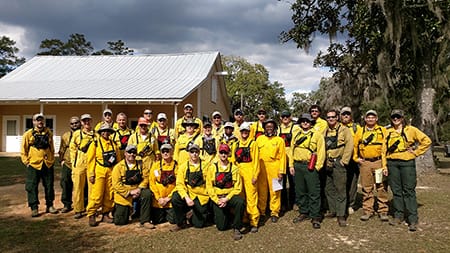
Module of the class poses for a team photo after completing a burn for the Georgia Forestry Commission.
Participants were split into five modules and conducted 62 prescribed burns for 15 different cooperators totaling 35,607 acres. In addition, the students worked on task books to advance in their career. There were 11 type two burn boss trainees (RXB2) that were able to accomplish 61 assignments. They arrived with an average of 27% of their task book complete and left with an average of 96% completion. Three trainees were recommended to their home unit for certification. In addition there were 16 firing boss trainees (FIRB), one engine boss trainee (ENGB) and nine fire effects monitor trainees (FEMO). All were able to accomplish assignments and additional tasks. Eight FIRBs and three FEMOs were recommended for certification following the session.
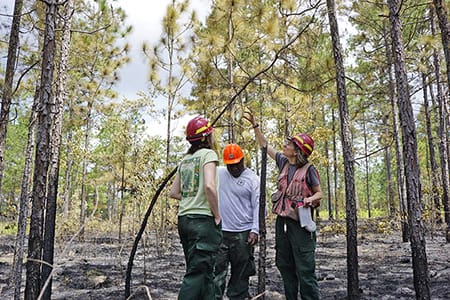
At left, Bernie Meizal, firing boss trainee from the Bighorn National Forest in Wyoming, conducts ignition at Dudley Farm, a Florida Sate Park. At right, Ruby Burks, burn boss trainee from the Tahoe National Forest, discusses burn progress with Julian Esquivel, firing boss trainee from the Davidson River Initial Attack in North Carolina, at the University of Florida’s Ordway-Swisher Biological Station.
The Center also has an agreement with the University of Florida to offer three upper division credits to students through their attendance at a session and some additional work. In January one participant took advantage of this opportunity.
Tall Timbers 2013 Naturalists’ Ball Honors Lane Green
Painting of Lane Green with Brittany spaniels by C. Ford Riley was given to Lane as retirement gift by Tall Timbers staff; it was used for the cover of the Naturalists’ Ball invitations.
At the 2013 Naturalists’ Ball held on Saturday, February 16, the Tall Timbers Board of Trustees honored Lane Green for his 22 years of service as Executive Director of Tall Timbers Research Station & Land Conservancy and the Tall Timbers Foundation. Lane retired in December 2012 to pursue his passions: time with family, hunting, travel, playing baseball and managing his family land.
The Naturalists’ Ball was held at Glen Arven Country Club in Thomasville, Georgia; 190 guests enjoyed dinner and dancing at this black tie event. Tallahassee band, Tom and the Cats, played Lane’s favorites, as he and his wife Susan, as well as family, friends, Tall Timbers staff and well-wishers danced the night away.
Naturalists’ Ball Album
The entrance to Glen Arven Country Club was decorated with a prescribed fire theme in honor of Lane Green, our regional “fire evangelist.”
Lane and Smokey,” toe to toe.”
From left to right, Lane Green, Cornelia Corbett, Smokey, Dick Corbett, Cyndi and George Watkins.
Lane, center, reveals his Tom and the Cats (name of the band that played) t-shirt under his tux. Band member, Richard Bevis is at left, Dick Corbett at right.
The M-CORES program, which includes the proposed Suncoast Connector Toll Road in Jefferson County, passed through the Florida Legislature at breakneck speed with little review or analysis. Tall Timbers has a number of concerns given the potential for significant and wide spread impacts. These include fragmenting public and private conservation lands, robbing business from Main Street Monticello, impacting our rivers and other water resources, and making prescribed fire more difficult and costly.
Join us in asking the Jefferson County Board of County Commissioners to OPPOSE the Suncoast Connector toll road and its path through Jefferson County.
Take action now with our easy email form.
Send an email to all five Jefferson County Board of County Commissioners with one click!
Burn prioritization modeling seminars and fire modeling tools are supported by Wildland Fire Science to train managers in the important planning stages of prescribed fires.
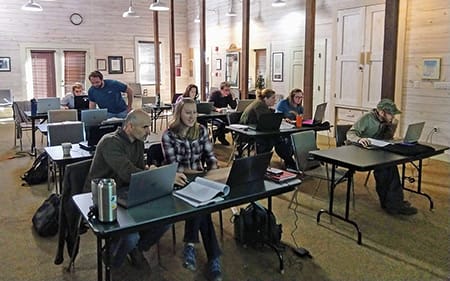
Educating and guiding the next generation of fire researchers and managers is a key goal of Wildland Fire Science and a resource for testing new ideas in fire research.
Tall Timbers hosts the premier fire technology transfer organization—the Southern Fire Exchange. This JFSP funded effort helps connect research to management through webinars, workshops, and support of the Prescribed Fire Science Consortium.
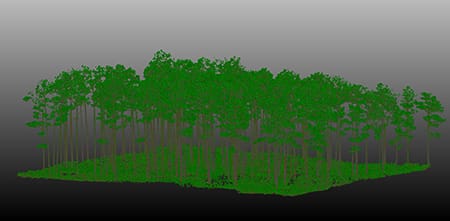
Working with partners in the Prescribed Fire Science Consortium, the program is building nexgen 3-D fuel beds using terrestrial LiDAR and novel sampling techniques to power new fire behavior models for prescribed fire managers. This work links to Tall Timbers work in wildlife habitat usage and ecological forestry.
The Longleaf Legacy landscape prescribed fire burn team arm of Wildland Fire Science works directly with landowners and partners to effectively put fire on the ground and promote prescribed fire throughout the region.
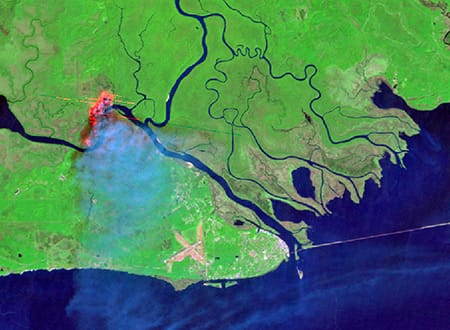
Tall Timbers is leading an effort to map fire regimes at the landscape scale. Staff work with numerous agencies to evaluate fire records and satellite imagery to build this critical conservation database. https://skfb.ly/6DqOY
Tall Timbers hosts the Prescribed Fire Science Consortium, a national network of researchers and managers who promote integrated research and management to advance next generation tools for fire practitioners. https://arcg.is/1DSjDT
We are linking physics and field observations to understand the fluid dynamics of fire behavior surface fire regimes. Our work combines field observations using advanced thermal imaging techniques, laboratory studies, and coupled fire-atmospheric modeling to help managers improve outcomes of managed fire regimes.
Selected Publications authored by Wildland Fire Science staff.
Staff and researchers support Federal fire training by serving as a cadre for NWCG training courses, ranging from basic wildland fire to advanced fire effects.
(PFTC) specializes in training fire fighters the principles and techniques of prescribed fire through practical hands-on experience. https://www.fws.gov/fire/pftc/
Private land owners are the largest source of prescribed fire in the country. These land owners and the culture of fire that was maintained by them during decades of suppression are a part of why Tall Timbers is a world-wide center for prescribed fire science. Workshops and fire training are a critical focus of the Longleaf Legacy Landscape Burn Team and our support of the Georgia Forestry Commission Prescribed Fire Center in Marion County.
The conserved lands of the Greater Red Hills region are found on working, income-producing properties that support agriculture, forestry, and recreational hunting. These properties contribute $272 million annually to local economies and support 2,300 jobs. [link to Planning & Advocacy section] The landowners’ strong stewardship ethic preserves their working lands while replenishing drinking water supplies, protecting water quality, and providing wildlife habitat for dozens of rare and endangered species. Tall Timbers’ conservation easements on these working properties encourage landowners to retain their traditional livelihood by keeping farms in family ownership.
Home to world-class wild quail populations, the Greater Red Hills region contains the largest concentration of gamebird preserves in the United States. These preserves also support the largest community of Red-cockaded woodpeckers on private lands. Indicators of high quality habitat found here include the gopher tortoise, Bachman’s sparrow, fox squirrel, and many amphibians. Tall Timbers’ conservation easements identify and protect the critical habitats of these species.
The region also boasts outstanding aquatic resources. Large river systems, like the Flint/Apalachicola, Ochlockonee, and Aucilla, flow from Georgia and feed into the Gulf of Mexico to support some of the world’s most productive estuaries. Large disappearing sinkhole lakes, like Iamonia, Miccosukee, and Jackson, provide habitat for an array of aquatic species and migratory birds. Tall Timbers’ conservation easements protect these vital watersheds and wetlands that are the lifeblood for the ecological health of the region.
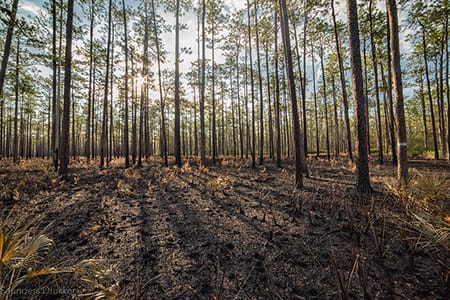
Once dominated by longleaf pine, our pine woodlands support abundant wildlife and local economies. These forests need prescribed fire to stay healthy. Herbert L. Stoddard and his associates Ed and Roy Komarek were pioneers in this emerging scientific field during the mid-20th century. Tall Timbers continues that legacy with applied research on prescribed fire and land management. Today, there is a tremendous need to expand prescribed fire use beyond the Red Hills to ensure ecosystem health and reduce wildfire risk. Additionally, Tall Timbers uses conservation easements to permanently protect private woodlands while balancing the need for economic return from selective timbering.

 This past January, the Game Bird Program and Stoddard Bird Lab initiated a new collaborative study on the dove that could help to fill some important information gaps. It turns out that Ground Doves regularly find their way into the walk-in traps used for quail, and a simple mark-recapture effort focused on these birds might yield information on dove survival and movements that heretofore have never been assessed. Quail techs managed to trap and band 32 individual birds and recapture 12 individuals (with one individual being recaptured 6 times). These numbers are well within the range needed to provide important long-term information, but it will take a couple of years before survival patterns begin to emerge.
  Broadleaf woody plants that re-sprout after being top killed by fire make up a large portion of the groundcover plants in natural southeastern U.S. pine forests. Sometimes it is important to estimate the root biomass of groundcover plants because of their contribution to competition, carbon sequestration, soil dynamics, and other ecosystem processes. Under normal conditions, root biomass is related to the biomass of the above-ground part of the plant. However, where there is frequent fire, this relationship breaks down because the top part of the plant is repeatedly killed while the roots stay intact.
  The results show the expected relationships between stem and leaf biomass and root biomass, but that the relationship is different for different species (see Figure). At one year following fire, there is always much more root biomass than above-ground biomass. An important management implication is that the rate of re-sprout growth and size of re-sprouts, at a certain time since fire, is more strongly related to root size, then to the fire intensity, season, or frequency of fire in the short term. That is to say, when it comes to burning woody re-sprouts, you tend to get back what you had before. However, over the course of multiple fires, fire frequency and season are expected to influence root growth (or root loss) and thereby affect re-sprout growth rate and size.
 Turn on the tap, out comes the water. Fresh, clean, and seemingly endless. Over the years, I’ve often asked groups visiting Tall Timbers Research Station & Land Conservancy where our drinking water comes from. “The faucet” is a common response. Prodded further, there is often a surprising range of responses that accompany the correct answer – groundwater.