New education project provides virtual forest tours
eorgia learn more about the important role of working forest lands for conservation and the economy. Association leadership invited Tall Timbers to be part of the project and help highlight the vital role of prescribed fire and wildlife management.
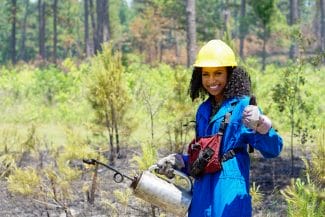
The virtual forest tour project focuses on fourth through sixth grade students and will include videos, interactive web pages, and teacher guides. Producer Gloria Camacho and the film crew visited Tall Timbers in March and April to capture footage of prescribed fire and interview staff members. On their most recent visit, the virtual forest tour host Chelsea Phillips Tafoya joined the group and was ecstatic about the opportunity to work with Eric Staller on the ignition of a prescribed fire. This was Chelsea’s first experience with prescribed fire, and she was amazed with both the control and beauty of it. Celebrating another lap around the sun, Chelsea exclaimed “best birthday ever,” as she ignited a flanking fire along the burn unit.
Brian Wiebler, Outreach & Education Coordinator at Tall Timbers, will continue to coordinate with the production team as the project takes shape over the coming months. Georgia Public Broadcasting and the Georgia Forestry Association will launch a campaign in 2019, to promote use of the new virtual forest tour materials in schools statewide.
Production Album
Photos by Brian Wiebler
Photos clockwise from top left: Eric Staller, Natural Resource Coordinator and Land Manager at Tall Timbers, prepares for a retake during a segment were he explains the fire prescription for the day to program host Chelsea Phillips Tafoya; Eric Staller, Natural Resource Coordinator and Land Manager at Tall Timbers, explains how fires top kill some woody vegetation; Kevin Hiers, Wildland Fire Scientist at Tall Timbers, prepares for ignition while explaining heat release from vegetative fuels; Monica Rother, Fire Ecologist at Tall Timbers, holds for lighting adjustments during her interview about studying fire history through tree rings. A camera operator takes in a flank fire during a prescribed fire at Tall Timbers. Producer Gloria Camacho directs filming of a prescribed fire at Tall Timbers.
Prescribed Burn of the Wade Tract Preserve at Night — a Site to Behold
By Dr. Kevin Robertson, Fire Ecology Program Director
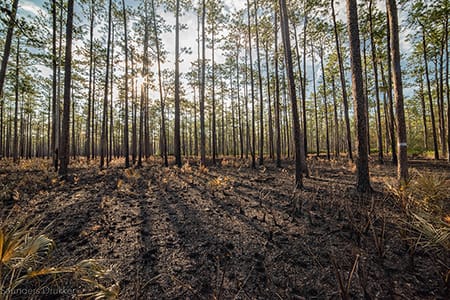
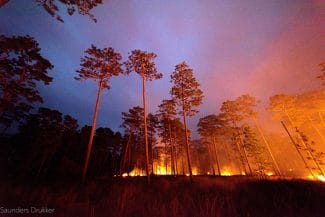
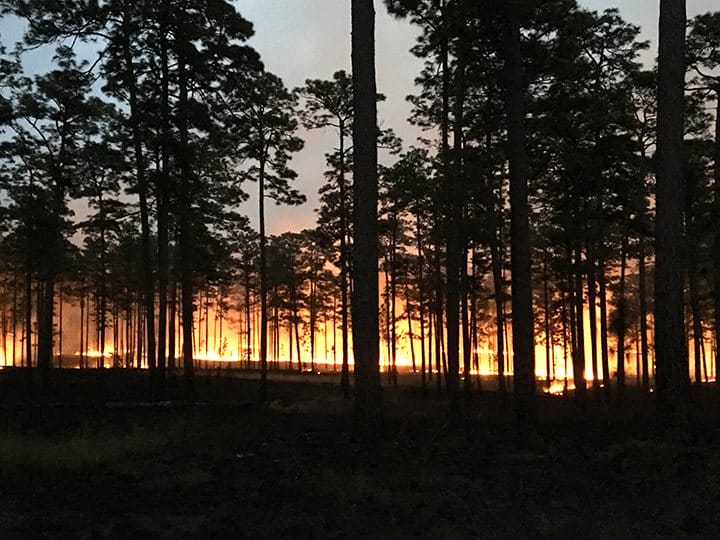
Tall Timbers conducted a night burn on the west side of the Wade Tract old-growth longleaf pine forest on Arcadia Plantation on March 26. This kind of burning is relatively mild, causing little crown scorch and resulting in some unburned patches. Since this is a longleaf pine mast year (seed dispersal year, occurring about once in a decade), we wanted to allow some of the longleaf pine seedlings to escape fire and become established in the open gaps were there are currently no trees. These areas are less likely to burn because there are fewer pine needles to provide fuel. Burning at night is the way it was typically done in the South, until a few decades ago, having the advantages listed above and leaving some unburned areas as cover for quail. They are also beautiful to behold. Arcadia manager and forester Paul Massey called to congratulate us on a burn nicely done, saying, “That burn took me back 40 years!”
Night burns have become rare because of increasing concerns about smoke management, resulting in reluctance on the part of state forestry agencies to issue burn authorizations allowing fire past 5:00 PM. Typically, when the sun goes down and stops heating the soil surface, the warm air slowly rising from the ground creates an “inversion layer” over the cooler air beneath, creating a low ceiling on rising smoke. This presents a dangerous situation for roadways where smoke may reduce visibility. Low winds and high humidity and make the situation worse, where smoke may creep down into drains and onto roadways, and water may adhere to smoke particles to make fog.
The night we burned, the night time dispersion index were unusually high, over 15 compared to the usual level of 2-4, owing to strong winds, low night time humidity, and a cool cloudy day, preventing a strong inversion. Fuels were also moist and did not smolder long after the fire went out. The result was no smoke on roads and a successful burn. However, these conditions are rare — maybe a few in a modern lifetime — as safety, including good smoke management, is priority number one.
Austin Dixon and Cinnamon Morrison were on the burn team for the Wade Tract prescribed fire. Cinnamon is refilling Austin’s water bag.
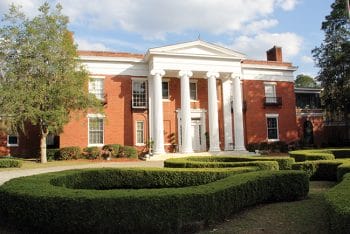
Tall Timbers hosted its first Dixie Ladies Luncheon, Wednesday, March 28, in support of the Phase III interior rehabilitation of the Dixie Mansion. The luncheon was held in the dining room at historic Dixie Mansion. The Dixie Mansion was designed in 1936 by acclaimed architect John Russell Pope, who also designed the Jefferson Memorial and the National Gallery of Art on the Washington Mall. Dixie is his only building designed and constructed in Florida. A beautiful Live Oak allee leads to the stunning 14,200-sq. ft. Neo-Classical Revival country house with its massive two-story Ionic columned portico.
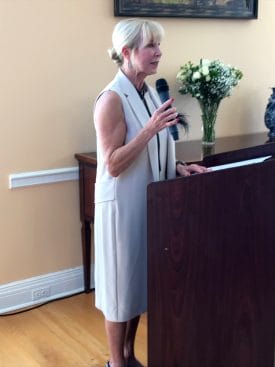
We were honored to have Florida’s First Lady Ann Scott join us as our keynote speaker. The First Lady thanked Tall Timbers for taking on the task of restoring part of Florida’s history. The luncheon served as the unveiling of the work completed for Phases I and II rehabilitation — thanks to funding from Florida Department of State Special Category grants — and the needs to be met for Phase III. Phase III interior rehabilitation needs include:
Life safety and code compliance upgrades: 2nd floor fire exit, 1st floor accessible bathroom, and fire alarm system
Once the final phase is completed, the beautifully restored Dixie Mansion will serve as an important social and educational center, hosting scientific seminars, conferences,and civic programs.
To help, contact Crystal Davis: 850.893.4153, x343 or email Crystal.
After lunch, the guests were given a tour of the mansion. Photos by Rose Rodriguez
Tall Timbers hosts the Prescribed Fire Science Consortium
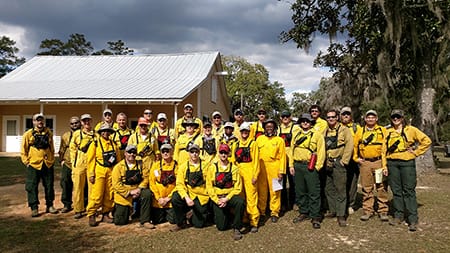
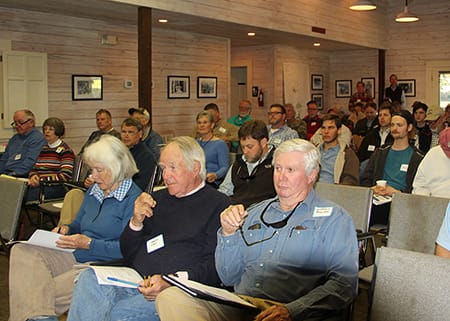
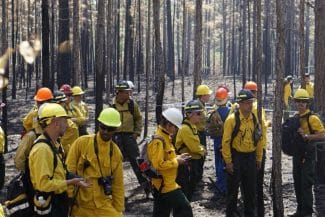
More than seventy-five prescribed fire researchers and managers assembled at Tall Timbers April 16-22, for the annual 5-day Prescribed Fire Science Consortium Burn Event. Organized by Kevin Hiers and the Wildland Fire Research Program, the event provides fire researchers a common platform to conduct studies on smoke and fire behavior, which leads to greater efficiency, integration, and collaboration. Just as critical, prescribed fire managers from around the country are invited to share their research needs and discuss limitations to expanding the use of prescribed fire. This year, managers from New Jersey to Utah were exposed to cutting edge drone technologies, new fire behavior modeling tools, 3D fuel scans using LiDAR, and novel smoke research.
This effort is an innovative attempt to implement the concept of “co-production of science” by integrating managers and researchers into conversations about science needs, prescribed fire outcomes, and applications of emerging technologies. Funding through the USFS Pacific Northwest Research Station and the USFS Southern Research Station for this year’s effort resulted in 5 burns in 4 days, 15 hours of drone flights in smoke, and a comparison of 5 novel methods of the fire environment to traditional measures.
Photo Album
Album photos by David Godwin, Southern Fire Exchange Program and Outreach Coordinator
Prescribed Fire Science Consortium Secures Department of Defense Grants
Prescribed Fire Science Consortium led by Tall Timbers’ Wildland Fire Science program secures four Department of Defense SERDP grants to study 3D fuels and fire spread.
Through the Strategic Environmental Research and Development Program (SERDP) the Department of Defense periodically funds environmental research projects to address wide ranging issues from military land management and climate to weapon system use and everything in between. These extremely competitive grants generate solutions to the Department’s environmental challenges reducing costs, environmental risks, and time required to resolve environmental problems while enhancing and sustaining military readiness.
Last October, SERDP released a statement of need requesting proposals of wildland fire research to improve military land use efficiency. The research objectives requested by this statement of need included an understanding of fire processes and fuel characterization in time and space through diverse conditions. The recently organized Prescribed Fire Consortium led by Tall Timbers is uniquely poised to answer all of the objectives laid out in the statement of need, and as such, was successful in securing four grants totaling 6.4 million dollars over the next four years.
These grants include two 3D fuel characterization grants using Terrestrial LiDAR techniques, a fire pattern and processes modeling grant and a grant that ties fuel characterization to modeling and fire processes.
Photo: US Forest Service research scientists test a 3D fuel sampling rig that will help validate remote sensing fuel sampling techniques that will be developed by the SERDP grants.
The M-CORES program, which includes the proposed Suncoast Connector Toll Road in Jefferson County, passed through the Florida Legislature at breakneck speed with little review or analysis. Tall Timbers has a number of concerns given the potential for significant and wide spread impacts. These include fragmenting public and private conservation lands, robbing business from Main Street Monticello, impacting our rivers and other water resources, and making prescribed fire more difficult and costly.
Join us in asking the Jefferson County Board of County Commissioners to OPPOSE the Suncoast Connector toll road and its path through Jefferson County.
Take action now with our easy email form.
Send an email to all five Jefferson County Board of County Commissioners with one click!
Selected Publications authored by Wildland Fire Science staff.
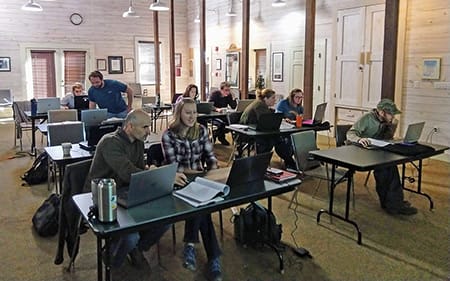
Educating and guiding the next generation of fire researchers and managers is a key goal of Wildland Fire Science and a resource for testing new ideas in fire research.
Tall Timbers hosts the Prescribed Fire Science Consortium, a national network of researchers and managers who promote integrated research and management to advance next generation tools for fire practitioners. https://arcg.is/1DSjDT
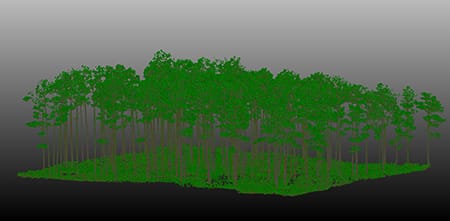
Working with partners in the Prescribed Fire Science Consortium, the program is building nexgen 3-D fuel beds using terrestrial LiDAR and novel sampling techniques to power new fire behavior models for prescribed fire managers. This work links to Tall Timbers work in wildlife habitat usage and ecological forestry.
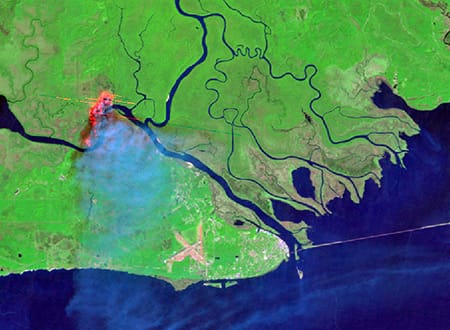
Tall Timbers is leading an effort to map fire regimes at the landscape scale. Staff work with numerous agencies to evaluate fire records and satellite imagery to build this critical conservation database. https://skfb.ly/6DqOY
We are linking physics and field observations to understand the fluid dynamics of fire behavior surface fire regimes. Our work combines field observations using advanced thermal imaging techniques, laboratory studies, and coupled fire-atmospheric modeling to help managers improve outcomes of managed fire regimes.
Burn prioritization modeling seminars and fire modeling tools are supported by Wildland Fire Science to train managers in the important planning stages of prescribed fires.
The conserved lands of the Greater Red Hills region are found on working, income-producing properties that support agriculture, forestry, and recreational hunting. These properties contribute $272 million annually to local economies and support 2,300 jobs. [link to Planning & Advocacy section] The landowners’ strong stewardship ethic preserves their working lands while replenishing drinking water supplies, protecting water quality, and providing wildlife habitat for dozens of rare and endangered species. Tall Timbers’ conservation easements on these working properties encourage landowners to retain their traditional livelihood by keeping farms in family ownership.
Home to world-class wild quail populations, the Greater Red Hills region contains the largest concentration of gamebird preserves in the United States. These preserves also support the largest community of Red-cockaded woodpeckers on private lands. Indicators of high quality habitat found here include the gopher tortoise, Bachman’s sparrow, fox squirrel, and many amphibians. Tall Timbers’ conservation easements identify and protect the critical habitats of these species.
The region also boasts outstanding aquatic resources. Large river systems, like the Flint/Apalachicola, Ochlockonee, and Aucilla, flow from Georgia and feed into the Gulf of Mexico to support some of the world’s most productive estuaries. Large disappearing sinkhole lakes, like Iamonia, Miccosukee, and Jackson, provide habitat for an array of aquatic species and migratory birds. Tall Timbers’ conservation easements protect these vital watersheds and wetlands that are the lifeblood for the ecological health of the region.
Once dominated by longleaf pine, our pine woodlands support abundant wildlife and local economies. These forests need prescribed fire to stay healthy. Herbert L. Stoddard and his associates Ed and Roy Komarek were pioneers in this emerging scientific field during the mid-20th century. Tall Timbers continues that legacy with applied research on prescribed fire and land management. Today, there is a tremendous need to expand prescribed fire use beyond the Red Hills to ensure ecosystem health and reduce wildfire risk. Additionally, Tall Timbers uses conservation easements to permanently protect private woodlands while balancing the need for economic return from selective timbering.
Tall Timbers hosts the premier fire technology transfer organization—the Southern Fire Exchange. This JFSP funded effort helps connect research to management through webinars, workshops, and support of the Prescribed Fire Science Consortium.
The Longleaf Legacy landscape prescribed fire burn team arm of Wildland Fire Science works directly with landowners and partners to effectively put fire on the ground and promote prescribed fire throughout the region.
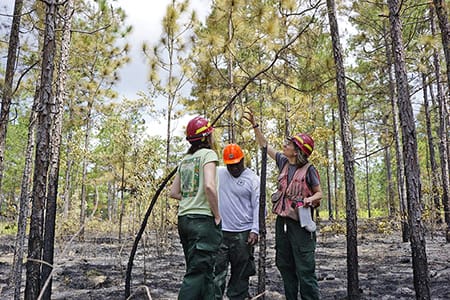
Staff and researchers support Federal fire training by serving as a cadre for NWCG training courses, ranging from basic wildland fire to advanced fire effects.
(PFTC) specializes in training fire fighters the principles and techniques of prescribed fire through practical hands-on experience. https://www.fws.gov/fire/pftc/
Private land owners are the largest source of prescribed fire in the country. These land owners and the culture of fire that was maintained by them during decades of suppression are a part of why Tall Timbers is a world-wide center for prescribed fire science. Workshops and fire training are a critical focus of the Longleaf Legacy Landscape Burn Team and our support of the Georgia Forestry Commission Prescribed Fire Center in Marion County.


 eorgia learn more about the important role of working forest lands for conservation and the economy. Association leadership invited Tall Timbers to be part of the project and help highlight the vital role of prescribed fire and wildlife management.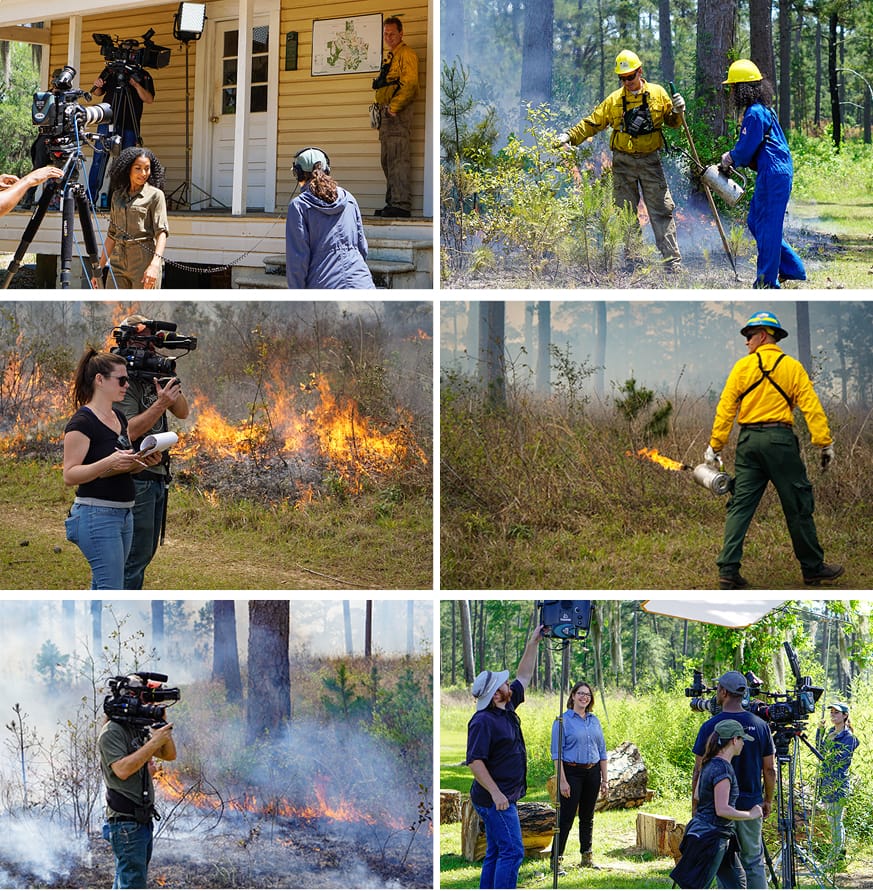

 Tall Timbers conducted a night burn on the west side of the Wade Tract old-growth longleaf pine forest on Arcadia Plantation on March 26. This kind of burning is relatively mild, causing little crown scorch and resulting in some unburned patches. Since this is a longleaf pine mast year (seed dispersal year, occurring about once in a decade), we wanted to allow some of the longleaf pine seedlings to escape fire and become established in the open gaps were there are currently no trees. These areas are less likely to burn because there are fewer pine needles to provide fuel. Burning at night is the way it was typically done in the South, until a few decades ago, having the advantages listed above and leaving some unburned areas as cover for quail. They are also beautiful to behold. Arcadia manager and forester Paul Massey called to congratulate us on a burn nicely done, saying, “That burn took me back 40 years!”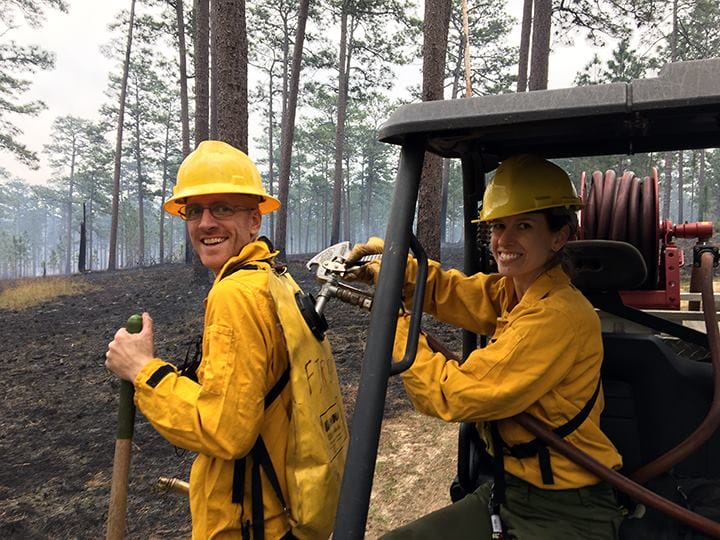


 We were honored to have Florida’s First Lady Ann Scott join us as our keynote speaker. The First Lady thanked Tall Timbers for taking on the task of restoring part of Florida’s history. The luncheon served as the unveiling of the work completed for Phases I and II rehabilitation — thanks to funding from Florida Department of State Special Category grants — and the needs to be met for Phase III. Phase III interior rehabilitation needs include: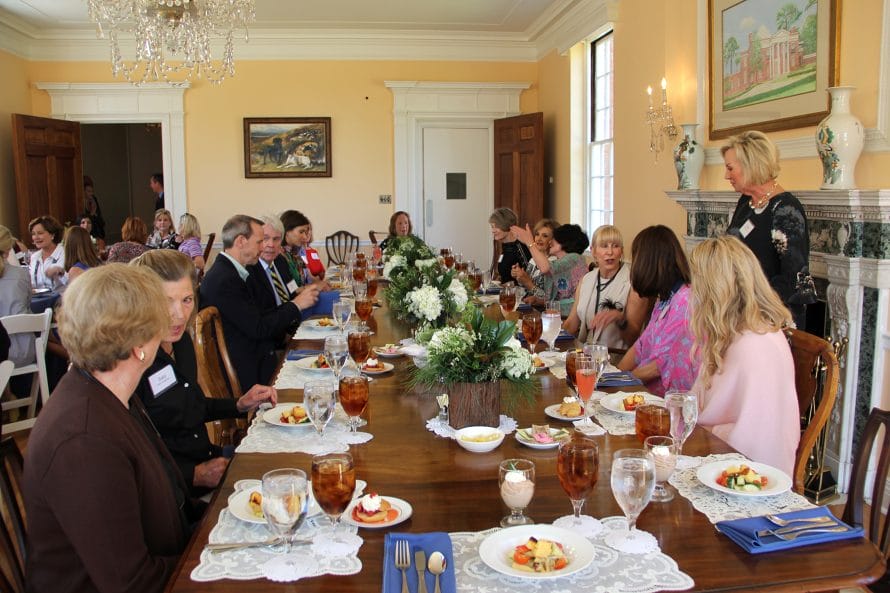


 More than seventy-five prescribed fire researchers and managers assembled at Tall Timbers April 16-22, for the annual 5-day Prescribed Fire Science Consortium Burn Event. Organized by Kevin Hiers and the Wildland Fire Research Program, the event provides fire researchers a common platform to conduct studies on smoke and fire behavior, which leads to greater efficiency, integration, and collaboration. Just as critical, prescribed fire managers from around the country are invited to share their research needs and discuss limitations to expanding the use of prescribed fire. This year, managers from New Jersey to Utah were exposed to cutting edge drone technologies, new fire behavior modeling tools, 3D fuel scans using LiDAR, and novel smoke research.


 Prescribed Fire Science Consortium led by Tall Timbers’ Wildland Fire Science program secures four Department of Defense SERDP grants to study 3D fuels and fire spread.