Mark your calendars for the first Red Hills Fire Festival on Sunday, January 22, 2017. Fire Festival is a collaboration between many organizations in Florida and Georgia to spread awareness about prescribed fire and healthy forests. Attend this all-ages event to experience, enjoy and learn about the special natural process of fire in southern pinelands. The festival will include live prescribed fire, equipment demonstrations, wagon ride tours of healthy forests, fire talks with experts, kids’ activities, food vendors, and live music.
Please join us for this free celebration of prescribed fire as a safe way to apply a natural process, ensure ecosystem health, and reduce wildfire risk. If you have ever been curious about the function of fire in your local forests, this is a fun and accessible chance to explore fire, healthy forests, and wildlife conservation.
Red Hills Fire Festival
When: Sunday, January 22, 2017 | 11:00 AM-3:00 PM
Where: Tall Timbers Research Station & Land Conservancy, 13093 Henry Beadel Drive, Tallahassee, Florida
For More Information
Contact:Brian Wiebler, Tall Timbers Research Station & Land Conservancy 850-893-4153 ext. 345 | brian@ttrs.org
The goal of the event was to raise awareness about the important role of fire in maintaining southern pine forests. Increasing local understanding of the benifits of fire is part of the long-term strategy to promote the use of prescribed fire on private and public lands.
Tall Timbers worked with the North Florida Prescribed Fire Council, The Nature Conservancy, Longleaf Alliance, Florida Forest Service and Fish and Wildlife Conservation Commission to plan the event. Many other local partners participated, and helped make the event such a success.
Event Photo Album
Partners
Apalachicola National Forest exhibit and helicopter
Displays by the Longleaf Alliance and the Florida Forest Service
Florida Fish & Wildlife Conservation Commission staff and kids activity – a gopher tortoise tunnel and burrow.
Birdsong Nature Center kids activity
Tall Timbers Activities
Tall Timbers kids activities. Volunteer Kaylin Staller with corn snake at Tall Timbers natural history exhibit
Waiting to load a wagon
Tall Timbers staff and volunteers led 21 wagon tours throughout the day with 465 visitors on the wagons
Bruce Means signing his new book published by Tall Timbers, Diamonds in the Rough
At left, Tall Timbers staff: Jessica Coker, Lou Maxwell and Rosi Nicols. At right Conservation Biologist Kim Sash and PhD Candidate Kristen Malone help at the Tall Timbers natural history exhibit
Crossroad Bluegrass Band entertained the
Prescribed Burn Demonstrations
Burn Team
Kevin Hiers, at left, discusses prescribed fire; at right, Mike McCall discusses fire and weather.
Raffle winners (in blue Nomex) got to participate in the prescribed burn demonstrations. At left, Tyeler McClean with Tall Timbers Land Manager Eric Staller; at right, Daniel McAuliffe with Tall Timbers Outreach & Education Coordinator, Brian Wiebler.
Prescribed Fire Demonstration viewers
USFS helicopter takes off at the end of the Fire Festival
By Kevin Hiers, Wildland Fire Science Program Director
Tall Timber’s Wildland Fire Science Program is pleased to announce that Scott Pokswinski was hired this month as its lab coordinator. Scott is the current research coordinator on a $2 million Department of Defense funded project to understand the connection of fine scale fire behavior and fire effects in longleaf pine ecosystems at Eglin AFB, Florida. His will continue to manage that grant on a Joint Venture Agreement with the US Forest Service until he transitions full time to Tallahassee this summer.
Over the last eight years, Scott Pokswinski has been managing fire related grant research at Eglin AFB. His responsibilities included collecting fire, fuels, soils, flora and fauna data in the field and assisting other researchers with the complexities of navigating access to research sites and field sampling challenges. Scott worked with a diverse range of researchers including physicists, biologists, meteorologists and foresters. He has participated in landscape fire management at Eglin and has helped to translate research to land managers through decision support models, ecological monitoring, and management workshops. He helped organize the Prescribed Fire Combustion and Atmospheric Dynamics Research Experiment (RxCADRE), which brought together more than 100 researcher from around the globe to Eglin AFB, and was featured on the Discovery Channel. Scott has a MS in Wildlife Biology; his expertise and organizational skills are critical to the advancement of the Wildland Fire Science Program.
Tall Timber’s Wildland Fire Science Program, led by Kevin Hiers, is growing steadily in 2017. In addition to Scott Pokswinki’s hiring, the program received more than $150,000 in US Forest Service and US Fish and Wildlife Service grants for 2017, as well as support from three institutions for graduate students working on aspects of fire science, fire effects, and fire management. In April, Kevin Hiers and Kevin Robertson will host the first Prescribed Fire Science Consortium burn event, which will bring in scientists from around the country to focus on how we quantify fine scale fire behavior and link heat release to ecological fire effects. A number of regional managers will be engaged in the event to help ensure management application of the group’s research.
Diamonds in the Rough: Natural History of the Eastern Diamondback Rattlesnake
This book is the monograph of the eastern diamondback rattlesnake. Its publication is a culmination of over 40 years of long-term, in-depth study of the world’s largest rattlesnake, Crotalus adamanteus. In the preface author Bruce Means writes, “The limited biological knowledge available for this species is all the more amazing when one considers the economic impact of this snake. Because of its large size and highly toxic venom, it is arguably the most dangerous venomous snake in the United States and Canada, accounting for more human mortality than any other species (Klauber 1972; Parrish 1980). Its ecological importance may be even more significant, however. The eastern diamondback is a major predator of the cotton rat (Sigmodon hispidus), a significant crop pest that is probably the most abundant rodent in the southeastern United States (Lowery 1974). Moreover, the eastern diamondback, which weighs up to about thirteen pounds (5.9 kilograms), is the largest cold-blooded terrestrial vertebrate living in the temperate zones of the earth (Means 1985).”
This book sets forth some of the major aspects of the life history and ecology of Crotalus adamanteus based on three major sources of information: 1) a large sample (n = 776) of carcasses that I and my assistants dissected from north Florida and south Georgia; 2) field studies I conducted over a 38-year period in eastern panhandle Florida and south Georgia; and 3) the scientific literature that existed through 2014. The most important component of the field studies involved a mark-recapture and radiotelemetry investigation of a free-ranging population carried out from 1976 to 1984 on Tall Timbers Research Station near Tallahassee, Leon County, and Alligator Point, Franklin County, Florida. A second study was conducted on the population on Little Saint Simons Island near Brunswick, Glynn County, Georgia, off and on from 1990 to 1997. Data and information from other important trapping and radiotelemetry studies are also cited (Timmerman 1995; Waldron et al. 2006, 2008, 2013a, 2013b; Steen et al. 2007, 2012, 2013, 2014; Hoss et al. 2010).
About the Author
Bruce Means is the president and executive director of the Coastal Plains Institute and Land Conservancy. He is a courtesy professor of biological science at Florida State University, where he has taught courses on the ecology of upland, wetland, and coastal environments of the southeastern U. S. While a graduate student, his studies were supported from 1969–1975, by a Gerald Beadel Fellowship from Tall Timbers Research Station; Means later became director of the research station from 1978–1984. It was during this time that his long-term, in-depth study of the eastern diamondback rattlesnake began.
Published by Tall Timbers Press | 416 pages; 8.375 x 10.875 | Cloth: $100 + tax & $5.00 s/h
Tall Timbers Publishes New Book on George M. Sutton and His Paintings for Georgia Birds
George M. Sutton (1898–1982), an esteemed ornithologist, was also one of the preeminent bird artists of the Twentieth Century. He was asked by his friend Thomas D. Burleigh, who worked on his manuscript for Georgia Birds during the 1940s and ’50s, to provide the illustrations. Sutton painted a series of individual portraits of a select group of Georgia birds shown in their natural habitats. Sutton arranged to spend the spring and summer of 1952 with his friend Herbert L. Stoddard at Stoddard’s Sherwood Plantation in southern Grady County. They made a field trip to the Georgia coast near Savannah and Brunswick to study shore birds. Otherwise Sutton sought, studied, and painted birds in Stoddard’s backyard. Sutton described his experiences with Stoddard and his Meridian Road neighbors in an affectionate essay in the front matter of Georgia Birds, and in charming one-paragraph vignettes for each painting. Sutton gave the original Georgia Birdswatercolors to Stoddard whose son later donated them to Tall Timbers, and are part of the Stoddard Collection. There will be an exhibit of the original paintings in the Beadel House Webster Art Gallery at Tall Timbers. The exhibit opens on Sunday, November 19 from 2:00–4:30 PM. and continues until February 28, 2018, during gallery hours.
Burleigh’s Georgia Birds was published in 1958. Sutton was disappointed in the reproduction of the colorplates in Georgia Birds as a result of the engraving process used. Robert L. Crawford and Rosalie Rodriguez have collaborated on a new book, George M. Sutton’s Watercolors for Georgia Birds: A New Look, which features the paintings beautifully reproduced and Sutton’s original essay and vignettes. The hardcover book, published by Tall Timbers Press, is 10 x 12 inches, 96 pages, and will be available for purchase at the exhibit opening, November 19 and on our website November 27. The cost is $35 plus tax, and shipping and handling if mailed.
The M-CORES program, which includes the proposed Suncoast Connector Toll Road in Jefferson County, passed through the Florida Legislature at breakneck speed with little review or analysis. Tall Timbers has a number of concerns given the potential for significant and wide spread impacts. These include fragmenting public and private conservation lands, robbing business from Main Street Monticello, impacting our rivers and other water resources, and making prescribed fire more difficult and costly.
Join us in asking the Jefferson County Board of County Commissioners to OPPOSE the Suncoast Connector toll road and its path through Jefferson County.
Take action now with our easy email form.
Send an email to all five Jefferson County Board of County Commissioners with one click!
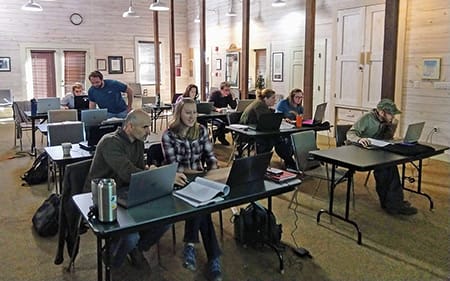
Burn prioritization modeling seminars and fire modeling tools are supported by Wildland Fire Science to train managers in the important planning stages of prescribed fires.
Educating and guiding the next generation of fire researchers and managers is a key goal of Wildland Fire Science and a resource for testing new ideas in fire research.
Tall Timbers hosts the premier fire technology transfer organization—the Southern Fire Exchange. This JFSP funded effort helps connect research to management through webinars, workshops, and support of the Prescribed Fire Science Consortium.
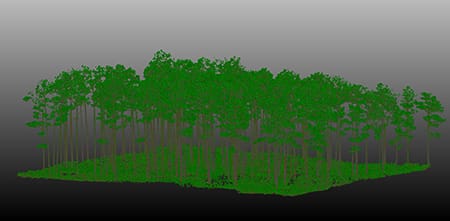
Working with partners in the Prescribed Fire Science Consortium, the program is building nexgen 3-D fuel beds using terrestrial LiDAR and novel sampling techniques to power new fire behavior models for prescribed fire managers. This work links to Tall Timbers work in wildlife habitat usage and ecological forestry.
The Longleaf Legacy landscape prescribed fire burn team arm of Wildland Fire Science works directly with landowners and partners to effectively put fire on the ground and promote prescribed fire throughout the region.
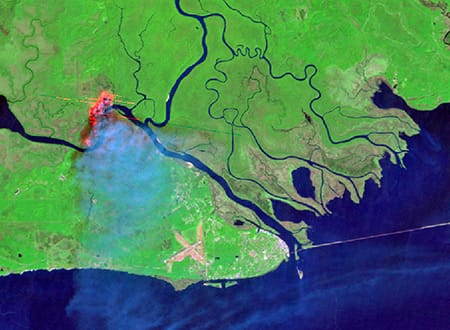
Tall Timbers is leading an effort to map fire regimes at the landscape scale. Staff work with numerous agencies to evaluate fire records and satellite imagery to build this critical conservation database. https://skfb.ly/6DqOY
Tall Timbers hosts the Prescribed Fire Science Consortium, a national network of researchers and managers who promote integrated research and management to advance next generation tools for fire practitioners. https://arcg.is/1DSjDT
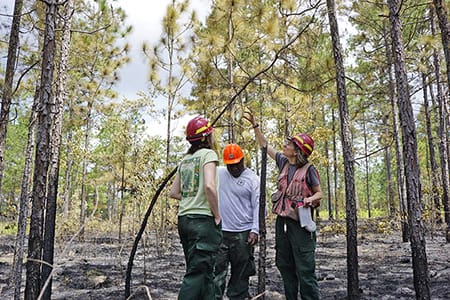
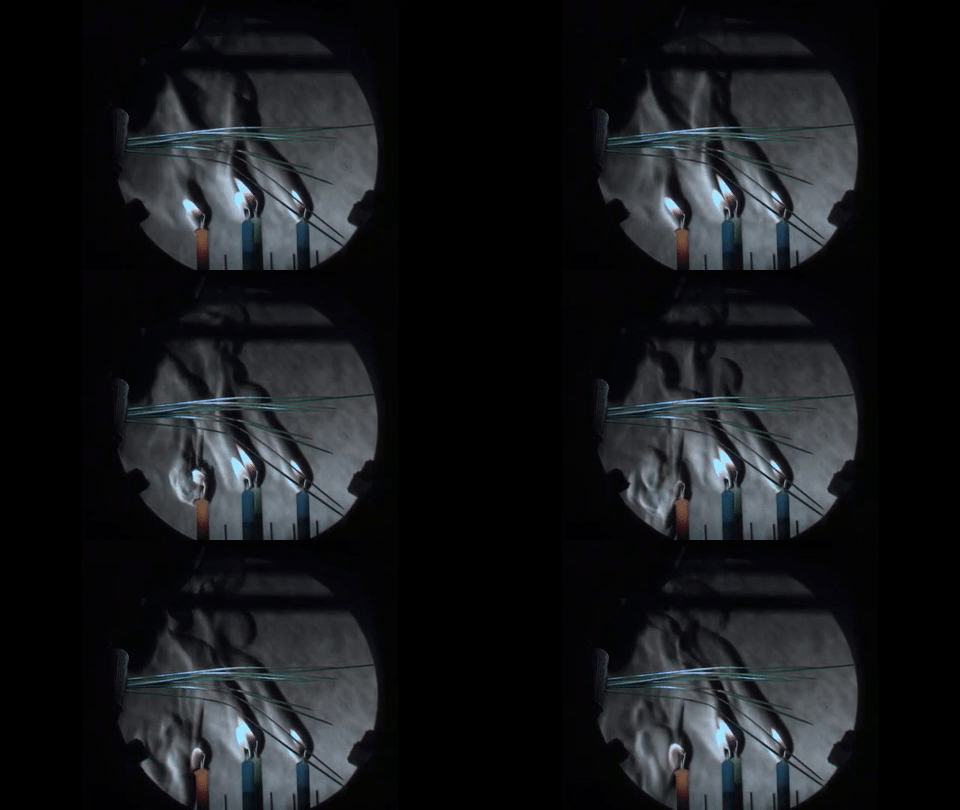
We are linking physics and field observations to understand the fluid dynamics of fire behavior surface fire regimes. Our work combines field observations using advanced thermal imaging techniques, laboratory studies, and coupled fire-atmospheric modeling to help managers improve outcomes of managed fire regimes.
Selected Publications authored by Wildland Fire Science staff.
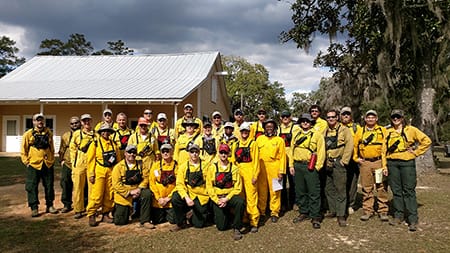
Staff and researchers support Federal fire training by serving as a cadre for NWCG training courses, ranging from basic wildland fire to advanced fire effects.
(PFTC) specializes in training fire fighters the principles and techniques of prescribed fire through practical hands-on experience. https://www.fws.gov/fire/pftc/
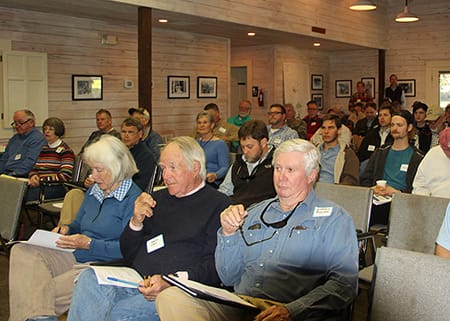
Private land owners are the largest source of prescribed fire in the country. These land owners and the culture of fire that was maintained by them during decades of suppression are a part of why Tall Timbers is a world-wide center for prescribed fire science. Workshops and fire training are a critical focus of the Longleaf Legacy Landscape Burn Team and our support of the Georgia Forestry Commission Prescribed Fire Center in Marion County.
The conserved lands of the Greater Red Hills region are found on working, income-producing properties that support agriculture, forestry, and recreational hunting. These properties contribute $272 million annually to local economies and support 2,300 jobs. [link to Planning & Advocacy section] The landowners’ strong stewardship ethic preserves their working lands while replenishing drinking water supplies, protecting water quality, and providing wildlife habitat for dozens of rare and endangered species. Tall Timbers’ conservation easements on these working properties encourage landowners to retain their traditional livelihood by keeping farms in family ownership.
Home to world-class wild quail populations, the Greater Red Hills region contains the largest concentration of gamebird preserves in the United States. These preserves also support the largest community of Red-cockaded woodpeckers on private lands. Indicators of high quality habitat found here include the gopher tortoise, Bachman’s sparrow, fox squirrel, and many amphibians. Tall Timbers’ conservation easements identify and protect the critical habitats of these species.
The region also boasts outstanding aquatic resources. Large river systems, like the Flint/Apalachicola, Ochlockonee, and Aucilla, flow from Georgia and feed into the Gulf of Mexico to support some of the world’s most productive estuaries. Large disappearing sinkhole lakes, like Iamonia, Miccosukee, and Jackson, provide habitat for an array of aquatic species and migratory birds. Tall Timbers’ conservation easements protect these vital watersheds and wetlands that are the lifeblood for the ecological health of the region.
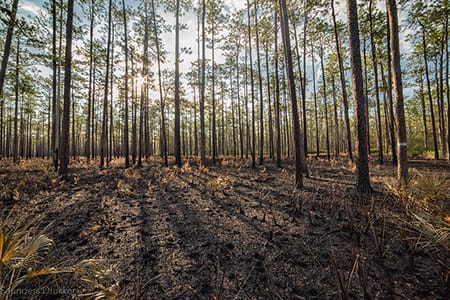
Once dominated by longleaf pine, our pine woodlands support abundant wildlife and local economies. These forests need prescribed fire to stay healthy. Herbert L. Stoddard and his associates Ed and Roy Komarek were pioneers in this emerging scientific field during the mid-20th century. Tall Timbers continues that legacy with applied research on prescribed fire and land management. Today, there is a tremendous need to expand prescribed fire use beyond the Red Hills to ensure ecosystem health and reduce wildfire risk. Additionally, Tall Timbers uses conservation easements to permanently protect private woodlands while balancing the need for economic return from selective timbering.