Prescribed fire and air quality – getting the right numbers
By Dr. Kevin Robertson, Fire Ecology Scientist
One of the biggest threats to prescribed burning is increasingly strict air quality regulations. Fire emits "particulate matter" (PM) into the air as part of smoke, and PM can cause health problems. Although prescribed burning in the South contributes a very small percentage of total PM relative to coal burning power plants and automobiles, large amounts of PM are released in one place for a short time while burning, making prescribed burning a visible and relatively easy target for restriction. Our ability to use prescribed burning in the future will depend heavily on air quality agencies having accurate numbers for how much PM is emitted by prescribed burning, so that they may pursue appropriate policies for protecting the public’s health.
Inventories of PM produced by burning are built from estimates of area burned, amount of fuel consumed, and an "emission factor" used to calculate amount of PM released per biomass burned or carbon dioxide (CO2) released. The emission factor has traditionally been calculated by measuring PM and CO2 in the air before and during burning to estimate the amounts released and then taking the ratio of the two amounts. However, there are reasons to believe that the air measured during burns does not have all of the pre-fire CO2, which would skew the calculations. The implications of such error for accurately inventorying PM emitted from prescribed fires and advising air quality policy could be widespread.
In collaboration with Dr. Y. Ping Hsieh and Dr. Glynnis Bugna of Florida A&M University, the Fire Ecology Program has acquired a National Science Foundation grant to improve estimates of emission factors in southeastern U.S. natural communities. The new approach involves using carbon isotope analysis to directly measure how much of the CO2is actually emitted from the fire, thus improving the emission factor and PM estimates. Research is under way and early results are promising. We plan to share the results with state and federal air quality regulators and public land managers in workshops held in Tallahassee, Florida and Atlanta, Georgia.
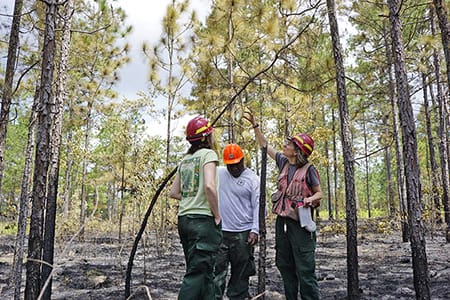
Above, Dr. Bugna preparing the air sampler to collect particulate matter and carbon dioxide from a prescribed burn on Tall Timbers Research Station and Land Conservancy.
Independent projects by Tall Timbers interns expand our knowledge base
By Jim Cox, Vertebrate Ecology Scientist
Internships provided by Tall Timbers represent wonderful opportunities where budding wildlife biologists learn new skills and have a chance to become immersed in real-world field studies. Interns in the Vertebrate Ecology Program also are encouraged to spend a portion of their time working on independent projects that provide young minds with a chance to learn some of the basics of experimental design and data collection and analysis. In some instances, these projects also have helped to expand our knowledge base and introduced interns to the process of preparing and submitting scientific publications.
Two former interns at Tall Timbers recently submitted scientific papers based on the independent projects they pursued during their internships. Aubrey Sirman, now a senior at Florida State University, studied singing frequency in Bachman’s Sparrows in 2009 and found that most of the males heard singing in May and June were actually very lonely. Bachelor sparrows that have yet to attract females sing nearly 30-times more frequently than males that are paired at this time of year, and nearly half the males monitored in May and June typically were not paired. It makes sense for unpaired males to advertize their availability, but the results have implications for surveys based on counts of singing males and what such counts mean in terms of site suitability. Based in part on Aubrey’s data, we are developing new methods for assessing site productivity to help determine whether sites with lots of singing males also represent sites that produce lots of young sparrows.
Emily Pipher, now a second-year Masters student at the University of Manitoba, recently published a paper based on field observations that she made on the Wade Tract in 2008. While monitoring provisioning rates for color-banded males, Emily saw a Bachman’s Sparrow carrying a small lizard to its nest. She quickly snapped a picture of the bird, with the Carolina Anole hanging from its beak, and found out that this was the first instance where a North American sparrow had been observed feeding on another vertebrate. Seems these seed and insect loving birds like a little meat in their diet now and again.
Other independent intern projects have helped to determine the detectability of brown-headed nuthatches and Bachman’s Sparrows when different survey techniques are used, as well as methods for quickly expelling flying squirrels from the cavities used by red-cockaded woodpeckers. The projects also apparently create a thirst for field research because two-thirds of recent interns in the program are now engaged in graduate studies in ornithology. If you’d like to sponsor a summer internship in 2011, contact Vann Middleton at 850.893.4154, x343 or vann@ttrs.org.
Obtain burn authorization from local Division of Forestry – day of burn.
Begin conducting prescribed burns as needed.
Forestry
It is an extremely poor seed year for longleaf on many properties in the region. Delay burning one more year in blocks where you captured longleaf regeneration last year.
Plant longleaf seedlings where needed.
Make plans for thinning and other cultural treatments in stands for periods of dry weather.
Game Bird
Prepare fire breaks to burn 50-60% of area in 25-500 acre patches depending on weather, populations, and predation.
Complete disking of fields for brood habitat.
Spread supplemental feed at 2 bu/ac/yr (we will customize each year).
Take soil samples in dove field.
Burn low areas and turkey woods in late February if dry.
Land Management
Complete any planting of mast-producing trees and shrubs as needed for wildlife food and cover.
Disk strips in fallow fields to promote ragweed and partridge pea for bobwhite quail.
Prescribe burn pine stands.
Lime/bottom plow old fields if needed.
Draw down moist soil management ponds for migrating shore birds.
Vertebrate Ecology
Clean and repair eastern bluebird nest boxes.
Clean and repair wood duck nest boxes; install new ones.
March Management Recommendations
Fire Ecology
Burning after bud break on woody stems (usually after March 1) appears to be the most effective means of reducing vigor of re-sprouting
Consider burning stands of native grasses mixed with domestic grasses as this time of the year.
It is a moderately grassy year. Use ignition patterns that result in less intense burns and minimize crown scorch, e.g. spot ignition, lighting flanks into the wind, and using backing fire, instead of strip head fires.
Along major highways, minimize the distance burned along the highway edge in one day, and mop up aggressively to prevent smoke on the roads.
Forestry
Because it is a extremely poor mast year for longleaf on many properties, put off burning for 1-2 years in places where you captured regeneration last year.
Initiate timber stand improvement thinnings, hardwood removal and other cultural treatments in forest stands.
Delay cutting in areas where heavy equipment will cause severe rutting.
Game Bird
Drain Duck Ponds and take soil samples.
Supplemental Feed at 2 bu/ac/yr.
Burn old-field lands now through April.
Nest predator management should begin now if needed.
Take time for dog training.
Land Management
Prepare wider fire lanes when burning during the driest time of year and always have water tanks available for suppression.
Avoid disking around wetlands and ponds as many reptiles and amphibians are actively moving to wetter areas for breeding.
Plant native grasses, forbs, and legumes.
Prepare for wildflower bloom season in late March in most parts of Florida as tubular flowers like honeysuckle will attract wildlife species, such as the ruby-throated hummingbird.
De-water flooded areas to promote growth of wetland vegetation.
Mow clover patches to stimulate re-growth while trying to avoid areas where ground nesting birds may lay eggs.
This April, Tall Timbers will host the second Public Lands Summit. This event follows the first Public Lands Summit held at Tall Timbers in November 2005, with Florida’s management agency leadership in attendance. At the meeting, it was recognized that there was a tremendous need for managing declining wildlife species on public lands in Florida by increasing prescribed fire frequency, managing timber, building partnerships and monitoring results. The outcome was the Upland Ecosystem Restoration Project (UERP), which through public-private partnerships now influences management on nine public land focal properties in Florida — influencing management on over 100,000 acres. UERP receives support and advice from its primary partners, which include: the Florida Department of Environmental Protection, the Florida Division of Forestry, the Florida Fish and Wildlife Conservation Commission and the US Forest Service.
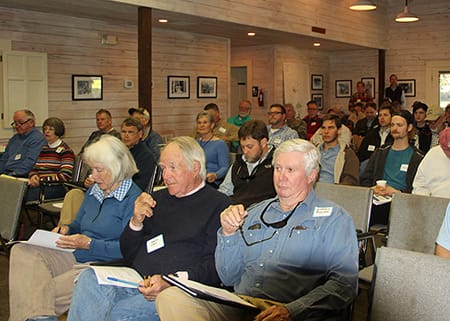
Attendees at the 2005 Public Lands Summit
The second Public Lands Summit will report to agency leaders, representatives, and conservation groups on the successful UERP model, the continuing challenges Florida faces in managing upland habitats, and develop a vision for the future of upland ecosystems in Florida.
Tall Timbers continues to be your advocate for protection of the greater Red Hills region’s lands, traditions and values
By Lane Green, Executive Director
In most every issue of E-News or our other bulletins you will see something related to land use issues and advocacy for protecting traditional land uses, the right to use fire, land stewardship, hunters as conservationists, and wildlife management regulations. Over the past 20 years, we have been very politically and publicly active while still maintaining our standards of excellence in research, conservation and on-the-ground management information and products. Our regional planning coordinator, Neil Fleckenstein, tracks and engages us in issues that threaten the traditions and values that we hold dear. Positions on any of these issues are only adopted after a confirming vote of our Board of Trustees. We have to be strategic and focused on positions we take as they are usually costly in terms of staff time and money. Of the many issues we have taken a long term interest in, the right to use prescribed fire, is always a top priority. Just recently I had the honor and opportunity to address the new Governor and Cabinet members in Florida as they adopted a resolution for proclaiming Prescribed Fire Awareness Week, January 23-29. Tall Timbers has always been and always will be out front in these forums by working to maintain and enact favorable legislation, working with our public partners at the local, state and Federal levels and playing a leadership role in Prescribed Fire Councils in Florida and Georgia. The mission of these Councils is to protect the right to burn, to encourage the use of fire, and to promote public awareness and understanding of the natural role of fire.
There are 23 advocacy positions that Tall Timbers has been involved in since 1990. Most have been successful from our view point, even with the compromises necessary to keep us in the game. Recently, we have been involved in: coal plant issues that could threaten the use of prescribed fire due to the impact of their emissions on air quality in our region; zoning and comprehensive land use plan amendments in neighboring counties; mobility plans that could threaten rural lands and future land uses; scenic rural road protection, and river corridor protection that could threaten our lakes and streams. The list goes on and on. Be assured that we are ever vigilant – looking out for the interests of landowners in the region. Many of you have probably been called on to help in these causes and we are most grateful for the time, energies and resources you have committed. Rest assured you will be needed again in the future. You can count on it, and we hope you will be just as willing and eager to answer that call when it comes, as you have in the past.
If you have questions or comments about any of these issues or others that we may not know about yet, please contact Neil Fleckenstein, 850-893-4153, ext. 335 or Lane at ext. 239.
The M-CORES program, which includes the proposed Suncoast Connector Toll Road in Jefferson County, passed through the Florida Legislature at breakneck speed with little review or analysis. Tall Timbers has a number of concerns given the potential for significant and wide spread impacts. These include fragmenting public and private conservation lands, robbing business from Main Street Monticello, impacting our rivers and other water resources, and making prescribed fire more difficult and costly.
Join us in asking the Jefferson County Board of County Commissioners to OPPOSE the Suncoast Connector toll road and its path through Jefferson County.
Take action now with our easy email form.
Send an email to all five Jefferson County Board of County Commissioners with one click!
Burn prioritization modeling seminars and fire modeling tools are supported by Wildland Fire Science to train managers in the important planning stages of prescribed fires.
Educating and guiding the next generation of fire researchers and managers is a key goal of Wildland Fire Science and a resource for testing new ideas in fire research.
Tall Timbers hosts the premier fire technology transfer organization—the Southern Fire Exchange. This JFSP funded effort helps connect research to management through webinars, workshops, and support of the Prescribed Fire Science Consortium.
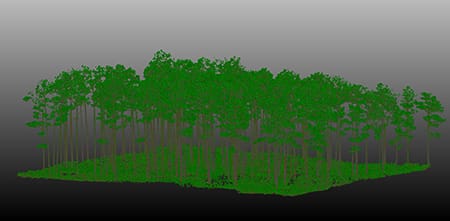
Working with partners in the Prescribed Fire Science Consortium, the program is building nexgen 3-D fuel beds using terrestrial LiDAR and novel sampling techniques to power new fire behavior models for prescribed fire managers. This work links to Tall Timbers work in wildlife habitat usage and ecological forestry.
The Longleaf Legacy landscape prescribed fire burn team arm of Wildland Fire Science works directly with landowners and partners to effectively put fire on the ground and promote prescribed fire throughout the region.
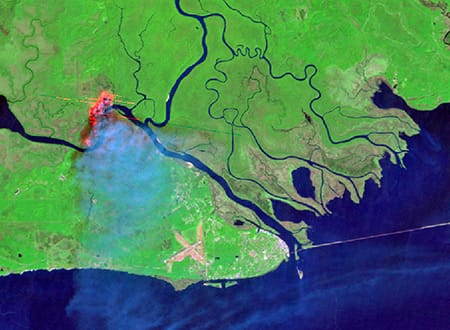
Tall Timbers is leading an effort to map fire regimes at the landscape scale. Staff work with numerous agencies to evaluate fire records and satellite imagery to build this critical conservation database. https://skfb.ly/6DqOY
Tall Timbers hosts the Prescribed Fire Science Consortium, a national network of researchers and managers who promote integrated research and management to advance next generation tools for fire practitioners. https://arcg.is/1DSjDT
We are linking physics and field observations to understand the fluid dynamics of fire behavior surface fire regimes. Our work combines field observations using advanced thermal imaging techniques, laboratory studies, and coupled fire-atmospheric modeling to help managers improve outcomes of managed fire regimes.
Selected Publications authored by Wildland Fire Science staff.
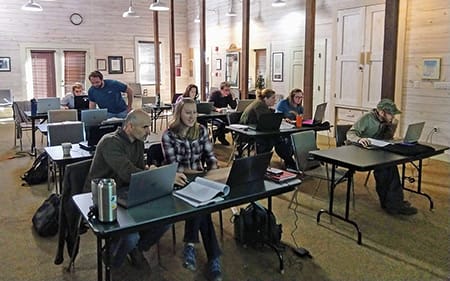
Staff and researchers support Federal fire training by serving as a cadre for NWCG training courses, ranging from basic wildland fire to advanced fire effects.
(PFTC) specializes in training fire fighters the principles and techniques of prescribed fire through practical hands-on experience. https://www.fws.gov/fire/pftc/
Private land owners are the largest source of prescribed fire in the country. These land owners and the culture of fire that was maintained by them during decades of suppression are a part of why Tall Timbers is a world-wide center for prescribed fire science. Workshops and fire training are a critical focus of the Longleaf Legacy Landscape Burn Team and our support of the Georgia Forestry Commission Prescribed Fire Center in Marion County.
The conserved lands of the Greater Red Hills region are found on working, income-producing properties that support agriculture, forestry, and recreational hunting. These properties contribute $272 million annually to local economies and support 2,300 jobs. [link to Planning & Advocacy section] The landowners’ strong stewardship ethic preserves their working lands while replenishing drinking water supplies, protecting water quality, and providing wildlife habitat for dozens of rare and endangered species. Tall Timbers’ conservation easements on these working properties encourage landowners to retain their traditional livelihood by keeping farms in family ownership.
Home to world-class wild quail populations, the Greater Red Hills region contains the largest concentration of gamebird preserves in the United States. These preserves also support the largest community of Red-cockaded woodpeckers on private lands. Indicators of high quality habitat found here include the gopher tortoise, Bachman’s sparrow, fox squirrel, and many amphibians. Tall Timbers’ conservation easements identify and protect the critical habitats of these species.
The region also boasts outstanding aquatic resources. Large river systems, like the Flint/Apalachicola, Ochlockonee, and Aucilla, flow from Georgia and feed into the Gulf of Mexico to support some of the world’s most productive estuaries. Large disappearing sinkhole lakes, like Iamonia, Miccosukee, and Jackson, provide habitat for an array of aquatic species and migratory birds. Tall Timbers’ conservation easements protect these vital watersheds and wetlands that are the lifeblood for the ecological health of the region.
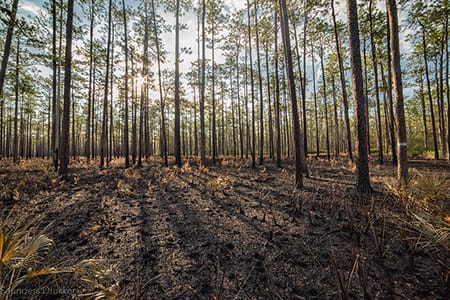
Once dominated by longleaf pine, our pine woodlands support abundant wildlife and local economies. These forests need prescribed fire to stay healthy. Herbert L. Stoddard and his associates Ed and Roy Komarek were pioneers in this emerging scientific field during the mid-20th century. Tall Timbers continues that legacy with applied research on prescribed fire and land management. Today, there is a tremendous need to expand prescribed fire use beyond the Red Hills to ensure ecosystem health and reduce wildfire risk. Additionally, Tall Timbers uses conservation easements to permanently protect private woodlands while balancing the need for economic return from selective timbering.