Ross Morrell spoke about the materials found at the Jones Tenant Farm dig site.
Staff, volunteers and former tenant family members at Tall Timbers were saddened to learn of the death of Ross Morrell on July 9, 2020. He had a long history of work with Tall Timbers as the State Historic Preservation Officer and later at the Florida Fish and Wildlife Conservation Commission. It was after his retirement from the state that he became directly involved with Tall Timbers as the project archaeologist for the restoration and interpretation of the Jones Family Tenant Farm.
Ross Morrell and young folks who participated at the Jones Tenant Farm Dig Day in 2012
He didn’t just unearth materials from the site, but he got to know the former tenants in order to better understand just how certain tools and other house whole goods were used during the active days of the farm. The audio portion of the Syrup-Making operation features Ross and Alex Sloan discussing the steps from the harvesting of the sugar cane, until the final syrup was rendered and stored for either home consumption or sale. He made understanding the past through the study of artifacts and oral history interesting to all who worked with him. Long after his project survey reports were complete he returned several times for youth “archaeology days.” Those were always special days when Ross treated these young students with the same respect he had for his graduate students. He made learning about archaeology fascinating for all educational levels.
Volunteers and former tenants plan to hold a celebration of remembrance for Ross by planting a tree near the Jones Tenant Farm, after the property is again open to the public. For information about this event, contact Juanita Whiddon at 850.566.3390.
Ross Morrell and 2012 Dig Day participants at the Jones Family Tenant Farm dig site.
Suncoast Connector Toll Road: What we are Learning
Update — As many eNews readers know, Tall Timbers is deeply concerned about the potential impacts of the Suncoast Connector toll road, a proposed 150-mile toll road corridor extending from Citrus County through Jefferson County in the Red Hills (https://talltimbers.org/suncoast-connector-toll-road-update-2/). In this update, we will share key results from recent studies by subject matter experts who are helping shed light on this risky project.
Before getting to that however, if you have not already done so, please sign up to receive periodic updates and occasional requests to help us respond to this threat to the Red Hills (for example: sending an email to the Florida DOT or to a local county commissioner). Your help is vital as Tall Timbers and our partners cannot do this alone!
Economic Feasibility and Transportation Need — Florida TaxWatch, an independent, non-profit taxpayer research institute focused on improving productivity and accountability of Florida government, recently completed a detailed analysis of the proposed Suncoast Connector toll road (https://floridataxwatch.org/). In the interest of full transparency, Tall Timbers is a member of Florida TaxWatch. Analysts at Florida TaxWatch found that:
The Suncoast Connector toll road could cost between $4.0 billion and $10.5 billion. If toll revenues are not sufficient to meet debt service requirements, tolls paid by drivers on other Turnpike segments would help subsidize the Connector, taking revenue away from needed improvements in heavily traveled Central and South Florida. As important, the new toll road may also require funding from the State Transportation Trust Fund, diverting money from locally needed transportation projects.
There is a lack of demonstrated need for the project. The large portion of U.S. 19 that is located in FDOT District 2 is operating at only 3 percent capacity at peak hour times. Based on FDOT District 2 projections, peak hour operating capacity is only expected to increase from 16.3 percent to 18.8 percent between 2018 to 2045.
Florida has a well-established and fiscally sound transportation planning process. Local and regional projects start with an identified need. These projects go through extensive review and vetting including cost projections and project rankings at several levels in the process. If they are needed and cost feasible, they can be included in the district work programs. The Suncoast Connector project did not go through any of these steps and was approved by the Legislature in only 74 days. The traditional DOT planning process exists for good reason.
FTW also highlighted some of the many examples of toll revenues falling well short of optimistic projections. They conclude their report stating “This TaxWatch analysis finds that the Suncoast Connector is a risky project with what is sure to be a large price tag and little demonstrated transportation need. Complicating the process is that this project is moving forward while COVID-19 has the state facing major reductions in government revenue—including gas taxes and tolls.”
Resiliency of the Suncoast Connector study area — There are other major concerns with the proposed Suncoast Connector as well. University of Florida researchers evaluating the resiliency of the Suncoast Connector planning area for Tall Timbers found that:
Over 50 percent of the study area where the existing U.S. 19/U.S. 27/U.S. 98 corridor is located and where a new toll road might be built is located in the 100-or 500-year floodplain. At least 30 percent is vulnerable to storm surge from a Category 5 hurricane at current sea levels. This risk will only increase over time due to projected sea level rise and stronger storms.
Expansion of roadway infrastructure within the Suncoast Connector study area will significantly increase the amount and cost of development and assets at risk from intensifying coastal hazards. This induced development will result in higher costs for mitigation and recovery from storm events and sea level rise.
UF researchers conclude that “The probability of significant and irreversible change in the study area, coupled with a high degree of vulnerability to existing and future coastal hazards suggests that this region has low suitability for supporting the kind of new toll road and infrastructure corridor proposed in the M-CORES project.” https://talltimbers.org/suncoast-connector/
Conservation and Natural Resource Protection —Tall Timbers is also worried about the impact that construction of the Suncoast Connector toll road would have on public and private conservation lands and the natural resources they protect. The Suncoast Connector study area cuts through the heart of one of the most ecologically sensitive, largely undeveloped areas remaining in Florida. Importantly, Florida taxpayers have already invested over $418 million conserving land and water resources in the toll road planning area through Florida Forever and other land conservation programs. Why would we jeopardize this investment on such a risky, unnecessary gamble?
Recommendations — For these reasons, Tall Timbers strongly opposes the construction of a new toll road corridor or the co-location of new travel lanes within the existing US 19 corridor from Jefferson County through Levy County. In lieu of building a new Suncoast Connector toll road through the Big Bend, Tall Timbers supports:
Transportation improvements in rapidly growing Citrus County —which could include tolled roadways and non-tolled multi-modal projects — to address mobility challenges in that rapidly growing county;
Investment in local mobility projects north of Citrus County that are broadly supported by the local community, businesses, and residents;
Investment in needed infrastructure — such as broadband — in existing rural communities in the corridor; and
Further consideration by DOT of the consensus recommendations contained in the 2016 I-75 Relief Task Force Report for enhancing traffic flow in Central and North Florida.
For additional information — contact Red Hills Planning Coordinator Neil Fleckenstein or Tall Timbers CEO/President Bill Palmer.
Carbon Consequences: Modeling Future Fire Risk in North Florida
By E. Louise Loudermilk and J. Kevin Hiers
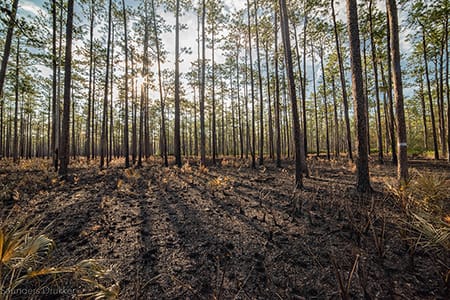
Prescribed burn in pine flatwoods
Extreme fire weather events are the major driver of wildfire in the Southeast, and prescribed fire is our best tool for mitigating those wildfires. Some specific landscapes in the region are particularly prone to large wildfires, including the swamps and pine flatwoods connecting the Okefenokee National Wildlife Refuge to the Osceola National Forest. One of the unlikely forest types in that landscape that can contribute to extreme fire behavior are hardwood-cypress swamps. Under certain conditions, these ephemeral wetlands can work with their more frequently burned neighbors, pine flatwoods, to sustain immense wildfires, cause substantial smoke emissions, and deplete carbon stores in these forests. Pine flatwoods typically contain longleaf pines (Pinus palustris) and are managed with frequent prescribed fire and timber harvest.
Our colleagues, Dan Krofcheck and Matthew Hurteau at the University of New Mexico, and Robert Scheller at North Carolina State University worked with us on a recent study published in the journal Ecosphere and funded by the USDA Forest Service, Joint Fire Science Program to examine these complex interactions. At the Osceola National Forest in Florida, our group examined long-term management practices during extreme fire weather across these two vastly different, yet intertwined ecosystems.
Border between ecosystems on the Osceola National Forest
Like the longleaf pine forests in most of North Florida, the removal of fire is really the disturbance in pine flatwoods because, without fire, southern pine forests can quickly accumulate fuel loads for wildfire or eventually transition to a hardwood or shrub ecosystem within a few decades. This study looked at future forest outcomes of removing prescribed fire, using prescribed fire while targeting harvests in zones adjacent to wetlands, or leaving a standard rotation of prescribed fire within the landscape. We asked, what were the changes in wildfire, ecosystem and long-term carbon stocks given the inevitable onset of future wildfires under these management scenarios and anticipated changes in extreme fire weather?
We found that targeted placement and frequent application of management can limit large wildfires and maintain ecosystem carbon stocks through time. Model results showed that targeting overstory thinning treatments to the interface of the hardwood–cypress swamps and maintaining the pine flatwoods edges with prescribed burning limited the spread of high‐severity wildfire at the landscape scale during severe droughts. This strategy also maintained more stable landscape carbon levels. This study highlights the importance of understanding how changes to fire weather severity may alter future fire regimes and consequently carbon stability of these highly interspersed yet functionally dissimilar ecosystems. Optimizing prescribed fire and timber harvest at the landscape scale is critical to managing these risks in regions where wetlands can contribute to large fire growth, particularly during drought. This strategy sustains forest carbon which also leads to environmental stability, enabling the continued use of the forest’s resources, including hunting, birdwatching, and recreation regardless of changes in future drought severity.
Tall Timbers Receives Grant to Control Feral Swine
Tall Timbers received the Florida-Georgia Red Hills Region Pilot Feral Swine Control Grant in July of 2020. This is a joint project between Natural Resources Conservation Service (NRCS), the United States Department of Agriculture (USDA) – Wildlife Services (WS), and Tall Timbers. With funding from NRCS, Tall Timbers’ role is to supply the WS trappers with all necessary supplies for control techniques, conduct research and monitoring, and coordinate workshops and surveys. Wildlife Services is providing trapping services and workshops for Best Management Practice education to landowners and managers.
The purpose of this pilot project is to reduce feral swine (hogs) in the Red Hills Region by at least 75%, with a goal to reduce the physical damage hogs cause by at least 80%. To determine if goals have been achieved, Tall Timbers will monitor:
1. Native wildlife;
2. Water quality, including E. coli source tracing;
3. Feral swine population and control;
4. Economic impacts of feral swine;
5. Native habitat (upland and wetlands) and crop damage.
There are 17 such pilot projects nationwide, including one in the Albany area run by the Flint River Soil and Water Conservation District, the Jones Center at Ichauway, and the University of Georgia-Athens. Collaboration between projects will improve outcomes and lessons learned. Ultimately, these pilot projects will inform the development of a nationwide feral swine control program and guidelines, as part of future Farm Bill programs.
At this time in the Red Hills, hog control has occurred on roughly 78,000 acres, starting along the Ochlockonee River heading east, but also moving north and south, following the hog population. In the next several months, the general plan is to move south to Interstate 10, east to the Aucilla River, and north to Thomasville. The goal is to have 90% property participation, so that we don’t have pockets of feral swine as source populations.
Acres being treated by Wildlife Services to control feral swine populations.
To enroll in the program, the land owner and manager will meet with wildlife services’ trappers and Tall Timbers’ staff to outline a mutually-agreeable work plan. All entities in this program understand that this is your private land, and we will be diligent to not get in the way of any of your activities. At the same time, we need to work together to obtain desired results. The landowner will need to allow Wildlife Services staff access to use feral swine control techniques, and Tall Timbers to do the monitoring. Once again, we are very flexible and can accommodate any needs of the property. For more information please contact Eric Staller or 850-508-5458, of Kim Sash or 850-545-3982.
Tall Timbers Awarded a Grant from Park Cities Quail Coalition
Tall Timbers’ Game Bird Program is honored to be a 2020 Park Cities Quail Coalition grant recipient in the amount of $75,000. The grant will fund work to restore bobwhite quail in East Texas, by working cooperatively with landowners to manage habitat and reintroduce wild quail.
Tall Timbers received a generous endowment gift to help establish a research and management program in East Texas. In addition, we have been fortunate to have a future translocation site identified, and habitat work has begun with support from a private landowner. The Parks Cities Quail Coalition grant provides critical gap funding to help jump start our conservation work in East Texas, while we complete the endowment goal to support a scientist position in the region!
This year, Park Cities Quail Coalition raised over $1.9 million, which has allowed them to distribute grants totaling $1.5 million to organizations like Tall Timbers. Indeed, their “grant will make a difference we can all celebrate.”
The M-CORES program, which includes the proposed Suncoast Connector Toll Road in Jefferson County, passed through the Florida Legislature at breakneck speed with little review or analysis. Tall Timbers has a number of concerns given the potential for significant and wide spread impacts. These include fragmenting public and private conservation lands, robbing business from Main Street Monticello, impacting our rivers and other water resources, and making prescribed fire more difficult and costly.
Join us in asking the Jefferson County Board of County Commissioners to OPPOSE the Suncoast Connector toll road and its path through Jefferson County.
Take action now with our easy email form.
Send an email to all five Jefferson County Board of County Commissioners with one click!
Selected Publications authored by Wildland Fire Science staff.
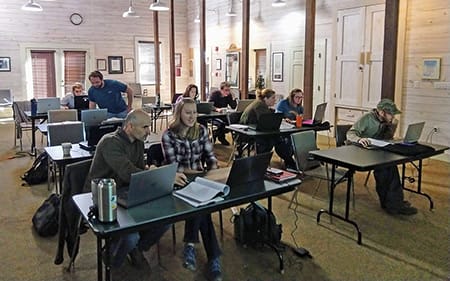
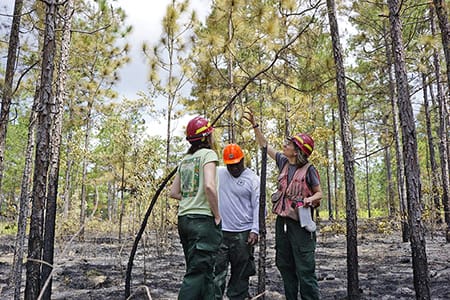
Educating and guiding the next generation of fire researchers and managers is a key goal of Wildland Fire Science and a resource for testing new ideas in fire research.
Tall Timbers hosts the Prescribed Fire Science Consortium, a national network of researchers and managers who promote integrated research and management to advance next generation tools for fire practitioners. https://arcg.is/1DSjDT
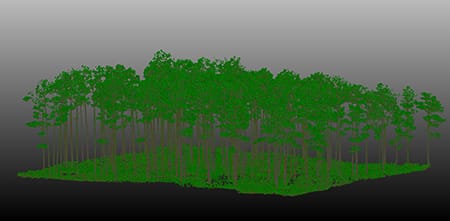
Working with partners in the Prescribed Fire Science Consortium, the program is building nexgen 3-D fuel beds using terrestrial LiDAR and novel sampling techniques to power new fire behavior models for prescribed fire managers. This work links to Tall Timbers work in wildlife habitat usage and ecological forestry.
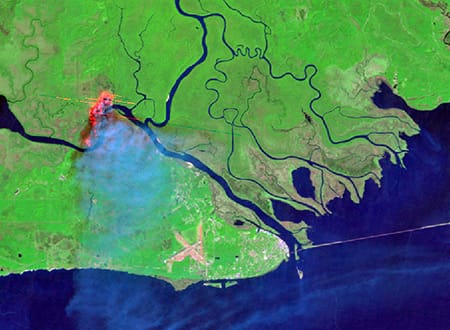
Tall Timbers is leading an effort to map fire regimes at the landscape scale. Staff work with numerous agencies to evaluate fire records and satellite imagery to build this critical conservation database. https://skfb.ly/6DqOY
We are linking physics and field observations to understand the fluid dynamics of fire behavior surface fire regimes. Our work combines field observations using advanced thermal imaging techniques, laboratory studies, and coupled fire-atmospheric modeling to help managers improve outcomes of managed fire regimes.
Burn prioritization modeling seminars and fire modeling tools are supported by Wildland Fire Science to train managers in the important planning stages of prescribed fires.
The conserved lands of the Greater Red Hills region are found on working, income-producing properties that support agriculture, forestry, and recreational hunting. These properties contribute $272 million annually to local economies and support 2,300 jobs. [link to Planning & Advocacy section] The landowners’ strong stewardship ethic preserves their working lands while replenishing drinking water supplies, protecting water quality, and providing wildlife habitat for dozens of rare and endangered species. Tall Timbers’ conservation easements on these working properties encourage landowners to retain their traditional livelihood by keeping farms in family ownership.
Home to world-class wild quail populations, the Greater Red Hills region contains the largest concentration of gamebird preserves in the United States. These preserves also support the largest community of Red-cockaded woodpeckers on private lands. Indicators of high quality habitat found here include the gopher tortoise, Bachman’s sparrow, fox squirrel, and many amphibians. Tall Timbers’ conservation easements identify and protect the critical habitats of these species.
The region also boasts outstanding aquatic resources. Large river systems, like the Flint/Apalachicola, Ochlockonee, and Aucilla, flow from Georgia and feed into the Gulf of Mexico to support some of the world’s most productive estuaries. Large disappearing sinkhole lakes, like Iamonia, Miccosukee, and Jackson, provide habitat for an array of aquatic species and migratory birds. Tall Timbers’ conservation easements protect these vital watersheds and wetlands that are the lifeblood for the ecological health of the region.
Once dominated by longleaf pine, our pine woodlands support abundant wildlife and local economies. These forests need prescribed fire to stay healthy. Herbert L. Stoddard and his associates Ed and Roy Komarek were pioneers in this emerging scientific field during the mid-20th century. Tall Timbers continues that legacy with applied research on prescribed fire and land management. Today, there is a tremendous need to expand prescribed fire use beyond the Red Hills to ensure ecosystem health and reduce wildfire risk. Additionally, Tall Timbers uses conservation easements to permanently protect private woodlands while balancing the need for economic return from selective timbering.
Tall Timbers hosts the premier fire technology transfer organization—the Southern Fire Exchange. This JFSP funded effort helps connect research to management through webinars, workshops, and support of the Prescribed Fire Science Consortium.
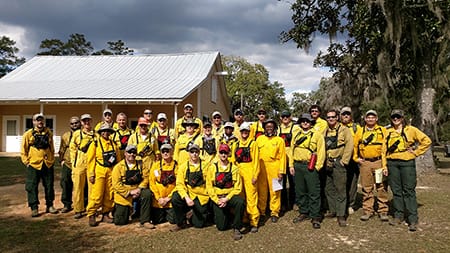
The Longleaf Legacy landscape prescribed fire burn team arm of Wildland Fire Science works directly with landowners and partners to effectively put fire on the ground and promote prescribed fire throughout the region.
Staff and researchers support Federal fire training by serving as a cadre for NWCG training courses, ranging from basic wildland fire to advanced fire effects.
(PFTC) specializes in training fire fighters the principles and techniques of prescribed fire through practical hands-on experience. https://www.fws.gov/fire/pftc/
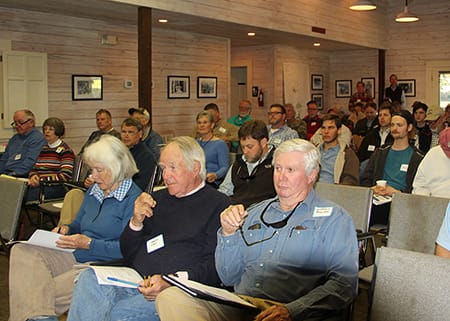
Private land owners are the largest source of prescribed fire in the country. These land owners and the culture of fire that was maintained by them during decades of suppression are a part of why Tall Timbers is a world-wide center for prescribed fire science. Workshops and fire training are a critical focus of the Longleaf Legacy Landscape Burn Team and our support of the Georgia Forestry Commission Prescribed Fire Center in Marion County.