Red Hills Spring Dinner and Easement Seminar recap
By Kevin McGorty, Land Conservancy Director
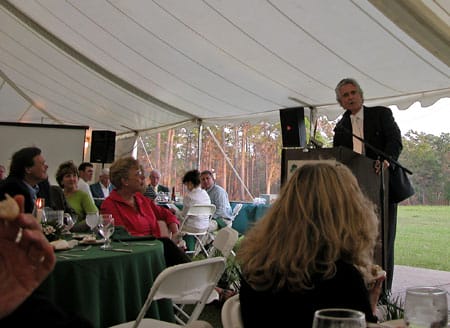
With a gentle breeze blowing off Lake Iamonia, some 200 guests celebrated the twentieth anniversary of the Red Hills Spring Dinner on April 8 at Tall Timbers. The dinner address was given by noted tax attorney, Stephen Small, who spoke at the inaugural dinner in 1991.
Noted tax attorney, Stephen Small, was the guest speaker at the 20th Anniversary Red Hills Spring Dinner held at Tall Timbers in April. Photo – Rose Rodriguez
This year’s event showcased the 2009-2010 conservation easement donors. In addition, a special tribute was given to the late Kate Ireland, one of the founders of the Tall Timbers Land Conservancy. In paying tribute to Miss Kate, Lane Green remarked that she “was the driving force behind the entire conservation movement here in the Red Hills.” On a personal note, Green stated, “She was a neighbor, mentor, boss, and ultimately my friend.”
The dinner also honored three professionals whose distinguished careers made a substantial difference in saving the Red Hills region. The late Lou Clark was considered the “dean of conservation easement appraisers” in the South. In the Red Hills, he worked with landowners to protect over 80,000 acres. His assistant, Ms. Park Palmer, fondly remembered Lou’s integrity and modesty. He was a gentle giant in both stature and in his field of expertise.
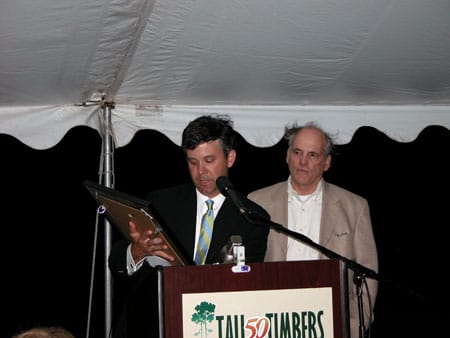
Attorneys Tommy Vann and Duby Ausley were recognized for their leadership and guidance in helping Red Hills’ landowners with conservation easements. Speaking in praise of Tommy, Vann Middleton remarked that Tommy’s firm represented “small family farms such as the historic Moody Farm in Boston, Georgia to the larger and more complex Seminole Plantation easement. Tommy has worked with a wide diversity of clients helping each of them conserve their land and its precious natural resources for future generations to enjoy.”
Vann Middleton of Tall Timbers presents attorney Tommy Vann with plaque in recognition of his exceptional leadership and distinguished legal services assisting landowners with donated conservation easements in the Red Hills. Photo – Rose Rodriguez
In his acceptance speech, Tommy observed, “The donation of a conservation easement is a team sport. If any member of the team falls down on his or her job, the whole house can collapse. It takes a charitably motivated conservation minded donor. It takes a qualified done organization, and Tall Timbers, in my opinion, is in the elite category of being qualified in this country to receive and administer conservation easements. It takes a competent lawyer to guide the client to record his or her wishes. It takes a good CPA to report the transaction and to defend it, if necessary. It takes a really good appraiser. In a recent case, I was dealing with an IRS appraiser who made an assumption at the beginning that we didn’t agree with. I said to him, ‘In railroad vernacular, when you start off on the wrong track, every station you come to is the wrong station.’ Stephen Small got us on the right track. I was at his first seminar 20 years ago, and he got me on the right track, and he got Tall Timbers on the right track. The landowners continue to be on the right track, but you have to be vigilant in your documentation, as Stephen said. You have to expect the most out of each member of the team, but remember to inspect what you expect.”
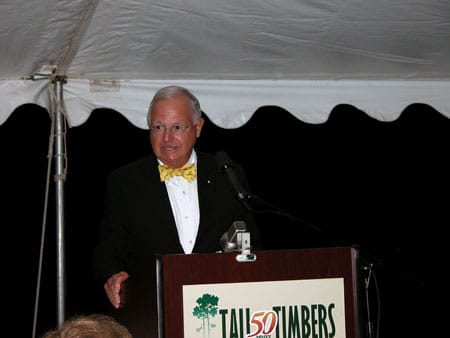
The final recipient was Duby Ausley. His firm has worked on 22 easement projects protecting over 35,000 acres in the Red Hills. Duby expressed gratitude for the honor he was given, and praised the work of Tall Timbers in preserving the beautiful Red Hills and in its quail research. Humorously, he acknowledged that he was an “accidental recipient” of honor at the dinner, since he originally opposed the idea of conservation easements for Kate Ireland’s Foshalee Plantation. Duby said he began conservation easement work when Miss Kate threatened to “get another lawyer” if he didn’t figure it out. So, he noted, “I figured it out!”In addition, he placed his own property, Mistletoe Plantation, under conservation easement with Tall Timbers. He added, “I am honored to be honored on the same podium as Tommy and Lou who are true professionals, and the same program as Kate Ireland because none of this would have happened if it wasn’t for Kate.”
Attorney Duby Ausley accepting his plaque for distinguished legal service at the Red Hills Dinner. Photo – Rose Rodriguez
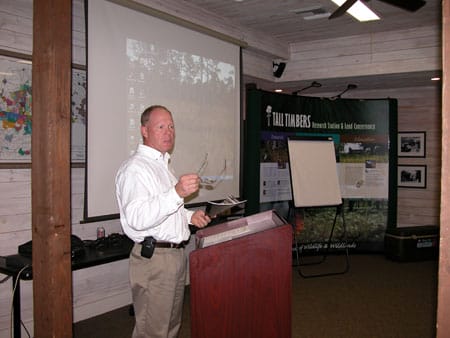
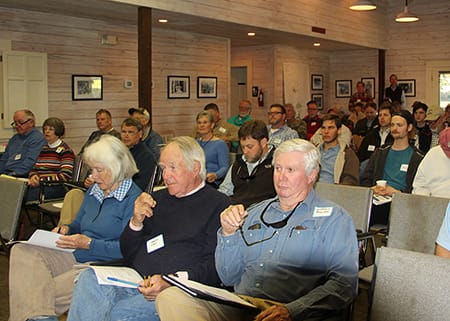
In his dinner address, and at his seminar held earlier that day, attorney Stephen Small spoke about Conservation Easements 2011: the Good, the Bad, and the Ugly, and the Next Decade. In referencing the good, he said that some twenty years ago when he gave his first speech at Tall Timbers, “it was all hope, it was all promise, it was a concept, it was all an idea that someday, maybe we’d get some conservation easements on some of these wonderful properties that make this a beautiful place to live. …That’s what was on the table in 1991, how special and how spectacular the Red Hills is, and is there something we can do to save it, to protect the open space, wildlife habitat, and the scenic views, and the quality of life and the lifestyle commitment that we’ve made? The good news is, it’s a reality now. There’s still a lot of work to do, but with 82 easements and 114,000 acres protected since 1991, that’s enormous. That’s real progress.”
The other good news he stated is the federal income tax incentives have never been better. Through the end of this year, a landowner donating a conservation easement can take 50% adjusted gross income off their taxes, and if a majority of a landowner’s income is derived from farming, ranching, or timbering, a deduction of 100% can be taken and carried forward fifteen years.
On the estate tax side, he commented that “the estate and gift tax rules in this country have never been more generous than they are right now.”With these incentives, he suggested landowners consider, “How does my family land fit into my overall estate tax situation, and is this a good time to do some planning to get my family land down to future generations?”
He talked about the “Bad and the Ugly,” and asked if there was anyone in the audience from the IRS. He spoke about bad conservation easement deals that are tainting the overwhelming good donations. According to Small, the IRS doesn’t like conservation easements, and is “on the warpath” auditing easements. Instead of rooting out overly inflated easement values or conservation easements that don’t have a clear public purpose, the IRS’ tactic is to win its cases on “technical points of law” such as not having acknowledgement gift letters. “You can donate the most significant easement in the history of the United States, and if you don’t have that gift letter, you can lose the deduction.” The IRS has been winning cases on these technical issues. He argued they should be going after the bad deals and bad actors.
He offered some tips on how to stay out of trouble with the IRS.
Stay away from the bad deals. “If a deal looks too good to be true, it is too good to be true.”
Don’t be intimidated by conservation easements or the IRS. Hire competent advisors including experienced appraisers.
Work with a land trust in good standing.
Make sure that the IRS return packet has all the forms filled out correctly, includes the conservation easement and related documents, and includes the acknowledgement letter. Having a completed packet cross the desk of an IRS agent stands a better chance of getting it “moved to the outbox” than a defective package that can be flagged for a technicality.
He concluded his remarks with four observations about the next decade.
There needs to be more financial sophistication in land trust deals, including linking a pool of investors to purchase landowner rights for a limited time to be used in the marketplace for such purposes as carbon sequestration credits, wetland mitigation credits, and timber income credits. This could turn a profit for all parties involved while protecting open land.
Land trusts should consider securing easements from non-traditional landowners, such as colleges and universities, religious organizations, and municipalities and government agencies. Lands under these entities are not protected and are vulnerable for sale. Land trusts should identify key strategic lands held under these entities that add benefit to a community.
Land trusts need more funding and capability, and therefore need to reach out to major donors.
To be sustainable and relevant, land trust organizations need to continually focus on community outreach and education, building membership, raising funds, and then repeating this cycle in order to carry out the work of saving the distinctiveness of their communities.
In April 2011, a second Public Lands Summit was held at Tall Timbers to update the state and federal agency leadership on the Upland Ecosystem Restoration Project (UERP) – its successes and challenges. UERP is a multi-agency effort to increase populations of northern bobwhites and other declining fire-dependent wildlife species.
The primary 10-year goal of the project is to establish 100,000 new acres of high quality upland habitat on public lands in Florida. In attendance at the Summit was the leadership of Florida’s agencies who manage public lands in the state: FL Division of Forestry (DOF), FL Department of Environmental Protection (DEP) and FL Fish and Wildlife Conservation Commission (FWC), as well as representatives from the US Forest Service (USFS) and other conservation groups.
While the leadership has changed since the first Summit was held in November 2005, the understanding of the value of this collaborative project to Florida’s uplands management has not.
Public Lands Summit Attendees listen to Commissioner of Agriculture Adam Putnam, who welcomed them to the Summit via conference call.
As in 2005, the main concern of the UERP project continues to be improving habitat for species of birds in serious decline, including bobwhite, Bachman’s sparrow, brown-headed nuthatch, loggerhead shrike, eastern meadowlark, as well as 40 threatened plants and animals. As an indication of the seriousness of the declines for all these species, harvest of bobwhites has declined in Florida from over 3 million just 40 years ago, to less than 100,000 today. These declines are due in large part to changes in land use in Florida; but where potential habitats still exist on our public lands, frequent fire is key to sustaining required habitat and wildlife populations. This habitat can be found on private lands (hunting preserves) in parts of the state, where bobwhite thrive, because of sustained management with frequent fire.
UERP is not like any other project in Florida, both because it is multi-agency, and also because it is a private-public partnership. Director of DOF, Jim Karels, commented on how the UERP Director, Greg Hagan, works with each agency to custom fit a management plan that suits their objectives. Taking a long-term view is critical, because habitat improvements take time and everyone is learning the best approaches of improving habitat. To facilitate learning, monitoring the vegetation and bird community responses provides feedback to both managers of properties and UERP.
Jim Karels, Director of the Florida Division of Foresty speaking at the Public Lands Summit
Benefits from UERP go beyond improving outdoor recreation opportunities for quail hunters, bird watchers and other outdoor enthusiasts. Parks Small, DEP Bureau Chief, recognized how important healthy uplands are to Florida, both from reducing wildfires and reducing management costs (it is easier to manage uplands burned every 1-3 years, than 3-5 years, as fuels for fires are much reduced). It costs roughly ten times as much to restore habitat as to maintain it and at least five times more to fight wildfires than prescribe burn! Other benefits from healthy functioning uplands include ecosystem services, which help to sustain human life, and improved resilience of ecosystems to stressors (like droughts and flooding).
Objectives, successes and challenges Ahead
Greg Hagan discussed the objectives of the project and presented some of the successes and challenges ahead.
The objectives of UERP are to develop long-term, landscape scale projects on public land with measureable targets. These targets are to:
increase populations of northern bobwhite to a bird per three acres on focal properties;
increase fire frequency to 1-2 year intervals on focal landscapes to enhance grassland communities and the wildlife species dependent upon them; and
increase upland land management activities (timber harvest, roller chopping, hardwood control) on selected areas to maintain healthy groundcover communities.
Since UERP began work in 2006, Hagan and his state and federal land management partners have been successful in restoring bobwhite and other species they are monitoring on focal properties. These properties include: Three Lakes Wildlife Management Area, Jennings State Forest, Blackwater River State Forest, Withlacoochee State Forest, Volusia County, St. Sebastian River Preserve State Park, Myakka River State Park, Apalachicola National Forest, and Osceola National Forest. The properties chosen for restoration were guided by a steering committee, comprised of agency leaders. Focal properties have high biological value, as well as important restoration value, adequate staff to implement the objectives outlined, ability to demonstrate stand-alone results, and will increase recreational opportunities for the public.
The challenges ahead Hagan says are to: “keep the good stuff good”, refine prescribed burning to meet wildlife objectives (how much fire and when), engage private partners to increase resources, and keep focused on the objectives stated above.
A successful model – accountability and action
Although all states in the southeast have plans to restore habitat for bobwhites, UERP and its state and federal partners in Florida have broken out of the continuous planning cycle. UERP provides a statewide view of the issues rather than an individual agency focus. UERP, as an independent entity, facilitates communication within and among agencies; assesses agency activities by monitoring and giving immediate feedback (accountability); and finally, UERP has been able to obtain outside dollars to directly fund increased land management through public-private partnerships.
The restoration of longleaf pine on the Osceola National Forest is an example of an UERP/Tall Timbers collaboration. Implementing UERP’s model, Carl Petrick, Ecosystem Management Staff Officer with the National Forests in Florida, is working with UERP Director Hagan, on a Collaborative Forest Landscape Restoration Project. Petrick, who spoke at the Summit, conceded that the flatwoods in Florida are in bad shape, needing twice as much prescribed burning as has been previously applied in managing the forests. Over the next five years, UERP staff will help oversee and monitor the restoration activities being conducted on the Osceola National Forest. The goal is to achieve a forest that is in good or excellent ecological condition – one that can be efficiently and effectively maintained with fire.
Sustaining and improving UERP’s momentum
The Summit concluded with a discussion by Tim Breault, Director Division of Habitat and Species Conservation, FWC, on how important it was to sustain UERP and the partnership through the tough economic climate in Florida. Rhetorically he asked, “If there were additional resources available, where would the project expand?” He noted that to keep the momentum of UERP’s success going it was important to work collaboratively with Tall Timbers to look for non-traditional partners in the private sector, to leverage the dollars available through new public-private partnerships, and to showcase the project to the legislature and the public through better communication and outreach and education activities, such as field days.
Despite severe dry weather and temperatures flirting with 100 degrees, quail nesting rate on Tall Timbers is similar to last year’s statistics. Current nesting statistics show 0.36 nests per hen versus 0.32 for hens last year. Adult survival since the beginning of the nesting season is actually higher this spring on Tall Timbers, currently at 81%, versus 72% last spring. High survival of adults bodes well for a strong mid to late season hatch as drought conditions begin to moderate. We have had just enough thundershowers to adequate provide cover areas burned in early March and later burns are now starting to recover adequate ground cover. While still early, brood captures have demonstrated normal chick survival rate, which is critical to producing high fall populations.
One statistic that is off this year a bit is early male nest incubation. On Tall Timbers, male contribution to the hatch can be as high 40%, but this year only one male has incubated a nest thus far. Managers report seeing a few broods around, but we expect the rate at which broods are seen to increase by the end of June and early July. Some managers are concerned that this year’s hatch is behind last years. The combination of a large number of birds entering the nesting season, the slow recovery of habitat in burned areas (especially late burns), and dry hot conditions may all be contributing to this feeling. However, statistics from our radio-tagged sample show reproduction is basically on track again this year.
Game bird technician, Jonathan Garrow, is documenting recent vegetation conditions during the drought. Monthly vegetation surveys are part of the long-term data collection conducted at Tall Timbers Research Station. Game bird biologist, Shane Wellendorf, compared the June field vegetation data from last year to this year. The plant height went from 48 cm last year to 26 cm this year, a 46% decrease, and the plant canopy coverage went from 69% last year to 19% this year, a 72% reduction. These observations clearly document the impacts of the recent dry conditions on vegetation quality.
The Albany area has been suffering a more severe drought than much of the Tallahassee and Thomasville areas, with some sites receiving almost no rain in the last two months and temperatures over 100 degrees. Due to the sandy soils, cover in brood fields in Albany is highly dependent on rainfall; both burned woods and brood fields are currently lacking necessary cover. Bobwhite survival on our study area in Albany has not been as high as we would like (55%). This has been a problem for the last couple of years due to low cotton rat number, but is also being magnified this year by the weather. Nesting is currently at 0.20 nests per hen, which is not far behind where we were last year (0.22), however last year was also a low adult survival year. The end result of last years’ hatch was “hold your own” or a slight decrease in bird numbers. We are hopeful that rainfall will return soon and help produce a strong late hatch more similar to what we saw in 2008.
Bobwhites on our South Carolina Study area are showing nesting rates similar to that on Tall Timbers, with nests per hen at 0.35 as of June 8. Interestingly, half of the nests thus far have been incubated in May, whereas we had few May nests in Thomasville and Albany this year. So, bobwhite reproduction across our study areas show that despite dry conditions, nesting activity is about normal where some rainfall has occurred. The huge bird numbers on some Red Hills properties, combined with large over-winter carry-over may be dampening nesting on some sites. Where rainfall has been absent and habitat has not recovered, lower survival rates of adults, and perhaps lower nesting rates, will negatively influence the early hatch. Weather forecasts predict “normal conditions” returning for July through September. With adequate rainfall we have the opportunity for a strong mid and late season hatch, which will be needed on sites suffering the worst drought conditions thus far.
The study site in Alabama is holding up much like Tall Timbers and South Carolina, with survival at 75% and nests per hen at 0.32. According to Albany Quail Project director, Clay Sisson, this site has a little better soil and has had a couple of rain showers that Albany did not have.
In these times of financial uncertainty, it is critical that we remain focused on our mission: Promoting good land stewardship through research, conservation and education. For over 50 years now, Tall Timbers has remained at the forefront of critical research in the areas of fire ecology, forestry and wildlife management. Tall Timbers continues to be a vocal advocate for private landowner rights, helping shape public policy decisions on wildlife management, prescribed fire and land conservation. It is our hope that you will continue your investment in the future of Tall Timbers by renewing your annual gift this year.
You can be assured that your financial investment in Tall Timbers is being put to great use. Our research and conservation staff is able to leverage the support of our membership program by finding matching grant dollars from foundations, government agencies and corporate resources to help fund our programs at full capacity. In many cases, for every $1 contributed to our membership program we are able to find an additional $3 to match it from outside sources.
If you have already renewed your membership gift this year, we thank you. If not, you can easily renew online www.talltimbers.org/membership.html. If you know someone who might benefit from our work, please share this link and encourage their support. Our current donors are our best salespeople. With your help we can reach our annual goal of $400,000 by the end of the year.
Thanks as always for your support of the research, conservation and education programs of Tall Timbers.
The M-CORES program, which includes the proposed Suncoast Connector Toll Road in Jefferson County, passed through the Florida Legislature at breakneck speed with little review or analysis. Tall Timbers has a number of concerns given the potential for significant and wide spread impacts. These include fragmenting public and private conservation lands, robbing business from Main Street Monticello, impacting our rivers and other water resources, and making prescribed fire more difficult and costly.
Join us in asking the Jefferson County Board of County Commissioners to OPPOSE the Suncoast Connector toll road and its path through Jefferson County.
Take action now with our easy email form.
Send an email to all five Jefferson County Board of County Commissioners with one click!
Selected Publications authored by Wildland Fire Science staff.
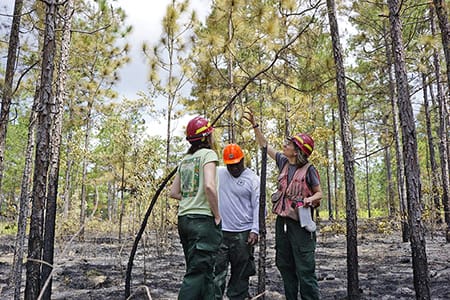
Educating and guiding the next generation of fire researchers and managers is a key goal of Wildland Fire Science and a resource for testing new ideas in fire research.
Tall Timbers hosts the Prescribed Fire Science Consortium, a national network of researchers and managers who promote integrated research and management to advance next generation tools for fire practitioners. https://arcg.is/1DSjDT
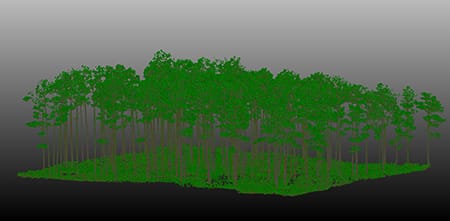
Working with partners in the Prescribed Fire Science Consortium, the program is building nexgen 3-D fuel beds using terrestrial LiDAR and novel sampling techniques to power new fire behavior models for prescribed fire managers. This work links to Tall Timbers work in wildlife habitat usage and ecological forestry.
Tall Timbers is leading an effort to map fire regimes at the landscape scale. Staff work with numerous agencies to evaluate fire records and satellite imagery to build this critical conservation database. https://skfb.ly/6DqOY
We are linking physics and field observations to understand the fluid dynamics of fire behavior surface fire regimes. Our work combines field observations using advanced thermal imaging techniques, laboratory studies, and coupled fire-atmospheric modeling to help managers improve outcomes of managed fire regimes.
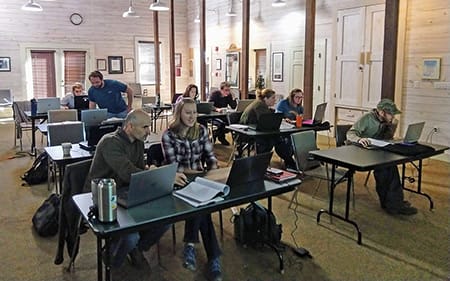
Burn prioritization modeling seminars and fire modeling tools are supported by Wildland Fire Science to train managers in the important planning stages of prescribed fires.
The conserved lands of the Greater Red Hills region are found on working, income-producing properties that support agriculture, forestry, and recreational hunting. These properties contribute $272 million annually to local economies and support 2,300 jobs. [link to Planning & Advocacy section] The landowners’ strong stewardship ethic preserves their working lands while replenishing drinking water supplies, protecting water quality, and providing wildlife habitat for dozens of rare and endangered species. Tall Timbers’ conservation easements on these working properties encourage landowners to retain their traditional livelihood by keeping farms in family ownership.
Home to world-class wild quail populations, the Greater Red Hills region contains the largest concentration of gamebird preserves in the United States. These preserves also support the largest community of Red-cockaded woodpeckers on private lands. Indicators of high quality habitat found here include the gopher tortoise, Bachman’s sparrow, fox squirrel, and many amphibians. Tall Timbers’ conservation easements identify and protect the critical habitats of these species.
The region also boasts outstanding aquatic resources. Large river systems, like the Flint/Apalachicola, Ochlockonee, and Aucilla, flow from Georgia and feed into the Gulf of Mexico to support some of the world’s most productive estuaries. Large disappearing sinkhole lakes, like Iamonia, Miccosukee, and Jackson, provide habitat for an array of aquatic species and migratory birds. Tall Timbers’ conservation easements protect these vital watersheds and wetlands that are the lifeblood for the ecological health of the region.
Once dominated by longleaf pine, our pine woodlands support abundant wildlife and local economies. These forests need prescribed fire to stay healthy. Herbert L. Stoddard and his associates Ed and Roy Komarek were pioneers in this emerging scientific field during the mid-20th century. Tall Timbers continues that legacy with applied research on prescribed fire and land management. Today, there is a tremendous need to expand prescribed fire use beyond the Red Hills to ensure ecosystem health and reduce wildfire risk. Additionally, Tall Timbers uses conservation easements to permanently protect private woodlands while balancing the need for economic return from selective timbering.
Tall Timbers hosts the premier fire technology transfer organization—the Southern Fire Exchange. This JFSP funded effort helps connect research to management through webinars, workshops, and support of the Prescribed Fire Science Consortium.
The Longleaf Legacy landscape prescribed fire burn team arm of Wildland Fire Science works directly with landowners and partners to effectively put fire on the ground and promote prescribed fire throughout the region.
Staff and researchers support Federal fire training by serving as a cadre for NWCG training courses, ranging from basic wildland fire to advanced fire effects.
(PFTC) specializes in training fire fighters the principles and techniques of prescribed fire through practical hands-on experience. https://www.fws.gov/fire/pftc/
Private land owners are the largest source of prescribed fire in the country. These land owners and the culture of fire that was maintained by them during decades of suppression are a part of why Tall Timbers is a world-wide center for prescribed fire science. Workshops and fire training are a critical focus of the Longleaf Legacy Landscape Burn Team and our support of the Georgia Forestry Commission Prescribed Fire Center in Marion County.