New gopher tortoise research at the Wade Tract Preserve
Tom Radzio, a graduate student in Dr. Michael O’Connor’s lab at Drexel University in Philadelphia, Pennsylvania is conducting research into the physiological and conservation ecology of young Gopher Tortoises at the Wade Tract. The work focuses on determining how environmental characteristics influence behavior, growth, and survivoral in juvenile and sub-adult tortoises.
This summer, 10 small, immature tortoises and 10 adult females will be outfitted with radio transmitters and temperature recorders. Video recording devices set near burrows will monitor the activities of two immature and two adult tortoises per day in order to compare basking, foraging, and anti-predator behavior between cohorts. Future work may determine how forest canopy density influences individual and population growth rates or how forage quality might influence feeding time and associated predation risk in young tortoises.
Land Management and Research: Collaboration Brings Positive Results
By Ron Masters, Director of Research
Over the past decade the Research Department at Tall Timbers has focused on creating a collaborative atmosphere among the science and land management staff. We operate on a philosophy that land management on Tall Timbers is research. The difference between land management here and that practiced by some others is that of monitoring and measurement of outcomes wrapped in an experimental design. As Herbert L. Stoddard, Sr. once remarked, “land management is an art that builds on history and is based in science.”
During this time period we have pieced together some long-term data needed to illustrate where land management and research has taken us throughout our history. Period photographs prior to the 1950s from various places on Tall Timbers illustrate a landscape that varied from pine dominated forests to open woodlands interspersed with fallow fields and a ground cover dominated by broomsedge bluestem (Andropogon virginianus) and a few weedy species.
A hunting scene at Tall Timbers in 1926, shows the landscape dominated by broomsedge bluestem.
By the late 1970s and early 1980s, hardwoods had encroached and were becoming much more prevalent despite the use of frequent fire. Data from a later upland hardwood removal shows that 71.6% of the upland hardwoods on Tall Timbers became established from the 1950s through the 1970s. Very little was established prior to the 1930s and in the 1990s. The remaining hardwoods (27.5%) were somewhat equally established across the decades of the 1930s, 1940s and 1980s.
This change from woodland to forest had important ramifications on the various wildlife populations on Tall Timbers. The first to show significant decline was the red-cockaded woodpecker which, was eventually disappeared from Tall Timbers in the early 1980s. By the mid-1990s, the quail population had declined to its lowest point and the gopher tortoise populations also had declined precipitously. The Tall Timbers landscape had slowly shifted from an open park-like pine-grassland to a denser, mixed pine-hardwood forest. Based on historical aerial photography, forest canopy cover and density was at its highest point post-civil war.
So what allowed this shift? A gradual change in burning regime and a couple of major weather events precipitated the movement from open woodland to dense forest. In 1971 a tornado touched down on Tall Timbers knocking down many huge loblolly pines over a broad area. Small diameter hardwoods were present across the property and began to inch into the mid-story. Twenty-five percent of the hardwoods later removed were established in this decade alone. In 1985 Hurricane Kate forcibly made more dramatic changes in the composition of dominant canopy trees across the property. This dervish knocked down many more large pines in areas of the property, particularly on the southern part, and evidently furthered the development of a mid-story hardwood component in that area.
The scientific thought of the 1970s and 1980s focused on growing season burns as the more “ecologically appropriate” season of burn. Some supporting scientific evidence suggested that indeed early growing season fire was more effective at controlling woody re-sprouts than dormant season fire. But that was in native vegetation types. The science of that time had not yet documented the differences between native fuels and old field fuels. Native fuels were very different than old field fuels and burned with higher intensity. Old field fuels were forb and woody dominated with a comparatively small grass component. The dominant forb component was less effective at carrying fire during the growing season than grass dominated fuels of native ground cover. Thus hardwoods began encroaching and as hardwoods encroached hardwood leaf litter became a dominant fuel type in many scattered areas and was less flammable. The compounded effect was lower fire intensity. Tall Timbers was dominated by old field vegetation. Thus we theorize that the hardwood component continued to develop and increase during this time.
Following discussions between research and land management in the mid to late 1990s, momentum was established to halt the hardwood encroachment on Tall Timbers and restore the open pinelands (Figures 1). A hardwood thinning was conducted beginning in 1997 and a follow-up thinning with pine and hardwood removal conducted in 2007 (Figures 2). During the interim, the focus by land management on burning shifted away from growing season to transition season (between dormant and growing season) burning and burning only under conditions of low humidity and low fuel moisture.
Figure 1. Photo point taken on Tall Timbers in 1995.
Figure 2. Photo point taken on Tall Timbers in 2007.
As the results have unfolded, we have seen quail populations with the highest numbers ever, the gopher tortoise has doubled in population size and the red-cockaded woodpecker has been re-introduced and is reproducing well. Mr. Stoddard was right after all, land management is indeed an art, but must carefully examine and build upon history, then finally must be put to the test with a scientific perspective. The proof is in the results.
Ability to predict fuel consumption during fires is essential for a wide range of applications, including estimation of fire effects and pollution emissions, which influence our ability to conduct prescribed burns. We are close to publishing results providing estimates of fuel consumption during 212 prescribed burns in southern pine forests under a range of land cover conditions, including native versus old-field pine forest, summer verses winter burns, and 1-4 years since last fire. We have also analyzed how fuel consumption is influenced by several fuel and environmental variables, including fuel load and moisture of various fuel categories, pine and hardwood tree basal area, temperature, relative humidity, days since last rain, Keetch-Byrum Drought Index, and Energy Release Component.
Experimental burn to measure fuel consumption in native longleaf pine forest three years following the previous burn.
Overall, fuel consumption is higher in native than in old-field forests, higher in summer than in winter burns, and and higher with increasing time since last burn, reflecting higher initial fine fuel loads available for consumption. Percent fine fuel consumed was also related to the amount of initial dead fine fuel and was inversely related to moisture of partially decayed fuel on the soil surface. Surprisingly, higher relative humidity did not result in lower fuel consumption, suggesting that fine dead fuels are generally well dried out during the pre-heating phase as flames approach.
Comparison of our results with predictions by the widely used First Order Fire Effects Model (FOFEM) under similar conditions showed our estimates to be 30% lower than predicted when averaged over community type, season, and time since burn. These results suggest that pollution from prescribed burns in southern pine forests is being over-estimated. Our data will be provided to a data clearing house used by the developers of FOFEM and other computer models to improve their fuel consumption estimates, which are in turn used by air quality monitoring agencies for development of appropriate policies regarding prescribed fire.
Nestlé abandons plans to use Wacissa River for bottling
In an issue that had as many twists and turns as the Wacissa River itself, Nestlé Waters North America announced on July 27, 2011 they would no longer pursue using the Wacissa River as a water source for commercial bottling. In a press release, Nestlé Natural Resource Manager Kent Koptiuch said “After a thorough review of the data, we have determined that while the Wacissa River springs complex continues to produce an abundant 200 million gallons of water per day or more, Allen Spring is naturally subject to seasonal low flows that do not meet our strict selection criteria for a stable, sustainable water supply."
This decision follows closely on the heels of Jefferson County developing an Aquifer Protection Ordinance which would require a super-majority vote of the Board of County Commissioners to approve any development associated with or related to the production of bottled water.
On July 21, Jefferson County was scheduled to hold a public hearing to gather input on the proposed Aquifer Protection Ordinance. That hearing was cancelled at the last minute at the request of the Suwannee River Water Management District to allow additional time to ensure the ordinance did not conflict with District authority to regulate water use.
Nestlé’s interest in using the Wacissa River to supplement its commercial bottling operation in Madison County sparked the creation of the Friends of the Wacissa, a diverse group who vocally opposed this proposal. Tall Timbers also had concerns about Nestlé’s proposal. These included the potential impact of water withdrawals on the ecology of the river and on the people who are dependent on the river for recreation and subsistence. Also of concern was the potential impact to the rural character of the Wacissa community from excessive truck traffic associated with transporting water from the Wacissa River to Madison County. Tall Timbers was also uneasy about setting a precedent within the Red Hills of approving the commercial use of a public resource like the Wacissa River for private benefit.
Nestlé has said they have no plans to explore other sites in Jefferson County but will focus on other areas in north Florida. Given the importance of water resources, increasing demand, and the relative abundance of water in the Red Hills, this will not be the last challenge facing our rivers, springs, and aquifer.
Leon County Animal Control Ordinance
The Leon County Board of Commissioners is considering revising the county’s animal control ordinance, and that has a number of individuals and organizations worried. In fact, the outpouring of concern resulted in Commissioners cancelling a public hearing early in July 2011, after many potentially affected parties objected to what they believed was inadequate notice to review and respond to proposed code changes.
There are several areas of concern to kennel owners, dog trainers, and foster families for abandoned dogs and cats. One proposed change would limit the number of dogs and cats based on the size of a parcel on which a kennel is located. Though not a problem for many in the Red Hills, this could be an issue if a kennel was located on small out-parcels (less than 5-acres) surrounded by larger properties. Another proposed change would prohibit dogs from running loose on private roads. A strict interpretation of this proposed change could potentially limit the use of hunting dogs on private land. Another concern has been raised in regard to a new definition of “proper shelter” for outdoor dogs. The new definition requires structures to be “sufficiently insulated.” Depending upon how “sufficiently insulated” is defined, this could directly affect Red Hills landowners.
Tall Timbers LandConservancy staff will be contacting potentially affected landowners in the Red Hills to make them aware of proposed changes to the Animal Control Ordinance. Planning staff will contact Leon County Commissioners to inform them of the concerns noted above and will attend and provide comments on this issue at the next public hearing on August 23, 2011 at the Leon County Courthouse.
Valuation of Ecosystem Services
Valuation of Ecosystem Services is a multi-year project with the University of Georgia to estimate the economic value of ecosystem services in the Red Hills. What are ecosystem services? Ecosystem services are natural processes provided by forests and wetlands that provide irreplaceable services such as water recharge, water filtration, flood control, pollination, and habitat, among others.
Results from the Red Hills project are expected in August 2011, and will be presented in a publication, which will be finished by the end of 2011. The results from this study will be used to educate decision-makers about the ecological and economic importance of the Red Hills region. The study will also provide an opportunity to communicate to landowners about additional potential sources of revenue to help maintain Red Hills’ rural landscapes.
Quail Nest Predator Index – using Tall Timbers as a threshold test site
By Bill Palmer, Game Bird Program Director
In our studies of nest predation we have developed a predator index that tracks the relative abundance and activity of nest predators on a property. The index entails running scent stations, which are sand rings with a scent tablet that attracts mammals, to determine the level of activity by nest predators. We use this value to judge if their abundance reaches a point that severely reduces the reproduction of a quail population. Our studies indicate that the index threshold occurs at 15 to 20 predator visits per hundred scent station-days (i.e., one scent station for 5 days is 5 scent station-days). If predator abundance exceeds the threshold of 15 to 20 visitations, then we have recommended nest predator control. Or if nest predator control is occurring and the index is below 15 visitations per 100 scent station-days, then a manager can feel confident they have their nest predator situation under control.
To test the index on Tall Timbers, we stopped trapping nest predators in 2006, and have been monitoring nest predator changes. Our index began to climb rapidly in 2009 this past October (2010) was one of the highest we have measured at 48 visitations per 100 scent station-days. Had bobwhite nesting success remained high (45% to 65%) as in previous years, then that would cast doubt on our index of nest predation. However, as predicted by our index, nesting success has declined to only 28% this year. We suspect that the drought conditions early in the nesting season may have exacerbated predation on quail nests because of lower alternative food resources.
Nest predator index (i.e., the total number of visits to scent stations by armadillos, foxes, bobcats, raccoons, and opossums divided by the number of scent stations-days) on Tall Timbers showing most years predator abundance was maintained at or below our management “threshold” but without predator control numbers have recently spiked and are negatively influencing productivity of the population.
Quail populations are somewhat resilient to low nesting success because the hens re-nest, but at these low levels we are likely to see a significant drop in numbers this fall. Survival rate of adults has been good through the early nesting season, and nesting rate is very high (hens keep re-nesting after their nests fail), so we are getting some chick production. Had adult survival been low, re-nesting would not be as prevalent and the end result would be potentially severe population declines.
Nest predator numbers have likely increased regionally and our long-term monitoring demonstrates once again that controlling the level of mammal nest predators is an important aspect of managing for high density bobwhites and reducing variation in productivity from year to year. We will monitor the impact on our fall densities, but recruitment thus far has been extremely low because of so few nest hatches. Reducing nest predator abundance in the future, monitoring the response on the predator index and the quail population will further help test the utility of this program. Sometimes, doing things “wrong” (i.e., allowing nest predator abundance to increase), is important because it demonstrates why it is important to follow best management practices and reinforces what we think we know.
The M-CORES program, which includes the proposed Suncoast Connector Toll Road in Jefferson County, passed through the Florida Legislature at breakneck speed with little review or analysis. Tall Timbers has a number of concerns given the potential for significant and wide spread impacts. These include fragmenting public and private conservation lands, robbing business from Main Street Monticello, impacting our rivers and other water resources, and making prescribed fire more difficult and costly.
Join us in asking the Jefferson County Board of County Commissioners to OPPOSE the Suncoast Connector toll road and its path through Jefferson County.
Take action now with our easy email form.
Send an email to all five Jefferson County Board of County Commissioners with one click!
Burn prioritization modeling seminars and fire modeling tools are supported by Wildland Fire Science to train managers in the important planning stages of prescribed fires.
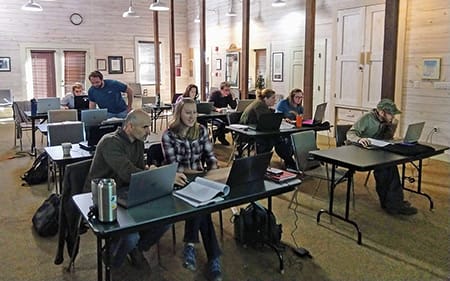
Educating and guiding the next generation of fire researchers and managers is a key goal of Wildland Fire Science and a resource for testing new ideas in fire research.
Tall Timbers hosts the premier fire technology transfer organization—the Southern Fire Exchange. This JFSP funded effort helps connect research to management through webinars, workshops, and support of the Prescribed Fire Science Consortium.
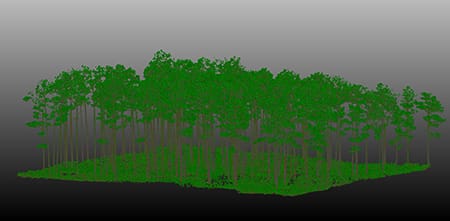
Working with partners in the Prescribed Fire Science Consortium, the program is building nexgen 3-D fuel beds using terrestrial LiDAR and novel sampling techniques to power new fire behavior models for prescribed fire managers. This work links to Tall Timbers work in wildlife habitat usage and ecological forestry.
The Longleaf Legacy landscape prescribed fire burn team arm of Wildland Fire Science works directly with landowners and partners to effectively put fire on the ground and promote prescribed fire throughout the region.
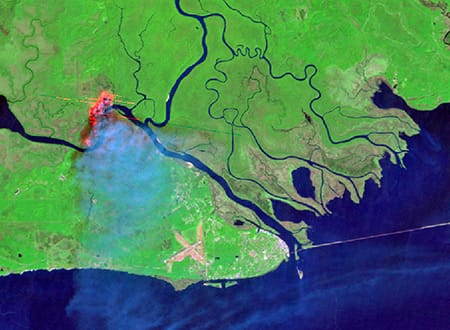
Tall Timbers is leading an effort to map fire regimes at the landscape scale. Staff work with numerous agencies to evaluate fire records and satellite imagery to build this critical conservation database. https://skfb.ly/6DqOY
Tall Timbers hosts the Prescribed Fire Science Consortium, a national network of researchers and managers who promote integrated research and management to advance next generation tools for fire practitioners. https://arcg.is/1DSjDT
We are linking physics and field observations to understand the fluid dynamics of fire behavior surface fire regimes. Our work combines field observations using advanced thermal imaging techniques, laboratory studies, and coupled fire-atmospheric modeling to help managers improve outcomes of managed fire regimes.
Selected Publications authored by Wildland Fire Science staff.
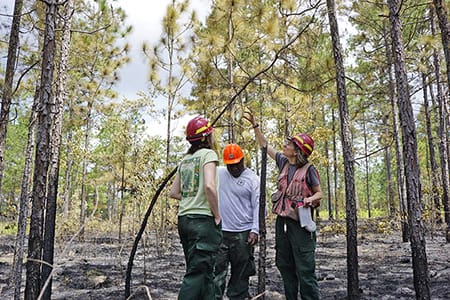
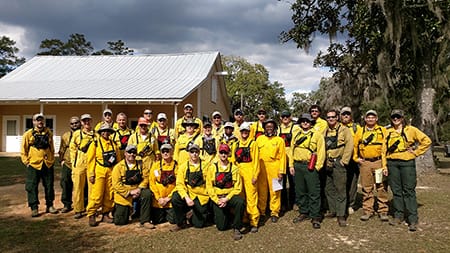
Staff and researchers support Federal fire training by serving as a cadre for NWCG training courses, ranging from basic wildland fire to advanced fire effects.
(PFTC) specializes in training fire fighters the principles and techniques of prescribed fire through practical hands-on experience. https://www.fws.gov/fire/pftc/
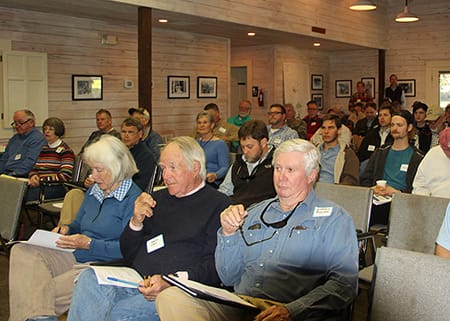
Private land owners are the largest source of prescribed fire in the country. These land owners and the culture of fire that was maintained by them during decades of suppression are a part of why Tall Timbers is a world-wide center for prescribed fire science. Workshops and fire training are a critical focus of the Longleaf Legacy Landscape Burn Team and our support of the Georgia Forestry Commission Prescribed Fire Center in Marion County.
The conserved lands of the Greater Red Hills region are found on working, income-producing properties that support agriculture, forestry, and recreational hunting. These properties contribute $272 million annually to local economies and support 2,300 jobs. [link to Planning & Advocacy section] The landowners’ strong stewardship ethic preserves their working lands while replenishing drinking water supplies, protecting water quality, and providing wildlife habitat for dozens of rare and endangered species. Tall Timbers’ conservation easements on these working properties encourage landowners to retain their traditional livelihood by keeping farms in family ownership.
Home to world-class wild quail populations, the Greater Red Hills region contains the largest concentration of gamebird preserves in the United States. These preserves also support the largest community of Red-cockaded woodpeckers on private lands. Indicators of high quality habitat found here include the gopher tortoise, Bachman’s sparrow, fox squirrel, and many amphibians. Tall Timbers’ conservation easements identify and protect the critical habitats of these species.
The region also boasts outstanding aquatic resources. Large river systems, like the Flint/Apalachicola, Ochlockonee, and Aucilla, flow from Georgia and feed into the Gulf of Mexico to support some of the world’s most productive estuaries. Large disappearing sinkhole lakes, like Iamonia, Miccosukee, and Jackson, provide habitat for an array of aquatic species and migratory birds. Tall Timbers’ conservation easements protect these vital watersheds and wetlands that are the lifeblood for the ecological health of the region.
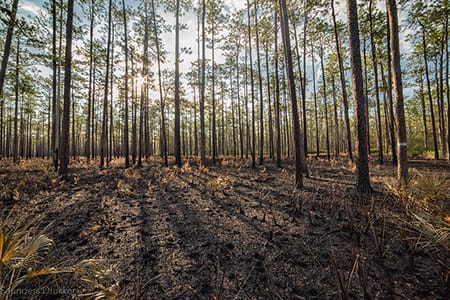
Once dominated by longleaf pine, our pine woodlands support abundant wildlife and local economies. These forests need prescribed fire to stay healthy. Herbert L. Stoddard and his associates Ed and Roy Komarek were pioneers in this emerging scientific field during the mid-20th century. Tall Timbers continues that legacy with applied research on prescribed fire and land management. Today, there is a tremendous need to expand prescribed fire use beyond the Red Hills to ensure ecosystem health and reduce wildfire risk. Additionally, Tall Timbers uses conservation easements to permanently protect private woodlands while balancing the need for economic return from selective timbering.


 As the results have unfolded, we have seen quail populations with the highest numbers ever, the gopher tortoise has doubled in population size and the red-cockaded woodpecker has been re-introduced and is reproducing well. Mr. Stoddard was right after all, land management is indeed an art, but must carefully examine and build upon history, then finally must be put to the test with a scientific perspective. The proof is in the results.