Who knew that prescribed fire was an important tool in restoring and conserving imperiled butterflies?
Dave McElveen, Research Associate in the Stoddard Bird Lab, traveled to Maryland recently to help assess how prescribed fire might be used to maintain habitat for the rare Frosted Elfin butterfly (Callophrys irus). Dave was invited there by the Maryland Department of Natural Resources (MDNR) to help determine how vulnerable the Frosted Elfin might be to the use of fire during different life stages.
Dave and a team of MDNR staff and local volunteers collected 40 Frosted Elfin larvae and placed them in enclosures mimicking natural conditions. During the larval stage of their annual cycle, individuals feed exclusively on wild indigo and sundial lupine host plants and lack the wings needed to outrace an approaching flame. After 30 days, the enclosures were carefully searched to locate where larvae ended up as pupae for the next stage of life. Most were in the leaf litter or on the soil surface. This was novel because the pupae often burrow a bit deeper underground in other populations and, as a result, may be more susceptible to prescribed fires set during larval/pupae stages in Maryland.
The Frosted Elfin is imperiled throughout its range due, in part, to habitat changes as a result of fire exclusion. Burning maintains habitat for the butterfly, but it may be important to shift the timing of fires to a time of the year where the butterfly is less susceptible to the heat. This can be especially important for small, isolated populations. The major remaining site in Maryland is a 5-acre pine-oak upland that MDNR wants to restore and maintain using fire. Fire needs to be applied to maintain appropriate conditions, and this new information will help to determine when fires can be applied without decimating this isolated population.
By Dr. Theron M. Terhune, Game Bird Program Director
Bobwhite nest and brood production has been good this year, slightly above average in fact, for the Red Hills region. Managers have reported seeing several amalgamated broods early in the season which is a good indicator of a lot of hatching activity, but brood sizes in late June and July have been low. We have also noted a significant deviation in brood sizes during capture events compared to clutch sizes at time of hatch, further suggesting that early brood survival is low. In capturing scores of broods this summer, we have deployed a record breaking 258 radio-tags on bobwhite chicks this summer, and observed low chick survival across the board on our study sites.
Peering into 19 years of capturing and wing-tagging chicks, a recent analysis proved just how detrimental both the number of rainfall events and the amount of rainfall can be on chick survival. Chicks are particularly vulnerable to rainfall during the first 30 days of life. For example, we found that for every 4 rainfall events greater than ¼ inch that a brood encounters during its first 30 days following hatch, there is an average of 12% reduction in chick survival, and cumulative or successive rain days can exacerbate brood loss (see Figure 1). Similarly, for every additional 2 inches of rainfall that a brood encounters during the first 30-days post-hatch chick survival decreases by 12-16% (see Figure 2). When combined, consecutive days of rainfall and cumulative higher amounts of rainfall have even greater impacts on chick survival. These numbers truly underscore why a wet June and July can be too much for bobwhite chicks and are generally not good for fall recruitment. Whereas ample rainfall has taken a toll on chick survival so far this summer, adult survival remains good, and the rain has produced excellent cover conditions. In addition, our small mammal trapping of late indicates an increase in cotton rat abundance. As a result, we are well poised for a good late hatch, we surely could use it this year!
Winter weather impacts hunt success, covey movement, and bobwhite survival
By Theron Terhune, PhD, Game Bird Program Director
November and December were uncharacteristically hot in the Red Hills and Albany areas. We experienced several warm fronts followed by high winds, which resulted in “jumpy” or “edgy” birds on top of not-so-great scenting conditions. During a recent stroll through the woods I noticed grasshoppers still leaping and fluttering from vegetation along with other bugs which is also not characteristic of this time of year. The warm weather early in the season, and good cover from previous spring/summer rains, nurtured abundant native food resources (seeds and insects alike), which has resulted in overall reduced movements, smaller home ranges and less frequent use of the feed lines by radio-tagged bobwhite coveys early in the hunting season. Our recent research on covey detection has shown that reduced movements of coveys decrease the probability of encountering a covey during a hunt. In addition many properties have reported reduced bird numbers and this has translated into a slight decline in hunt success compared to last year for some. Yet other properties have been experiencing a banner year, which may be a result of better localized weather conditions during the previous breeding season.
We also observed that bobwhite survival was very good from October through early January, which was associated with the warmer weather and delayed arrival of migratory hawks. However, we paid the price dramatically these past couple of weeks as the cold weather in January pushed raptors into our area in droves. We picked up more than 20 radio-tagged bobwhites in less than 2 weeks due to mortality by hawks during the end of January and early February resulting in a combined 15% net loss of radio-tagged birds in January. Reducing hunting pressure by not overhunting an area during this time can mitigate unnecessary pressure and subsequent movement of bobwhite coveys, increasing their chance of survival. We are hopeful that since the hawks came late they won’t stay long, but in the past we have seen that they can prolong their stay through March (one of the normal peaks in raptor migration in the Red Hills); should they overstay their welcome we may be in for a tough couple of months in terms of bobwhite mortality.
Burn timing likely key to winter carryover
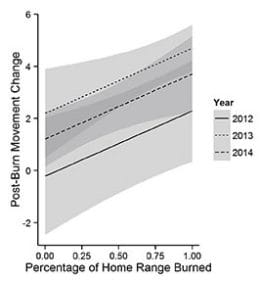
We recently completed a study in south Florida investigating the impacts of scale of fire on bobwhites. This study was a collaboration between Tall Timbers Game Bird Program, The University of Georgia, and the Florida Fish and Wildlife Conservation Commission. We found that not only does fire size dictate the amount of burned/unburned area available to individual bobwhites but greater amounts of home range burned affects bobwhite movements and subsequently their survival (i.e., increased fire size results in negative impacts on survival). The larger the individual burn and proportion of their “normal’ home range burned the greater bobwhites move (see Figure 1). However, the amount of residual structure left standing following a burn also can influence bobwhite movement or displacement. The relationship between burn size and amount of home range burned with that of bobwhite movements and survival can be exacerbated by the presence of migratory hawks. Thus, careful planning of prescribed burning may prove advantageous this year to maximize survival and winter carryover.
Figure 1. Relationship between percentage of pre-burn home range burned and subsequent post-burn changes in movement for northern bobwhites over 3 years.
We typically recommend burning between March and mid-May to achieve quail management goals and reduce hardwood encroachment. Delaying burning by a week or two will provide a little extra time for the migrating hawks to check out. Coming off the heels of the strongest El Nino event in history, NOAA forecasts a wet spring and summer during 2016, but the 2006-2007 El Nino told a very different story with record setting droughts across the region. Therefore, not burning too much too early will mitigate impacts on quail if drought conditions persist as a result of an unpredictable El Nino weather pattern. Stretching out burning over several weeks to months, and leaving more cover during the presence of hawks from natural migration patterns, can result in increased quail survival and carry more birds into the nesting season. An added benefit of burning later is that vegetation often responds quicker, especially when followed by spring rains, which also provides survival benefits to quail and fosters great brood habitat.
Disking effects on native groundcover plant species
By Kevin Robertson, PhD, Director of the Fire Ecology Program and Monica Rother, PhD, Fire Ecology Scientist
It is widely known that soil disturbance, such as disking, roller chopping, and deep rutting, reduces wiregrass (Aristida stricta), and that this species is typically slow to come back in such disturbed areas. What is less well known is how it effects the other hundreds of species that make up native upland longleaf pine-wiregrass communities.
In winter 2012 and 2013, firebreaks that were created with one pass of a tractor and disk in two different longleaf pine-wiregrass native groundcover areas gave us the opportunity to study which plants were reduced and which survived or became reestablished during the subsequent 3-4 years. We compared plant species composition between the disk lines and the undisturbed area just outside of the lines. At the site disked in 2012, there was also a firebreak that had been disked annually which was abandoned that year. We used it to study which plants were capable of becoming established in an area completely without vegetation.
At left- Recently disked line in longleaf-wiregrass native plant community, studied to determine survival and recovery of plant species. At right – Frequently disked firebreak one year after abandonment, studied to determine which plants can recolonize the area.
This past fall (2015), at 47 locations along each of the two disk lines, we counted all plant species within 1 square meter frames, both inside and just outside of the disk line. We also counted plants within 47 frames in the abandoned fire break. We ran analyses to determine whether plants were significantly associated with either the disturbed or undisturbed plots, or if they were well represented in both. There were 66 species with large enough samples to analyze.
Results showed that 17 plants were common in the undisturbed area but did not recolonize the abandoned firebreak. Of those, 12 species were also significantly reduced by the single disking 3-4 years after the disturbance. Most of these species have been identified in past studies as being sensitive to soil disturbance, including wiregrass (Aristida stricta), dwarf huckleberry (Gaylussacia dumosa), Darrow’s blueberry (Vaccinium darrowii), deerberry (Vaccinium stamineum), goat’s rue (Tephrosia virginiana), Dixie white-top aster (Sericocarpus tortifolius), bracken fern (Pteridium acquilinum), pinelands twinflower (Dyschoriste oblongifolia), skeleton grass (Gymnopogon ambiguus), running oak (Quercus pumila), sand post oak (Quercus margarettae), and bluejack oak (Quercus incana). Wiregrass was almost completely eliminated by the single disking. Although these species made up only 25% of the plant species analyzed in this study, unpublished data from our Pebble Hill fire plots project suggest that these species make up over 50% of the total plant cover in nearby native areas, such that their reduction would have a large effect on the dominant vegetation.
Another 30 species showed a neutral response to the disking and most of these also were capable of recolonizing the abandoned firebreak. Finally, 17 species either responded positively to the single disking or else were found almost exclusively in the abandoned firebreak. These were mostly common agricultural weeds, which are eventually outcompeted by other plants in the absence of further soil disturbance.
At left – Goat’s rue (Tephrosia virginiana) was greatly reduced by a single disking and did not recolonize the abandoned firebreak. At right- Partridge pea (Chamaecrista fasciculate) was resilient to the single disking area and was able to recolonize the abandoned firebreak.
Our study suggests that while most plant species in longleaf native groundcover can survive or become re-established following a small-scale soil disturbances, there is a certain suite of species that are negatively impacted and slow to recover, and which otherwise make up a significant proportion of the vegetation cover in undisturbed areas. These species also happen to be the most flammable, including wiregrass and waxy broadleaf woody plants that burn well at relatively high humidity. As a result, extensive soil disturbance in native areas is likely to reduce the range of conditions that allow for effective prescribed burns.
This study on the effects of disking on native groundcover will contribute to a review paper on effects of soil disturbance on plant species in southern U.S. pine communities.
Tall Timbers is proud to welcome J. Kevin Hiers as our new Wildland Fire Scientist. Kevin has worked in prescribed fire science arena for nearly 20 years, has published over 50 peer-reviewed publications, and has a track record of cooperative work that fits perfectly with the new Tall Timbers Strategic Plan to attract prescribed fire expertise to the region. Kevin not only loves to prescribe burn and study fire behavior and its effects, he brings with him a breadth of knowledge in fire and smoke modelling, fire ecology, fire application, and implementation of large-scale complex studies, such as Rx CADRE.
The Greater Red Hills Region of NW Florida and SW Georgia, is the epicenter of prescribed fire in the Southeastern U.S. Our consistent application of fire provides opportunities for collaboration among top regional and national fire scientists that wish to study it. Through a soon to be developed prescribed fire consortium, we have the long-term goal of improving prescribed fire use and policies to ensure its continued safe application. “Tall Timbers can significantly improve prescribed fire science by leveraging the consistent application of fire in the region to attract the best minds developing and testing models to predict fire behavior and improve smoke management,” says Hiers. Kevin joins Tall Timbers in June and will be living in Thomasville, GA with his wife Stephanie of 14 years and their 2 children.
The M-CORES program, which includes the proposed Suncoast Connector Toll Road in Jefferson County, passed through the Florida Legislature at breakneck speed with little review or analysis. Tall Timbers has a number of concerns given the potential for significant and wide spread impacts. These include fragmenting public and private conservation lands, robbing business from Main Street Monticello, impacting our rivers and other water resources, and making prescribed fire more difficult and costly.
Join us in asking the Jefferson County Board of County Commissioners to OPPOSE the Suncoast Connector toll road and its path through Jefferson County.
Take action now with our easy email form.
Send an email to all five Jefferson County Board of County Commissioners with one click!
Selected Publications authored by Wildland Fire Science staff.
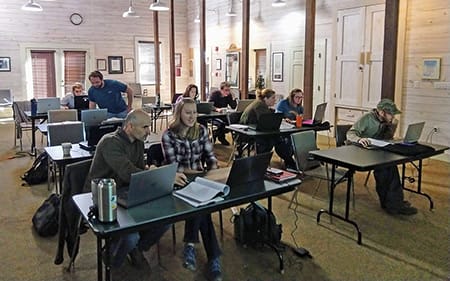
Educating and guiding the next generation of fire researchers and managers is a key goal of Wildland Fire Science and a resource for testing new ideas in fire research.
Tall Timbers hosts the Prescribed Fire Science Consortium, a national network of researchers and managers who promote integrated research and management to advance next generation tools for fire practitioners. https://arcg.is/1DSjDT
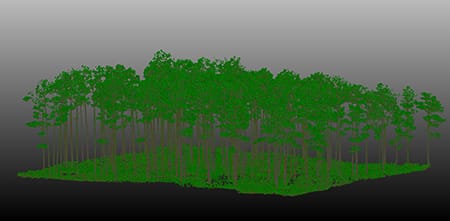
Working with partners in the Prescribed Fire Science Consortium, the program is building nexgen 3-D fuel beds using terrestrial LiDAR and novel sampling techniques to power new fire behavior models for prescribed fire managers. This work links to Tall Timbers work in wildlife habitat usage and ecological forestry.
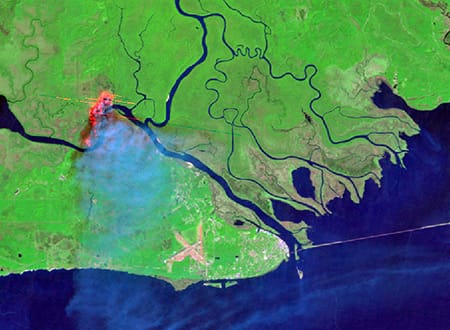
Tall Timbers is leading an effort to map fire regimes at the landscape scale. Staff work with numerous agencies to evaluate fire records and satellite imagery to build this critical conservation database. https://skfb.ly/6DqOY
We are linking physics and field observations to understand the fluid dynamics of fire behavior surface fire regimes. Our work combines field observations using advanced thermal imaging techniques, laboratory studies, and coupled fire-atmospheric modeling to help managers improve outcomes of managed fire regimes.
Burn prioritization modeling seminars and fire modeling tools are supported by Wildland Fire Science to train managers in the important planning stages of prescribed fires.
The conserved lands of the Greater Red Hills region are found on working, income-producing properties that support agriculture, forestry, and recreational hunting. These properties contribute $272 million annually to local economies and support 2,300 jobs. [link to Planning & Advocacy section] The landowners’ strong stewardship ethic preserves their working lands while replenishing drinking water supplies, protecting water quality, and providing wildlife habitat for dozens of rare and endangered species. Tall Timbers’ conservation easements on these working properties encourage landowners to retain their traditional livelihood by keeping farms in family ownership.
Home to world-class wild quail populations, the Greater Red Hills region contains the largest concentration of gamebird preserves in the United States. These preserves also support the largest community of Red-cockaded woodpeckers on private lands. Indicators of high quality habitat found here include the gopher tortoise, Bachman’s sparrow, fox squirrel, and many amphibians. Tall Timbers’ conservation easements identify and protect the critical habitats of these species.
The region also boasts outstanding aquatic resources. Large river systems, like the Flint/Apalachicola, Ochlockonee, and Aucilla, flow from Georgia and feed into the Gulf of Mexico to support some of the world’s most productive estuaries. Large disappearing sinkhole lakes, like Iamonia, Miccosukee, and Jackson, provide habitat for an array of aquatic species and migratory birds. Tall Timbers’ conservation easements protect these vital watersheds and wetlands that are the lifeblood for the ecological health of the region.
Once dominated by longleaf pine, our pine woodlands support abundant wildlife and local economies. These forests need prescribed fire to stay healthy. Herbert L. Stoddard and his associates Ed and Roy Komarek were pioneers in this emerging scientific field during the mid-20th century. Tall Timbers continues that legacy with applied research on prescribed fire and land management. Today, there is a tremendous need to expand prescribed fire use beyond the Red Hills to ensure ecosystem health and reduce wildfire risk. Additionally, Tall Timbers uses conservation easements to permanently protect private woodlands while balancing the need for economic return from selective timbering.
Tall Timbers hosts the premier fire technology transfer organization—the Southern Fire Exchange. This JFSP funded effort helps connect research to management through webinars, workshops, and support of the Prescribed Fire Science Consortium.
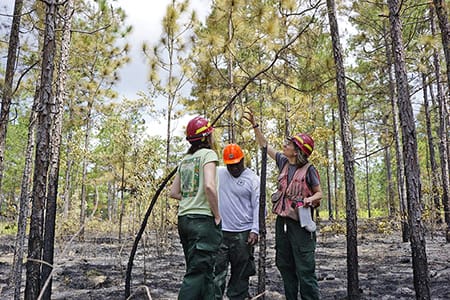
The Longleaf Legacy landscape prescribed fire burn team arm of Wildland Fire Science works directly with landowners and partners to effectively put fire on the ground and promote prescribed fire throughout the region.
Staff and researchers support Federal fire training by serving as a cadre for NWCG training courses, ranging from basic wildland fire to advanced fire effects.
(PFTC) specializes in training fire fighters the principles and techniques of prescribed fire through practical hands-on experience. https://www.fws.gov/fire/pftc/
Private land owners are the largest source of prescribed fire in the country. These land owners and the culture of fire that was maintained by them during decades of suppression are a part of why Tall Timbers is a world-wide center for prescribed fire science. Workshops and fire training are a critical focus of the Longleaf Legacy Landscape Burn Team and our support of the Georgia Forestry Commission Prescribed Fire Center in Marion County.


 We recently completed a study in south Florida investigating the impacts of scale of fire on bobwhites. This study was a collaboration between Tall Timbers Game Bird Program, The University of Georgia, and the Florida Fish and Wildlife Conservation Commission. We found that not only does fire size dictate the amount of burned/unburned area available to individual bobwhites but greater amounts of home range burned affects bobwhite movements and subsequently their survival (i.e., increased fire size results in negative impacts on survival). The larger the individual burn and proportion of their “normal’ home range burned the greater bobwhites move (see Figure 1). However, the amount of residual structure left standing following a burn also can influence bobwhite movement or displacement. The relationship between burn size and amount of home range burned with that of bobwhite movements and survival can be exacerbated by the presence of migratory hawks. Thus, careful planning of prescribed burning may prove advantageous this year to maximize survival and winter carryover.


 Tall Timbers is proud to welcome J. Kevin Hiers as our new Wildland Fire Scientist. Kevin has worked in prescribed fire science arena for nearly 20 years, has published over 50 peer-reviewed publications, and has a track record of cooperative work that fits perfectly with the new Tall Timbers Strategic Plan to attract prescribed fire expertise to the region. Kevin not only loves to prescribe burn and study fire behavior and its effects, he brings with him a breadth of knowledge in fire and smoke modelling, fire ecology, fire application, and implementation of large-scale complex studies, such as Rx CADRE.