FSU student Jessica Cusick received the Cruickshank Research Award at the spring meeting of the Florida Ornithological Society. The award will provide much needed support for her research on Brown-headed Nuthatches on Tall Timbers. Her Ph.D. research encompasses a broad range of genetic and behavioral issues associated with this declining pineland specialist, but the award specifically covers the expenses needed to assess key hormone levels in chicks. Variation in hormone levels can have a dramatic effect on behavior, and Jess will attempt to correlate the hormone levels collected for chicks with the behaviors they display later as adults. If you’d like to read more about this research, Jess, Jim Cox, and Emily DuVal recently published s popular article in Birding Magazine describing the interesting biology of this small songbird. The magazine is distributed by the American Bird Association and is available by following this link.
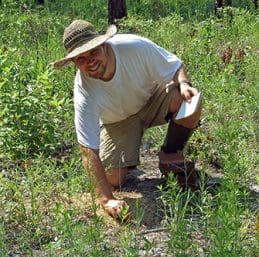
In other Stoddard Bird Lab news, Drexel University Ph.D. candidate Tom Radzio is back this spring conducting an in-depth census of Gopher Tortoises on the Wade Tract. Tom currently is mapping the locations of all the burrows he can find following a recent burn. The prime conditions for burrow searching provided by the burn have enabled Tom to locate scores of small burrows likely to be missed by other survey techniques (which also have been performed on the Wade Tract recently). The small burrows are used by individuals less than 5 years old and typically only a few inches in width. Once burrows are mapped, Tom will be using time-lapsed photography to monitor burrow occupancy and eventually develop a precise estimate of the gopher tortoise population size, as well as the distribution of individuals among different age classes. He’ll also be able to compare these data with a tortoise census conducted over 15 years ago.
By Kevin Robertson, PhD, Fire Ecology Program Director
Air quality agencies estimate various emissions from wildfires and prescribed fires by multiplying together estimates of the area burned, fuel consumed per unit area, and the amount of emission per unit fuel consumed, called the “emission factor” (EF). The Fire Ecology Program and researchers at Florida A&M University have been collaborating to improve estimates of emission factors for particulate matter (smoke particles) smaller than 2.5 microns (PM2.5), which poses a health risk and is regulated by the Environmental Protection Agency.
Kevin Robertson measuring smoke and gases from a prescribed fire on Tall Timbers Research Station
PM2.5 EF is typically measured by comparing the amount of PM2.5 released during the fire with the amount of carbon gases released, mostly carbon dioxide (CO2) and carbon monoxide (CO), which in turn indicates how much fuel was consumed. The traditional method assumes that the difference between CO2 + CO measured in the fire plume and CO2 + CO in the ambient (pre-fire) air represents the the amount of CO2 + CO released in combustion. However, because combustion processes can be complex and produce various products, it was possible that this assumption is not precisely true. We sought to test this assumption by more directly measuring which CO2 and CO was from the fuel versus that from the ambient air, using their different carbon 13 isotope signatures.
We found that the concentration of CO2 from ambient air found in the fire plume was higher than expected. This may be because the production of CO2 from combustion is slightly slower than the entrainment of CO2 from the ambient air. The result is that estimates of PM2.5 EF using the traditional method are 15% too low. This bias can be corrected for in future estimates using a correction factor.
We also tested the assumption that the ratio of CO2 to PM2.5 remains the same in the fire plume following combustion, which is an important assumption for accurate calculation of PM2.5 EF. In an experiment where we burned wood in a drum, we measured PM2.5 and gas (CO2 and CO) at different heights within and just outside of the fire plume. We found that, as long as the measurements were directly within the plume, the assumption of mixed gas and PM seemed good. However, if we measured just outside of the plume, there was a lot of PM2.5 but not much CO2, making the emission factor about nine times higher (see figure). Apparently if the mixture of PM2.5 and CO2 released from the fire is not within the rapidly rising fire plume, the CO2 and other gases quickly diffuse away, leaving the PM2.5 behind. Failing to measure directly within the plume, or else very soon after the PM and gases are released, is important for accurate estimates of emission factors.
These results were recently presented in a webinar to the National Wildfire Coordinating Group (NWCG) Interagency Smoke Committee (SmoC), which makes policy recommendations for better management and regulation of emissions from wildland fire, including prescribed burns.
The figure, above right, shows results from an experiment at Florida A&M University testing differences in estimated PM2.5 emission factors (EF) within and just outside of the fire plume. Outside of the plume the PM and gases released from fire are not well mixed, making the estimate of EF too high.
By Molly Neely-Burnham and Theron Terhune, PhD, Game Bird Program Director
Insects (or invertebrates to those “sciency” types) have long been recognized as the most abundant and diverse group of organisms, representing more than 80% of the world’s species. Their contribution to ecosystems is multi-fold such that they serve as: decomposers; herbivores; food staple for many species including birds and especially bobwhites; dispersal agents (e.g., disperse seed, pathogenic agents), and unmatched pollinators. Relative to their abundance, however, we have done little research on evaluating their presence, diversity and abundance germane to soil type in the Red Hills region. Thus, our aim is to sample insects across the Red Hills region (an beyond) to better understand the drivers of spatial and temporal fluctuations of insects relative to soil type, stand and habitat type, and management treatments (e.g., fire, fields, etc.) to inform on-the-ground management beneficial to bobwhite.
We recently partnered with a private property in coastal North Carolina, to restore quail on a Sandhills site through translocation. Given the sandy nature of the study site, land management established and maintained open fields in an effort to increase the diversity and abundance of insects. This was important because the diet of bobwhite chicks is primarily comprised of insects as they contain irreplaceable power-packed nutrients (proteins and lipids) needed for rapid growth and feather development, and the need for quality chick production and survival is inherent for the success of translocation. A considerable amount of time and cost was associated with field establishment and maintenance given the nature of these soils, requiring targeted soil inputs and amendments such as locally sourced agriculture waste, acting as a natural fertilizer to boost poor native sandy soils. As such, to determine whether the practice of maintaining fields should be continued and if they were indeed producing increased invertebrate food resources, we sampled insects in burned, unburned piney woods, and open field sites throughout the spring/summer field seasons during 2014 and 2015. Samples were collected by sweep-netting and a D-Vac insect vacuum, and resulted in the collection of invertebrates from two different Classes: Insecta (insects) and Arachnida (spiders and mites).
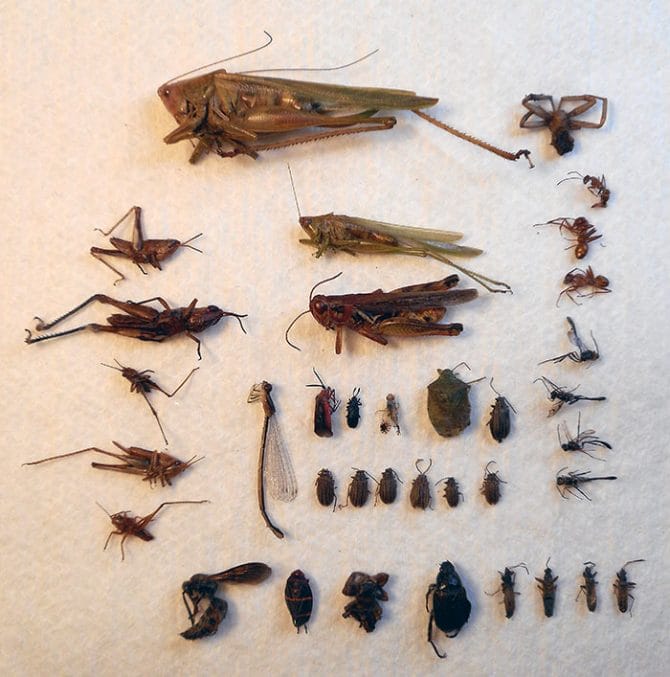
After collecting and identifying over 6000 invertebrate specimens for the two year period, it is clear that open field sites are far outpacing either burned or unburned piney wood sites. Over the two year period 62% of all specimens came from field sites, whereas burned and unburned piney woods contributed only 19% each. The six most represented Orders are: Araneae (spiders), Coleoptera (beetles), Diptera (flies), Hemiptera (true bugs), Hymenoptera (ants and wasps), and Orthoptera (grasshoppers). We look forward to this field season as we will continue to sample insects as it relates to specific habitat use by bobwhite chicks on this study site.
In an effort to better understand how different ecosystems and land management practices affect invertebrate food resources related to quail, we will be expanded to other sites across the Southeast. Another spin to future specimen analysis will be the addition of a microbalance, so that not only can we compare the raw number of specimens collected, but the biomass each site produces. We are still looking for a couple of candidate sites in the Red Hills region to conduct insect sampling so contact Theron if you are interested.
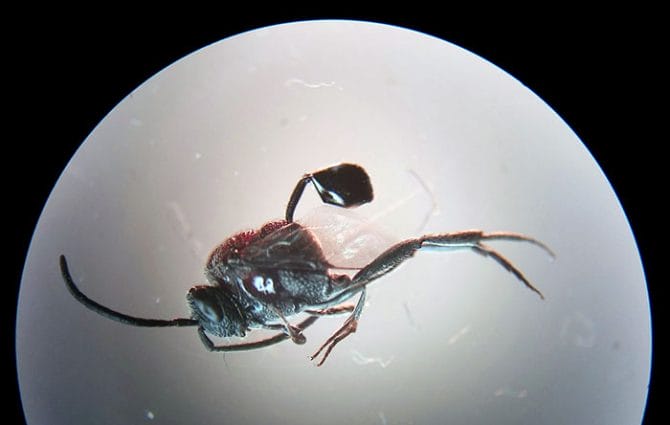
Order: Hymenoptera Family: Evaniidae
An ensign wasp was among the specimens collected, here viewed under magnification. The ensign wasps are parasites of the egg capsules (ootheca) of cockroaches and are likely to be found on the forest floor where cockroaches occur.
A smorgasbord of insects sampled on a quail plantation in coastal North Carolina.
Old-field pinelands – a long way towards restoration of native pineland soil
By Kevin Robertson, PhD, Fire Ecology Program Director
Old-field pinelands, where stands of loblolly and shortleaf pines have arisen from crop fields abandoned decades ago and managed with frequent fire, are well known in the Coastal Plain for being good quail hunting land. Perhaps less recognized is the fact that old-field pinelands represent a grand experiment in ecological restoration. We in the Fire Ecology Program have conducted various studies to look further into the ecology of old-field pinelands as compared to their humble agricultural origins, as well as native longleaf pine-wiregrass communities. One of our goals is to understand to what degree doing little more than burning an abandoned agricultural field on a two-year interval can eventually restore the fire-dependent native longleaf pine ecosystem.
Soil, which makes up the half of the ecosystem we cannot see, is a key factor in ecological restoration. We took advantage of the Whitcomb Plots on Tall Timbers Research Station to compare soil quality between plots annually tilled in different months of the year and those where tilling was replaced with biennial fire and natural establishment of loblolly and shortleaf pines, beginning in 1969. We also compared soil measurements between the Whitcomb Plots and native longleaf pine communities, which have never been plowed. Student researcher Amberlin Hines from Gallaudet University has been helping prepare a manuscript to publish the following results.
The effect of farming on soil texture (percent sand, silt, and clay) appears to be permanent, resulting in clay percentages in the surface soil that are more than twice as high as those in native pine communities, presumably because of erosion of the sandy surface horizon during farming. However, soil bulk density in the old-field pinelands was about half way between tilled fields and native sites, indicating that the old-field pinelands are increasing in aeration and water permeability on a path towards native soil conditions.
Phosphorus and potassium were found to be much higher in the disked fields and old-field pinelands than in native sites, probably because of liming of fields and the higher clay content in the surface soil. Calcium and magnesium levels were about half way between disked fields and native pine soils, suggesting steady increases toward native conditions over time.
Examples of statistically significant results comparing soil characteristics among disked plots, old-field pinelands arising from fields abandoned in 1969, and native longleaf pine-wiregrass communities
Importantly, total organic carbon is about the same between the old-field and native pine sites and twice as high as in disked fields. It appears that restoration of disked fields to frequently burned old-field pinelands is a valuable tool for restoration of carbon sequestration to native conditions. Also, both mineralizable carbon and mineralizable nitrogen (forms readily available to plants) were about two to three times as high in the old-field pinelands than in the currently disked fields, promoting higher plant productivity and health.
Stratification of soil nutrients with cessation of tilling is also quite evident. In tilled soils, levels of calcium, magnesium, total and mineralizable carbon and nitrogen, and bulk density were vertically mixed from 0-20 cm due to tilling. In contrast, each of these variables were more highly stratified after decades without disking, specifically with soil nutrients and carbon concentrated near the soil surface where plants can most easily use them. Stratification indices, or ratios of soil measurements between the 0-5 and 10-20 cm depth intervals, showed a steady increase from tilled fields to old-field pinelands to native pinelands, suggesting that this quality of soil in old-field pinelands is also on a trajectory towards native conditions.
While the partial loss of the sandiest surface layer may be practically irreversible, by most measures the transition from tilled fields to burned pinelands represents a strong trajectory toward native soil restoration and greater soil health. This change is important for its expected effect on which native plant species are able to become established over time. Our plant community studies show that numbers of native plant species in old-field pinelands more than 50 years old are about half way between tilled fields and native communities, suggesting improvement of conditions for many but not all plant species, and restoration of the basic pine-grassland community structure. In turn, old-field pinelands provide viable habitat for red-cockaded woodpeckers, Bachman’s sparrows, gopher tortoises, Sherman’s fox squirrels, and many other species of special conservation concern. These results have important implications for current efforts to restore longleaf pine ecosystems on recently abandoned fields, which promise to significantly improve soil health, biodiversity, and ecosystem services — if managed with frequent fire and timber thinning over the long run.
Stiff competition for limited resources can lead to elevated tension. Human societies try to deal with such tension using diplomacy and negotiation before advancing to more aggressive responses. Wildlife societies, on the other hand, often go straight for the jugular.
On-going studies of the Brown-headed Nuthatch on Tall Timbers have revealed some startlingly aggressive attacks launched by this 11 gram songbird (just a tad heftier than a ball point pen). This declining species excavates a new nest cavity each year in dead wood, and these cavities represent an important resource that often draws the attention of cavity nesting species such as Eastern Bluebird and Carolina Chickadee. A lot of overt aggression takes place around nuthatch excavations, as the nuthatches doing the work try to defend the resource from the other birds.
In 2007, we found a Carolina Chickadee suspended from a nuthatch nest cavity. The chickadee’s feet were tangled in the moss used to line the nest, and the motionless body swayed back and forth in a light breeze. We found numerous small peck marks on the back of the head, some of them deep enough to penetrate the skull.
We were never sure happened, but we long suspected a nuthatch or some other sharp-beaked bird had used its bill as a foil and steadily beat the chickadee senseless. This year, however, additional observations suggest the chickadee could easily have been murdered by the stiletto beak of a brown-headed nuthatch.
There are generally more nuthatches around each year than there is space to accommodate them, leading to another source of resource competition. Given the excess in numbers, some males and females lend help to other nuthatch breeders, rather than nest on their own, but we also observe “floaters” each year that are not aligned with specific territories. These birds tend to move unobtrusively among several neighboring territories not calling attention to themselves.
Last breeding season, Tall Timbers intern Amanda Lanphere tagged along on a morning of nuthatch monitoring. When we came to nest SA2, Amanda asked to check the nest and was warned that this female often held tight, and not to be alarmed if she was sitting on the eggs. When Amanda peered into the nest using a small flashlight, she calmly announced, “She’s sitting really tight. She’s had her head pecked in.”
We extracted the female using forceps, but, to our surprise, it was not the dominant female associated with the nest (who was banded). It was an unbanded female with massive head trauma. The wounds were similar to those seen on the chickadee, and we suspect this female had just dumped an egg in the nest and was caught in the act by the dominant female—leading to a lethal response.
Finally, we nearly lost an important piece of equipment this year thanks to another dose of nuthatch aggression. FSU Ph.D. candidate Jess Cusick uses a stuffed House Wren model to gauge the aggressive tendencies of marked nuthatches. The model is placed on the side of an active nesting cavity, and Jess scores the extent to which the model is attacked. Last spring, one marked male landed on the wren model and pummeled it relentlessly until the wren’s head was nearly severed.
Although fear of defeat or punishment often inhibits aggressive responses among animals, obviously you can push a small nuthatch only so far.
The M-CORES program, which includes the proposed Suncoast Connector Toll Road in Jefferson County, passed through the Florida Legislature at breakneck speed with little review or analysis. Tall Timbers has a number of concerns given the potential for significant and wide spread impacts. These include fragmenting public and private conservation lands, robbing business from Main Street Monticello, impacting our rivers and other water resources, and making prescribed fire more difficult and costly.
Join us in asking the Jefferson County Board of County Commissioners to OPPOSE the Suncoast Connector toll road and its path through Jefferson County.
Take action now with our easy email form.
Send an email to all five Jefferson County Board of County Commissioners with one click!
Selected Publications authored by Wildland Fire Science staff.
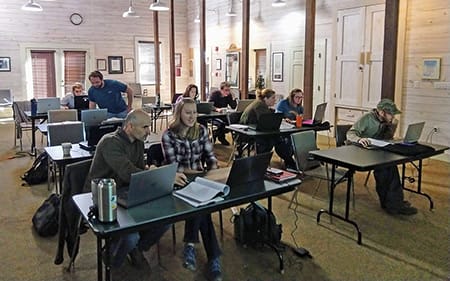
Educating and guiding the next generation of fire researchers and managers is a key goal of Wildland Fire Science and a resource for testing new ideas in fire research.
Tall Timbers hosts the Prescribed Fire Science Consortium, a national network of researchers and managers who promote integrated research and management to advance next generation tools for fire practitioners. https://arcg.is/1DSjDT
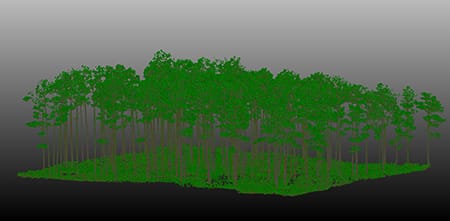
Working with partners in the Prescribed Fire Science Consortium, the program is building nexgen 3-D fuel beds using terrestrial LiDAR and novel sampling techniques to power new fire behavior models for prescribed fire managers. This work links to Tall Timbers work in wildlife habitat usage and ecological forestry.
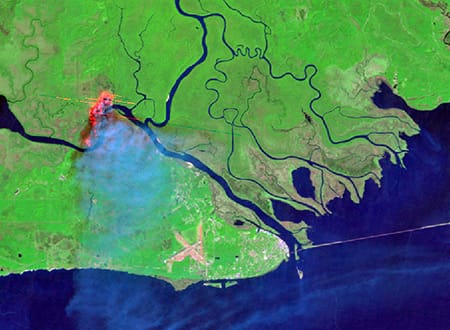
Tall Timbers is leading an effort to map fire regimes at the landscape scale. Staff work with numerous agencies to evaluate fire records and satellite imagery to build this critical conservation database. https://skfb.ly/6DqOY
We are linking physics and field observations to understand the fluid dynamics of fire behavior surface fire regimes. Our work combines field observations using advanced thermal imaging techniques, laboratory studies, and coupled fire-atmospheric modeling to help managers improve outcomes of managed fire regimes.
Burn prioritization modeling seminars and fire modeling tools are supported by Wildland Fire Science to train managers in the important planning stages of prescribed fires.
The conserved lands of the Greater Red Hills region are found on working, income-producing properties that support agriculture, forestry, and recreational hunting. These properties contribute $272 million annually to local economies and support 2,300 jobs. [link to Planning & Advocacy section] The landowners’ strong stewardship ethic preserves their working lands while replenishing drinking water supplies, protecting water quality, and providing wildlife habitat for dozens of rare and endangered species. Tall Timbers’ conservation easements on these working properties encourage landowners to retain their traditional livelihood by keeping farms in family ownership.
Home to world-class wild quail populations, the Greater Red Hills region contains the largest concentration of gamebird preserves in the United States. These preserves also support the largest community of Red-cockaded woodpeckers on private lands. Indicators of high quality habitat found here include the gopher tortoise, Bachman’s sparrow, fox squirrel, and many amphibians. Tall Timbers’ conservation easements identify and protect the critical habitats of these species.
The region also boasts outstanding aquatic resources. Large river systems, like the Flint/Apalachicola, Ochlockonee, and Aucilla, flow from Georgia and feed into the Gulf of Mexico to support some of the world’s most productive estuaries. Large disappearing sinkhole lakes, like Iamonia, Miccosukee, and Jackson, provide habitat for an array of aquatic species and migratory birds. Tall Timbers’ conservation easements protect these vital watersheds and wetlands that are the lifeblood for the ecological health of the region.
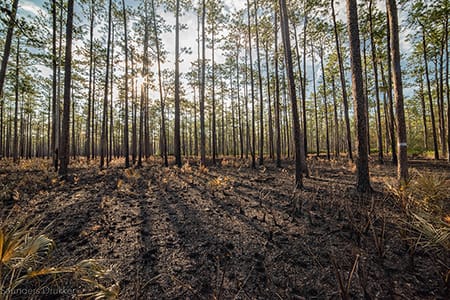
Once dominated by longleaf pine, our pine woodlands support abundant wildlife and local economies. These forests need prescribed fire to stay healthy. Herbert L. Stoddard and his associates Ed and Roy Komarek were pioneers in this emerging scientific field during the mid-20th century. Tall Timbers continues that legacy with applied research on prescribed fire and land management. Today, there is a tremendous need to expand prescribed fire use beyond the Red Hills to ensure ecosystem health and reduce wildfire risk. Additionally, Tall Timbers uses conservation easements to permanently protect private woodlands while balancing the need for economic return from selective timbering.
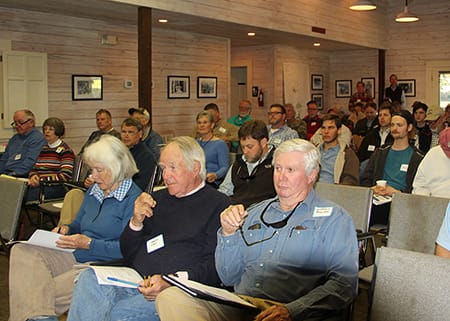
Tall Timbers hosts the premier fire technology transfer organization—the Southern Fire Exchange. This JFSP funded effort helps connect research to management through webinars, workshops, and support of the Prescribed Fire Science Consortium.
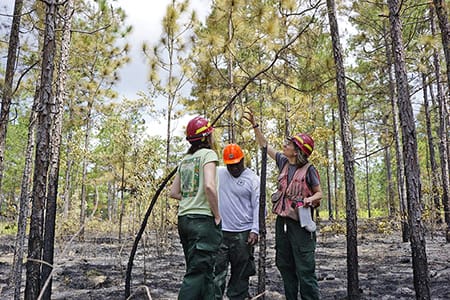
The Longleaf Legacy landscape prescribed fire burn team arm of Wildland Fire Science works directly with landowners and partners to effectively put fire on the ground and promote prescribed fire throughout the region.
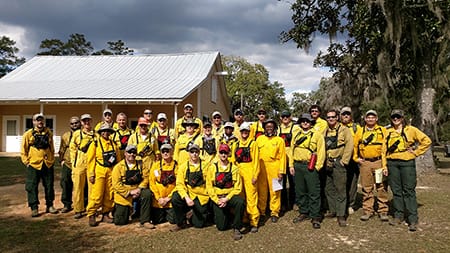
Staff and researchers support Federal fire training by serving as a cadre for NWCG training courses, ranging from basic wildland fire to advanced fire effects.
(PFTC) specializes in training fire fighters the principles and techniques of prescribed fire through practical hands-on experience. https://www.fws.gov/fire/pftc/
Private land owners are the largest source of prescribed fire in the country. These land owners and the culture of fire that was maintained by them during decades of suppression are a part of why Tall Timbers is a world-wide center for prescribed fire science. Workshops and fire training are a critical focus of the Longleaf Legacy Landscape Burn Team and our support of the Georgia Forestry Commission Prescribed Fire Center in Marion County.

 FSU student Jessica Cusick received the Cruickshank Research Award at the spring meeting of the Florida Ornithological Society. The award will provide much needed support for her research on Brown-headed Nuthatches on Tall Timbers. Her Ph.D. research encompasses a broad range of genetic and behavioral issues associated with this declining pineland specialist, but the award specifically covers the expenses needed to assess key hormone levels in chicks. Variation in hormone levels can have a dramatic effect on behavior, and Jess will attempt to correlate the hormone levels collected for chicks with the behaviors they display later as adults. If you’d like to read more about this research, Jess, Jim Cox, and Emily DuVal recently published s popular article in Birding Magazine describing the interesting biology of this small songbird. The magazine is distributed by the American Bird Association and is available by following this link.
 In other Stoddard Bird Lab news, Drexel University Ph.D. candidate Tom Radzio is back this spring conducting an in-depth census of Gopher Tortoises on the Wade Tract. Tom currently is mapping the locations of all the burrows he can find following a recent burn. The prime conditions for burrow searching provided by the burn have enabled Tom to locate scores of small burrows likely to be missed by other survey techniques (which also have been performed on the Wade Tract recently). The small burrows are used by individuals less than 5 years old and typically only a few inches in width. Once burrows are mapped, Tom will be using time-lapsed photography to monitor burrow occupancy and eventually develop a precise estimate of the gopher tortoise population size, as well as the distribution of individuals among different age classes. He’ll also be able to compare these data with a tortoise census conducted over 15 years ago.
 We also tested the assumption that the ratio of CO2 to PM2.5 remains the same in the fire plume following combustion, which is an important assumption for accurate calculation of PM2.5 EF. In an experiment where we burned wood in a drum, we measured PM2.5 and gas (CO2 and CO) at different heights within and just outside of the fire plume. We found that, as long as the measurements were directly within the plume, the assumption of mixed gas and PM seemed good. However, if we measured just outside of the plume, there was a lot of PM2.5 but not much CO2, making the emission factor about nine times higher (see figure). Apparently if the mixture of PM2.5 and CO2 released from the fire is not within the rapidly rising fire plume, the CO2 and other gases quickly diffuse away, leaving the PM2.5 behind. Failing to measure directly within the plume, or else very soon after the PM and gases are released, is important for accurate estimates of emission factors.
 Soil, which makes up the half of the ecosystem we cannot see, is a key factor in ecological restoration. We took advantage of the Whitcomb Plots on Tall Timbers Research Station to compare soil quality between plots annually tilled in different months of the year and those where tilling was replaced with biennial fire and natural establishment of loblolly and shortleaf pines, beginning in 1969. We also compared soil measurements between the Whitcomb Plots and native longleaf pine communities, which have never been plowed. Student researcher Amberlin Hines from Gallaudet University has been helping prepare a manuscript to publish the following results.
 Murderous Nuthatches?