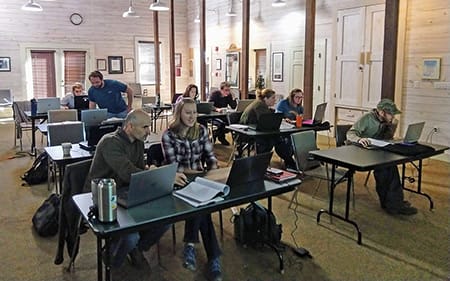
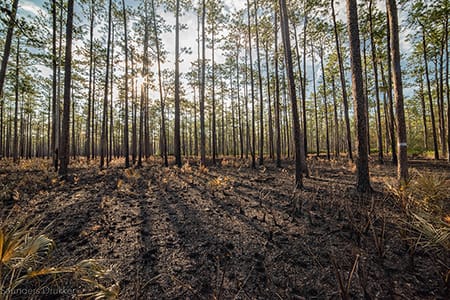
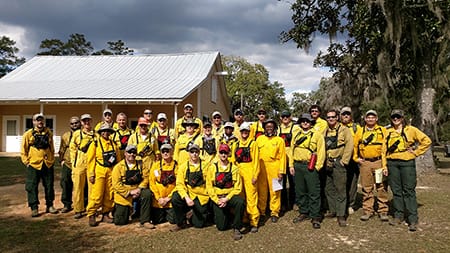
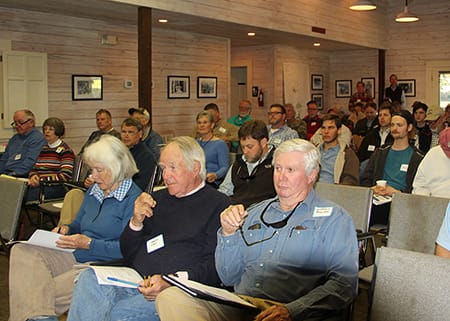
Tall Timbers hosted about 50 fire researchers, managers, technicians and graduate students April 17-23, who are members of the newly formed Prescribed Fire Science Consortium. The meeting’s theme was: “Linking Fine Scale Fire Behavior Measurements and Fire Effects.” This will be the first of the annual collaborative burn events for the consortium, which is dedicated to fire science that is relevant to prescribed fire managers, regulators, and policy makers.
The meeting was designed to bring collaborative science to prescribed fire management. Managers of private and public lands present were able to meet research objectives and discuss future needs with fire managers.
This year’s specific topics included:
Comparing sensors and emerging technologies, such as remotely piloted aircraft (drones) for quantifying fine scale fire behavior;
Linking high resolution fuel characterization to fire behavior and fire effects;
Exploring characteristics of sub-canopy boundary layers.
Measuring emissions from remotely piloted aircraft sensors
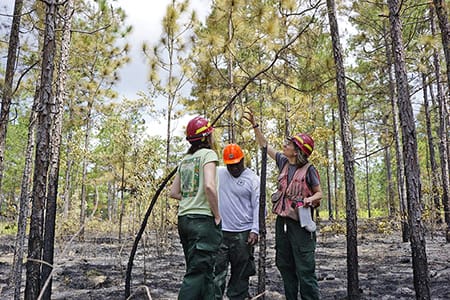
Shown here are scientists and managers observing a prescribed fire at one of the native groundcover, long-term research plots maintained by the Tall Timbers Fire Ecology Program at Pebble Hill Plantation. Photo by David Godwin, Southern Fire Exchange.
New Project Studies Effects of Longleaf’s Multi-century Life Cycle
By Dr. Kevin Robertson, Fire Ecology Program Director
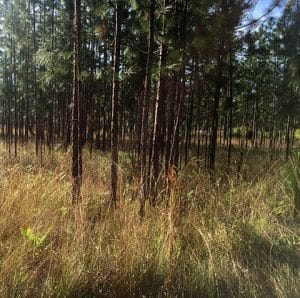
The Wade Tract old-growth longleaf pine preserve is well known for the amazing ages of its trees, but what is not known is how the age of trees affects the rest of the ecosystem. Longleaf pine typically regenerates in tight clusters of trees within gaps in the forest where the canopy is completely open. The lack of pine needle fuel either excludes fire or reduces its intensity in the gaps, which is apparently what allows the seedlings to survive there following mast years, that is, when seeds are produced in great quantities about every 7-10 years. These clusters remain recognizable until they are a couple of centuries old, while they prevent further longleaf regeneration beneath them. Then they eventually they break up as trees die one by one, mostly from lightning strikes.
Masters student Maria Paula Mugnani from the University of Florida Department of Wildlife Ecology and Conservation is testing the question — Does the plant community within these longleaf pine regeneration clusters change predictably with the age of the cluster? With help from tree increment bore data that Dr. William Platt and Dr. Steve Rathbun collected in the 1980s, and the repeatedly measured map of all trees within 60 hectares of the Wade Tract that Dr. Platt initiated in 1978, Maria Paula was able to place clusters in six different age classes, including gaps, ranging up to 250 years old.
Maria Paula will begin the plant census this summer, but in the meantime, she and the Fire Ecology lab are measuring several variables that might help explain any patterns in the plant community. Prior to burns on the east and west units of the Wade Tract in March and April, we measured different categories of plant material that could provide fuel for fires, then measured residual plant material after burns to estimate fuel consumed and energy released. Results confirm that the least heat is released in the gaps, and the most heat is released in the intermediate age classes (about 50-130 years old). Such fire effects, as well as mulching by pine needles, may influence which plants survive at a given time in the longleaf life cycle. Other measurements will include broadleaf woody plant abundance, herbaceous plant productivity, light, and soil chemistry. There is no guarantee that there will be strong patterns in plant species associated with the age of clusters, but if there is, it will be an important discovery of how the life cycle of these iconic trees control their entire ecosystem.
Photo top: Young cluster of longleaf pine. Photo below: Graduate student Maria Paula Mugnani sampling fuels prior to a prescribed burn at the Wade Tract. Photos by Kevin Robertson
By Dr. Theron M. Terhune, Game Bird Program Director
It is well known that bobwhites are highly gregarious birds and live in complex social groups called coveys throughout the non-breeding season to avoid predators through increased vigilance, thermoregulate and forage efficiently. Research suggests that the optimal covey size for bobwhites is 11-12 birds, and numerous factors can influence covey dynamics and behavior, such as loss of individual covey members through either or both harvest and natural mortality. Some of our past research also supports the notion that higher interrelatedness, genoptypically speaking, exists within coveys and among nearby coveys, compared to more distant covey groups.
Based on tracking thousands of birds over the years, we know that fidelity to covey groups varies among individuals and coveys. For example, some birds stay with a covey for an entire hunting season; and some birds that survive long enough will even regroup with former covey members in subsequent hunting seasons; and yet other individuals hedge their survival bets on floating from one covey to the next throughout the hunting season. This year we observed a couple of unique occurrences during our annual trapping.
The first occurrence involved multiple chicks from the same brood that were initially captured and radio-tagged at 12 days of age, and were captured together with their mother nearly 7 months later. Two of these chicks were banded and one was radio-tagged in July (see Figure). In the second incident, we captured a covey where nearly half of the birds were previously banded with the band numbers: 130350; 151203; 160212; 161253; and 170213. The interesting thing about this covey was not that so many were banded but rather how old they were – 2 birds were greater than 1 year old, 1 bird was greater than 2 years old and 1 bird was greater than 4 years old! The collective survival experience of these 5 birds is greater than 8 years — the odds of this occurring is less than 1 in 175,000. In either case, these success stories positively point to both good survival and good over-winter survival. We put new radio-tags on several of these birds, and hope to gain more insight into bobwhite survival in doing so.
Good Bobwhite Carryover Sets the Stage for a Productive Breeding Season
By Dr. Theron M. Terhune, Game Bird Program Director
We often say, “Dead hens don’t lay eggs,” because good carryover to April is essential to have high numbers of available breeders going into the nesting season. This year we observed fantastic over-winter survival of 61% and 68% in the Red Hills and Albany areas, respectively, indicating that we are carrying over more birds, on average, into the breeding season than typical. Warm winter weather contributed to less than ideal hunting conditions, but proved advantageous to bobwhite survival. The presence of avian predators associated with annual hawk migrations in fall and winter was abbreviated compared to previous years, resulting in lower than normal mortality during those times. As such, we are cautiously optimistic about the upcoming breeding season, given that survival and carryover were good, but we are a little concerned about the weather forecast going into breeding season. In both the Albany and Red Hills regions, we are already terribly dry and the NOAA forecast is pointing to a drier than normal spring and summer, which can have negative impacts on nesting activity.
Supplemental feeding can help to offset stress germane to reproduction and weather. Similarly, keeping meso-predators in check through trapping can help to increase nest survival. These management actions will be beneficial if reproductive activity is dampened due to poor (dry) weather conditions during the upcoming months.
Digging Up Some New Dirt on One of Our Most Reclusive Animals — the Pocket Gopher
By Jim Cox, Stoddard Bird Lab Director
With help from the Stoddard Bird Lab, research biologists from the Jones Ecological Research Center near Albany have been digging up some new dirt on one of our most reclusive animals. J. T. Pynne (left) and Danielle Clark (right) spent a week this July walking mile-long transects on several different properties in the Red Hills. Their goal was to find the tell-tale mounds of the pocket gopher, a small 8-inch mammal that rarely emerges from its subterranean lair.
Pocket gophers are named for the large, pocket-like cheeks they possess, but most folks locally know them as “sandy-mounder” or “salamander”. The fur-lined cheeks hold large quantities of roots and other foods that pocket gophers gather as they roam their burrows (not to carry soil, as some folk tales suggest). The pocket gopher also has long front claws, small eyes and ears, and a naked tail that is thought to help dissipate the heat that might build up in a warm, humid burrow.
Although the animal thrives in the frequently burn pine uplands of the Red Hills, it has become extremely rare elsewhere within its range. It once ranged throughout the coastal plan in Alabama, Florida, and Georgia, but it’s considered imperiled in Georgia and is listed as a species of conservation concern elsewhere.
“We’ve surveyed about 75 different regions in Georgia thus fare but located pocket gophers only in 3 of the regions,” Pynne reported. “As you can guess from this low encounter rate, most of our transects yielded absolutely nothing, but we’ve encountered dozens of pocket gopher mounds on each of the transects conducted here in the Red Hills region.” “It’s been great to see their mounds so regularly on all these private properties” he added.
Although reclusive, pocket gophers play an important role in upland pines by aerating soils and recycling soil nutrients. They dig rapidly with their noses to the ground, and some estimates suggest a healthy population may recycle as much as a ton of soil over the course of a year. All this churning and digging can enhance the diversity of plants, and the burrows also provide important refugia for up to 80 different types of insects, including 14 species that to occur only in burrows.
The Stoddard Bird Lab helped coordinate access to different properties and also steered the gopher&ndandash;seeking duo to the random starting points within each property. Assisting outside researchers is a common service that the staff of Tall Timbers provides as needed. After all, when you live and work in a place like the Red Hills, it’s important to share your good fortune as much as possible.
The M-CORES program, which includes the proposed Suncoast Connector Toll Road in Jefferson County, passed through the Florida Legislature at breakneck speed with little review or analysis. Tall Timbers has a number of concerns given the potential for significant and wide spread impacts. These include fragmenting public and private conservation lands, robbing business from Main Street Monticello, impacting our rivers and other water resources, and making prescribed fire more difficult and costly.
Join us in asking the Jefferson County Board of County Commissioners to OPPOSE the Suncoast Connector toll road and its path through Jefferson County.
Take action now with our easy email form.
Send an email to all five Jefferson County Board of County Commissioners with one click!
Selected Publications authored by Wildland Fire Science staff.
Educating and guiding the next generation of fire researchers and managers is a key goal of Wildland Fire Science and a resource for testing new ideas in fire research.
Tall Timbers hosts the Prescribed Fire Science Consortium, a national network of researchers and managers who promote integrated research and management to advance next generation tools for fire practitioners. https://arcg.is/1DSjDT
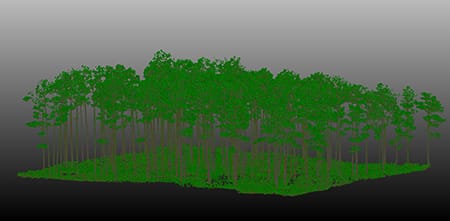
Working with partners in the Prescribed Fire Science Consortium, the program is building nexgen 3-D fuel beds using terrestrial LiDAR and novel sampling techniques to power new fire behavior models for prescribed fire managers. This work links to Tall Timbers work in wildlife habitat usage and ecological forestry.
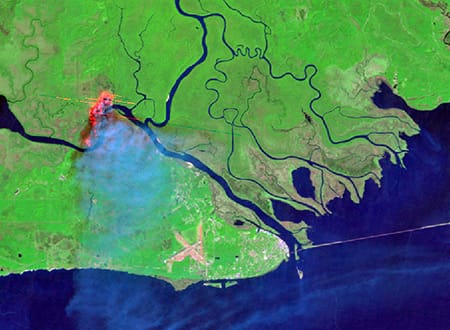
Tall Timbers is leading an effort to map fire regimes at the landscape scale. Staff work with numerous agencies to evaluate fire records and satellite imagery to build this critical conservation database. https://skfb.ly/6DqOY
We are linking physics and field observations to understand the fluid dynamics of fire behavior surface fire regimes. Our work combines field observations using advanced thermal imaging techniques, laboratory studies, and coupled fire-atmospheric modeling to help managers improve outcomes of managed fire regimes.
Burn prioritization modeling seminars and fire modeling tools are supported by Wildland Fire Science to train managers in the important planning stages of prescribed fires.
The conserved lands of the Greater Red Hills region are found on working, income-producing properties that support agriculture, forestry, and recreational hunting. These properties contribute $272 million annually to local economies and support 2,300 jobs. [link to Planning & Advocacy section] The landowners’ strong stewardship ethic preserves their working lands while replenishing drinking water supplies, protecting water quality, and providing wildlife habitat for dozens of rare and endangered species. Tall Timbers’ conservation easements on these working properties encourage landowners to retain their traditional livelihood by keeping farms in family ownership.
Home to world-class wild quail populations, the Greater Red Hills region contains the largest concentration of gamebird preserves in the United States. These preserves also support the largest community of Red-cockaded woodpeckers on private lands. Indicators of high quality habitat found here include the gopher tortoise, Bachman’s sparrow, fox squirrel, and many amphibians. Tall Timbers’ conservation easements identify and protect the critical habitats of these species.
The region also boasts outstanding aquatic resources. Large river systems, like the Flint/Apalachicola, Ochlockonee, and Aucilla, flow from Georgia and feed into the Gulf of Mexico to support some of the world’s most productive estuaries. Large disappearing sinkhole lakes, like Iamonia, Miccosukee, and Jackson, provide habitat for an array of aquatic species and migratory birds. Tall Timbers’ conservation easements protect these vital watersheds and wetlands that are the lifeblood for the ecological health of the region.
Once dominated by longleaf pine, our pine woodlands support abundant wildlife and local economies. These forests need prescribed fire to stay healthy. Herbert L. Stoddard and his associates Ed and Roy Komarek were pioneers in this emerging scientific field during the mid-20th century. Tall Timbers continues that legacy with applied research on prescribed fire and land management. Today, there is a tremendous need to expand prescribed fire use beyond the Red Hills to ensure ecosystem health and reduce wildfire risk. Additionally, Tall Timbers uses conservation easements to permanently protect private woodlands while balancing the need for economic return from selective timbering.
Tall Timbers hosts the premier fire technology transfer organization—the Southern Fire Exchange. This JFSP funded effort helps connect research to management through webinars, workshops, and support of the Prescribed Fire Science Consortium.
The Longleaf Legacy landscape prescribed fire burn team arm of Wildland Fire Science works directly with landowners and partners to effectively put fire on the ground and promote prescribed fire throughout the region.
Staff and researchers support Federal fire training by serving as a cadre for NWCG training courses, ranging from basic wildland fire to advanced fire effects.
(PFTC) specializes in training fire fighters the principles and techniques of prescribed fire through practical hands-on experience. https://www.fws.gov/fire/pftc/
Private land owners are the largest source of prescribed fire in the country. These land owners and the culture of fire that was maintained by them during decades of suppression are a part of why Tall Timbers is a world-wide center for prescribed fire science. Workshops and fire training are a critical focus of the Longleaf Legacy Landscape Burn Team and our support of the Georgia Forestry Commission Prescribed Fire Center in Marion County.


 The Wade Tract old-growth longleaf pine preserve is well known for the amazing ages of its trees, but what is not known is how the age of trees affects the rest of the ecosystem. Longleaf pine typically regenerates in tight clusters of trees within gaps in the forest where the canopy is completely open. The lack of pine needle fuel either excludes fire or reduces its intensity in the gaps, which is apparently what allows the seedlings to survive there following mast years, that is, when seeds are produced in great quantities about every 7-10 years. These clusters remain recognizable until they are a couple of centuries old, while they prevent further longleaf regeneration beneath them. Then they eventually they break up as trees die one by one, mostly from lightning strikes.
 Maria Paula will begin the plant census this summer, but in the meantime, she and the Fire Ecology lab are measuring several variables that might help explain any patterns in the plant community. Prior to burns on the east and west units of the Wade Tract in March and April, we measured different categories of plant material that could provide fuel for fires, then measured residual plant material after burns to estimate fuel consumed and energy released. Results confirm that the least heat is released in the gaps, and the most heat is released in the intermediate age classes (about 50-130 years old). Such fire effects, as well as mulching by pine needles, may influence which plants survive at a given time in the longleaf life cycle. Other measurements will include broadleaf woody plant abundance, herbaceous plant productivity, light, and soil chemistry. There is no guarantee that there will be strong patterns in plant species associated with the age of clusters, but if there is, it will be an important discovery of how the life cycle of these iconic trees control their entire ecosystem.
 It is well known that bobwhites are highly gregarious birds and live in complex social groups called coveys throughout the non-breeding season to avoid predators through increased vigilance, thermoregulate and forage efficiently. Research suggests that the optimal covey size for bobwhites is 11-12 birds, and numerous factors can influence covey dynamics and behavior, such as loss of individual covey members through either or both harvest and natural mortality. Some of our past research also supports the notion that higher interrelatedness, genoptypically speaking, exists within coveys and among nearby coveys, compared to more distant covey groups.
 We often say, “Dead hens don’t lay eggs,” because good carryover to April is essential to have high numbers of available breeders going into the nesting season. This year we observed fantastic over-winter survival of 61% and 68% in the Red Hills and Albany areas, respectively, indicating that we are carrying over more birds, on average, into the breeding season than typical. Warm winter weather contributed to less than ideal hunting conditions, but proved advantageous to bobwhite survival. The presence of avian predators associated with annual hawk migrations in fall and winter was abbreviated compared to previous years, resulting in lower than normal mortality during those times. As such, we are cautiously optimistic about the upcoming breeding season, given that survival and carryover were good, but we are a little concerned about the weather forecast going into breeding season. In both the Albany and Red Hills regions, we are already terribly dry and the NOAA forecast is pointing to a drier than normal spring and summer, which can have negative impacts on nesting activity.
 With help from the Stoddard Bird Lab, research biologists from the Jones Ecological Research Center near Albany have been digging up some new dirt on one of our most reclusive animals. J. T. Pynne (left) and Danielle Clark (right) spent a week this July walking mile-long transects on several different properties in the Red Hills. Their goal was to find the tell-tale mounds of the pocket gopher, a small 8-inch mammal that rarely emerges from its subterranean lair.